


Texas Wrong Site Surgery Malpractice Lawyer
Wrong site surgery is a serious surgical error where an operation is performed on the wrong body part, the wrong side, the wrong procedure, or the wrong patient. It is widely recognized as a preventable never event that signals a breakdown in basic safety protocols and can leave lasting physical and emotional harm. These incidents often involve communication failures, unclear site marking, fatigue, and skipped verification steps in the operating room. If you or a loved one were harmed or worse due to wrong site surgery malpractice in Texas, contact Hastings Law Firm for a free, confidential case review.

Last Updated: July 27, 2026
Trusted Texas Medical Attorneys for Wrong Site Surgery Claims
When a surgeon operates on the wrong body part, wrong side, or even the wrong patient, the experience can be overwhelming. Wrong-site surgery, which refers to any surgical procedure performed on an incorrect body part, the wrong side of the body, or the wrong person entirely, is one of the most preventable errors in medicine. If this happened to you or someone you love, your instinct that something went terribly wrong is correct.
Led by Tommy Hastings, who is board-certified in personal injury trial law, our team of attorneys, in-house nurses, and medical consultants focuses exclusively on Texas wrong site surgery malpractice cases. We understand the confusion you may be feeling, and we have the medical knowledge and legal experience to help you find answers. Contact us for a free, confidential consultation so we can review what happened and explain your options.

Understanding Wrong Site Surgery and Never Events in Texas
Wrong-site surgery is classified as a “never event” by the National Quality Forum, meaning it is a medical error so serious and preventable that it should never happen when standard safety protocols are followed. Because it happens, it points to a significant breakdown in the standard of care and often constitutes medical negligence.
A never event is a term used in patient safety to describe errors that are clearly identifiable, measurable, and usually preventable. These events are a subset of what healthcare regulators call sentinel events, which are unexpected incidents that result in death, serious harm, or the risk of either.
According to the NCBI Bookshelf overview of Sentinel Events, The Joint Commission requires hospitals to investigate these occurrences and implement corrective action.
Wrong-site surgical errors fall into three main categories:
- Wrong body part: Surgery performed on the incorrect anatomical site, such as removing the left kidney instead of the right.
- Wrong patient: A procedure intended for one patient is mistakenly performed on another.
- Wrong procedure: The correct patient and site are identified, but the surgical team performs the wrong operation entirely.
One challenge in tracking these errors is that hospitals often self-report. Studies consistently suggest that reported numbers undercount actual occurrences, as facilities may fail to capture every incident or “near miss” in their data. Some errors go unrecorded, particularly when they are caught during the procedure or when outcomes are ambiguous.
This gap between official data and reality makes surgical malpractice in Texas difficult to quantify, but it does not make the harm any less real. This monitoring is often coordinated through The Joint Commission, which tracks these sentinel events to improve patient safety nationwide.
If you experienced any form of wrong site surgery malpractice, the medical community itself has already classified what happened to you as an event that never should have occurred. That classification matters, both medically and legally.

Common Causes of Surgery on the Wrong Body Part
Common causes of surgery on the wrong body part include systemic failures such as miscommunication between staff, fatigue, failure to mark the surgical site clearly, or neglecting the mandatory “time-out” protocol before incision. These errors typically stem from breakdowns in protocol rather than a single person’s mistake.
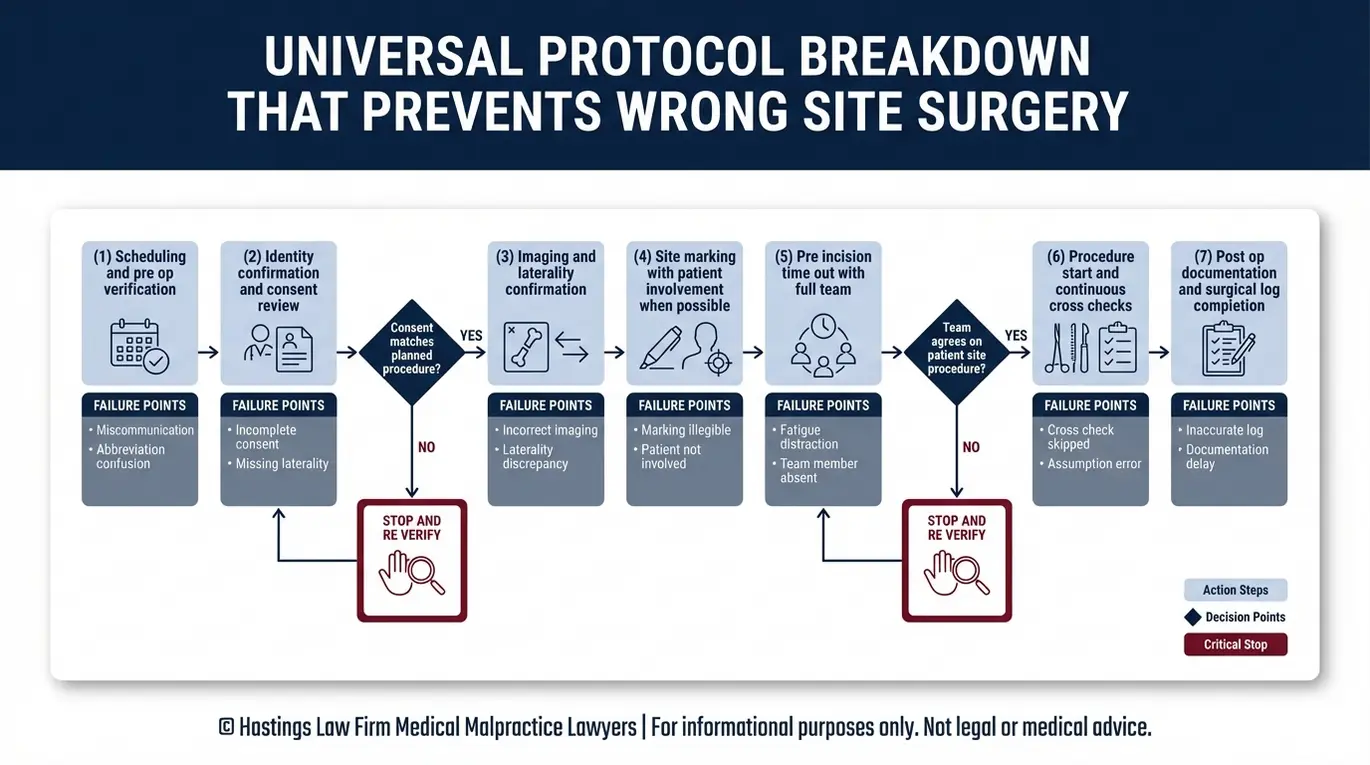
The Agency for Healthcare Research and Quality (AHRQ) overview of the Universal Protocol for Preventing Wrong Site, Wrong Procedure, Wrong Person Surgery outlines a series of safety steps that every surgical team is expected to follow. The Universal Protocol is a standardized, evidence-based checklist designed to prevent wrong-site surgical errors before they happen. Its core components include:
- Pre-operative verification: Confirming the correct patient, procedure, and surgical site using all available documentation, including the consent form, surgical logs, and imaging studies.
- Surgical site marking: The operating surgeon marks the intended site directly on the patient’s body, ideally with the patient awake and involved.
- The time-out: A mandatory pause taken immediately before the first incision, during which every member of the surgical team verbally confirms the patient’s identity, the procedure being performed, and the correct site and side.
The time-out protocol, which is the final safety check before the surgeon begins, is one of the most critical safeguards in the operating room. When any member of the team skips it or treats it as a formality, the last line of defense against a wrong-site error disappears.
Communication breakdowns are one of the most common root causes. A consent form may list one side while the surgical schedule lists another. If no one catches the discrepancy, the error carries forward into the operating room unchallenged.
Marking confusion can also cause serious problems. For example, some surgeons mark the operative site with an “X,” which other team members may interpret as “do not operate here.” Inconsistent marking practices within a hospital create preventable ambiguity.
Fatigue and distraction round out the picture. Overworked surgeons and nurses operating on limited rest are more prone to lapses in attention. When staff are stretched thin, even well-designed protocols can break down. These wrong site surgical errors are almost always the result of multiple failures happening at once, not a single moment of carelessness.
The Hastings Law Firm Difference
Results matter, but what truly sets us apart is how we achieve them. Every verdict, every settlement, and every Texas courtroom victory comes from one guiding promise: To treat each client’s fight for justice as if it were our own.
This balance of skill, experience, and empathy reflects our core philosophy that justice should not only compensate the injured, but also make health care safer nationwide.

Liability and Accountability in Texas Surgical Error Cases
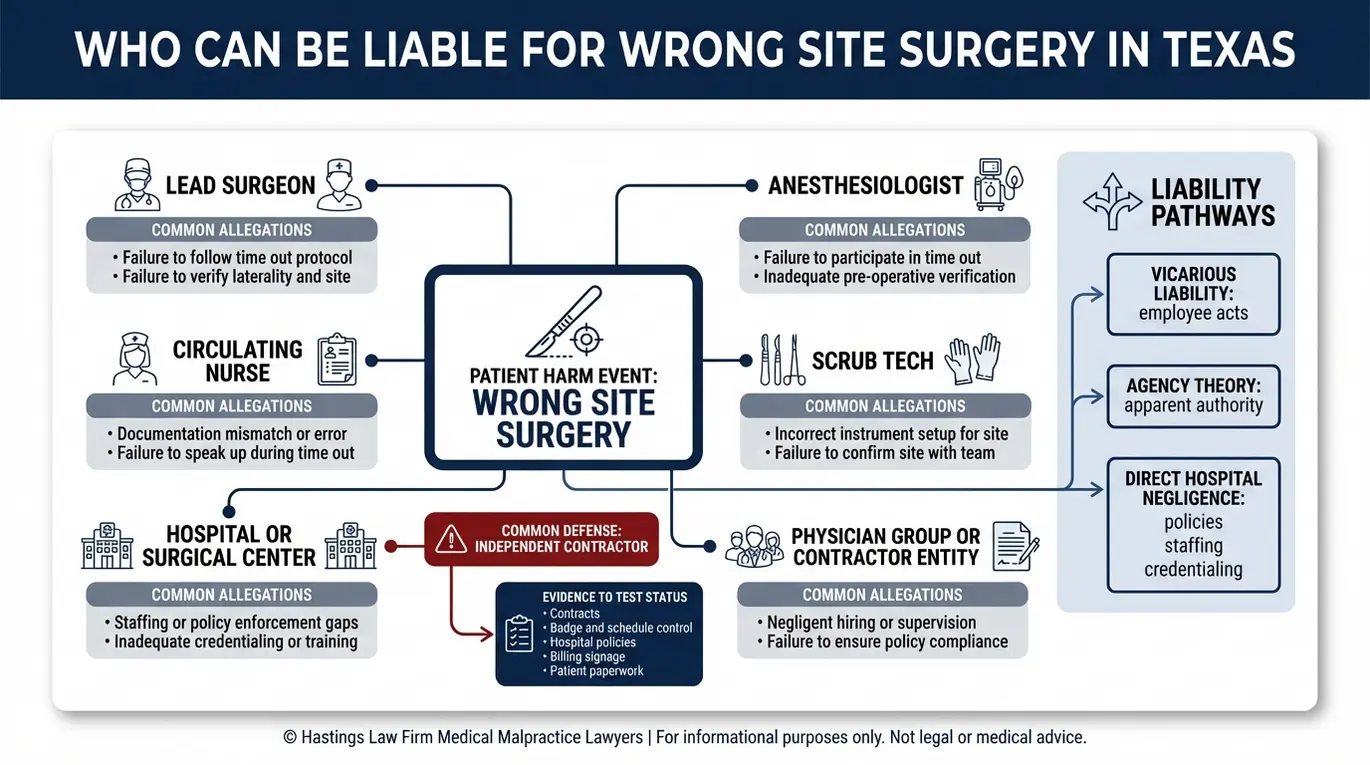
Liability can extend beyond the lead surgeon to include the anesthesiologist, nursing staff, and the hospital itself, depending on employment status and whether hospital policies contributed to the error.
Surgeon Liability
Historically, the “Captain of the Ship” doctrine held the lead surgeon solely responsible for everything that happened in the operating room. Modern Texas malpractice claims recognize a more nuanced reality. While the surgeon typically bears primary responsibility for verifying the correct site and performing the correct procedure, other team members have independent duties as well. The anesthesiologist, circulating nurse, and surgical technologist each play a role in the verification process.
Hospital Liability
Hospitals can be held liable under a legal theory called vicarious liability, which means the institution is responsible for the negligent acts of its employees performed within the scope of their duties. This relates to agency theory, which examines the relationship between the provider and the facility. However, many hospitals in Texas classify their surgeons as independent contractors rather than employees. This distinction can complicate a claim because independent contractors are generally responsible for their own negligence.
That said, hospitals may still face liability for wrong site surgery based on their own independent failures, often referred to as direct hospital negligence. If the hospital failed to enforce the Universal Protocol, provided inadequate staffing, or did not properly credential a surgeon, those systemic breakdowns can form the basis of a separate claim against the facility. Direct negligence claims often involve wrong-procedure surgery, where the incorrect operation is performed, or wrong-patient surgery, where the procedure is done on the wrong person.
| Basis of Liability | Surgeon | Hospital |
|---|---|---|
| Direct negligence (wrong site, wrong procedure, wrong patient) | Yes | Possibly, if systemic failures contributed |
| Vicarious liability for employee actions | N/A | Yes, if the provider is an employee |
| Failure to enforce safety protocols | No (but may face direct claims) | Yes |
| Inadequate staffing or credentialing | No | Yes |
Hospital Non-Disclosure and Concealment
After a wrong-site error, the surgical log, which is the official operating room record documenting what was done and when, becomes a key piece of evidence. Hospitals may attempt to minimize the error internally or delay disclosure to the patient. Medical records can be amended, and incident reports may be routed through risk management channels designed to limit the hospital’s exposure.
This concealment breaches the trust placed in medical providers. While doctors have a fiduciary duty to act in your best interest, risk management strategies often prioritize the institution’s finances. Securing records early is one of the first steps we take when investigating a potential claim.
Recoverable Damages for Wrong Site Surgery Victims
Patients harmed by wrong-site surgery can recover compensation for surgical errors, including funds for corrective surgeries, lost wages, pain and suffering, and the emotional distress caused by the trauma of the error. Texas law divides these into two main categories: economic and non-economic damages.
Economic damages cover the measurable financial losses tied to the injury, such as medical bills and lost income. These are not subject to a cap under Texas law and may include:
- Costs of corrective or revision surgery
- Extended hospital stays and rehabilitation
- Future medical care and medical expenses
- Lost wages and diminished earning capacity
Non-economic damages address the human cost of the error, the harm that does not come with a receipt. These may include:
- Physical pain and disfigurement
- Mental anguish and emotional distress
- Loss of enjoyment of life
- Post-traumatic stress related to the surgical experience
Under the Texas Civil Practice and Remedies Code Section 74.301, non-economic damages in medical malpractice cases are subject to statutory caps. These caps limit recovery for pain and suffering but do not restrict economic damages like medical bills and lost income. Understanding the applicable damage cap is essential for realistic case expectations.
In rare cases involving gross negligence, punitive damages may also be available. While uncommon, a wrong site surgery lawsuit involving an egregious disregard for patient safety could support a punitive damages claim. These cases require clear evidence that the conduct went beyond ordinary negligence.
How Our Texas Surgical Malpractice Attorneys Prove Negligence
We use a thorough investigation process that includes securing qualified expert witnesses, analyzing operative reports for discrepancies, and filing the mandatory Chapter 74 expert reports required under Texas law.
Securing records immediately. One of the first things we do as your Texas wrong site surgery lawyer is obtain complete medical records, including operative notes, surgical logs, nursing documentation, and consent forms. Because records can be altered or supplemented after the fact, early preservation is essential. Our in-house nursing staff reviews these documents to identify inconsistencies that may not be obvious to someone without clinical training.
Retaining qualified expert witnesses. Texas law requires that a medical malpractice claim be supported by testimony from a qualified expert in the same specialty as the provider being sued. This expert must review the case and confirm that the standard of care was breached. In wrong-site cases, the breach is often clear, but the legal standard still demands formal expert analysis. Our national network of medical experts allows us to match each case with the right specialist.
Filing the Chapter 74 expert report. Under Texas Chapter 74, a patient must serve an expert report within 120 days after the date each defendant’s original answer is filed. Chapter 74 refers to the Texas Medical Liability Act, which governs how these cases must be filed. This report must identify the applicable standard of care, explain how it was breached, and establish how that breach caused the patient’s injury. As an experienced malpractice attorney in Texas, we build this report from day one to ensure we meet the deadline.
Establishing causation. Even when the error seems obvious, we must meet the burden of proof to show that “but for” the negligence, the injury would not have occurred. This involves documenting the original condition, the surgical plan, what actually happened, and the consequences. We examine surgical site marking, the process where the surgeon physically marks the operative site, as well as laterality records and pre-operative checklists to build a minute-by-minute timeline of the failure.
Contact the Texas Surgical Error Attorneys at Hastings Law Firm Today for Help
Wrong-site surgery is an event the medical community itself says should never happen. If it happened to you or someone in your family, you deserve answers, and you should not have to face the hospital’s legal team on your own.
Hastings Law Firm has the medical and legal resources to investigate what went wrong, identify who is responsible, and pursue the compensation you are owed. Our team includes former defense attorneys who previously represented medical systems, giving us a strategic advantage in anticipating their tactics. We prepare every case from day one as if it will go to a jury trial to ensure our clients receive the full value of their claim.
We handle these cases on a contingency fee basis, which means you pay no attorney fees unless we recover compensation for you. Call us today or reach out online for a free, confidential case evaluation. Let us review your records, explain your legal rights, and help you take the next step.
Frequently Asked Questions About Wrong Site Surgery Malpractice in Texas


This content was researched and written by the Hastings Law Firm editorial team, which includes attorneys, medical professionals, and experienced researchers. Our writing is informed by internal knowledge and practical experience, and we cross-check critical details against authoritative sources cited throughout. Every piece undergoes human-led fact-checking and legal review. Because legal and medical information can change, if you spot an error, please contact us. Learn more about our content standards and review process on our editorial policy page.

Gabe Sassin has focused exclusively on medical malpractice law since 2007. After spending more than a decade as a malpractice defense attorney, he knows exactly how the other side works. He has seen firsthand how healthcare providers, insurers, corporate defendants, and their legal teams think, prepare, and build their defense against claims. That knowledge works for the people who need it most today, injured patients and their families. His unique experience shapes everything he writes, giving readers a look at how these cases actually work from someone who has handled them from both sides.
