


Texas Delayed or Prolonged Surgery Lawyer
Delayed or prolonged surgery can leave patients facing worsening injuries, lasting impairment, emotional distress, and in the most severe situations, loss of a loved one. Malpractice concerns arise when timing falls below accepted standards without a valid clinical reason and that lapse changes the outcome. These cases often turn on whether earlier action would likely have prevented harm and whether records show unexplained gaps or inconsistent documentation. Understanding how delays happen and how harm is connected to timing can help families make informed decisions. If you or a loved one were harmed or worse due to delayed or prolonged surgery in Texas, contact Hastings Law Firm for a free, confidential case review.

Last Updated: July 27, 2026
Trial-Ready Legal Representation for Surgical Injuries in Texas
When a surgery is delayed or takes far longer than it should, the consequences can be severe and life-altering. If you or a loved one suffered a worsening condition, permanent injury, or the death of a family member because a needed procedure did not happen on time, you deserve answers about what went wrong and why.
At Hastings Law Firm, we focus exclusively on medical malpractice. Our team of attorneys, in-house nurse consultants, and board-certified patient advocates investigates surgical delay and prolonged surgery cases across the state. As a Texas Delayed or Prolonged Surgery Lawyer, we build detailed, evidence-based timelines to determine whether negligence caused or contributed to your injuries.
If something doesn’t feel right about the care you or your loved one received, we welcome the chance to review what happened and explain your options at no cost and no obligation.

When Does a Delayed or Prolonged Surgery Constitute Malpractice
Surgical malpractice occurs when a delay in starting or completing a procedure deviates from the accepted standard of care and directly causes a worsening of the patient’s condition or death. Medical malpractice provides the legal framework for patients to seek accountability when timing errors occur. Not every bad outcome means negligence happened, but when a preventable lapse in timing leads to harm, the law provides a path to accountability.
Understanding the standard of care. The standard of care is the level of treatment a reasonably competent medical professional would provide under similar circumstances. For surgical timing, this standard can be very specific.
Cardiac emergencies, for example, have established “door-to-balloon” benchmarks. Emergency cesarean sections have recognized time thresholds. When a hospital or surgical team falls below these accepted benchmarks without a valid clinical reason, that failure may constitute a breach of duty.
Two distinct problems can arise in the operating room. A delayed surgery, meaning the procedure did not start when it should have, occurs when a patient waits too long for a needed surgical intervention because of scheduling failures, diagnostic errors, or lack of urgency. Prolonged surgery, sometimes called prolonged operative time, is a procedure that takes significantly longer than expected. This keeps a patient under anesthesia and exposes them to greater risk of post-operative complications like infection, blood loss, or organ damage.
Either scenario can form the basis of a medical malpractice claim, but only if causation is established. Causation is the legal requirement to prove that the outcome would likely have been different if the surgery had started sooner or been completed within an appropriate timeframe. This is often the most contested element in these cases. A lawyer for prolonged surgery injuries can make the difference by working with qualified medical experts to connect the delay to the harm.
Negligence vs. Complication: Key Differences
| Factor | Non-Negligent Complication | Potential Malpractice |
|---|---|---|
| Timing | Procedure occurred within accepted time standards | Unjustified gap between diagnosis and surgical intervention |
| Standard of Care | Medical team followed accepted protocols | Medical team deviated from recognized benchmarks |
| Causation | Outcome was a known risk despite proper care | Earlier action would have likely prevented or reduced the harm |
| Documentation | Records reflect timely decisions and communication | Records show gaps, inconsistencies, or unexplained inaction |

Common Causes of Operating Room Delays and Systemic Failures
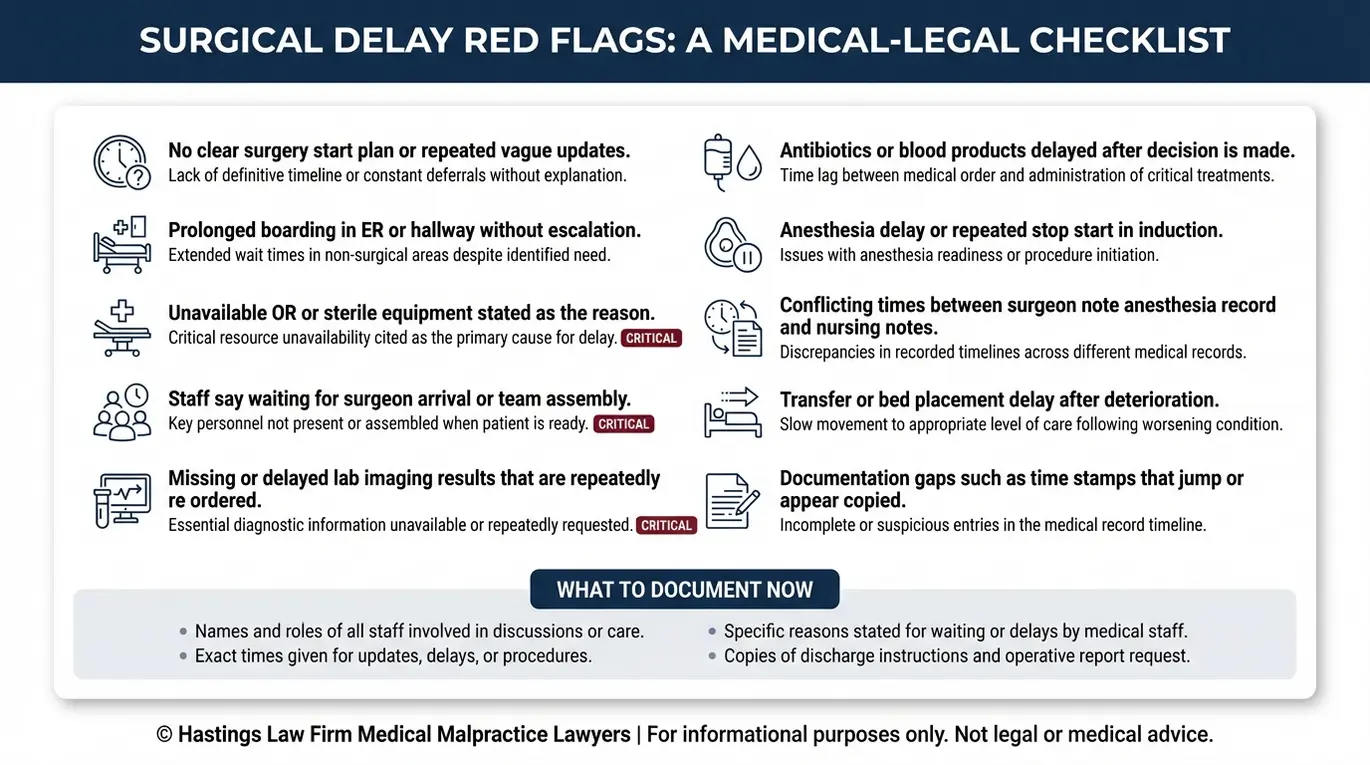
Delays are often caused by administrative and institutional failures such as understaffing, scheduling conflicts, lost lab results, or failure to recognize urgent symptoms like internal bleeding. These errors often stem from systemic hospital failures rather than a single doctor’s mistake. Our founder, Tommy Hastings, is a board-certified trial lawyer who leads our investigations into these institutional breakdowns.
Here are some of the most common hospital systemic failures we investigate:
- Miscommunication between teams. When ER physicians, surgeons, anesthesiologists, and nursing staff fail to relay critical information, a patient’s deteriorating condition can go unaddressed. This lack of coordination often leads to a preventable failure to operate. Research published by the Agency for Healthcare Research and Quality’s Patient Safety Network (PSNet) has documented how communication failures directly contribute to adverse patient outcomes.
- Emergency department boarding. Emergency department boarding, or ED boarding, is a situation where admitted patients remain in the ER because inpatient beds are unavailable. This is a classic sign of ER overcrowding. While the patient waits for a room, the lack of immediate surgical monitoring can result in permanent harm.
- Equipment and resource failures. Delays caused by unavailable operating rooms, lack of sterile instruments, or missing supplies can push back urgent procedures by hours. Missing sterile tools are often a sign of hospital mismanagement rather than medical necessity. A breakdown in sterile instrument processing can also lead to dangerous delays.
- Anesthesia errors. Problems inducing or monitoring anesthesia can significantly prolong a procedure. These errors can lead to a longer recovery time and higher medical costs for the patient. When anesthesia teams are stretched thin or improperly prepared, these operating room errors increase the risk of infection.
- Failure to escalate. Sometimes, the signs of an emergency are present in the chart but no one acts on them with the required urgency. Reviewing the chart timing helps us show when the team missed their chance to act. A patient’s labs, vitals, or imaging may clearly indicate the need for immediate surgery, yet the surgical team is not mobilized.
A Texas surgical delay attorney examines each of these potential failure points to determine where the system broke down and who is responsible.
Analyzing Psychological Trauma From Waiting
The damage from a surgical delay is not limited to physical injury. Emotional distress is a legal component of injury cases that recognizes how hospital neglect impacts a patient’s mental health. Patients who are aware they need help but feel ignored or dismissed often experience intense mental anguish. In medical negligence cases, this psychological harm is real and legally recognizable.
The Hastings Law Firm Difference
Results matter, but what truly sets us apart is how we achieve them. Every verdict, every settlement, and every Texas courtroom victory comes from one guiding promise: To treat each client’s fight for justice as if it were our own.
This balance of skill, experience, and empathy reflects our core philosophy that justice should not only compensate the injured, but also make health care safer nationwide.

Proving Negligence Using Operative Reports and Timelines
Attorneys prove negligence by creating a minute-by-minute timeline using anesthesia logs, OR nursing notes, and electronic medical record (EMR) metadata to show unjustified gaps in care. Reconstructing the medical timeline is essential for establishing how the standard of care was breached. We look for unjustified gaps in care that demonstrate where the medical team failed to act.
We closely examine the operative report, which is the surgeon’s own written account of a procedure, alongside the anesthesia record. This anesthesia log documents the patient’s vital signs and the exact start and stop times of anesthesia. It often contains the objective data needed to challenge the defense’s narrative. When these two records don’t align, or when they conflict with nursing notes and electronic timestamps, it can reveal critical gaps in the minute-by-minute timeline.
Evidence we analyze in delayed surgery cases:
- Operative reports and surgeon dictation notes
- Anesthesia records with time-stamped vital sign data
- OR nursing logs documenting who was present and when
- Electronic medical record (EMR) audit trails, which track every chart modification in a hospital’s computer system
- Lab results, imaging reports, and timestamps of when they were ordered versus reviewed
- Communication records between departments, including pages, calls, and consult requests
Research published in the National Library of Medicine (PubMed) has examined whether delayed operations increase injury and death. This study confirms that as surgical wait times increase, so do the risks of severe complications. This reinforces what experienced Texas delayed surgery lawyers already know: time matters, and the data often tells the story.
Rebutting the “outcome would have been the same” defense. Hospitals frequently argue that the patient was already too sick, and that earlier surgery would not have changed the result. We counter this by working with a qualified expert witness to analyze clinical data and the patient’s own trajectory to demonstrate causation. The chances of a better outcome diminished with every hour of delay. Timestamp discrepancies between anesthesia logs and surgeon notes can also undermine the defense’s version of events.
The Role of Minute-by-Minute OR Records
Electronic medical records contain an EMR audit trail, which is a digital log of every action taken in a patient’s chart. Audit trails serve as digital evidence to confirm the physical presence of medical staff during critical surgical moments. This forensic tool allows us to verify whether a surgeon was actually present during the times documented in the operative report.

Damages Recoverable for Injuries Caused by Surgical Delays
Patients harmed by surgical delays can recover economic damages for additional medical bills and lost wages, as well as non-economic damages for pain, suffering, and physical impairment. These legal claims seek to restore the financial balance for families who have faced unexpected medical crises. We focus on identifying all recoverable losses that resulted from the surgical error.
Medical bills and treatment costs. A delayed or prolonged surgery often leads to complications that require additional procedures, extended hospital stays, and ongoing care. For example, a patient who develops sepsis because of an operating room delay may need weeks of ICU monitoring. The cost of treating these preventable complications is recoverable.
Lost earning capacity. When a surgical delay results in permanent disability, such as perioperative nerve injury, which is trauma to nerves occurring as a result of a surgical procedure, the patient may be unable to return to work. A lawyer for surgical delay lawsuits works with economic and vocational experts to calculate the full scope of lost future income.
Pain, suffering, and impairment. Non-economic damages account for the physical pain, emotional distress, and diminished quality of life caused by the injury. A patient who suffers a bowel perforation, a hole or tear in the intestinal wall that allows contents to leak and cause infection, faces a painful recovery and lasting anxiety.
Wrongful death. When a family loses a loved one because a hospital failed to operate in time, Texas law allows surviving family members to pursue a wrongful death claim. These cases seek compensation for funeral expenses, loss of companionship, and the mental anguish of the surviving family.
At Hastings Law Firm, we handle surgical delay cases on a contingency fee basis, meaning you pay nothing unless we recover compensation for you. Insurance companies and hospital defense teams should not be the reason a family gives up on finding out the truth.
Contact the Texas Surgical Error Attorneys at Hastings Law Firm Today for Help
A delay in surgery is often a failure of the system, not just bad luck. When hospitals are understaffed or a surgical team does not act with urgency, the consequences can be devastating.
At Hastings Law Firm, our entire team of attorneys, in-house nurses, and former defense counsel is dedicated solely to medical malpractice. Our team includes former defense attorneys who offer a strategic advantage by predicting the tactics hospital systems use to defend these claims. We prepare every case as if it is going to trial to ensure our clients have the strongest possible position.
If you believe a surgical delay caused injury or the loss of someone you love, reach out to our team for a free, confidential case evaluation. As your Texas Delayed or Prolonged Surgery Lawyer, we can review your medical records, consult with qualified experts, and give you honest answers about your options. You pay nothing unless we win.
Call us today or contact us online to schedule your risk-free consultation.
Frequently Asked Questions About Delayed or Prolonged Surgery in Texas


This content was researched and written by the Hastings Law Firm editorial team, which includes attorneys, medical professionals, and experienced researchers. Our writing is informed by internal knowledge and practical experience, and we cross-check critical details against authoritative sources cited throughout. Every piece undergoes human-led fact-checking and legal review. Because legal and medical information can change, if you spot an error, please contact us. Learn more about our content standards and review process on our editorial policy page.

Gabe Sassin has focused exclusively on medical malpractice law since 2007. After spending more than a decade as a malpractice defense attorney, he knows exactly how the other side works. He has seen firsthand how healthcare providers, insurers, corporate defendants, and their legal teams think, prepare, and build their defense against claims. That knowledge works for the people who need it most today, injured patients and their families. His unique experience shapes everything he writes, giving readers a look at how these cases actually work from someone who has handled them from both sides.
