


Texas Spine Surgeon Malpractice Lawyer
Spine surgery complications can leave patients with lasting pain, new neurological problems, and a sense that something went wrong without clear explanations. Some poor outcomes are known risks, but others may reflect preventable errors such as wrong level surgery, improper hardware placement, or missed post operative warning signs. Understanding how standard of care, causation, and medical records shape these situations can help families make informed decisions after a serious surgical injury. If you or a loved one were harmed or worse due to spine surgeon malpractice in Texas, contact Hastings Law Firm for a free, confidential case review.

Last Updated: July 27, 2026
Trusted Legal Representation for Surgical Negligence in Texas
When spine surgery doesn’t go as planned, the physical and emotional toll can be overwhelming. You may be living with new or worsening pain, struggling to get clear answers from your medical team, and wondering whether what happened to you was preventable. These are legitimate concerns, and you deserve honest, informed guidance.
Founded by board-certified trial attorney Tommy Hastings in 2005, Hastings Law Firm focuses exclusively on medical malpractice. Our team includes in-house nurse consultants and board-certified patient advocates who understand both the medicine and the law behind complex spinal injury cases. If you’re looking for a Texas spine surgeon malpractice lawyer, we can review what happened and explain your options in a free, confidential consultation.

Proving Negligence and Liability in Back Surgery Cases
To prove liability in spine surgery cases, a plaintiff must demonstrate that the surgeon breached the accepted standard of care, directly causing injury or worsening the condition, rather than simply experiencing a known complication. This distinction between a bad outcome and actual negligence is at the heart of every back surgery claim.
Texas medical malpractice law, governed by Texas Civil Practice and Remedies Code Chapter 74, requires proof of four elements. The surgeon owed a duty of care to the patient. The surgeon breached that duty by deviating from what a reasonably competent neurosurgeon or orthopedic surgeon would have done under similar circumstances. That breach directly caused the injury, and the patient suffered real, measurable damages as a result.
The standard of care is the level of treatment a competent spine surgeon would provide in the same situation. For lumbar spine or cervical spine procedures, this standard is shaped by established surgical protocols, imaging findings, and the patient’s specific anatomy. Our attorneys evaluate whether the surgeon’s decisions fell outside these accepted boundaries to assist in proving liability.
One of the most critical and contested elements is causation, which involves proving the surgeon’s error actually caused the specific harm. Spine surgery carries inherent risks, and not every poor result is negligence. The question is whether the injury, such as nerve root compression (pressure on spinal nerves exiting the spine) or spinal cord injury (damage to the cord itself resulting in neurological deficits), was a foreseeable complication or the direct result of a preventable mistake.
Independent expert review is essential for these cases. Our legal team includes former defense attorneys who provide insight into how hospitals and insurance companies defend these claims. Our attorneys retain independent medical experts outside the treating network to provide objective, unbiased opinions.
Key elements we evaluate to establish a breach of duty:
- The surgeon’s pre-operative planning and imaging review
- Whether the correct spinal level and surgical approach were selected
- Intraoperative decisions, including use of neuromonitoring
- Whether recognized protocols for patient positioning and verification were followed
- The adequacy of post-operative neurological assessments
- Documentation accuracy in the operative report compared to imaging evidence
Malpractice Risks in Laminectomy, Discectomy, and Fusion Procedures
Negligence during common procedures like laminectomy, discectomy, and spinal fusion often involves improper hardware placement, failure to decompress the nerve root, or damaging surrounding structures due to surgical fatigue or lack of skill. We investigate these cases to determine if the harm resulted from surgical negligence.
Laminectomy and Spinal Decompression
A laminectomy involves removing a portion of bone (the lamina) to relieve pressure on the spinal cord or nerves, a process known as spinal decompression. Malpractice in this procedure can go in either direction. Removing too little bone results in incomplete decompression, meaning the patient’s spinal stenosis (narrowing of the spinal canal) symptoms persist after surgery.
Removing too much bone can destabilize the spine, creating new problems that may require additional procedures. Our attorneys can review operative notes to determine if the surgeon failed to identify the correct decompression limits or caused preventable dural tears (small rips in the protective sac surrounding the nerves) during the bone removal process.
Spinal Fusion and Hardware Placement
Spinal fusion is a procedure that permanently joins two or more vertebrae using bone graft material, metal rods, and pedicle screws, which are specialized screws anchored into the bony projections of the vertebrae to stabilize the spine. Errors during fusion surgery can involve misplaced screws that breach the vertebral wall and impinge on nerves, improper rod placement, or use of hardware that is the wrong size for the patient’s anatomy.
According to MedlinePlus’s pedicle screw overview, these screws must be placed with precision to achieve proper spinal alignment and stability. When placement is negligent, the consequences can include chronic pain, nerve damage, and the need for revision surgery (a follow-up operation to fix a previous one).
Surgeons sometimes describe a “race between fusion and hardware failure.” Bone graft material needs time to incorporate and create a solid bony bridge between vertebrae. If the grafting technique is inadequate or the wrong graft material is selected, the implants may bear excessive mechanical load and fail before fusion occurs.
This often leads to screw loosening or rod breakage requiring urgent reoperation. We investigate whether the bone grafting approach met accepted standards.
Discectomy
A discectomy addresses a herniated disc by removing the portion of disc material pressing on a nerve. The margin for error is narrow. Removing too much disc material can cause spinal instability. Failing to identify the correct fragment, or using excessive force near the nerve root, can cause permanent nerve damage. We examine operative reports and post-surgical imaging to determine whether the technique was appropriate.
| Procedure | Common Malpractice Errors | Potential Patient Harm |
|---|---|---|
| Laminectomy | Incomplete decompression; excessive bone removal | Persistent stenosis symptoms; spinal instability |
| Spinal Fusion | Misplaced pedicle screws; inadequate bone grafting; wrong implant size | Nerve impingement; hardware failure; need for revision surgery |
| Discectomy | Wrong fragment removed; excessive force near nerve root; too much disc removed | Permanent nerve damage; chronic pain; instability |

The Hastings Law Firm Difference
Results matter, but what truly sets us apart is how we achieve them. Every verdict, every settlement, and every Texas courtroom victory comes from one guiding promise: To treat each client’s fight for justice as if it were our own.
This balance of skill, experience, and empathy reflects our core philosophy that justice should not only compensate the injured, but also make health care safer nationwide.

Legal Recourse for Failed Back Surgery Syndrome (FBSS)
Failed Back Surgery Syndrome (FBSS) is not always malpractice, but it becomes actionable when the failure results from a preventable surgical error, a misdiagnosis of the original condition, or improper surgical technique. Failed Back Surgery Syndrome is a general term describing persistent or new pain following spine surgery that did not achieve the expected outcome.
A narrative review published in PubMed Central on Failed Back Surgery Syndrome highlights that this condition can stem from a wide range of causes, some unavoidable and some clearly preventable. The distinction matters for legal purposes.
One common scenario involves operating on the wrong spinal level or performing surgery that was not indicated by the patient’s actual medical condition (pathology). For example, if a patient’s pain was caused by referred pain from the thoracic spine or a soft tissue condition rather than structural nerve compression, surgery on the lumbar spine may have been unnecessary from the start. We investigate whether the pre-operative diagnosis was supported by objective imaging and clinical findings.
FBSS can also arise from surgical technique errors that lead to conditions like arachnoiditis, a painful inflammation of the membranes surrounding the spinal nerves caused by irritation during surgery. When scar tissue or inflammation develops around the nerve roots due to operative trauma, patients may face chronic pain that is resistant to treatment.
Red flags that may indicate malpractice in an FBSS case:
- Pain is identical to or worse than pre-surgical symptoms immediately after recovery
- Post-operative imaging reveals hardware at the wrong spinal level
- The original diagnosis was not supported by MRI or other objective testing
- Surgery was recommended without adequate conservative treatment first
- Multiple revision surgeries have been needed to correct the original procedure
- The surgeon did not discuss alternative treatment options before operating
The long-term consequences can be severe. Patients with FBSS may face a lifetime of pain management, repeated revision surgeries, and permanent disability. Our team evaluates whether these outcomes trace back to decisions that fell below the standard of care.
Analyzing Surgical Errors and Wrong-Level Procedures
Severe surgical errors such as operating on the wrong spinal level, damaging the spinal cord, or failing to monitor nerve function during surgery constitute gross negligence and often result in permanent paralysis or neurological deficits. These are not borderline calls; they represent fundamental breakdowns in surgical protocol.
Wrong-Level Surgery
Wrong-level surgery, an error where a surgeon operates on the incorrect vertebra or disc space, often traces back to failures in surgical site verification. Research from a Duke University survey-based study on wrong-level lumbar spine surgery found that these errors frequently involve skipped protocols.
Every operating room is required to perform a “time-out,” a standardized pause before incision where the team confirms the patient’s identity, the procedure, and the correct surgical site using intraoperative imaging. When this step is skipped or performed carelessly, the consequences can be irreversible.
Consider a scenario where a patient undergoes a lumbar discectomy, and post-operative imaging reveals the surgery was performed one level above the actual herniation. The patient wakes up with the same pain, now compounded by unnecessary surgical trauma, and faces a second procedure with all its attendant risks.
Direct Cord and Nerve Injury
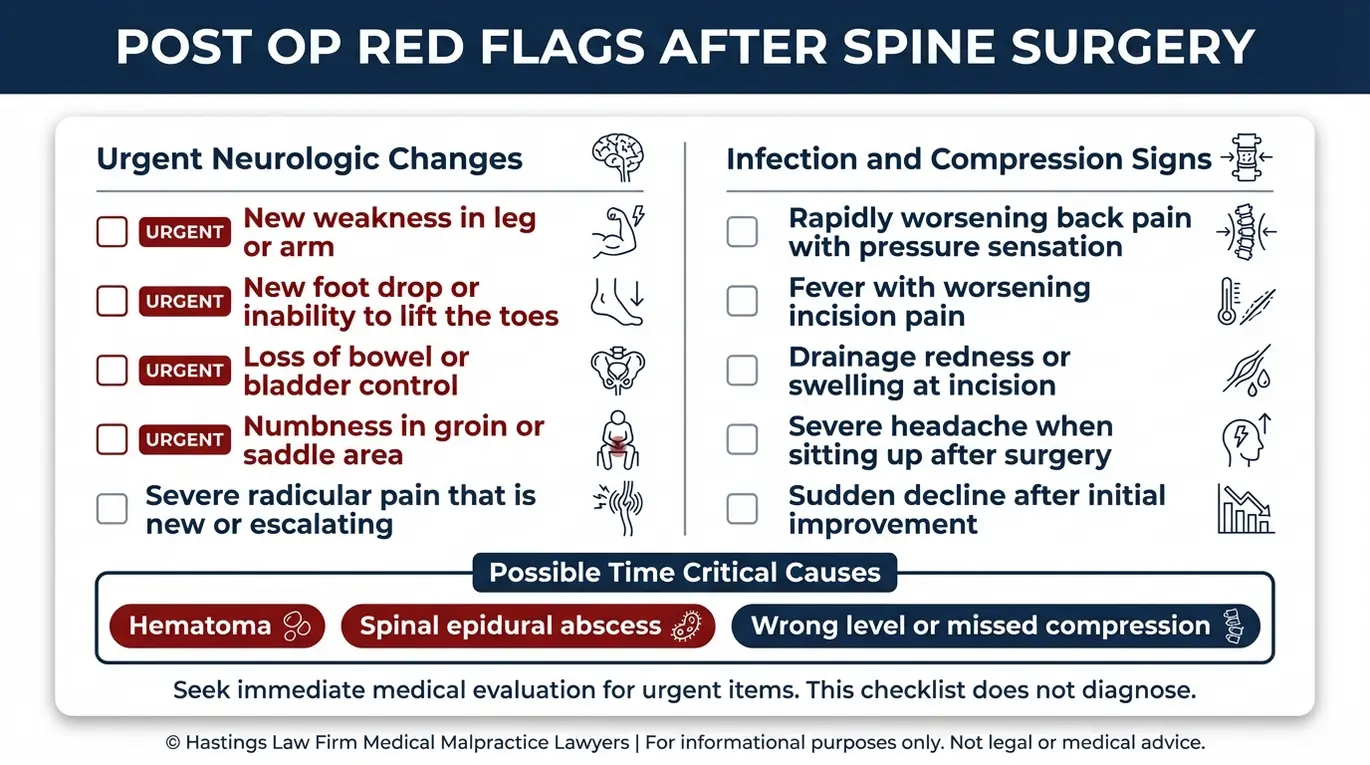
Damage to the spinal cord or nerve roots during surgery can cause paralysis, foot drop (the inability to lift the front of the foot due to nerve damage), or cauda equina syndrome, a serious condition where the bundle of nerves at the base of the spinal cord is compressed, potentially causing loss of bladder and bowel control.
These injuries may result from excessive retraction, improper instrument placement, or failure to use intraoperative neuromonitoring to detect nerve root compression before it becomes permanent. If you have suffered from this degree of negligence, a spinal cord injury attorney can help determine liability.
Post-Operative Negligence
Not all surgical negligence occurs in the operating room. A hematoma, or collection of blood near the surgical site, can compress the spinal cord in the hours following surgery. A spinal epidural abscess, an infection that forms in the space surrounding the spinal cord, can also develop in the days after a procedure. Both conditions require an emergency decompression to prevent permanent damage.
When post-operative neurological checks are missed or symptoms like rapidly progressing weakness are dismissed, the window for intervention can close. Operating room communication failures and surgeon fatigue are contributing factors our team specifically investigates when reviewing these cases. We examine operative logs, nursing notes, and time-stamped records to reconstruct what happened and when.
The Role of Expert Witnesses and Medical Records in Spine Litigation
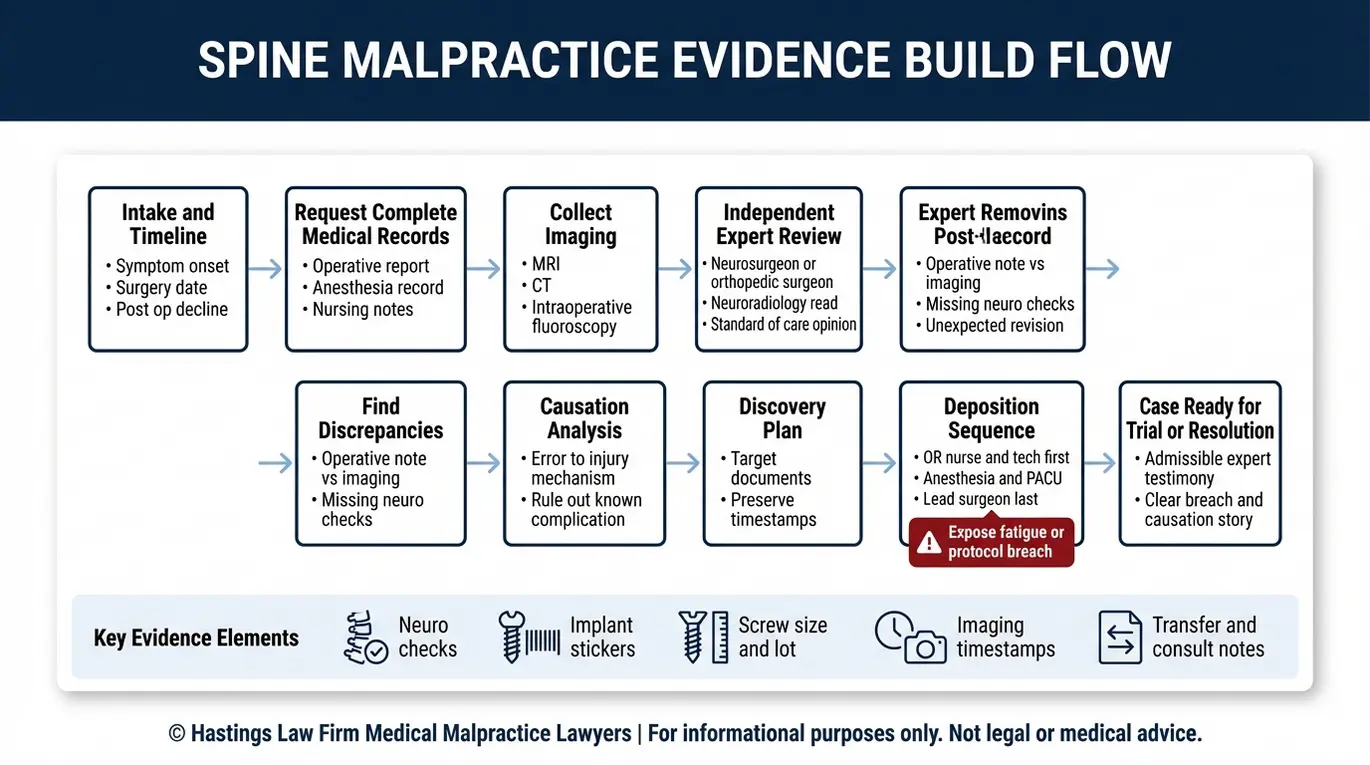
Building a successful spine malpractice case requires a meticulous review of medical records and MRI or CT imaging by qualified neurosurgical experts who can identify discrepancies between the surgeon’s operative notes and the actual radiological evidence. Our founder, Tommy Hastings, is board-certified in Personal Injury Trial Law, a distinction held by fewer than 2% of lawyers in Texas. Having this specialized insight is critical for any medical malpractice case.
Under Texas Civil Practice and Remedies Code § 74.051, a patient must provide pre-suit notice to the defendant healthcare provider at least 60 days before filing a lawsuit. This statutory requirement makes early investigation critical, because the quality of your expert witness analysis and medical record review often determines whether a case can move forward.
How Imaging Shapes the Case
Specialized neuroradiology reads, meaning expert interpretation of spine imaging by radiologists trained specifically in neurological structures, can reveal findings that contradict vague or self-serving operative notes. A surgeon’s report may describe “adequate decompression” or “good screw placement,” while a CT scan tells a different story. These imaging studies provide objective radiological evidence that our medical team analyzes alongside every operative report.
Hardware failure, the mechanical breakdown of rods, screws, or other implants after surgery, often becomes visible on follow-up imaging and can point to errors in the original procedure.
Strategic Discovery and Depositions
Our litigation approach includes deposing operating room staff, such as nurses and surgical technicians, before taking the lead surgeon’s deposition. These staff members can provide critical testimony about what actually happened during the procedure, including whether time-out protocols were followed, whether the surgeon appeared fatigued, and whether communication breakdowns occurred. This sequencing allows us to build a factual record that the surgeon must then address under oath.
Our case-building process for spine surgery claims:
- Collect and organize the complete medical record, including operative reports, anesthesia logs, nursing notes, and neuromonitoring data
- Obtain all pre-operative and post-operative imaging for independent neuroradiology review
- Identify discrepancies between the surgeon’s documented narrative and objective imaging findings
- Retain qualified neurosurgical or orthopedic experts to evaluate standard of care and causation
- Depose OR staff and support personnel before the lead surgeon
- Develop a timeline reconstructing key decisions, delays, and deviations from protocol
Our team at Hastings Law Firm brings in-house medical staff and former defense attorneys together to handle every phase of this process. Our nurse consultants review clinical data alongside our attorneys, and our former defense counsel anticipate the strategies the other side will use.
Contact the Texas Surgical Error Attorneys at Hastings Law Firm Today for Help
You should not have to face the aftermath of a surgical error alone. If you or a loved one is living with pain, disability, or worsening symptoms after spine surgery, our team is here to help you find answers.
Hastings Law Firm represents patients and families across Texas from offices in Houston, The Woodlands, Dallas, and Austin. We handle every case on a contingency fee basis, meaning you pay no attorney fees or costs unless we recover compensation on your behalf.
Your consultation is free and confidential. We will listen to what happened, review your records, and give you an honest assessment of your legal options. Call us today or complete our online form to schedule your risk-free case evaluation.
Frequently Asked Questions About Spine Surgeon Malpractice in Texas


This content was researched and written by the Hastings Law Firm editorial team, which includes attorneys, medical professionals, and experienced researchers. Our writing is informed by internal knowledge and practical experience, and we cross-check critical details against authoritative sources cited throughout. Every piece undergoes human-led fact-checking and legal review. Because legal and medical information can change, if you spot an error, please contact us. Learn more about our content standards and review process on our editorial policy page.

Brady D. Williams is a nationally recognized medical malpractice attorney who has spent his career handling high-stakes litigation for injured patients and families across the country. Licensed in both Texas and California, Brady draws on experience from hundreds of resolved medical cases to break down complex legal and medical topics for the people who need that information most. His writing reflects the same attention to detail and commitment to clarity that he brings to every case he handles.
