


Texas Outpatient Surgery Center Malpractice Lawyer
Ambulatory surgery center errors can leave patients facing unexpected complications and lasting harm in a setting that may have limited emergency resources. Responsibility may extend beyond the surgeon when a facility fails to maintain equipment, staff safely, monitor patients appropriately, or arrange timely transfer to a hospital. Texas claims often involve disputes over whether a surgeon was truly independent and whether the center created the appearance of an employment relationship. If you or a loved one were harmed or worse due to outpatient surgery center malpractice in Texas, contact Hastings Law Firm for a free, confidential case review.

Last Updated: July 27, 2026
Trial-Ready Legal Representation for Ambulatory Surgery Errors in Texas
If you or a loved one was harmed during a procedure at an ambulatory surgery center (ASC), a freestanding facility where same-day surgeries are performed without an overnight hospital stay, you may have questions about what went wrong and who should be held responsible. These cases raise issues that go beyond the surgeon’s actions. The facility itself may bear significant legal responsibility for the conditions under which your procedure took place.
As a firm that handles medical malpractice cases exclusively, we understand how disorienting this experience can be. Our team includes former hospital nurses and board-certified patient advocates who understand internal facility protocols. You trusted a medical team, and now you are dealing with an injury that should not have happened. Tommy Hastings, a board-certified trial lawyer, founded our firm to provide specialized help for those harmed by medical errors.
A Texas outpatient surgery center malpractice lawyer at Hastings Law Firm can review the details of your situation and explain your legal options. We help you understand whether the surgery center, the surgeon, or both may be liable. Contact us for a free, confidential case evaluation.

Risks and Liability in Texas Outpatient Surgery Centers
Malpractice in outpatient settings often involves the facility’s failure to maintain emergency equipment, inadequate staffing, or negligent credentialing of surgeons, and these failures are distinct from errors made by the doctor alone. Understanding these differences is essential when evaluating a potential claim against a Texas ambulatory surgery center. An experienced Texas ambulatory surgery malpractice attorney understands these differences.
The number of procedures performed at ASCs has grown rapidly across Texas and the rest of the country. Data tracked through the Texas Outpatient Public Use Data File (Texas Department of State Health Services) reflects this growth of outpatient surgery. Same-day surgery centers offer convenience and lower costs, but the pressure to turn over operating rooms quickly can create conditions where safety protocols or monitoring are affected. Our lawyers for same-day surgery negligence understand how high-volume schedules can impact patient safety.
One of the most significant risks involves what happens when something goes wrong during or after a procedure. ASCs are not hospitals. They typically lack the extensive crash teams, ICU backup, and around-the-clock specialists that a full-service hospital provides. Under 26 Tex. Admin. Code § 508.4, ambulatory surgical centers must meet specific operational standards, but those standards reflect the emergency response limitations and limited scope of an outpatient environment.
Another concern is premature discharge, which occurs when a patient is sent home before they have fully stabilized, often to free up space in the post-anesthesia care unit (PACU), the recovery area where patients are monitored immediately after surgery. When a patient develops complications at home that should have been caught during a longer observation period, the facility’s discharge decisions become a central part of the investigation. An outpatient surgery malpractice lawyer in Texas will scrutinize these discharge records.
Key Differences: Hospital vs. Ambulatory Surgery Center
- Emergency response capability: Hospitals maintain dedicated rapid response and code teams; ASCs may rely on a small staff to manage emergencies until EMS arrives.
- ICU and inpatient backup: Hospitals can admit and monitor patients overnight; ASCs are designed for discharge the same day.
- Specialist availability: Hospitals typically have on-call specialists across disciplines; ASCs may have only the surgical team and anesthesia provider on-site.
- Staffing levels: Hospitals are subject to broader nurse-to-patient ratio requirements; ASCs operate with leaner staffing models.
- Transfer protocols: When an ASC patient deteriorates, the facility must arrange a transfer to a hospital, and delays in that transfer can be the difference between recovery and permanent injury.
Lawyers for outpatient center negligence examine each of these factors when determining whether the facility met the standard of care, the level of treatment a reasonably competent surgery center would have provided under similar circumstances.

Holding the Center Liable: Vicarious Liability and Apparent Agency
While surgery centers often claim their surgeons are independent contractors to avoid liability, Texas law allows patients to sue the facility under theories of apparent agency if the patient reasonably believed the doctor was a facility employee. This distinction is critical in outpatient surgery malpractice cases, and an experienced malpractice counsel for surgical facility errors can help identify the right legal theory for your claim.
Many ASCs structure their relationships with surgeons specifically to limit the center’s legal exposure. When a complication occurs, the facility’s first defense is often that the surgeon was not its employee and that the center bears no responsibility for the doctor’s clinical decisions. An attorney for ambulatory surgery liability can challenge this defense.
Vicarious liability is a legal principle that holds an employer responsible for the negligent acts of its employees performed within the scope of their work. Apparent agency extends this concept further: even if the surgeon technically operated as an independent contractor, the center may still be liable if its conduct led the patient to reasonably believe the surgeon was part of the facility’s team. This concept, often referred to as agency by estoppel, prevents the facility from denying liability when they held the doctor out as their own. A lawyer for outpatient facility negligence can use these facts to build a claim.
Establishing the Employment Relationship
The evidence that supports an apparent agency claim often comes from the facility’s own materials. The legal responsibility of a surgery center often depends on how it represents its relationship with its doctors. We look at intake forms, marketing materials, and the center’s website to determine the facility’s representation of the surgeon.
If you checked in at the center’s front desk, signed the center’s consent forms, and were never told the surgeon was an independent contractor, those facts can support a finding that you reasonably relied on the appearance that the doctor worked for the center.
Factors that may establish the center’s liability:
- The facility’s website or brochures listed the surgeon as part of its medical team
- Intake paperwork did not disclose the surgeon’s independent contractor status
- The patient had no meaningful choice in selecting the surgeon
- The center controlled scheduling, billing, and the surgical environment
- The facility failed to perform proper credentialing and privileging, which is the process of verifying a surgeon’s qualifications, training, and history before granting them permission to operate at the center
Negligent credentialing is a separate theory of corporate negligence. If the center allowed a surgeon with a history of disciplinary actions or malpractice claims to perform procedures at the facility, the center itself can be held liable for the harm that resulted. The Texas Civil Justice League’s analysis of a Texas Supreme Court decision on health organization liability for physician negligence provides additional context on how Texas courts evaluate these claims. Suing a Texas surgery center requires a careful examination of the corporate structure, the surgeon’s relationship with the facility, and what the patient was told before the procedure.
The Hastings Law Firm Difference
Results matter, but what truly sets us apart is how we achieve them. Every verdict, every settlement, and every Texas courtroom victory comes from one guiding promise: To treat each client’s fight for justice as if it were our own.
This balance of skill, experience, and empathy reflects our core philosophy that justice should not only compensate the injured, but also make health care safer nationwide.

Common Types of Negligence in Ambulatory Settings
Frequent errors in ASCs include anesthesia complications due to insufficient monitoring, surgical site infections from poor sterilization, and failure to transfer patients to a hospital when emergencies arise. An attorney for outpatient surgical errors will investigate which of these failures, or a combination of them, contributed to the patient’s injury.
Anesthesia errors are among the most dangerous complications in outpatient settings. Unlike a hospital with a full respiratory team on standby, many ASCs rely on a single anesthesia provider. Proper monitoring requires capnography, which is end-tidal CO₂ monitoring that tracks whether a patient is breathing adequately under sedation.
When this monitoring is absent, delayed, or ignored, patients can suffer oxygen deprivation before anyone recognizes the problem. A Texas outpatient surgery injury attorney can evaluate if monitoring was sufficient.
Surgical errors in ASCs follow many of the same patterns seen in hospitals but carry additional risk because the facility may lack the resources to respond quickly. Common issues our ambulatory surgery center malpractice lawyers see include:
- Wrong-site surgery: Operating on the wrong body part, often resulting from a skipped or incomplete surgical time-out
- Retained surgical items (RSIs): Sponges, instruments, or other foreign objects left inside the patient after closure, sometimes not discovered until the patient develops pain, infection, or internal complications
- Organ perforation or damage: Accidental injury to surrounding tissue during a procedure, particularly in laparoscopic or endoscopic surgeries
- Post-procedure infections and sepsis: Infections caused by non-sterile instruments, contaminated surgical environments, or inadequate wound care protocols that can progress to sepsis, a life-threatening immune response
- Medication mistakes: Wrong drug, wrong dose, or failure to account for a patient’s drug allergies or interactions
- Failure to transfer: When a patient’s condition deteriorates and the ASC does not call 911 or arrange an immediate hospital transfer, the delay can turn a treatable complication into a catastrophic injury or wrongful death
Each of these categories requires a different type of evidence and expert analysis. A surgery center negligence lawyer in Texas will obtain surgical logs, anesthesia records, and nursing notes. We use these to build a timeline of what happened and where the standard of care was breached.

Proving Malpractice and Texas Chapter 74 Requirements
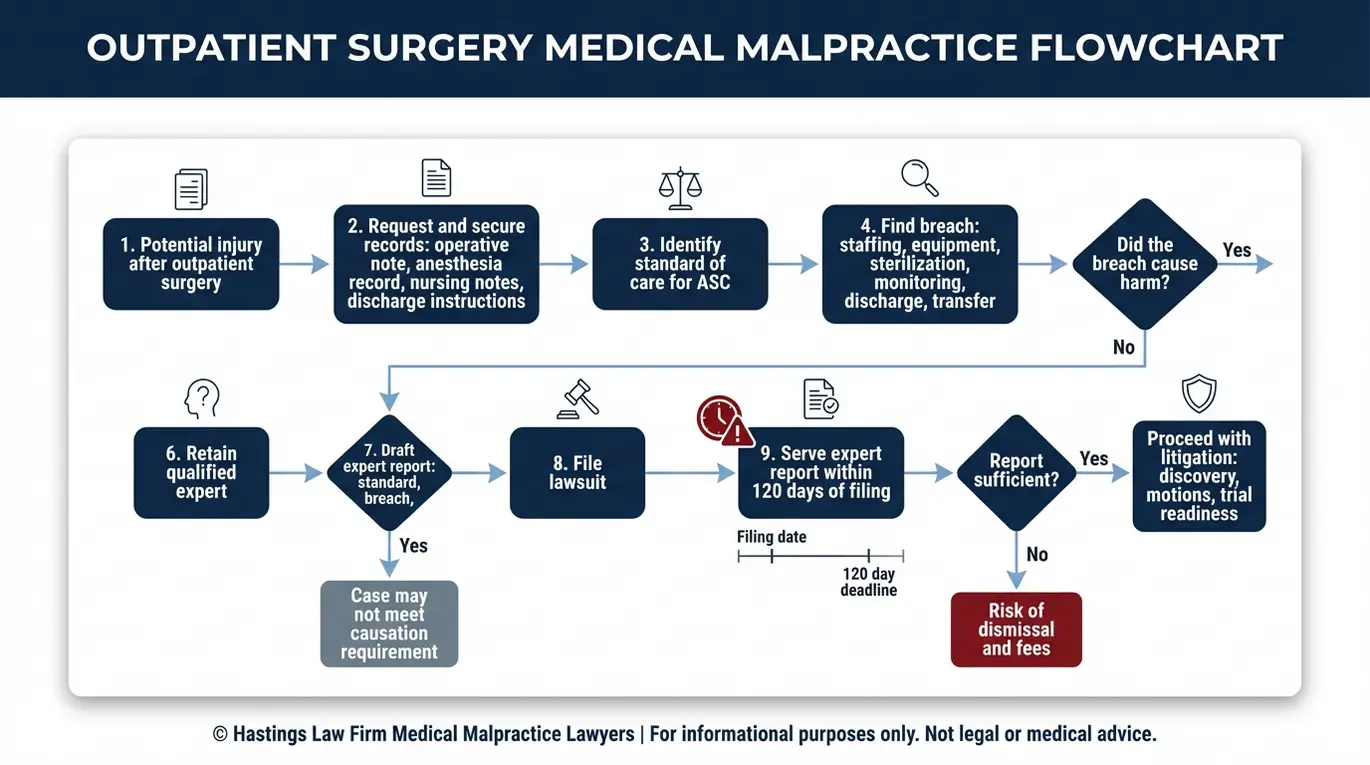
Texas law requires a “Certificate of Merit,” or qualified expert report, to be filed within 120 days after each defendant files an original answer, and that report must detail the specific breach of the standard of care by the surgery center. Missing this deadline can result in dismissal of your case, which is why early involvement of an experienced attorney matters.
Under Texas Civil Practice and Remedies Code § 74.351, every medical malpractice claim in Texas must be supported by an expert report from a qualified healthcare professional. This report must identify the applicable standard of care, explain how the surgery center or its providers deviated from that standard, and describe how that deviation caused the patient’s injury. This requirement exists for claims against ASCs just as it does for claims against hospitals and physicians.
Proving a case against a surgery center typically follows these steps:
- Identify the standard of care: What would a reasonably prudent ambulatory surgery center have done under the same or similar circumstances? A Texas surgery center malpractice lawyer helps establish this baseline. This includes staffing, equipment maintenance, infection control, monitoring protocols, and transfer readiness.
- Establish the breach: Where did the facility fall short? This could involve broken equipment that was not replaced, an anesthesia provider who was unsupervised, or a failure to follow a surgical time-out, which is the Universal Protocol safety step where the team pauses to verify the correct patient, correct procedure, and correct surgical site.
- Prove causation: The breach must be directly linked to the injury. If a wrong-site surgery, which is an operation performed on the incorrect part of the body, occurred because no time-out was performed, that connection is relatively direct. Other cases, such as delayed transfer, require expert analysis showing that earlier intervention would have changed the outcome.
- Document the damages: Medical records, billing statements, employment records, and expert projections all factor into establishing the full scope of harm used to support a lawsuit against an outpatient facility.
The Texas Civil Practice and Remedies Code § 74.251 also sets the statute of limitations for filing a claim against a surgery center. Acting early gives our team the time needed to secure records, retain qualified medical experts, and prepare a certificate of merit that satisfies Texas medical negligence legal requirements before the court-imposed deadlines expire.
Recoverable Damages and Statute of Limitations
Patients harmed by outpatient surgery center negligence can recover economic damages like medical bills and lost wages, along with non-economic damages for pain and suffering. Texas does impose a cap on non-economic damages in medical liability cases, making it necessary to build the strongest possible case for every category of loss.
Damages Breakdown
| Damage Type | Examples |
|---|---|
| Past Economic Damages | Emergency care, corrective surgeries, hospital stays, medications, medical devices |
| Future Economic Damages | Ongoing treatment, rehabilitation, home care, lost earning capacity |
| Non-Economic Damages | Physical pain, emotional distress, loss of enjoyment of life, disfigurement, impairment |
| Wrongful Death Damages | Funeral expenses, loss of companionship, loss of financial support, mental anguish of surviving family |
Texas caps non-economic damages at $250,000 per claimant against all individual physicians and healthcare providers and $250,000 against a single healthcare institution such as a surgery center. These non-economic damage caps are strictly enforced.
While they limit recovery for pain and suffering, they do not restrict funds needed for necessary medical care or reimbursement for lost income, which is why establishing future economic needs is critical. The total cap is roughly $750,000 depending on the number of defendants in the case. Economic damages, including past and future medical costs and lost income, are not capped.
The Texas malpractice statute of limitations is generally two years from the date the negligence occurred or was discovered. Exceptions may apply in cases involving minors or situations where the injury was not immediately apparent. For instance, the deadline may be extended if the injured party is a minor under the age of 12, or in cases where the negligence could not have been discovered immediately despite reasonable diligence. Because the expert report deadline begins running shortly after filing, the timeline for compensation for surgery center injuries is tight. Consulting with a Texas malpractice attorney early protects your ability to pursue every available category of recovery.
Contact the Texas Surgical Error Attorneys at Hastings Law Firm Today for Help
If you believe you or a family member was harmed by negligence at an outpatient surgery center, Hastings Law Firm is here to help you find answers. Our firm handles medical malpractice cases exclusively, and our team includes former defense attorneys, in-house nurse consultants, and board-certified patient advocates who understand how surgery centers operate and where breakdowns in care occur.
We have the resources and experience to take on corporate surgery centers and the insurance carriers behind them. Our team prepares every case using trial-ready preparation, and this work directly strengthens your position whether the case resolves through settlement or before a jury.
There is no fee unless we recover compensation for you. Contact us today to request a free case evaluation and take the first step toward understanding what happened and what your options are.
Frequently Asked Questions About Outpatient Surgery Center Malpractice in Texas


This content was researched and written by the Hastings Law Firm editorial team, which includes attorneys, medical professionals, and experienced researchers. Our writing is informed by internal knowledge and practical experience, and we cross-check critical details against authoritative sources cited throughout. Every piece undergoes human-led fact-checking and legal review. Because legal and medical information can change, if you spot an error, please contact us. Learn more about our content standards and review process on our editorial policy page.

Brady D. Williams is a nationally recognized medical malpractice attorney who has spent his career handling high-stakes litigation for injured patients and families across the country. Licensed in both Texas and California, Brady draws on experience from hundreds of resolved medical cases to break down complex legal and medical topics for the people who need that information most. His writing reflects the same attention to detail and commitment to clarity that he brings to every case he handles.
