


Texas Neurosurgeon Malpractice Lawyer
Brain and spine surgery can carry serious risks, but some injuries happen because a surgeon deviated from the accepted standard of care. Neurosurgical malpractice often turns on whether a preventable error occurred during planning, the procedure, or post operative monitoring, rather than a known complication that was properly disclosed and managed. These cases can involve complex records, disputed causation, and life changing neurological harm that affects a whole family. If you or a loved one were harmed or worse due to neurosurgeon malpractice in Texas, contact Hastings Law Firm for a free, confidential case review.

Last Updated: July 27, 2026
Trial-Ready Legal Representation for Brain and Spine Surgery Negligence
When brain or spinal surgery leads to an unexpected injury, the physical and emotional toll can be overwhelming. You may be struggling with new limitations, unanswered questions, and a deep sense that something went wrong during your care. Those concerns deserve to be taken seriously.
Neurosurgical malpractice cases are among the most medically and legally demanding claims in the country. They require attorneys who understand both the medicine and the law at an advanced level. As a Texas neurosurgeon malpractice lawyer team, Hastings Law Firm focuses exclusively on medical negligence, and our in-house medical professionals and board-certified trial attorney are prepared to examine exactly what happened.
If you or a loved one suffered a serious injury during or after brain or spinal surgery, we can review your medical records, explain your options, and help you understand whether negligence may have played a role. Contact us for a free, confidential case evaluation.

Defining Malpractice in Complex Neurosurgical Procedures
Neurosurgical malpractice occurs when a surgeon deviates from the accepted standard of care during brain or spinal procedures, directly causing injury or death through negligence rather than an acceptable surgical risk. The standard of care refers to the level of treatment a reasonably competent neurosurgeon would provide under similar circumstances. In high-stakes specialties like neurosurgery, that standard demands precise pre-operative planning, meticulous intraoperative technique, and careful post-operative monitoring.
Not every bad outcome is malpractice. Neurosurgery carries inherent risks, and patients can experience complications even when the surgeon performs flawlessly. The critical distinction lies between a known complication that was properly disclosed and managed, and a preventable error caused by a departure from accepted medical practice. Determining this distinction is a challenge.
High-stakes neurosurgery demands a rigorous adherence to safety protocols because the margin for error is nonexistent. When a surgeon bypasses these protocols, such as skipping a safety check or rushing a procedure, the deviation forms the basis of a negligence claim.
A systematic review and meta-analysis published in PubMed on neurosurgical malpractice litigation confirms that neurosurgery is one of the most frequently litigated surgical specialties. This reflects both the high stakes involved and the frequency with which preventable errors occur. Patients often assume that a poor result is just unfortunate, but the data suggests that preventable surgical errors are a significant driver of adverse outcomes in this field. Claims often center on surgical errors and wrong-level spinal surgery. They also involve failures in post-operative management, such as uncontrolled intracranial pressure (ICP), which is the pressure inside the skull that can spike dangerously after surgery.
| Known Complication | Malpractice (Negligence) | |
|---|---|---|
| Definition | A recognized risk of the procedure that occurs despite proper technique | A preventable error caused by a breach of the standard of care |
| Disclosure | Typically discussed during informed consent | May involve risks the patient was never warned about |
| Surgeon Conduct | Followed accepted protocols | Deviated from what a competent surgeon would have done |
| Example | Post-surgical swelling managed with appropriate monitoring | Operating on the wrong spinal level due to inadequate imaging review |
| Legal Liability | Generally not actionable | May form the basis of a malpractice claim |
Experienced neurosurgeon malpractice attorneys examine the surgical records, imaging studies, and post-operative notes to determine which side of this line your case falls on.

Common Errors Committed by Surgeons in Texas
Frequent errors in neurosurgery include wrong-site surgery, operating on the wrong spinal level, severing nerves during dissection, failing to monitor hematomas after surgery, and performing unnecessary procedures. Surgical mistakes in the brain or spine often result from a deviation from established medical protocols. These errors tend to fall into distinct categories depending on whether the surgery involved the spine or the brain.
Spinal Surgery Errors
- Wrong-level surgery, such as operating on a lumbar vertebra when the cervical spine was the intended target
- Misplacement of screws, rods, or other spinal instrumentation
- Nerve root damage during a laminectomy, a procedure that removes part of the vertebral bone to relieve pressure on the spinal cord
- Incomplete decompression during a discectomy, which is the removal of herniated disc material pressing on a nerve
- Failure to identify and address hardware complications during follow-up
Brain Surgery Errors
- Clipping or cauterizing the wrong blood vessel, leading to hemorrhage or stroke
- Failing to control intracranial pressure after a craniotomy
- Leaving surgical instruments, sponges, or other foreign objects inside the skull
- Inadequate monitoring that allows a post-operative hematoma, a collection of blood outside the blood vessels, to go undetected
Systemic Concerns
Some Texas malpractice lawyers for neurosurgery also investigate patterns of unnecessary spinal fusions driven by economic incentives. In these cases, patients may undergo costly procedures they did not need, exposing them to surgical risk without genuine medical justification. This practice raises serious informed consent issues, as patients are rarely told that their costly fusion was elective or unnecessary. They are exposed to the risks of surgery without a truthful discussion of their options. The Inpatient Quality Indicators published by the Texas Department of State Health Services provide data that can help identify facilities with unusual complication rates or procedure volumes.
If you are looking for a lawyer for brain surgery errors or spinal negligence, the specific type of error matters because it shapes both the investigation and the legal strategy.
The “Recovery Race” in Spinal Fusion
Spinal fusion procedures depend on a biological timeline. After surgery, the body must grow new bone to fuse the vertebrae together, and during that window, spinal instrumentation (the screws, rods, and plates holding the spine in position) bears the mechanical load.
Hardware failure occurs when surgical implants fail to support the spine during the healing process. This creates what is sometimes called the “recovery race.” The bone needs to fuse before the hardware fatigues and fails. When a surgeon ignores signs of pseudarthrosis, the medical term for non-union or failure of the bone to fuse, the hardware can loosen or break. This often leads to additional surgery, chronic pain, or permanent instability.
We examine post-operative imaging, follow-up records, and surgical notes to determine causation, linking the surgeon’s negligence directly to the hardware failure, and to check whether signs of non-union were present and whether the surgeon responded appropriately.

The Hastings Law Firm Difference
Results matter, but what truly sets us apart is how we achieve them. Every verdict, every settlement, and every Texas courtroom victory comes from one guiding promise: To treat each client’s fight for justice as if it were our own.
This balance of skill, experience, and empathy reflects our core philosophy that justice should not only compensate the injured, but also make health care safer nationwide.

Catastrophic Outcomes and Neurological Injuries
Negligence in neurosurgery can result in permanent paralysis, cognitive impairments, loss of motor function, stroke, or fatal brain bleeds, often requiring lifetime care and millions of dollars in future medical costs. Medical errors in these complex procedures often lead to long-term care needs that significantly impact the quality of life for the patient and their family.
Spinal cord injuries from surgical error may cause paraplegia or quadriplegia, fundamentally changing how a person lives, works, and interacts with their family. Brain injuries can be equally devastating but sometimes less visible. Personality changes, memory loss, difficulty concentrating, and emotional instability are all forms of neurological deficits, meaning measurable impairments in brain or nervous system function that may persist long after surgery.
Families often bear the heavy burden of caregiving. The financial and emotional strain of supporting a loved one with profound cognitive or physical deficits can destabilize an entire household. Securing resources for this long-term care is a primary goal of litigation.
An epidural hematoma, a dangerous collection of blood between the skull and the brain’s protective covering, can develop after neurosurgery if bleeding is not properly controlled. Without immediate intervention, it can cause brain damage or death. The Stoke Mandeville Spinal Needs Assessment Checklist from Shirley Ryan AbilityLab illustrates the scope of long-term care that spinal cord injury patients may require.
| Condition | Potential Long-Term Care Needs |
|---|---|
| Paraplegia / Quadriplegia | 24/7 nursing, home modification, adaptive equipment, physical therapy |
| Traumatic Brain Injury | Cognitive rehabilitation, behavioral therapy, supervised living |
| Stroke (surgical cause) | Speech therapy, occupational therapy, ongoing neurological monitoring |
| Chronic Pain Syndrome | Pain management, medication, psychological support |
| Wrongful Death | Funeral costs, loss of household income, loss of companionship |
A neurosurgeon negligence attorney evaluates the full scope of these injuries to determine the medical and financial resources you or your family will need going forward.
Navigating Texas Chapter 74 and Liability Laws
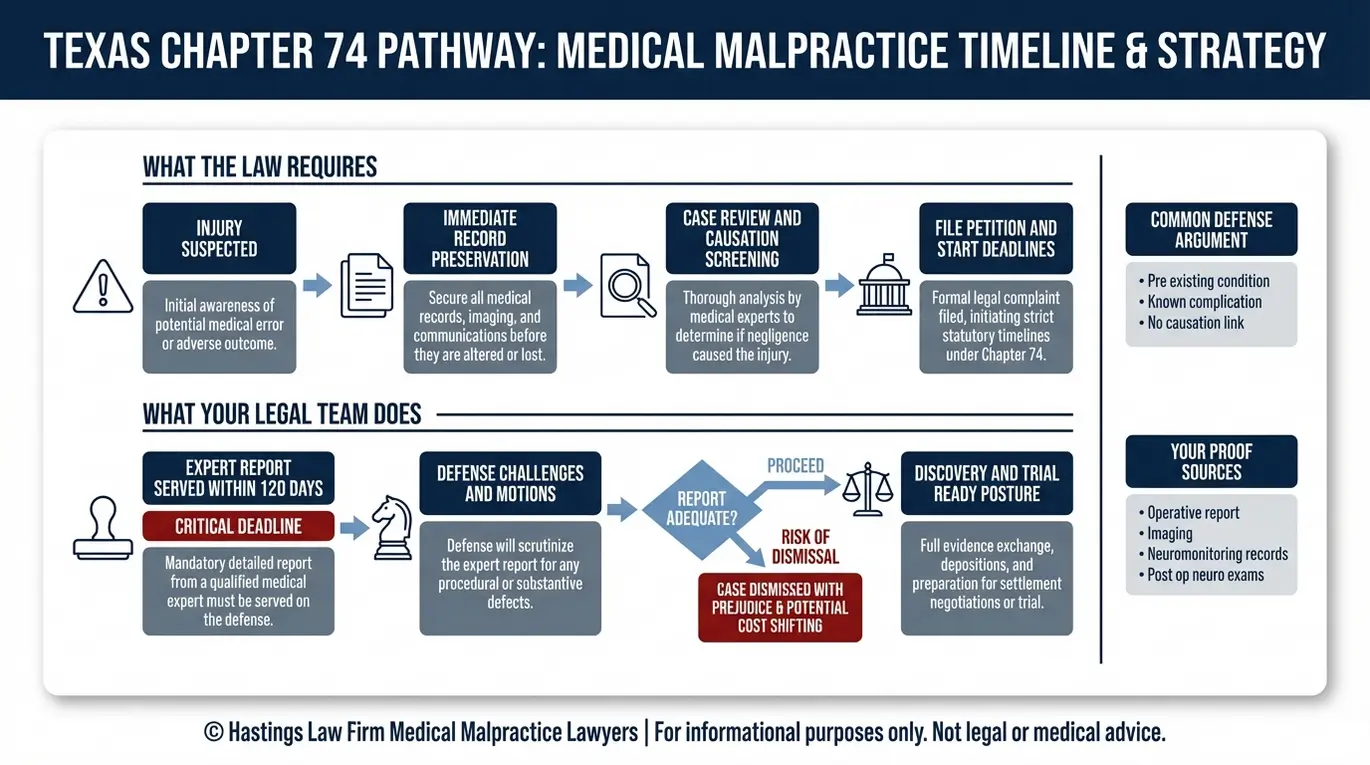
Texas law requires patients in medical malpractice cases to file a qualified expert report within 120 days after the defendant’s original answer is filed and to comply with a strict two-year statute of limitations. These rules determine how a medical liability claim proceeds in court. Missing either deadline can end your case permanently, making early legal action critical.
Texas Civil Practice and Remedies Code Chapter 74 governs all medical liability claims in the state. It imposes specific procedural requirements that do not apply in other types of personal injury lawsuits.
Here is what a Chapter 74 claim generally involves:
- Pre-suit notice: Under Texas Civil Practice and Remedies Code § 74.051, you must provide written notice to each healthcare provider at least 60 days before filing suit.
- Filing the lawsuit: The claim must be filed within two years from the date of the negligent act. Texas also has a 10-year statute of repose, which is an absolute outer deadline regardless of when the injury was discovered. Because this statute of repose can permanently bar claims after ten years, acting within the legal timeline is important.
- Expert report deadline: Under Texas Civil Practice and Remedies Code § 74.351, a detailed report from a qualified medical expert must be served on each defendant within 120 days after that defendant’s original answer is filed. This report must identify the standard of care, explain how the surgeon breached it, and establish causation between the breach and your injury. This report is a gatekeeper; without a supportive opinion from a credible expert witness, the claim cannot proceed.
- Proportionate responsibility: The defense may argue that a pre-existing condition, rather than surgical negligence, caused the injury. We work with medical experts to isolate the surgeon’s role and establish direct causation.
The expert report requirement is the single biggest procedural hurdle in Texas malpractice cases. Without a credible, well-supported report from a qualified specialist, the court will dismiss the case. A malpractice lawyer in Texas who handles neurosurgical claims will begin building this report immediately after accepting a case.
Calculating Damages for Neurosurgical Injuries
Compensation in neurosurgical malpractice cases includes economic damages for past and future medical care and lost earning capacity, along with non-economic damages for pain, suffering, and physical impairment. Financial recovery helps families manage the high costs of long-term neurosurgical injuries.
Economic Damages (Uncapped)
Economic damages cover the measurable financial losses caused by the injury. In severe neurosurgical cases, these figures can be substantial:
- Past and future medical expenses, including surgeries, hospital stays, and rehabilitation
- Cost of 24/7 in-home nursing or long-term care facilities
- Home and vehicle modifications for wheelchair accessibility
- Lost wages and diminished future earning capacity
- Assistive devices and ongoing therapy
Because economic damages are not subject to a statutory cap in Texas, they often represent the largest portion of recovery in catastrophic injury cases. A life care plan prepared by a qualified expert can project these costs over the patient’s remaining lifetime. A life care plan is not just a list of bills; it is a comprehensive projection created by financial and medical experts. It accounts for inflation, rising healthcare costs, and the specific progression of your injury, ensuring that the compensation obtained today will still be sufficient to cover nursing care and medical needs decades from now.
Non-Economic Damages (Capped)
Non-economic damages cover intangible losses that are real but harder to quantify:
- Physical pain and suffering
- Mental anguish and emotional distress
- Loss of enjoyment of life
- Physical impairment and disfigurement
- Loss of companionship (in wrongful death claims)
Texas caps non-economic damages at $250,000 per claimant against all individual healthcare providers combined and $250,000 per healthcare institution, with a maximum of $500,000 across multiple institutions. While these caps limit one category of recovery, they do not reduce the uncapped economic damages that reflect the true cost of living with a catastrophic neurological injury.
Working with a Texas neurosurgeon malpractice counsel who understands how to document and present both categories is essential to recovering the full value of a claim.
Why Choose Hastings Law Firm for Your Case
We are a trial-ready firm that focuses exclusively on medical negligence, and our approach to neurosurgical cases reflects that specialization at every level. Choosing a firm with specialized neurosurgical knowledge is important for building a strong malpractice claim. As a Texas neurosurgeon malpractice lawyer team, we do not divide our attention across unrelated practice areas.
Our founder, Tommy Hastings, is board certified in personal injury trial law by the Texas Board of Legal Specialization, a distinction held by fewer than 2% of Texas attorneys. Our medical-legal team includes former defense attorneys who previously represented hospitals, giving us direct insight into how the other side builds its case. We also have in-house nurse consultants who review MRI reports, surgical notes, and post-operative records with clinical precision.
Every case we accept is prepared as though it will go to a jury. That level of preparation strengthens settlement negotiations and signals to defense counsel that we will not accept less than what the case is worth. If you need a law firm for spinal surgery negligence or brain surgery errors, we have the medical knowledge and courtroom experience to handle your case from investigation through trial.
Contact the Texas Surgical Error Attorneys at Hastings Law Firm Today for Help
Texas law imposes strict deadlines on medical malpractice claims, and evidence can become harder to preserve as time passes. If you or a loved one suffered a serious injury during or after neurosurgery, the time to act is now.
Our consultations are free and completely confidential. We work on a contingency fee basis, which means you pay no attorney fees or costs unless we recover compensation on your behalf. There is no financial risk in reaching out.
Let our team review your medical records, identify what went wrong, and explain your legal options. We believe every patient deserves the truth about their care, and we are here to help you find it.
Contact Hastings Law Firm today.
Frequently Asked Questions About Neurosurgeon Malpractice in Texas


This content was researched and written by the Hastings Law Firm editorial team, which includes attorneys, medical professionals, and experienced researchers. Our writing is informed by internal knowledge and practical experience, and we cross-check critical details against authoritative sources cited throughout. Every piece undergoes human-led fact-checking and legal review. Because legal and medical information can change, if you spot an error, please contact us. Learn more about our content standards and review process on our editorial policy page.

Gabe Sassin has focused exclusively on medical malpractice law since 2007. After spending more than a decade as a malpractice defense attorney, he knows exactly how the other side works. He has seen firsthand how healthcare providers, insurers, corporate defendants, and their legal teams think, prepare, and build their defense against claims. That knowledge works for the people who need it most today, injured patients and their families. His unique experience shapes everything he writes, giving readers a look at how these cases actually work from someone who has handled them from both sides.
