


Texas Gallbladder Surgery Error Lawyer
Gallbladder surgery is often treated as routine, but preventable mistakes can cause severe and lasting harm. Errors during cholecystectomy can involve misidentifying anatomy, injuring the bile duct, or failing to respond to warning signs after surgery, which can lead to infection, additional procedures, long term digestive problems, and financial strain. Texas law also places strict limits on how long a claim can remain available, which can affect options even when the injury is serious. If you or a loved one were harmed or worse due to gallbladder surgery errors in Texas, contact Hastings Law Firm for a free, confidential case review.

Last Updated: July 27, 2026
Trial-Ready Legal Representation for Surgical Injuries in Texas
If you or a loved one suffered a serious injury during gallbladder surgery, the confusion and frustration you feel right now are completely understandable. You trusted a surgeon to perform a routine procedure, and something went wrong. Now you may be facing additional surgeries, chronic pain, and mounting medical bills with no clear answers about what happened.
At Hastings Law Firm, we focus exclusively on medical malpractice. Our team includes in-house medical professionals and former defense attorneys who know how to uncover the truth behind surgical errors. As a Texas gallbladder surgery error lawyer, founder Tommy Hastings and his team have the experience to evaluate what went wrong and hold negligent providers accountable.
If you believe your surgeon made a preventable mistake, we can review your medical records and explain your options during a free, confidential consultation.

Common Errors Committed by Surgeons During Cholecystectomies
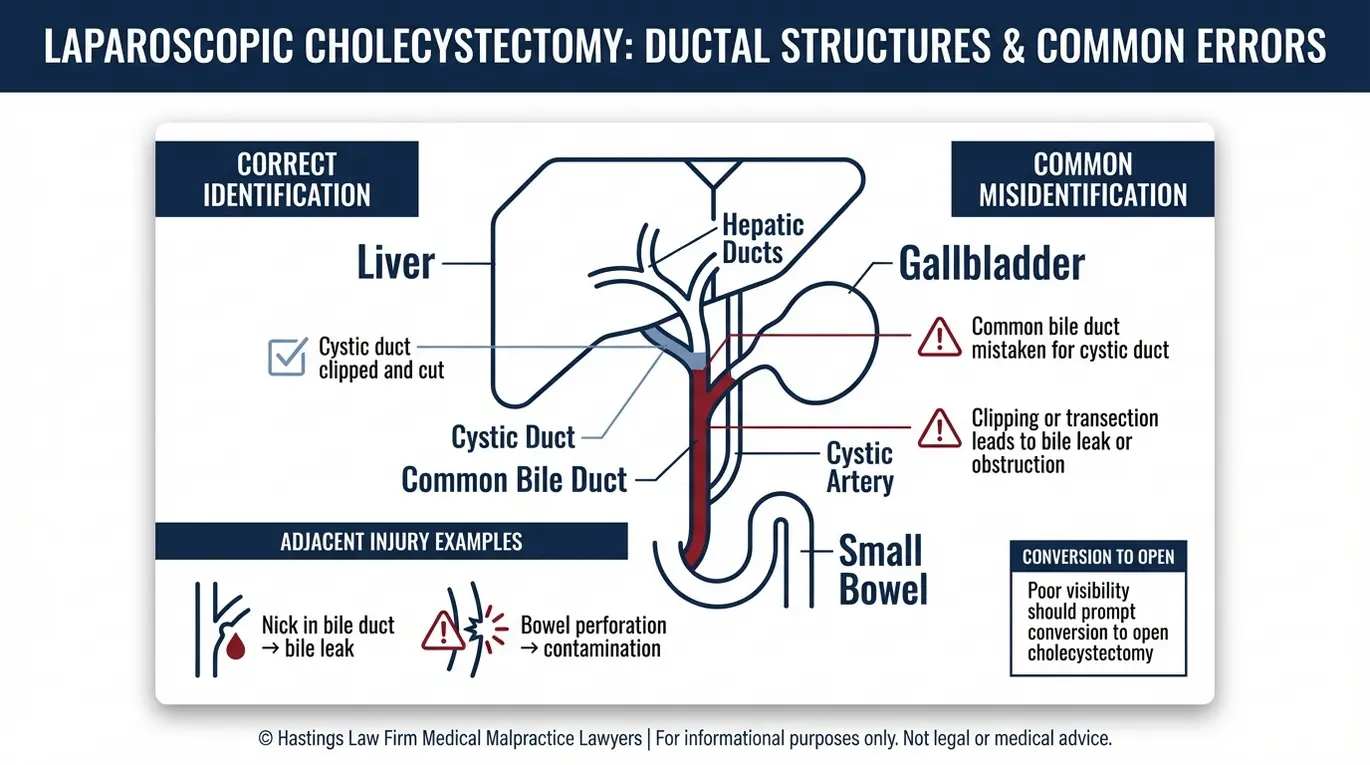
Surgical errors often occur when a surgeon fails to properly identify the cystic duct and the cystic artery before cutting, leading to the severance of the common bile duct or perforation of nearby organs. A cholecystectomy is the surgical removal of the gallbladder, often performed to treat painful gallstones or inflammation.
Gallbladder removal is one of the most commonly performed surgeries in the United States. Most are done as a laparoscopic cholecystectomy (often called a “lap chole”), a minimally invasive approach using small incisions and a camera. While the procedure is considered routine, the anatomy in that region is dense and variable from patient to patient, and the pressure surgeons feel to perform these procedures quickly can sometimes lead to mistakes. Errors during this surgery can cause life-altering injuries, and many of those errors are preventable.
A Texas gallbladder surgery malpractice attorney evaluates cases involving mistakes such as wrong-site surgery or:
- Misidentification of anatomy: The surgeon mistakes the common bile duct for the cystic duct, then clips or severs the wrong structure. This is the most common mechanism behind serious bile duct injuries, and it often stems from inadequate visualization of the surgical field. The National Cancer Institute’s bile duct intrahepatic anatomy resources illustrate how closely these structures sit together.
- Clipping and nicking errors: Even a small nick to the bile duct or a surrounding blood vessel can cause bile to leak into the abdominal cavity, leading to infection and the need for emergency corrective surgery.
- Bowel or organ perforation: Instruments used during laparoscopic surgery can accidentally puncture the bowel or other abdominal organs, especially when the surgeon is working with limited visibility.
- Unnecessary gallbladder removal: In some cases, the patient’s symptoms and diagnostic imaging did not support surgery at all. Removing a gallbladder without a clear medical indication may constitute a breach of the standard of care under Texas Civil Practice and Remedies Code Chapter 74.
Our team includes experienced gallbladder surgery error lawyers who ensure every aspect of your claim is thoroughly investigated.
The Danger of Eagerness for Laparoscopic Procedures
Laparoscopic cholecystectomy, a minimally invasive technique where the surgeon operates through small incisions using a camera, is the preferred approach for gallbladder removal because it means shorter recovery times. But this preference can become a problem when a surgeon pushes to complete the procedure laparoscopically, potentially relying on training shortcuts despite poor visibility or unclear anatomy.
The standard of care may require converting to an open cholecystectomy, a traditional approach involving a larger incision that gives the surgeon a direct view of the surgical field. Some surgeons resist converting because an open procedure takes longer and is perceived as less efficient. That resistance, when it compromises patient safety, is exactly the kind of deviation we investigate.
We examine whether the decision to continue laparoscopically was clinically justified or whether it placed the patient at unnecessary risk. Our team includes experienced nurse consultants who understand surgical workflows and help us identify where a protocol was ignored.
Distinguishing Actionable Malpractice from Known Surgical Risks
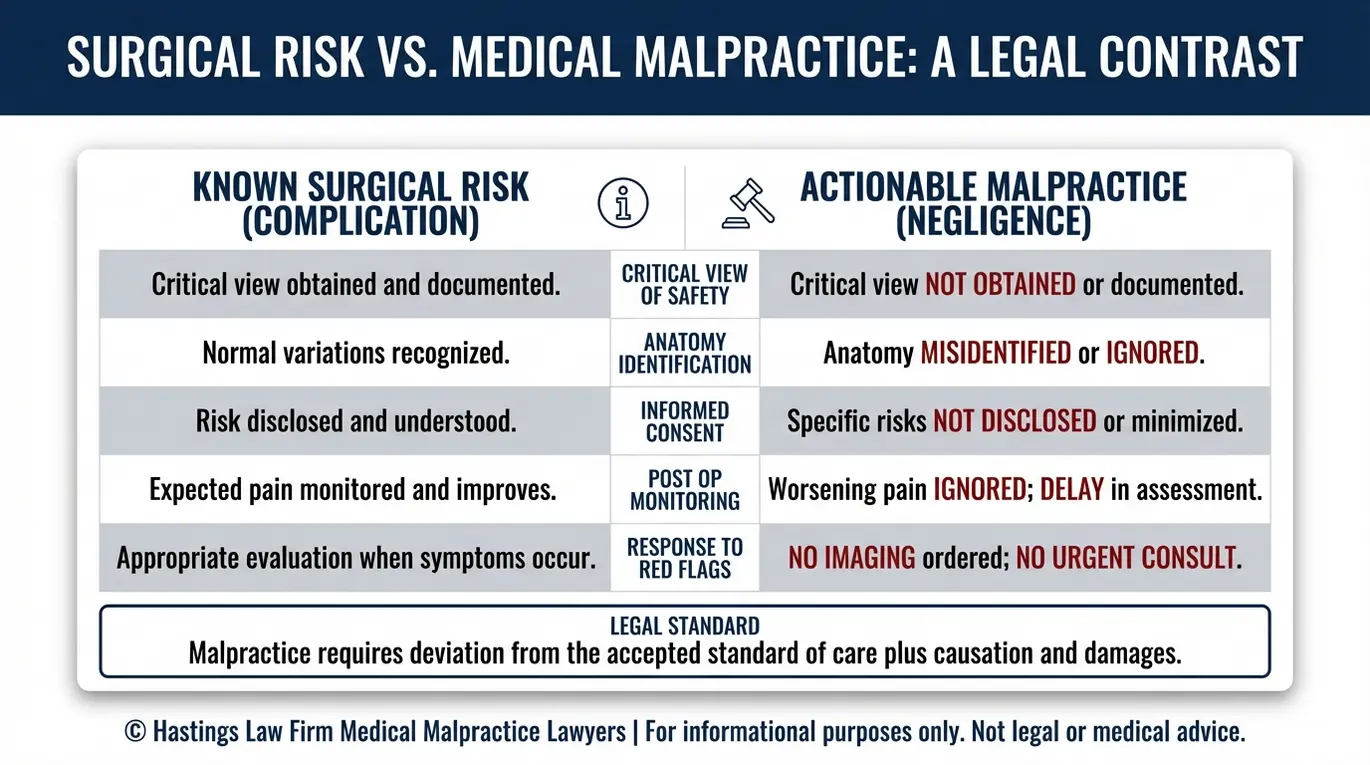
A negative outcome becomes malpractice when the surgeon deviates from the accepted medical standard of care, such as failing to establish the “Critical View of Safety” before cutting or ignoring signs of post-operative distress. Not every complication after gallbladder surgery means someone was negligent, but the line between a known risk and a preventable error is something a gallbladder malpractice lawyer can help you understand.
The standard of care is the level of treatment a reasonably competent surgeon would have provided under similar circumstances. In gallbladder surgery, this includes a widely accepted technique called the Critical View of Safety (CVS), a method of dissection that requires the surgeon to meet three specific criteria: clearing the hepatocystic triangle of fat and fibrous tissue, confirming that only two structures are connected to the gallbladder, and separating the lower third of the gallbladder from the liver bed before clipping or cutting anything. Research published by JAMA Network Open on patient complexity and bile duct injury highlights the ongoing risk of ductal injuries and the importance of meticulous surgical technique.
When a surgeon skips or inadequately achieves the CVS, the risk of cutting the wrong structure increases significantly. That is not a known complication; that is medical negligence.
The same principle applies after surgery. A bile leak, which occurs when bile escapes from a damaged duct into the abdominal cavity, can lead to peritonitis (a dangerous infection of the abdominal lining) or sepsis (a life-threatening immune response to infection). If a surgeon or hospital fails to recognize the warning signs of a post-operative leak, such as escalating pain, fever, or abnormal lab results, that delay in diagnosis can turn a treatable problem into a fatal one.
| Known Complication | Potential Malpractice | |
|---|---|---|
| Pre-Surgery | Patient is informed of general risks, including bile duct injury | Surgery performed without adequate diagnostic support, or informed consent did not disclose specific risks |
| During Surgery | Minor bleeding controlled appropriately | Surgeon fails to achieve Critical View of Safety before cutting; wrong structure clipped or severed |
| Post-Surgery | Mild pain managed with standard care | Signs of bile leak or infection ignored; delayed diagnosis leads to peritonitis or sepsis |
A surgical error attorney can review your records and work with qualified medical experts to determine whether you were harmed by a negligent surgeon.
Quantifying Bile Duct Injuries
Not all bile duct injuries are the same, and the severity directly affects both your medical prognosis and the strength of a legal claim. Surgeons and medical experts classify these injuries based on the location of the damage and the percentage of the duct that was cut or destroyed.
A bile duct transection, meaning the duct was completely cut through, is far more serious than a partial nick. Minor injuries may involve a small leak that can sometimes be managed with a stent, while major injuries involve complete transection or destruction of the biliary ducts and surrounding ductal structures. Major injuries typically require complex reconstructive surgery and can cause permanent digestive problems.
This technical grading matters in litigation because it determines the scope of future medical treatment, the degree of permanent impairment, and the overall value of the claim. We review imaging, pathology, and operative reports to classify the injury accurately and determine how it will affect your long-term health.
The Hastings Law Firm Difference
Results matter, but what truly sets us apart is how we achieve them. Every verdict, every settlement, and every Texas courtroom victory comes from one guiding promise: To treat each client’s fight for justice as if it were our own.
This balance of skill, experience, and empathy reflects our core philosophy that justice should not only compensate the injured, but also make health care safer nationwide.

Factors Influencing Settlement Values for Bile Duct Injuries
Settlement values are determined by the severity of the injury, the necessity of reconstructive surgeries, the extent of permanent digestive complications, and the clarity of the surgeon’s negligence. Every gallbladder surgery error lawyer evaluates these factors differently, which is why choosing a firm with deep medical knowledge matters.
Economic damages cover the financial losses you can document:
- Past and future medical bills, including hospitalizations, imaging, and medications
- Cost of reconstructive procedures such as a Roux-en-Y hepaticojejunostomy, a complex surgery that reroutes bile flow by connecting the remaining bile duct directly to the small intestine
- Endoscopic retrograde cholangiopancreatography (ERCP), a specialized procedure used to diagnose and treat bile duct problems, often required after a surgical injury. Recent research published by PubMed Central on endoscopic management of biliary leaks details the interventions patients may need
- Lost wages and diminished earning capacity during recovery and beyond
Non-economic damages address the harm that does not come with a receipt:
- Pain and suffering, including chronic pain and digestive disability
- Loss of quality of life and inability to enjoy daily activities
- Emotional distress from prolonged medical treatment
When a gallbladder surgery error results in fatal sepsis or organ failure, the family may pursue a wrongful death claim. Unless the injury involved a defective device warranting a medical product liability claim, most cases focus on negligence. A Texas surgical malpractice attorney at our firm evaluates every category of loss to build an accurate picture of what full compensation looks like. An experienced Texas surgical malpractice counsel can ensure no damages are overlooked.
Texas Statute of Limitations for Gallbladder Malpractice Lawsuits
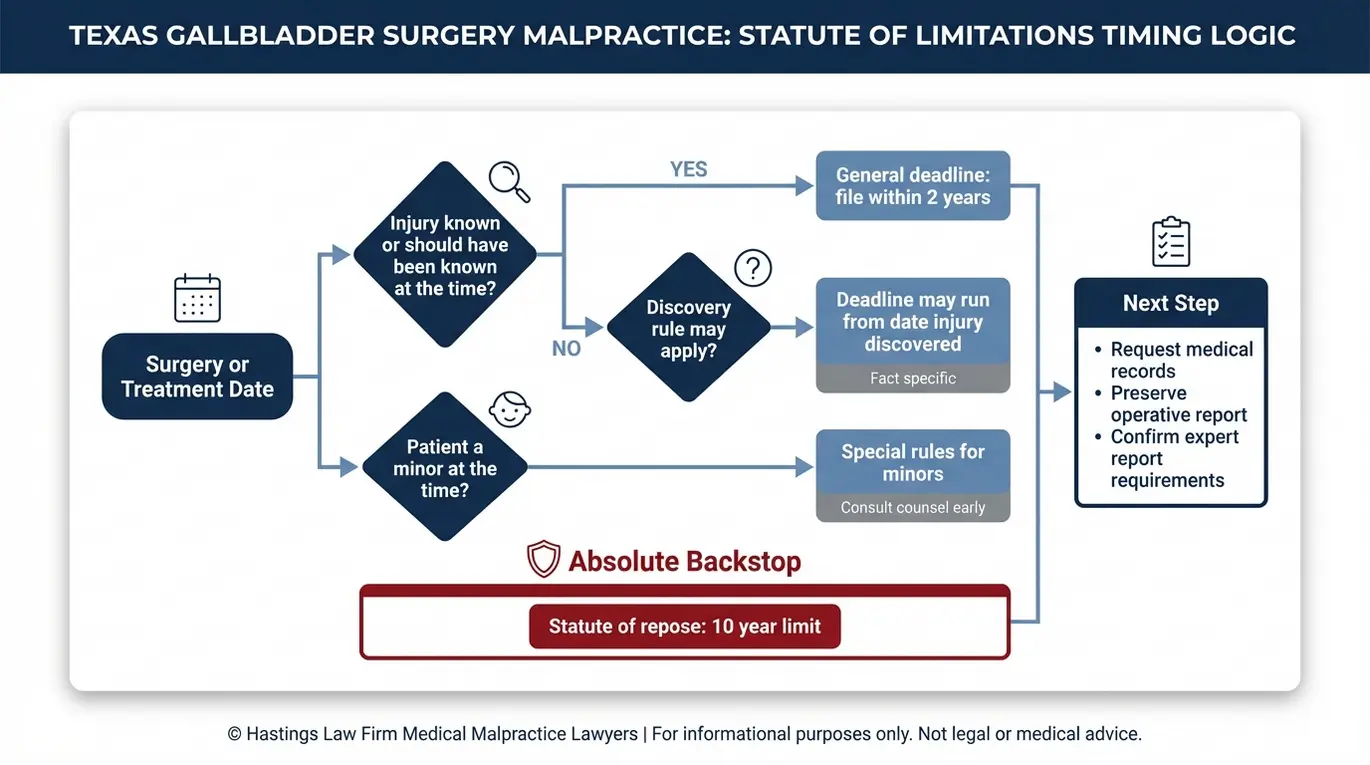
In Texas, patients generally have two years from the date of the surgical error to file a medical malpractice lawsuit, though exceptions exist for minors or cases where the injury could not have been immediately discovered. Missing this deadline almost always means losing the right to pursue a claim, regardless of how strong the evidence may be.
Under the Texas Civil Practice and Remedies Code, Section 74.251, the two-year statute of limitations clock typically starts on the date of the negligent act. However, if the injury was not immediately apparent, such as a bile duct injury that only manifests weeks later, the “discovery rule” may adjust when the clock begins.
Texas also imposes a 10-year statute of repose, which is an absolute deadline that bars claims filed more than 10 years after the date of the error, even if the injury was discovered later. Special rules apply for minor children, extending the filing window in pediatric cases. Filing a valid claim requires an expert report early in the process to proceed.
Because the timeline for legal representation for surgery errors is strict, early evaluation of your case is critical.
Contact the Texas Surgical Error Attorneys at Hastings Law Firm Today for Help
If a gallbladder surgery left you or a family member with injuries that should not have happened, you deserve answers. At Hastings Law Firm, our mission is to restore the trust that was broken and hold negligent providers accountable so this does not happen to someone else.
Our team, led by Board Certified trial attorney Tommy Hastings, includes in-house nurse consultants and former defense attorneys who know exactly how to investigate surgical error claims. We prepare every case as if it will go to trial, and that preparation gives us the leverage to pursue the full value of your claim.
As a Texas gallbladder surgery error lawyer, we handle cases on a contingency fee basis, meaning you pay no attorney fees unless we secure a recovery. Your consultation is free and confidential. Our Texas surgical error attorneys are ready to fight for you.
Contact Hastings Law Firm today for a risk-free case evaluation. Let us help you find the answers you deserve.
Frequently Asked Questions About Gallbladder Surgery Error in Texas


This content was researched and written by the Hastings Law Firm editorial team, which includes attorneys, medical professionals, and experienced researchers. Our writing is informed by internal knowledge and practical experience, and we cross-check critical details against authoritative sources cited throughout. Every piece undergoes human-led fact-checking and legal review. Because legal and medical information can change, if you spot an error, please contact us. Learn more about our content standards and review process on our editorial policy page.

Brady D. Williams is a nationally recognized medical malpractice attorney who has spent his career handling high-stakes litigation for injured patients and families across the country. Licensed in both Texas and California, Brady draws on experience from hundreds of resolved medical cases to break down complex legal and medical topics for the people who need that information most. His writing reflects the same attention to detail and commitment to clarity that he brings to every case he handles.
