


Texas Refractive Surgeon Malpractice Lawyer
Refractive surgery such as LASIK or PRK can improve vision, but preventable errors can leave patients with lasting vision problems and chronic pain. The difference between an expected complication and negligence often turns on screening, laser calibration, sterile technique, and whether meaningful risks were explained before surgery. When care falls below the medical standard, the impact can extend to work, driving, and emotional well being. If you or a loved one were harmed or worse due to refractive surgeon malpractice in Texas, contact Hastings Law Firm for a free, confidential case review.

Last Updated: July 27, 2026
Trusted Legal Representation for Healthcare Negligence in Texas
When you trust a surgeon with your eyesight, you expect skill, honesty, and careful judgment. If a refractive procedure like LASIK (Laser-Assisted in Situ Keratomileusis) or PRK (Photorefractive Keratectomy) has left you with worsened vision or chronic pain instead of the clear sight you were promised, the confusion and frustration you feel right now is completely understandable.
Not every complication means something went wrong. But when a surgeon cuts corners on screening, uses incorrect laser settings, or fails to explain real risks, the outcome may cross the line from known risk into preventable harm. Sorting out what happened, and whether negligence played a role, requires both medical knowledge and legal experience working together.
As a Texas refractive surgeon malpractice lawyer team, Hastings Law Firm focuses exclusively on medical malpractice. If you or a loved one has been harmed by a vision correction procedure, we can review what happened and explain your options in a free, confidential consultation.

Common Errors and Complications in Refractive Surgery
Refractive surgery malpractice occurs when a surgeon deviates from the standard of care, resulting in preventable injuries such as corneal ectasia, detached flaps, or severe infection. Refractive procedures like LASIK and PRK reshape the cornea to correct vision. These surgeries use laser technology to change how the eye focuses light. The distinction between a known risk and actionable negligence is one of the important questions Texas refractive surgery malpractice attorneys help answer.
Every surgical procedure carries some degree of risk. Temporary dry eye, mild glare, or short-term visual fluctuations after LASIK or PRK are generally considered known possibilities that should resolve with proper follow-up care. A study published in PubMed Central on patient-reported outcomes following topography-guided LASIK documented these expected recovery patterns.
Negligence is different. It involves specific, preventable failures during the procedure itself or in the care surrounding it. These can include:
| Known Surgical Risks | Red-Flag Errors (Potential Negligence) |
|---|---|
| Temporary dry eye that improves over weeks | Chronic, severe dry eye from improper candidate screening |
| Mild glare or halos during early healing | Persistent starbursts, double vision, or halos from incorrect laser calibration |
| Minor under-correction requiring enhancement | Significant over-correction or under-correction from wrong settings |
| Brief discomfort during recovery | Infectious keratitis, a serious post-operative infection, from failed sterile technique |
| Slight corneal flap irritation | Corneal flap dislocation or incomplete flap creation from equipment malfunction |
A corneal flap is the thin layer of tissue a surgeon creates and lifts during LASIK to reshape the underlying cornea. When equipment fails or a surgeon applies incorrect technique, that flap can be cut unevenly, torn, or left improperly repositioned, leading to permanent visual disturbances or vision loss.
The consequences of these errors extend beyond blurry vision. Patients may experience chronic pain, an inability to drive at night, job loss, and lasting emotional distress. A refractive surgeon malpractice lawyer in Texas can help determine whether what you experienced falls within expected outcomes or reflects a failure in care.

Proving Negligence and Screening Failures
To prove negligence, a plaintiff must demonstrate that the surgeon failed to properly screen the patient for contraindications or performed the surgery below the accepted medical standard of care. Contraindications are medical conditions that make a specific treatment or surgery risky for a patient. Negligence in vision correction involves failing to meet medical standards. Many of these cases begin not in the operating room, but in the exam that should have happened before surgery was ever scheduled.
A significant portion of refractive surgery claims stem from inadequate pre-operative screening. Certain patients are simply not safe candidates for LASIK or PRK. Conditions and risk factors, often highlighted by FDA guidelines, that should disqualify a patient include:
- Thin corneas that cannot safely withstand tissue removal
- Keratoconus, a progressive thinning and bulging of the cornea that LASIK can dramatically worsen
- Severe dry eye disease
- Autoimmune disorders that impair healing
- Unstable refractive prescriptions (changing myopia, hyperopia, or astigmatism)
- Large pupil size relative to the treatment zone
Keratoconus deserves particular attention. When a surgeon fails to detect early-stage keratoconus before performing LASIK, the procedure can trigger corneal ectasia, a post-surgical bulging and weakening of the cornea that may cause progressive, irreversible vision loss. Corneal topography and pachymetry, imaging and thickness measurements of the cornea, are standard tools that an ophthalmologist should use to identify these risks before clearing a patient for surgery.
The standard of care in these cases is established through expert testimony. Under Texas Civil Practice and Remedies Code, Chapter 74, a qualified ophthalmologist must review the case and provide a sworn report confirming that the treating surgeon’s actions fell below what a competent peer would have done under the same circumstances. A medical malpractice lawyer handling refractive surgery cases builds the medical foundation of the case around this expert analysis.
As a Texas refractive surgeon malpractice lawyer team, we work with nationally recognized eye care specialists to evaluate whether proper screening protocols were followed and whether the decision to operate was medically justified.

The Hastings Law Firm Difference
Results matter, but what truly sets us apart is how we achieve them. Every verdict, every settlement, and every Texas courtroom victory comes from one guiding promise: To treat each client’s fight for justice as if it were our own.
This balance of skill, experience, and empathy reflects our core philosophy that justice should not only compensate the injured, but also make health care safer nationwide.

Informed Consent and Corporate Liability in Texas
In Texas, physicians have a non-delegable duty to obtain informed consent, meaning they cannot rely solely on generic waivers or staff members to explain the severe risks of vision correction procedures. This requirement ensures doctors explain all significant risks before treatment.
Signing a consent form does not give a surgeon the right to be negligent. Patients deserve fair compensation when care standards are breached, whether the result is permanent vision loss or, in rare anesthesia-related cases, wrongful death.
If surgeons minimized the risks of dry eye disease or higher-order aberrations, the consent process may have been defective. Higher-order aberrations are visual distortions like starbursts that standard glasses cannot correct. A Texas malpractice lawyer for eye surgery can evaluate whether the information provided to you was adequate under the law.
Recent legislative developments, including Texas House Bill 923, reflect the ongoing focus on patient safety standards in Texas healthcare settings. Data from the Agency for Healthcare Research and Quality (HCUP) also highlights the systemic nature of adverse events originating within clinical facilities.
Deceptive Marketing and FDA Warnings
High-volume corporate eye centers may rely on deceptive marketing or bait-and-switch tactics that downplay risks or ignore FDA safety communications about refractive surgery complications. When marketing materials contradict known risks, or when volume-driven scheduling leads to rushed evaluations, liability can extend beyond the individual surgeon to the corporate entity operating the facility. This pattern of prioritizing throughput over individualized patient assessment is something we specifically examine in our investigations.
Investigating Your Claim with Medical Precision
Our firm conducts a comprehensive investigation using former defense attorneys and medical experts to uncover charting inconsistencies and equipment logs that prove surgical error. Our entire team focuses exclusively on medical malpractice litigation, which allows us to provide specialized insight into complex vision correction claims. Our medical-legal review identifies errors in surgical technique or post-operative care.
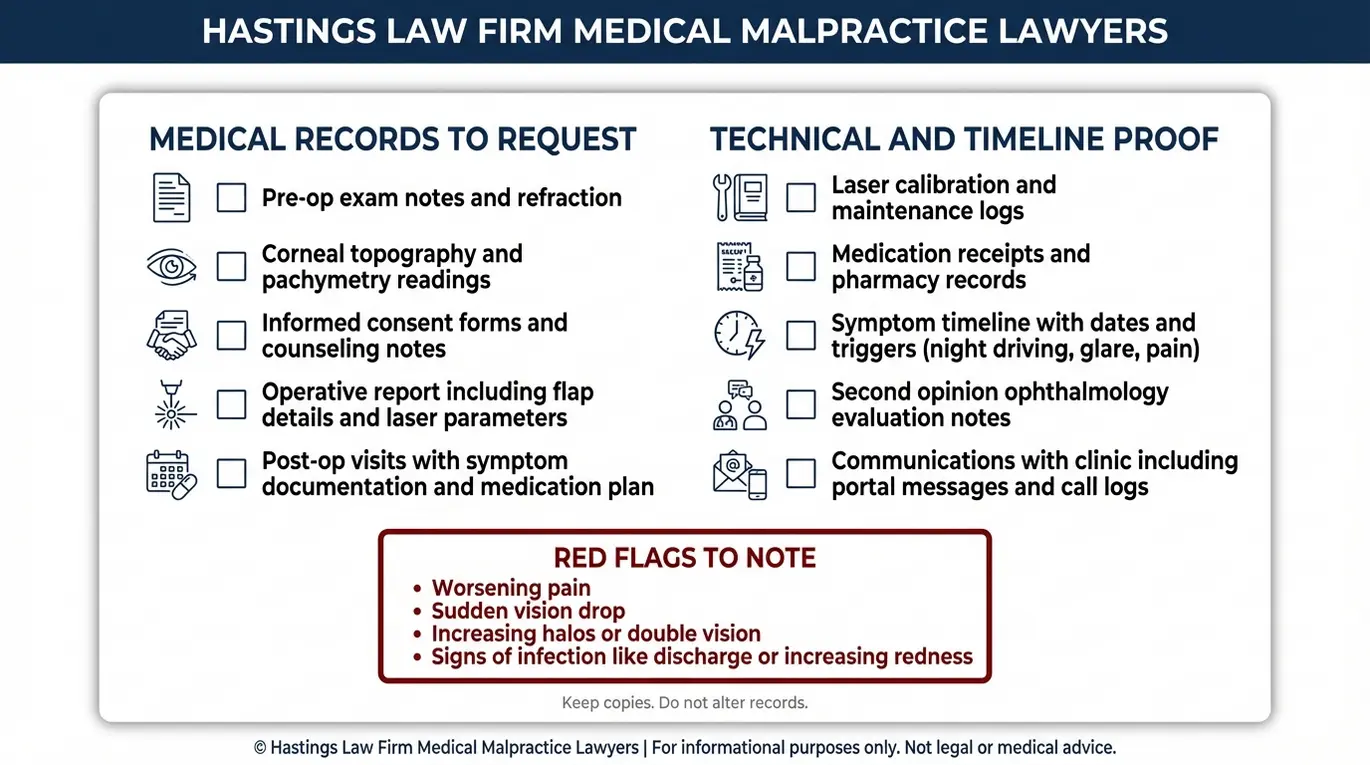
The process starts with a free, confidential case evaluation led by a Board Certified Patient Advocate. During this initial review, our medical legal team gathers your medical records, operative reports, and any marketing materials you received from the surgical center. Under HIPAA regulations outlined by the U.S. Department of Health and Human Services, you have the right to obtain complete copies of your medical records.
From there, our former defense counsel, attorneys who previously represented hospitals and physicians, review the case with an eye toward the strategies insurance companies for eye surgeons typically use to deny claims. The legal team includes former defense attorneys and experienced hospital nurses who previously worked for the systems they now challenge. Our in-house nursing staff analyzes corneal topography readings (surface mapping), pachymetry data (thickness measurements), and surgical device calibration records to identify exactly where the breakdown in care occurred.
Founder Tommy Hastings is Board Certified in Personal Injury Trial Law by the Texas Board of Legal Specialization, a credential held by less than 2% of Texas lawyers. This background supports our ability to prepare every claim from day one as if it will go to a jury.
The goal is full compensation for corrective surgeries, lost wages, pain and suffering, and loss of enjoyment of life. As a lawyer for refractive surgeon malpractice cases, we prepare every claim from day one as if it will go to a jury.
Contact the Texas Surgical Error Attorneys at Hastings Law Firm Today for Help
Vision loss caused by a preventable surgical error affects every part of your daily life, from your ability to work to the simple act of reading a book or recognizing a face across the room. You deserve answers about what happened and whether the care you received met the standard it should have.
Hastings Law Firm represents patients and families harmed by medical negligence across Texas, with offices in The Woodlands, Houston, Dallas, and Austin. Our team of attorneys, nurse consultants, and medical experts is ready to evaluate your refractive surgery case with the precision and care it requires.
We operate on a contingency fee basis, which means you pay no attorney fees or costs unless we secure a recovery for you. If you or a loved one has suffered harm from LASIK, PRK, or another vision correction procedure, contact us today for a free, confidential consultation. Let us help you find the answers you deserve.
Frequently Asked Questions About Refractive Surgeon Malpractice in Texas


This content was researched and written by the Hastings Law Firm editorial team, which includes attorneys, medical professionals, and experienced researchers. Our writing is informed by internal knowledge and practical experience, and we cross-check critical details against authoritative sources cited throughout. Every piece undergoes human-led fact-checking and legal review. Because legal and medical information can change, if you spot an error, please contact us. Learn more about our content standards and review process on our editorial policy page.

Brady D. Williams is a nationally recognized medical malpractice attorney who has spent his career handling high-stakes litigation for injured patients and families across the country. Licensed in both Texas and California, Brady draws on experience from hundreds of resolved medical cases to break down complex legal and medical topics for the people who need that information most. His writing reflects the same attention to detail and commitment to clarity that he brings to every case he handles.
