


Texas Postoperative Malpractice Lawyer
Postoperative malpractice involves preventable harm that happens when recovery care after surgery falls below the accepted standard of care. Missed warning signs, delayed treatment, and inadequate monitoring can allow a treatable problem to escalate into a life threatening emergency or worse. A key issue is separating an expected surgical risk from a failure to recognize and respond to clinical changes that should have prompted action. Accountability can matter for safety, recovery, and long term stability after a serious complication. If you or a loved one were harmed or worse due to postoperative malpractice in Texas, contact Hastings Law Firm for a free, confidential case review.

Last Updated: July 27, 2026
Trusted Legal Representation for Post-Surgical Negligence in Texas
Surgery is only part of the process. What happens in the hours and days after a procedure can determine whether a patient heals or suffers preventable harm. When postoperative care falls short, whether through missed warning signs, delayed treatment, or inadequate monitoring, the consequences can be severe and lasting.
If you or a loved one experienced a serious complication after surgery that you believe should have been caught and treated sooner, you are not wrong to ask questions. Holding medical providers to account is not an act of hostility; it is a reasonable response to a breakdown in the care you were owed.
As a Texas postoperative malpractice lawyer, Hastings Law Firm focuses exclusively on medical malpractice. Our team of attorneys, nurse consultants, and medical staff can review what happened and explain your legal options during a free, confidential consultation.

Understanding Postoperative Malpractice and the Standard of Care
Postoperative malpractice occurs when medical staff fail to adhere to the accepted standard of care during a patient’s recovery, resulting in preventable harm such as untreated infections or undetected internal bleeding. Not every complication after surgery is the result of negligence, but when a treatable problem goes unrecognized or unaddressed because of careless monitoring, the line between a known risk and medical malpractice becomes clear.
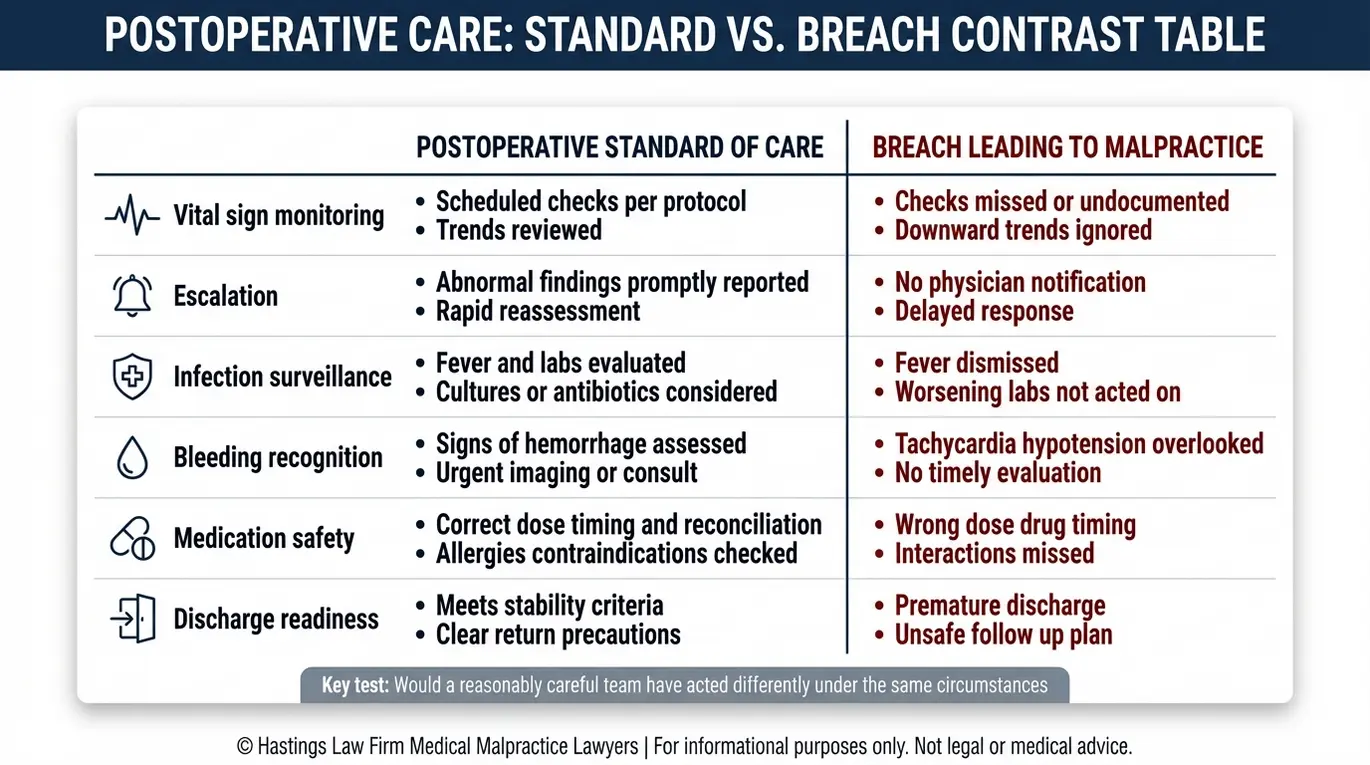
The standard of care is the level of treatment a reasonably competent medical professional would provide under similar circumstances. In the postoperative setting, this standard typically involves post-operative monitoring, the regular tracking of vital signs like blood pressure, heart rate, oxygen saturation, and temperature. Vital sign trends, or the direction those readings move over time, often reveal problems long before a patient visibly deteriorates.
When a nurse or physician fails to check these signs at appropriate intervals, or checks them but does not act on concerning changes, that failure can constitute a breach of the standard of care. For example, a steadily dropping blood pressure after abdominal surgery may signal internal bleeding. If no one responds to that trend, what might have been a manageable complication can escalate into a life-threatening emergency. Failure to meet these standards often constitutes hospital negligence.
A distinction exists between a bad outcome and actual postoperative negligence. Surgery carries inherent risks, and some complications can occur even when every provider does everything right. The legal question is whether the medical team identified and responded to it the way a competent provider should have. Texas law, including provisions of the Texas Health and Safety Code and related regulations, establishes standards that reinforce a hospital’s duty of care to its patients.
As a Texas postoperative malpractice lawyer, our role is to examine whether the care provided met that standard or fell short of it. That analysis requires both legal skill and deep medical knowledge, which is why our team includes in-house nurses and medical professionals who know how to read the clinical record with trained eyes.
Common Examples of Post-Surgical Negligence in Texas Hospitals
Common forms of post-surgical negligence include failure to monitor vital signs, ignoring symptoms of sepsis or hemorrhage, medication errors during recovery, and premature discharge before the patient is stable. These breakdowns in post-operative care can take many forms, but they share a common thread: a treatable condition was present, and no one acted on it in time.
Infections and Sepsis. Surgical site infections are among the most well-documented postoperative complications. Healthcare-Associated Infection reports published by the CDC indicate these infections remain a persistent threat. Signs like fever, elevated white blood cell count, or wound breakdown require immediate evaluation. Failure to respond can allow a localized infection to progress into sepsis, a systemic and potentially fatal condition.
Hemorrhage and Internal Bleeding. After certain surgeries, internal bleeding can develop without any visible external signs. Symptoms of shock, such as rapid heart rate, dropping blood pressure, confusion, or pale skin, are clinical red flags that trained staff must act on immediately. If those signs are missed or dismissed, the delay can lead to organ damage, stroke, or death.
Deep Vein Thrombosis and Pulmonary Embolism. Blood clots are a known risk after surgery, especially in patients with limited mobility. Deep vein thrombosis (DVT) can form in the legs and, if left undetected, travel to the lungs as a pulmonary embolism. Symptoms like leg pain, swelling, or sudden shortness of breath should trigger diagnostic testing. When staff fail to assess for DVT or administer preventive measures, that failure to diagnose a preventable condition can amount to negligence.
Compartment Syndrome. This condition occurs when pressure builds within a muscle compartment, restricting blood flow and potentially causing permanent tissue damage. A patient reporting severe, disproportionate pain after an orthopedic procedure may be presenting with compartment syndrome. Ignoring that complaint or attributing it to normal postoperative discomfort can result in limb loss.
Medication Errors. Medication errors during recovery, which include administering the wrong drug, wrong dose, or wrong timing, can interfere with healing or cause entirely new injuries. A medication administration record (MAR), the document that tracks what medications were given and when, is often a key piece of evidence in these cases.
Premature Discharge. Premature discharge, the release of a patient before they meet appropriate discharge criteria, can lead to rapid deterioration at home. Releasing a patient too early without adequate follow-up instructions or monitoring is a dangerous oversight.
Clinical Red Flags and Emergency Mechanisms
Each of these postoperative complications produces warning signs that trained medical professionals should be able to identify. The following table outlines common postoperative complications and the failures in care that can transform them from manageable risks into serious injuries.
| Condition | Negligent Action or Failure |
|---|---|
| Sepsis / Surgical Site Infection | Failure to monitor temperature, white blood cell count, or wound appearance |
| Internal Bleeding / Hemorrhage | Failure to respond to signs of shock (dropping blood pressure, elevated heart rate) |
| Deep Vein Thrombosis (DVT) | Failure to assess for leg swelling or pain; failure to order prophylactic treatment |
| Pulmonary Embolism | Failure to evaluate sudden shortness of breath or chest pain |
| Compartment Syndrome | Dismissing disproportionate pain complaints as normal post-surgical discomfort |
| Medication Errors | Administering incorrect drug, dose, or timing during recovery |
When these red flags appear and no one initiates an escalation of care, the structured process for alerting more senior staff or specialists to a deteriorating patient, a preventable injury may result. A postoperative malpractice lawyer examines whether the clinical team followed the protocols designed to catch these exact problems.
The Hastings Law Firm Difference
Results matter, but what truly sets us apart is how we achieve them. Every verdict, every settlement, and every Texas courtroom victory comes from one guiding promise: To treat each client’s fight for justice as if it were our own.
This balance of skill, experience, and empathy reflects our core philosophy that justice should not only compensate the injured, but also make health care safer nationwide.

Determining Liability Between Surgeons and Nursing Staff
Liability often depends on who had the duty to monitor; surgeons are responsible for the procedure itself, while hospital nurses are typically liable for failing to track vital signs or alert the physician to changes in the patient’s condition. Understanding where one provider’s responsibility ends and another’s begins is essential in any Texas postoperative malpractice case.
Key responsibilities typically divide as follows:
- Surgeons: Performing the operation, setting the initial post-operative plan, and responding to escalated complications.
- Nurses: Monitoring vital signs, administering medications, documenting patient status, and alerting physicians to clinical red flags.
In some situations, a legal concept known as the “Captain of the Ship” doctrine may apply. This legal theory addresses how responsibility is shared in the operating room. Under this theory, the surgeon retains overall authority and responsibility for a patient’s care during and immediately following a procedure. When this doctrine applies, the surgeon may be held liable even for errors made by other team members under their direction. Modern Texas courts often recognize that nurses have independent duties.
This shift means the hospital can be held directly liable for nursing failures, separate from the surgeon’s liability. In many cases, the hospital itself bears responsibility for the actions of its nursing staff. Nursing negligence can include failure to follow physician orders, failure to document vital signs in nursing notes, or failure to escalate concerns up the chain of command when a patient’s condition worsens.
If a nurse notices a concerning change but does not notify the attending physician, or if a nurse fails to check on a patient at required intervals, the hospital may face a medical negligence claim. Repeated failures in these areas may indicate systemic hospital negligence.
Premature discharge from a hospital also raises important liability questions. If a patient is sent home before meeting recognized discharge criteria and suffers a preventable complication, the question becomes who made that decision and whether it was clinically justified. Resources like the Hospital Quality Initiative maintained by CMS track hospital performance metrics that can shed light on institutional patterns of care. Our team, which includes former defense attorneys who previously represented hospitals, understands how facilities assign and sometimes deflect responsibility.
Proving Breach of Care With Medical Evidence
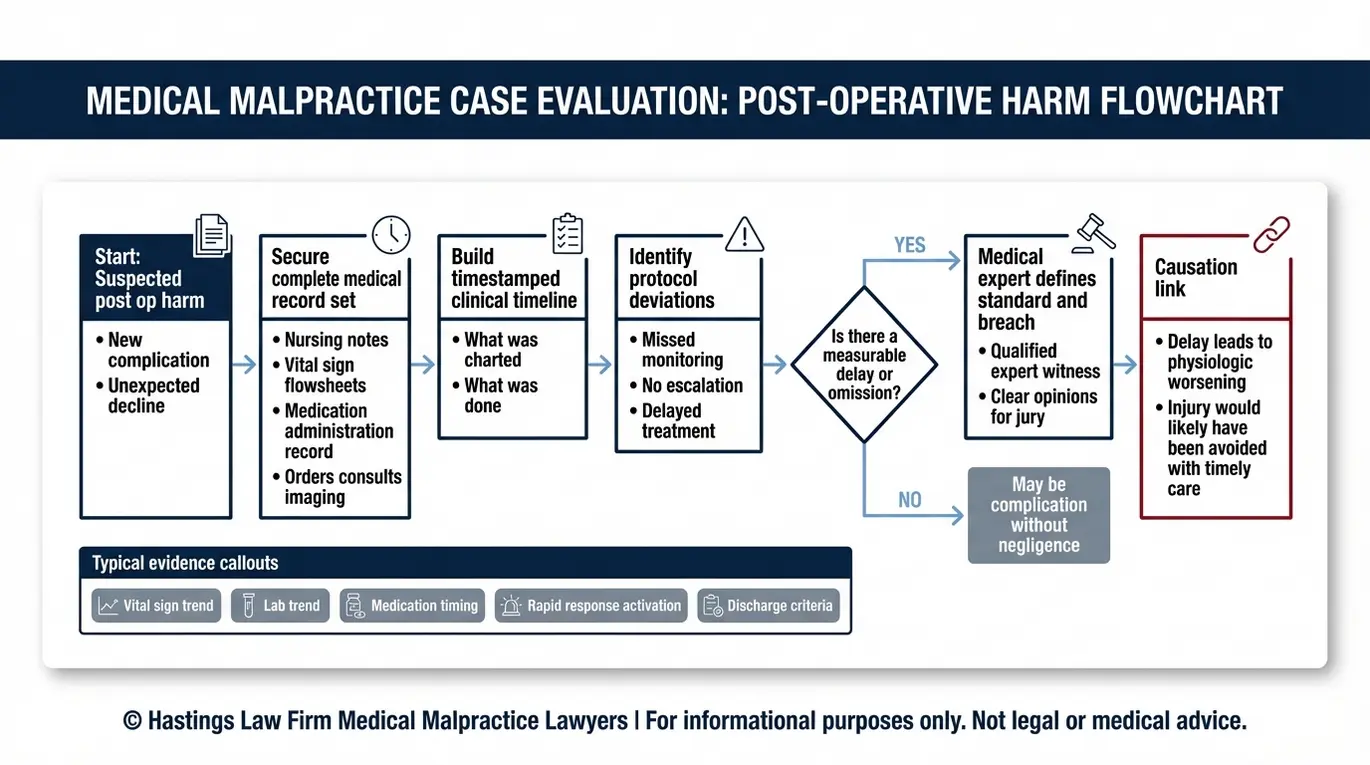
To prove a breach of care, your attorney must secure medical records that show a deviation from protocols and retain qualified medical experts to testify that a competent provider would have acted differently under similar circumstances. Building a strong postoperative malpractice case depends on connecting the documentary evidence to a clear violation of the standard of care.
The first step is obtaining the complete medical chart. This includes physician orders, nursing notes, lab results, imaging reports, and the medication administration record (MAR). The MAR is the log tracking every drug given to the patient, at what dose, and at what time. Gaps or inconsistencies in these documents can reveal where monitoring broke down. Our in-house medical staff reviews these records line by line, reconstructing a timeline of the patient’s postoperative course.
Causation is the second critical element. It is not enough to show that a provider made a mistake. We must also demonstrate that the mistake directly caused the patient’s injury.
For example, if a patient developed internal bleeding after surgery and the nursing staff failed to act on signs of hemorrhage for several hours, we work with medical experts to establish whether earlier intervention would have prevented the resulting harm. This element of the case is often the most contested. Defense experts will claim the outcome was inevitable, regardless of the delay. We use distinct medical timelines to prove otherwise.
Expert witness testimony is required in Texas medical malpractice cases. A qualified expert must explain to the jury what the standard of care required in that specific clinical situation and how the provider’s actions fell short. Our firm maintains a national network of top-tier medical experts across specialties who provide credible testimony grounded in current clinical practice.
Distinguishing Known Risks vs. Actionable Negligence
In medical malpractice cases, defense attorneys frequently argue that the patient’s injury was simply a known surgical risk. This argument is designed to reframe preventable injury as an unavoidable outcome. As a Texas postoperative malpractice lawyer, we counter this by showing that the negligence was not the complication itself, but the failure to identify and treat it.
A blood clot after surgery may be one of the known surgical risks. Ignoring the symptoms of that blood clot for hours is not a risk; it is a failure to treat a recognized and preventable condition.
Immediate Steps After Suspecting Postoperative Negligence
If you suspect negligence, immediately seek a second medical opinion to stabilize your health, request a full copy of your medical records before they can be altered, and contact a specialized malpractice attorney to preserve evidence. Time is a factor in both your recovery and in preserving the evidence needed to evaluate a potential claim.
Here is what we recommend:
- Seek a second medical opinion. Your health comes first. If you believe your postoperative care was inadequate, go to a different hospital or see another specialist. Getting stabilized and properly evaluated is the top priority.
- Request your complete medical records. Ask for a full copy of your hospital records, including nursing notes, lab results, and medication logs. Requesting these records promptly matters because entries can be amended or supplemented over time, and having an early copy helps preserve the integrity of the data.
- Start a personal journal. Document your symptoms, pain levels, and any conversations with medical staff, including dates and times. A personal journal serves as a contemporaneous record. By documenting your pain levels and the exact times you requested help, you create a timeline that can later be compared against the medical chart to find discrepancies.
- Contact a Texas postoperative malpractice lawyer. Consulting with a medical malpractice attorney allows you to understand whether what happened may have been negligent. Timing matters here because, under Texas Civil Practice and Remedies Code Chapter 74, there are specific procedural requirements and a statute of limitations that apply to medical malpractice claims. Waiting too long can jeopardize your ability to file.
At Hastings Law Firm, our initial evaluation is free and confidential, led by a patient advocate who can help you understand what your medical records show and whether your experience warrants further investigation.

Why Choose Hastings Law Firm for Your Recovery
Hastings Law Firm offers a unique advantage by combining the expertise of board-certified trial attorneys with in-house medical staff, ensuring every case is litigated with both legal aggression and medical precision.
We focus exclusively on medical malpractice. We do not take car accidents, slip-and-fall cases, or general personal injury matters.
Every member of our team, from our attorneys to our in-house nurse practitioners and board-certified patient advocates, is dedicated to one thing: holding negligent medical providers accountable. Our founder, Tommy Hastings, is board certified in Personal Injury Trial Law by the Texas Board of Legal Specialization, a distinction held by fewer than 2% of Texas attorneys. He was also inducted into the American Board of Trial Advocates (ABOTA) in 2025, an invitation-only organization for experienced trial lawyers.
What sets our approach apart is the combination of legal and medical expertise on every case. Our team includes former defense attorneys who know how hospitals and insurers build their arguments, and experienced nurses who can identify charting inconsistencies that others might miss. We fight to maximize your compensation, including recovery for lost wages and non-economic damages like pain and suffering.
We believe medical malpractice work is about more than financial recovery. It is about finding the truth, restoring trust, and preventing the same failures from harming someone else.
Contact the Texas Surgical Error Attorneys at Hastings Law Firm Today for Help
Post-surgical errors caused by inadequate monitoring, delayed treatment, or failures in follow-up care can leave patients and families dealing with consequences that never should have happened. If you or a loved one suffered a serious complication after surgery and you believe the medical team failed to provide proper postoperative care, you deserve answers.
Hastings Law Firm is ready to review your case and help you understand what went wrong. Our consultations are free and confidential, and we do not charge attorney fees or costs unless we recover compensation on your behalf. Call us today or complete our online form to speak with a patient advocate. Let us help you take the first step toward accountability and answers.
Frequently Asked Questions About Postoperative Malpractice in Texas


This content was researched and written by the Hastings Law Firm editorial team, which includes attorneys, medical professionals, and experienced researchers. Our writing is informed by internal knowledge and practical experience, and we cross-check critical details against authoritative sources cited throughout. Every piece undergoes human-led fact-checking and legal review. Because legal and medical information can change, if you spot an error, please contact us. Learn more about our content standards and review process on our editorial policy page.

Gabe Sassin has focused exclusively on medical malpractice law since 2007. After spending more than a decade as a malpractice defense attorney, he knows exactly how the other side works. He has seen firsthand how healthcare providers, insurers, corporate defendants, and their legal teams think, prepare, and build their defense against claims. That knowledge works for the people who need it most today, injured patients and their families. His unique experience shapes everything he writes, giving readers a look at how these cases actually work from someone who has handled them from both sides.
