


Texas Colorectal Surgeon Malpractice Lawyer
Colorectal surgery can carry serious risks, but preventable mistakes can turn a procedure into a life changing injury. The content addresses common colorectal surgical errors, how missed warning signs after surgery can escalate into severe infection or worse, and why the response to complications often determines whether negligence is involved. It also describes how standard of care issues are evaluated and the types of losses that may follow, including long term impairment and financial strain. If you or a loved one were harmed or worse due to colorectal surgeon malpractice in Texas, contact Hastings Law Firm for a free, confidential case review.

Last Updated: July 27, 2026
Trial-Ready Texas Attorneys for Colorectal Surgical Injuries
When a surgery meant to help you heal instead leaves you facing unexpected complications, the experience can feel isolating and overwhelming. Colorectal procedures carry real risks. When a preventable error leads to a life-altering outcome like an unplanned colostomy or sepsis, you deserve to know whether negligence caused your surgical injuries. A colostomy is a surgical opening in the abdomen to reroute the bowel. Sepsis is a dangerous, life-threatening condition in which the body’s response to an infection causes widespread organ dysfunction.
At Hastings Law Firm, we focus exclusively on medical malpractice. Our team includes in-house nurses, former defense attorneys, and board-certified trial lawyers who understand both the medicine and the law behind these cases. As a Texas colorectal surgeon malpractice lawyer team, we know how to identify surgical errors that other firms may overlook.
If you or a loved one suffered a serious complication after colon or rectal surgery, we can review what happened and explain your options at no cost.

Common Errors Committed by Colorectal Surgeons
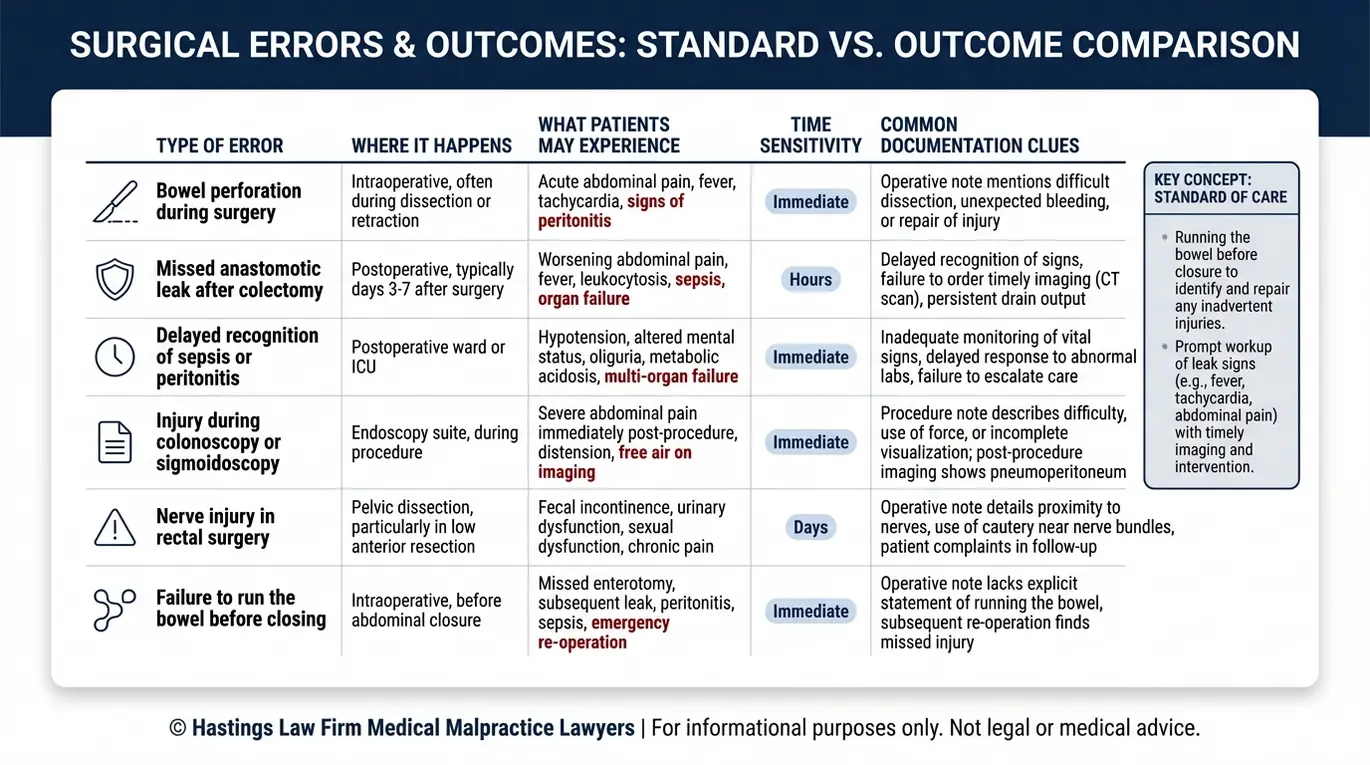
Colorectal surgical errors most frequently involve inadvertent bowel perforations, failure to detect post-operative leaks, and nerve damage that results in loss of function. Colorectal surgery involves procedures on the colon, rectum, and anus to treat various conditions. These are not minor complications. Suing a colorectal surgeon may be necessary when these errors are left unaddressed and become life-threatening.
Bowel Perforation and Its Consequences
A bowel perforation, sometimes called a perforated colon, is a hole or tear in the wall of the intestine. This bowel injury can happen during procedures on the colon or rectum performed by a proctologist, including diagnostic exams like a colonoscopy or sigmoidoscopy. If the perforation is not identified and repaired promptly, intestinal contents can leak into the abdominal cavity and cause peritonitis (a severe infection of the abdominal lining) or sepsis. Both conditions require emergency intervention and can be fatal.
Anastomotic Leak After Bowel Resection
During a colectomy or bowel resection, the surgeon removes a section of diseased intestine and reconnects the remaining ends. An anastomotic leak, which is a failure at the reconnection site that allows intestinal contents to escape, is one of the most serious post-surgical complications. When a surgeon or surgical team fails to recognize the signs of a leak in time, the patient may develop a widespread infection requiring additional emergency surgery.
Injuries During Diagnostic Procedures
Even routine screening procedures carry risk when performed negligently. Experienced colorectal surgeon malpractice attorneys often see cases where a colonoscopy used to identify polyps or screen for colorectal cancer results in a perforated colon because the scope is advanced with excessive force. These injuries may not become apparent until hours after discharge. Consulting a lawyer for colorectal surgery errors is appropriate when a diagnostic procedure leads to an emergency hospital admission.
A PubMed Central review of overlooked long-term complications of colorectal surgery shows many post-surgical injuries extend far beyond the initial recovery period. These complications can affect quality of life for years.
| Type of Surgical Error | How It Occurs | Potential Patient Consequence |
|---|---|---|
| Bowel perforation | Instrument punctures intestinal wall during surgery or colonoscopy | Peritonitis, sepsis, emergency surgery |
| Anastomotic leak | Reconnection site fails after colectomy or bowel resection | Infection, additional surgery, possible colostomy |
| Nerve damage | Dissection near pelvic nerves during rectal surgery | Urinary or sexual dysfunction |
| Undetected post-operative infection | Failure to monitor or recognize signs of post-surgical infection | Sepsis, organ failure, death |
| Missed perforation during colonoscopy | Scope advanced with excessive force or careless polyp removal | Delayed diagnosis of injury, peritonitis |
If you believe a surgical error caused your injury, speaking with a Texas colorectal surgeon malpractice lawyer can help clarify whether what happened to you falls outside the bounds of acceptable care.
The Procedural Duty to Run the Bowel
One of the most critical steps in abdominal and colorectal surgery is a practice known as “running the bowel.” This means the surgeon manually inspects the entire length of the intestine before closing the incision to check for nicks, burns, or perforations that may have occurred during the procedure.
This step is a recognized standard of care. When a surgeon skips or rushes through this inspection, a small injury to the bowel wall can go undetected. The patient is then closed up and sent to recovery with an active perforation that may lead to a serious, even fatal, infection within hours or days.
A failure in running the bowel is a common basis for establishing liability in surgical error cases. Operative reports and nursing documentation often reveal whether this step was performed, and if so, how thoroughly. When suing a colorectal surgeon, this is one of the first things our medical team examines.
Proving Negligence in Colon and Rectal Surgery Claims
Proving negligence requires demonstrating that the surgeon deviated from the accepted medical standard of care, directly causing an injury that was not simply an inherent risk of the procedure.
The standard of care for a colorectal surgeon, also referred to as a proctologist (a specialist in diseases and surgery of the colon, rectum, and anus), is defined by what a reasonably competent specialist with similar training would have done under the same circumstances. This is not a general standard. It is specific to the surgeon’s specialty, the procedure performed, and the clinical context.
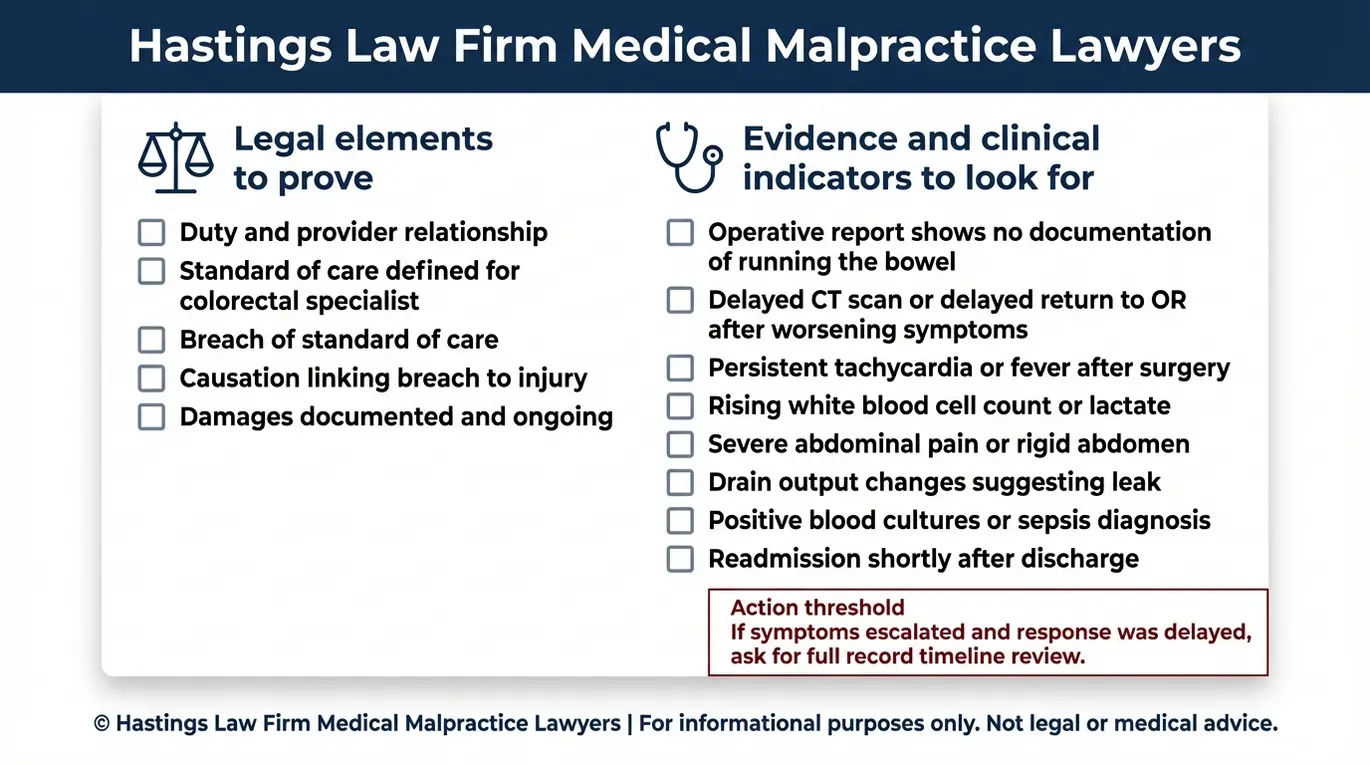
A colorectal surgeon negligence lawyer builds the case around four core elements:
- Duty: The surgeon had a professional obligation to treat the patient according to accepted standards.
- Breach: The surgeon’s actions fell below that standard (e.g., failing to inspect the bowel, causing a misdiagnosis or delayed diagnosis of polyps or colorectal cancer, or not ordering appropriate imaging).
- Causation: The breach directly caused the patient’s injury. For example, a missed anastomotic leak led to peritonitis, the infection and inflammation of the abdominal lining that would not have occurred with timely detection. A study published in Gavin Publishers examined early predictive markers for anastomotic leakage, reinforcing that timely detection is both possible and expected.
- Damages: The patient suffered measurable harm, whether physical, financial, or emotional.
Expert witness testimony is essential to this process. Texas law requires a qualified medical expert, typically another colorectal surgeon, to review the case and confirm that the standard of care was violated and that the violation caused the injury. Without this testimony, the claim cannot move forward.
Finding legal help for surgeon malpractice allows you to work with attorneys who connect the clinical evidence to the legal elements of the claim. This includes analyzing operative reports, pathology results, post-operative vitals, and imaging studies to build a clear causation timeline.
Distinguishing Inherent Risk vs Actionable Negligence
Not every complication is medical malpractice. Colon and rectal surgeries carry known risks, and patients typically sign informed consent documents acknowledging those risks before the procedure.
The distinction lies in what happens after the complication arises. A bowel perforation during surgery, while unfortunate, may fall within the range of accepted risks. But if the surgical team fails to identify the perforation during the procedure, or ignores post-operative warning signs like fever, rising white blood cell counts, or worsening abdominal pain, the focus shifts from inherent risk to potential liability.
A colorectal surgeon negligence lawyer evaluates whether the complication itself was avoidable and, just as important, whether the response to the complication met the expected standard. A delayed response to a post-surgical infection can turn a manageable problem into a catastrophic one.
The Hastings Law Firm Difference
Results matter, but what truly sets us apart is how we achieve them. Every verdict, every settlement, and every Texas courtroom victory comes from one guiding promise: To treat each client’s fight for justice as if it were our own.
This balance of skill, experience, and empathy reflects our core philosophy that justice should not only compensate the injured, but also make health care safer nationwide.

How Our Medical Malpractice Team Investigates Surgical Errors
Our team begins every investigation by securing all operative reports, anesthesia records, and nursing notes, then uses our in-house medical staff to reconstruct the surgery and identify deviations from safety protocols to establish liability.
Here is how the process works:
- Free case screening: A patient advocate conducts an initial, confidential evaluation to determine whether the facts suggest a potential deviation from the standard of care. There is no cost and no obligation.
- Medical record review: Our in-house nurses and Board Certified Patient Advocates examine the full medical records. Because several members of our team previously worked in hospital defense, they know exactly where to look for charting inconsistencies, missing documentation, and gaps in the surgical timeline.
- Expert consultation: We work with a national network of expert witness specialists, including colorectal surgeons, to provide independent opinions on whether the care was appropriate.
- Trial-ready preparation: From the moment we accept a case, we prepare it as if it is going to a jury. A Texas surgical malpractice lawyer on our team develops detailed medical timelines, secures expert reports, and builds the evidence needed to hold the responsible parties accountable. This level of preparation signals to defense attorneys and insurers that an attorney for rectal surgery negligence will not accept less than a fair outcome.
As a colorectal surgeon malpractice lawyer team with former defense counsel on staff, we understand how the other side thinks, and we use that knowledge to anticipate and counter their arguments early.

Compensation for Injuries Caused by Colorectal Surgery Negligence
Patients harmed by colorectal negligence may recover economic damages for medical bills and lost wages, as well as non-economic damages for pain, suffering, and physical impairment.
Economic damages cover the direct financial costs of the injury, including:
- Corrective and revision surgeries
- Extended hospital stays and emergency treatment
- Ostomy equipment and supplies (which, as outlined by Medicare’s coverage guidelines for ostomy supplies, can represent an ongoing lifetime expense)
- Lost income during recovery or permanent disability
- Future medical care, including follow-up procedures and rehabilitation
Non-economic damages account for the harm that does not come with a receipt: physical pain, emotional distress, mental anguish, loss of enjoyment of life, and disfigurement.
In cases where a surgical error leads to fatal sepsis or organ failure, surviving family members may pursue a wrongful death claim to recover both economic losses and the emotional devastation of losing a loved one.
A Texas colorectal surgeon malpractice lawyer can help you understand the full scope of damages in colorectal malpractice available based on your specific situation.
Long Term Impact Including Sexual and Urinary Dysfunction
Rectal and lower colon surgeries carry a unique risk that many generalist attorneys overlook: damage to the pelvic autonomic nerves, the nerves responsible for bladder control and sexual function. When these nerves are injured during dissection, the consequences can be a permanent impairment.
Patients may also develop low anterior resection syndrome (LARS), a cluster of symptoms including bowel urgency, incontinence, and unpredictable bowel habits that can persist for years after surgery. These conditions profoundly affect quality of life, personal relationships, and the ability to work or participate in daily activities.
These non-economic damages are real, significant, and recoverable. They deserve to be thoroughly documented and presented by a legal team that understands their medical basis and their impact on the patient’s life.
Contact the Texas Surgical Error Attorneys at Hastings Law Firm Today for Help
If you or a family member suffered a serious injury after colon or rectal surgery, you do not have to face this alone. Hastings Law Firm was built by founder Tommy Hastings, a board-certified trial lawyer with over 20 years of experience who has been recognized as a Texas Super Lawyer since 2013. We restore trust for patients who have been let down by the healthcare system and hold negligent providers accountable.
Our Texas colorectal surgeon malpractice law firm handles these cases on a contingency fee basis, which means you pay no attorney fees or costs unless we recover compensation for you.
We welcome you to contact our offices in The Woodlands, Houston, Dallas, or Austin for a free, confidential case evaluation. Let us review your records, answer your questions, and help you understand what happened and what comes next.
Frequently Asked Questions About Colorectal Surgeon Malpractice in Texas


This content was researched and written by the Hastings Law Firm editorial team, which includes attorneys, medical professionals, and experienced researchers. Our writing is informed by internal knowledge and practical experience, and we cross-check critical details against authoritative sources cited throughout. Every piece undergoes human-led fact-checking and legal review. Because legal and medical information can change, if you spot an error, please contact us. Learn more about our content standards and review process on our editorial policy page.

Gabe Sassin has focused exclusively on medical malpractice law since 2007. After spending more than a decade as a malpractice defense attorney, he knows exactly how the other side works. He has seen firsthand how healthcare providers, insurers, corporate defendants, and their legal teams think, prepare, and build their defense against claims. That knowledge works for the people who need it most today, injured patients and their families. His unique experience shapes everything he writes, giving readers a look at how these cases actually work from someone who has handled them from both sides.
