


Texas Transplant Surgeon Malpractice Lawyer
Written by: Hastings Law Firm | Reviewed by: Gabe Sassin | Updated: July 27, 2026
Organ transplant negligence can leave families struggling with grief, confusion, and a sense that a trusted system failed at the worst moment. These cases may involve surgical mistakes during implantation, failures in post operative monitoring, or improper changes to waiting list data that keep a patient from receiving an organ offer. Federal oversight and strict safety protocols can make the facts hard to untangle, especially when key details live in electronic records. If you or a loved one were harmed or worse due to transplant surgeon malpractice in Texas, contact Hastings Law Firm for a free, confidential case review.

Trusted Representation for Transplant Patient Negligence in Texas
What You Should Know About Organ Transplant Negligence Claims in Texas:
- Life altering harm can result when transplant programs manipulate waiting list data or commit surgical errors during a transplant.
- Access to an organ offer can be effectively blocked when listing criteria are set so narrowly that no realistic donor match will ever appear.
- Options can narrow when key transplant evidence is lost, since electronic records may be overwritten or become difficult to retrieve through routine system operations.
- Institutional accountability can become a central issue when federal investigations identify systemic problems that lead to transplant program closure.
- Recovery can include compensation tied to an unsuccessful transplant or a transplant that never occurred, including medical expenses and pain and suffering.
- Recovery can differ depending on whether the patient survived or whether the claim involves wrongful death or a survival action.
- Financial recovery for non economic harm can be limited under Texas damage caps, even when the underlying injury is severe.
- Proof disputes can turn on whether UNOS database entries were altered or backdated, since accurate reporting is treated as part of the standard of care.
- Patient safety failures can be indicated by missing timeout documentation or proceeding despite incompatibility testing concerns.
- Record integrity can be clarified by EHR audit trails that show who accessed or changed data and when those changes occurred.

A Healthcare Focused Law Firm
When someone you love needed a life-saving organ transplant and the system failed them, the grief can feel compounded by confusion and a deep sense of betrayal. Whether the failure involved surgical errors during the transplant itself or irregularities in how your family member was managed on the waiting list, you deserve to know what happened and why.
Transplant cases sit at the intersection of highly specialized surgery and federal regulatory oversight, making them some of the most complex claims in medical malpractice. As Texas transplant surgeon malpractice lawyers, Tommy Hastings and our team focus exclusively on holding negligent medical providers accountable. Our in-house medical staff and national network of transplant specialists allow us to investigate these cases with the depth they demand.
If your family has questions about a transplant outcome or waiting list decision that doesn’t add up, we can review what happened and explain your options in a free, confidential consultation.
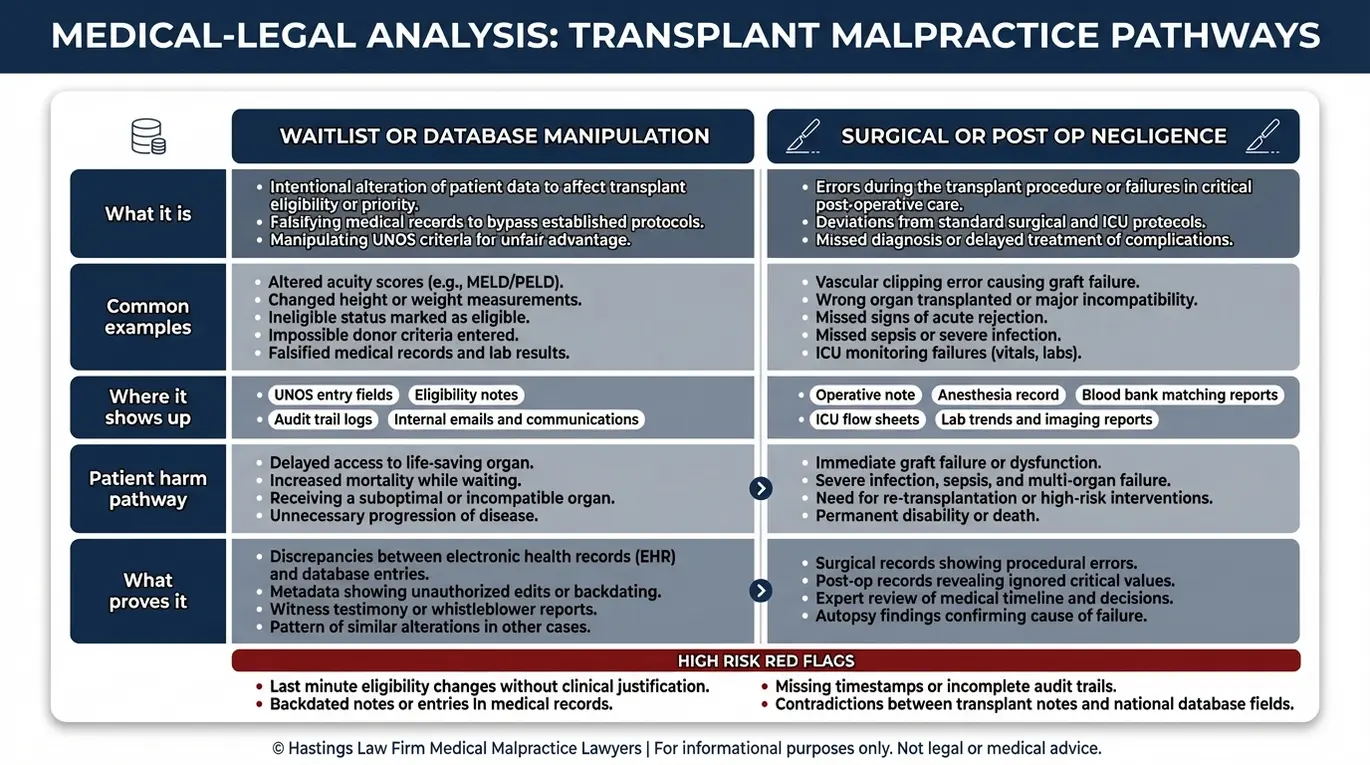
Allegations of Transplant List Manipulation and Surgical Negligence
Transplant malpractice occurs when a surgeon or hospital staff deviates from the standard of care, either through surgical errors during the procedure or administrative fraud that improperly prevents a patient from receiving an organ. These cases have drawn national attention in recent years as federal investigations have led to transplant program closure or uncovered programs where patient data may have been altered within government databases, and where surgical outcomes have raised serious questions about program integrity.
In some cases, investigations have revealed that transplant programs entered falsified medical records into the system to make patients appear ineligible for donor organs. In others, the concern centers on errors made during the surgery itself, or failures in post-operative monitoring. We evaluate both the administrative and clinical dimensions of what went wrong.
The types of actionable negligence in transplant cases generally fall into distinct categories:
- Database and waitlist fraud: Manipulating patient data such as weight, height, or acuity scores within the transplant waiting list to make a candidate appear ineligible for care. This list is a federally managed queue that ranks candidates for donor organs based on medical urgency and compatibility. The acuity score, often measured for liver transplant candidates by a system called the MELD score (Model for End-Stage Liver Disease), directly affects a patient’s ranking. Altering these numbers can effectively remove a patient from consideration for a kidney transplant, liver transplant, or heart transplant without their knowledge.
- Surgical error: Mistakes during the implantation or organ harvesting phase, including vascular clipping errors, damage to surrounding structures, or mishandling of the donor organ.
- Post-operative failure: Failure to monitor for signs of organ rejection, infection, or other complications in the ICU following transplant surgery.
Impossible Donor Criteria as a Mechanism of Fraud
One specific tactic that has emerged in recent investigations involves the entry of impossible donor criteria, which are acceptance parameters for a patient that could never realistically be met. For example, entering criteria that would only match a toddler-sized organ for a large adult patient. The practical effect is that the system never generates an organ offer for that candidate, even though the patient remains technically “on the list.”
This can amount to a form of shadow removal from the transplant waiting list. The patient and their family may believe they are actively waiting for a match through the United Network for Organ Sharing (UNOS). In reality, the eligibility parameters have been set so narrowly that no offer will ever come. We investigate whether a patient’s listing criteria were clinically appropriate or whether they were designed to ensure no organ was ever offered.
The Standard of Care Regarding UNOS Protocols and Surgical Safety
Transplant surgeons must follow strict protocols established by the United Network for Organ Sharing (UNOS), the federally mandated organization that manages the national organ allocation system, for waitlist management, along with the Universal Protocol for surgical safety, to prevent harm that should never occur in a properly run program.
The Universal Protocol is a set of patient safety standards designed to prevent “never events,” such as surgery on the wrong patient or site. These obligations cover both the administrative and surgical sides of transplant medicine. We examine whether the hospital and its surgeons met these duties at every stage.
Administrative duties require transplant programs to maintain accurate, truthful records within the national organ allocation system. Federal regulation under 42 CFR § 121.11 mandates that transplant centers report and maintain complete, timely records on every candidate, including clinical status, listing criteria, and outcomes. Falsifying or manipulating these entries violates both the regulatory standard and the medical standard of care owed to the patient.
Surgical duties include performing a “timeout,” a structured verification pause before the transplant begins, to confirm donor-recipient compatibility. This includes verifying blood type, tissue matching, and crossmatch test results, a laboratory test that checks whether the recipient’s blood will react against the donor organ. Skipping or rushing through this verification is a recognized sentinel event, which is a patient safety incident serious enough to warrant immediate investigation.
Regulatory oversight through HHS investigations can trigger formal findings of negligence or program closure. When the federal government identifies systemic problems at a transplant center, those findings can support a malpractice claim by establishing that the standard of care was breached at an institutional level.
A Texas transplant injury attorney looks for warning signs that these obligations were not met, including:
- Patient listing criteria that do not match actual clinical measurements
- Missing or incomplete timeout documentation before surgery
- An ABO mismatch, which is a never event that should not happen in a safe program
- Altered or backdated entries in the UNOS database
- Failure to act on crossmatch results showing incompatibility
- Gaps in post-operative monitoring documentation
Universal Protocol Failures in Transplant Surgery
The Universal Protocol consists of surgical safety standards used to confirm the correct patient and procedure. Never events in transplant surgery include implanting the wrong organ, transplanting an organ with known ABO incompatibility, or proceeding without proper verification of donor-recipient matching. An ABO mismatch, a situation where a patient receives an organ with an incompatible blood type, is an automatic breach of the standard of care because the Universal Protocol exists specifically to prevent it.
When a patient suffers medical negligence of this magnitude, the consequences can include acute organ failure, emergency re-operation, or wrongful death. Each of these failures leaves a clear trail in the medical records that our team knows how to identify and preserve.

The Hastings Law Firm Difference
Results matter, but what truly sets us apart is how we achieve them. Every verdict, every settlement, and every Texas courtroom victory comes from one guiding promise: To treat each client’s fight for justice as if it were our own.
This balance of skill, experience, and empathy reflects our core philosophy that justice should not only compensate the injured, but also make healthcare safer nationwide.

Investigating Systemic Fraud and Preserving Electronic Evidence
Securing evidence in transplant fraud cases requires immediate legal action to prevent hospitals from altering electronic medical records or deleting internal communications once scrutiny begins.
Transplant cases present a unique challenge because so much of the critical evidence exists in electronic form. The UNet system, the UNOS transplant database used to manage organ allocation, and the hospital’s own electronic health records both contain EHR audit trails. These are automatic logs that record who accessed, modified, or entered data and exactly when those changes were made. These audit trails are essential because they can reveal whether a patient’s listing criteria were changed after the fact or whether records were altered once an internal investigation started.
Acting quickly is necessary to protect electronic evidence. Once a hospital becomes aware of potential legal exposure or a federal inquiry, internal processes may lead to data being overwritten, archived, or otherwise made difficult to retrieve. This is not about assuming bad intent; it is about recognizing that electronic systems have retention policies, and critical evidence can be lost simply through routine operations if no one intervenes.
Under 45 CFR § 164.524, patients and their representatives have a right to access their protected health information. We build on that right by using formal discovery tools and expert testimony from forensic data analysts to reconstruct the complete record.
Using Restraining Orders to Preserve Medical Records
One of the most effective legal tools in transplant negligence cases is the Temporary Restraining Order (TRO). By filing a TRO, our attorneys can compel a hospital to freeze its servers and preserve all emails, database entries, and internal communications related to the transplant program. This prevents the destruction of evidence and ensures evidence preservation regarding waitlist management decisions, putting the facility on legal notice that records must remain intact. At Hastings Law Firm, our team of former defense attorneys understands exactly what data hospitals maintain internally and where to look for discrepancies, because they once managed those same systems from the other side.

Damages Recoverable for Wasted Gifts and Wrongful Death
Families may recover compensatory damages for medical expenses, pain and suffering, and in certain cases, damages related to the loss of a donated organ when negligence rendered the transplant unsuccessful or prevented it from happening at all.
The specific damages available depend on whether the patient survived the negligence or whether the family is pursuing a wrongful death claim. We evaluate the full scope of harm, which can include:
- Survival actions: Compensation for the pain, suffering, and medical costs the patient endured from the point of medical negligence until death. This includes the physical toll of acute rejection, the body’s immune response attacking a transplanted organ, or graft failure, also called primary non-function, a condition where the transplanted organ never begins working properly.
- Wrongful death claims: Recovery for the family’s loss of companionship, emotional support, and financial stability resulting from the death. Organ transplant cases often involve patients who, with proper care, had meaningful survival rates ahead of them.
- The “wasted gift” dimension: In cases where a viable donor organ was lost due to surgical error or improper matching, families and donor families may suffer a distinct emotional harm. The gift of life, freely given, was rendered meaningless by preventable negligence. While Texas law frames this through recognized damage categories, the emotional weight of a wasted organ is something juries understand.
Contact the Texas Surgical Error Attorneys at Hastings Law Firm Today for Help
If someone you love died while waiting for an organ they should have received, or suffered a preventable surgical error during transplant, what happened may be actionable medical malpractice. These cases demand a team that understands both the medicine and the federal regulatory framework governing transplant programs.
Tommy Hastings, who is Board Certified in Personal Injury Trial Law by the Texas Board of Legal Specialization, and the attorneys at Hastings Law Firm have the medical-legal resources to investigate a hospital’s internal records, audit trails, and UNOS data to find the truth. Our in-house nursing staff and national network of transplant medicine experts allow us to evaluate what went wrong and build the evidence from day one.
As a Texas transplant malpractice lawyer, Tommy and our team are prepared to act quickly to preserve records and protect your family’s rights. Contact Hastings Law Firm for a free, confidential case evaluation. You pay no fees unless we recover compensation on your behalf.
Frequently Asked Questions About Transplant Surgeon Malpractice in Texas


This content was researched and written by the Hastings Law Firm editorial team, which includes attorneys, medical professionals, and experienced researchers. Our writing is informed by internal knowledge and practical experience, and we cross-check critical details against authoritative sources cited throughout. Every piece undergoes human-led fact-checking and legal review. Because legal and medical information can change, if you spot an error, please contact us. Learn more about our content standards and review process on our editorial policy page.

Gabe Sassin has focused exclusively on medical malpractice law since 2007. After spending more than a decade as a malpractice defense attorney, he knows exactly how the other side works. He has seen firsthand how healthcare providers, insurers, corporate defendants, and their legal teams think, prepare, and build their defense against claims. That knowledge works for the people who need it most today, injured patients and their families. His unique experience shapes everything he writes, giving readers a look at how these cases actually work from someone who has handled them from both sides.
