


Texas Thoracic Surgeon Malpractice Lawyer
Written by: Hastings Law Firm | Reviewed by: Gabe Sassin | Updated: July 27, 2026
Thoracic and cardiothoracic surgery carries serious risk, but some injuries happen because of preventable errors rather than unavoidable complications. Surgical mistakes, retained objects, anesthesia problems, and missed postoperative complications can turn a treatable condition into lasting harm, and the difference between a known risk and negligence often depends on whether the outcome was preventable through reasonable care. Medical records and risk modeling may help clarify what happened and why. If you or a loved one were harmed or worse due to thoracic surgeon malpractice in Texas, contact Hastings Law Firm for a free, confidential case review.
Trusted Legal Representation for Cardiothoracic Procedure Errors in Texas
What You Should Know About Chest & Lung Surgery Negligence Claims in Texas:
- Life altering injury or death can follow thoracic surgery when a preventable deviation from accepted medical standards occurs.
- Accountability can be disputed because not every poor outcome is negligence and some complications are known risks even with flawless care.
- Severe outcomes can result when postoperative complications are not identified and treated in time, including sepsis and organ failure.
- Catastrophic harm can follow anesthesia mistakes during thoracic procedures, including brain injury and cardiac arrest.
- Clear options can narrow when Texas procedural requirements are missed, since failure to provide required expert support can lead to dismissal.
- Recovery for non economic harm can be limited in Texas, since state law caps certain damages even when injuries are severe.
- Economic losses can remain fully claimable in Texas, since medical bills and lost wages are not capped under state law.
- Hospital responsibility can be uncertain, since liability may depend on credentialing failures or the surgeon employment relationship.
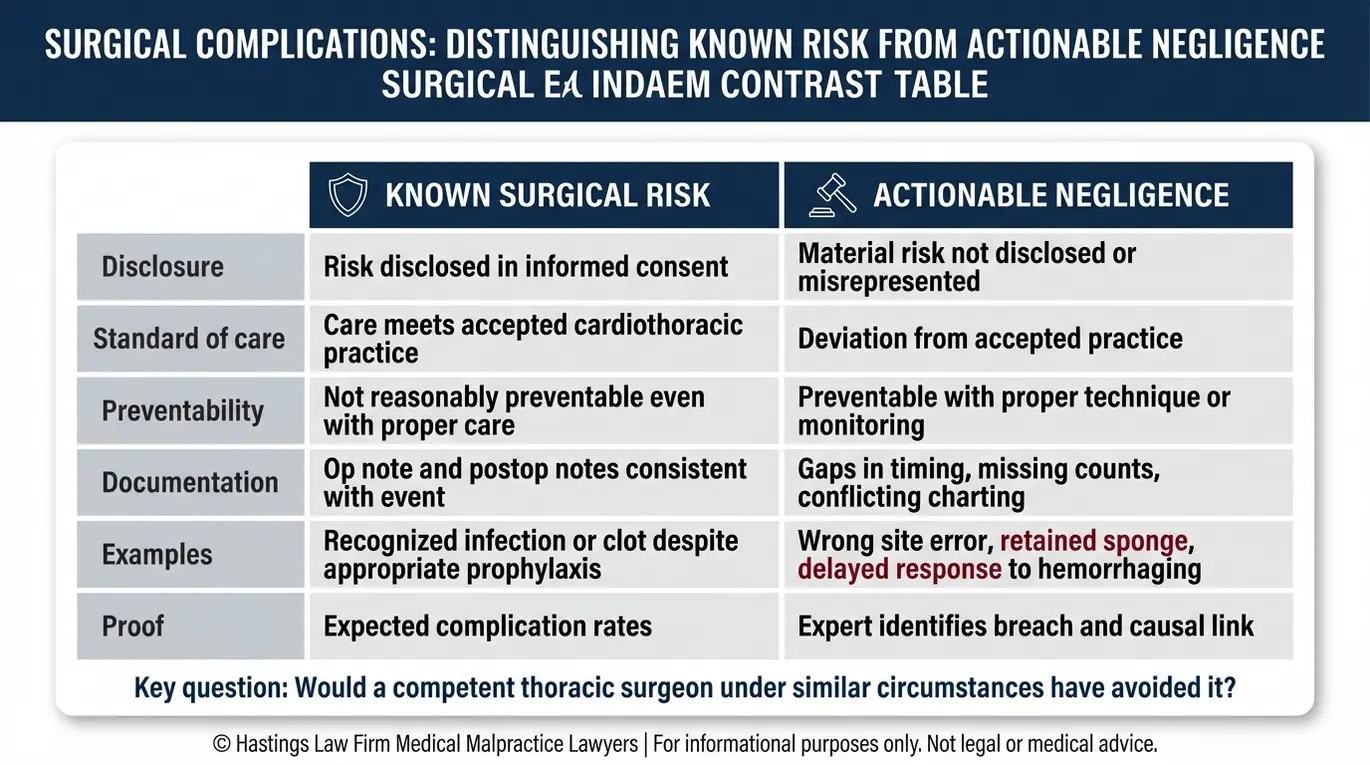
- Clarity about what went wrong can depend on documentation, since distinct trails may appear in operative reports, anesthesia records, and nursing notes.
- Outlier outcomes can raise concerns beyond baseline risk, since risk modeling like the STS Risk Calculator compares expected results to actual results.

A Healthcare Focused Law Firm
Thoracic surgery, which includes procedures on the heart, lungs, esophagus, and other structures within the chest, carries significant risk even under the best circumstances. When a surgeon’s error during coronary artery bypass grafting, a heart valve repair, or an esectomy turns a treatable condition into a life-altering injury, the consequences can be devastating.
If you or a loved one suffered unexpected harm after a cardiothoracic procedure, you may be questioning whether what happened was truly unavoidable. That question deserves a clear, honest answer. As a Texas thoracic surgeon malpractice lawyer, Hastings Law Firm focuses exclusively on medical malpractice cases and has the medical and legal resources to evaluate what went wrong. Contact us for a free, confidential case review so we can explain your options.
Common Errors Committed by Thoracic Surgeons
Thoracic surgical errors often involve preventable mistakes such as operating on the wrong site, accidentally nicking nearby arteries or nerves, leaving foreign objects inside the chest cavity, or failing to manage postoperative hemorrhaging effectively. These errors can occur during some of the most complex procedures in medicine, including coronary artery bypass grafting (CABG), lung cancer resections, and esophageal cancer surgeries.
Not every poor outcome means negligence occurred. But certain patterns of error appear repeatedly in thoracic surgery malpractice cases. A thoracic surgery malpractice attorney evaluates whether the harm was caused by a preventable deviation from accepted medical standards.
The most common categories of error include:
- Surgical precision failures. During procedures like CABG or valve replacement, the surgeon may accidentally lacerate the aorta, damage the esophagus, or cause a phrenic nerve injury, damage to the nerve that controls the diaphragm and allows you to breathe. A phrenic nerve injury can result in partial or complete diaphragm paralysis, leading to chronic breathing difficulty.
- Retained surgical objects. Sponges, needles, or instruments left inside the chest cavity after surgery are classified as retained surgical objects (RSOs), meaning any surgical item unintentionally left in a patient’s body after a procedure. The medical community widely recognizes RSOs as “never events,” preventable incidents that should not occur under any circumstances. Research published by PubMed Central on retained surgical objects supports the position that these events are preventable and that technology-assisted counting protocols can significantly reduce their occurrence.
- Postoperative negligence. After an esophageal or lung resection (the removal of diseased tissue from the lung), patients require close monitoring for internal bleeding, infection, and anastomotic leaks. Anastomotic leaks are failures at a surgical connection point where two structures have been joined. Failure to identify and treat these complications in time can lead to sepsis, organ failure, or death.
- Anesthesia errors. Incorrect dosing, failure to monitor airway function during thoracic procedures, or inadequate management of one-lung ventilation can cause brain injury, cardiac arrest, or other serious harm. One-lung ventilation is a technique where the anesthesiologist collapses one lung to provide better surgical access to the chest cavity.
Each of these errors leaves a distinct trail in the medical records. Our team, which includes in-house nurse consultants and former defense attorneys, knows exactly where to look.
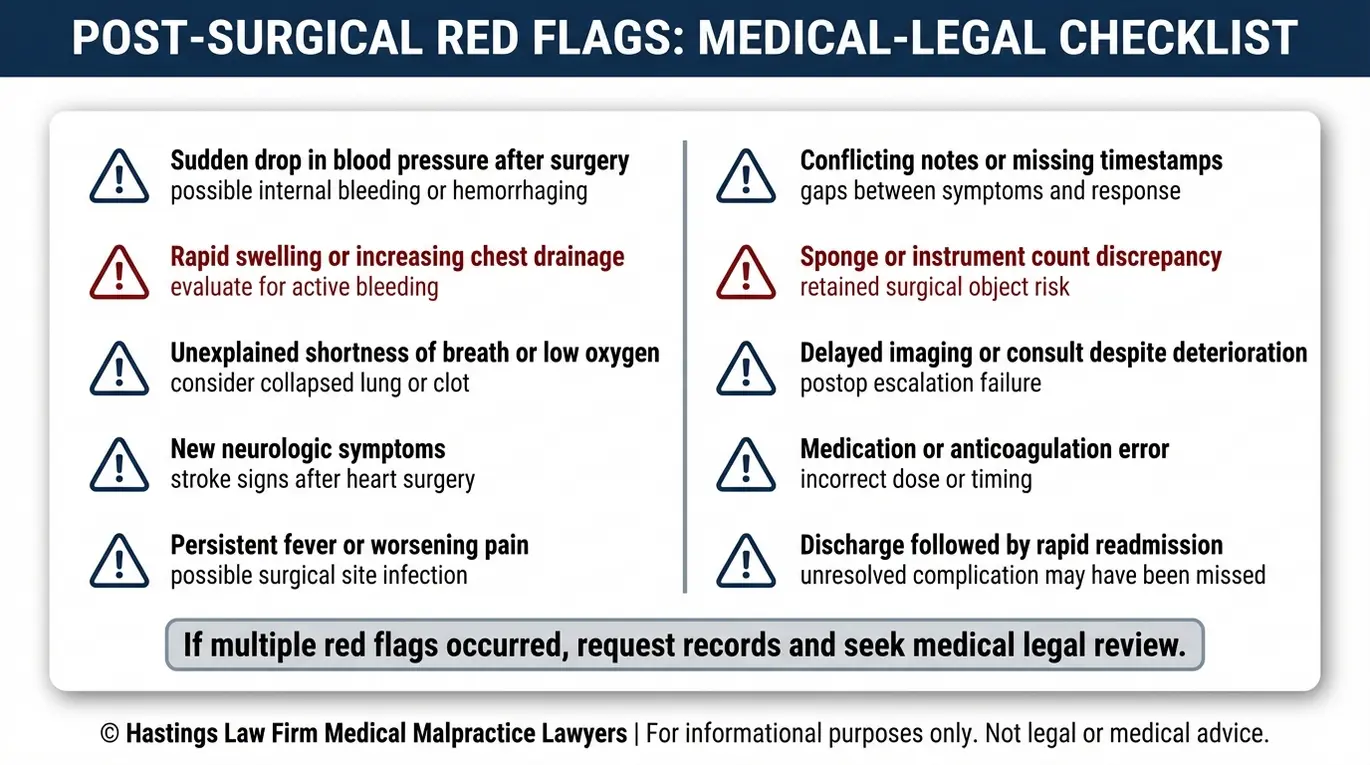
Distinguishing Between Surgical Risks and Actionable Negligence
Medical malpractice exists when a surgeon deviates from the accepted standard of care, meaning a competent surgeon under similar circumstances would not have made the same error. This is legally distinct from a “known risk” that the patient understood and accepted before the procedure.
Every cardiothoracic surgery carries inherent risks. Blood clots, stroke, infection, and postoperative hemorrhage (significant bleeding after surgery) are known complications that can occur even when the surgeon performs flawlessly. Before your procedure, you likely signed an informed consent form listing these possibilities.
According to the U.S. Department of Health and Human Services informed consent guidance, proper informed consent requires that patients receive clear disclosure of material risks before agreeing to treatment. The standard of care requires doctors to follow specific protocols to minimize these risks.
The legal question is not simply whether a bad outcome occurred. It is whether the specific outcome was caused by something the surgeon did, or failed to do, that fell below the standard of care. A Texas thoracic malpractice lawyer examines whether the complication was one the patient consented to, or whether it resulted from a preventable error that was never part of the disclosed risk.
An anastomotic leak, for example (a failure at a surgical connection point, such as where the remaining esophagus is reattached after a resection), can be a known risk. But if the leak occurred because the surgeon used improper technique or failed to test the connection before closing, that shifts from accepted risk to potential negligence. The distinction often comes down to whether the harm was preventable through reasonable care.
Utilizing the STS Risk Calculator to Establish Liability
One of the tools we use to evaluate cardiothoracic surgery cases is the Society of Thoracic Surgeons (STS) Risk Calculator, a statistical model that predicts a patient’s expected risk of complications and mortality based on their individual health profile. The STS National Database collects outcomes data from thousands of cardiothoracic programs nationwide.
Risk-adjusted mortality, a comparison of a patient’s actual outcome against what would statistically be expected given their age, health, and procedure type, can be powerful evidence in medical malpractice litigation. If a patient’s outcome falls significantly outside the predicted range of risk, it may suggest that something beyond the patient’s underlying condition contributed to the harm. This statistical model helps our legal team determine if a complication was a known risk or a likely result of negligence.
Our medical experts use this data alongside a full expert review to build a clear picture of what happened and why.
The Hastings Law Firm Difference
Results matter, but what truly sets us apart is how we achieve them. Every verdict, every settlement, and every Texas courtroom victory comes from one guiding promise: To treat each client’s fight for justice as if it were our own.
This balance of skill, experience, and empathy reflects our core philosophy that justice should not only compensate the injured, but also make healthcare safer nationwide.

Proving Causation in Complex Chest and Lung Surgery Cases
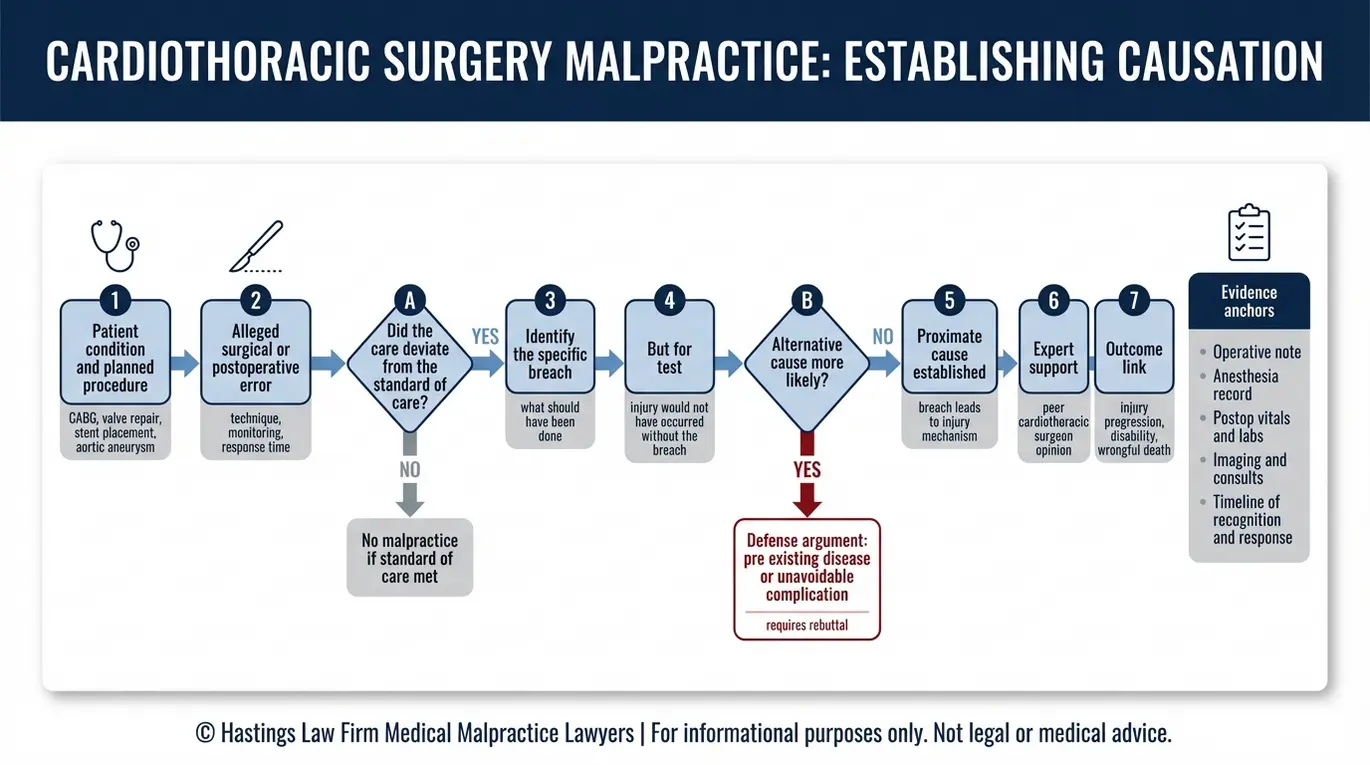
To win a malpractice claim, the patient must prove through expert testimony that the surgeon’s specific error, not the patient’s underlying condition, was the proximate cause of the injury or death. This is often the most challenging element in thoracic surgery cases because many patients enter the operating room with serious pre-existing heart or lung disease.
Causation is the legal link that proves the injury was a direct result of the medical error. Texas law requires the plaintiff to satisfy what is known as the “but-for” test: showing that the injury would not have occurred but for the surgeon’s mistake. In cases involving procedures like heart valve replacement or repair (surgery to fix or substitute a damaged heart valve), aortic aneurysm repair, or stent placement, the defense will almost always argue that the patient’s condition, not the surgeon’s conduct, caused the decline.
Overcoming that argument requires a qualified expert, typically a board-certified thoracic surgeon, who can provide an expert review of the records and testify that the error directly caused the harm in a medical malpractice claim. The expert establishes the proximate cause, proving the specific deviation led to the injury. Data from the Society of Thoracic Surgeons Congenital Heart Surgery Database demonstrates how risk models can help isolate surgical error from expected disease progression.
As a Texas thoracic surgeon malpractice lawyer, Hastings Law Firm works with nationally recognized cardiothoracic experts to establish causation in cases of injury or wrongful death. Our process includes:
- Reconstructing a detailed surgical timeline from operative reports, anesthesia records, and nursing notes
- Comparing the surgeon’s actions against the accepted standard of care for the specific procedure
- Identifying the precise point where the deviation occurred
- Demonstrating through medical evidence that the patient’s outcome would have been different absent the error
- Addressing and rebutting defense claims that pre-existing conditions caused the harm
This evidence-driven approach is built from day one, because proving causation in complex cases like coronary artery bypass grafting (CABG), a procedure that reroutes blood flow around blocked heart arteries, demands precision at every stage.
Compensation Available for Victims of Surgical Negligence
Patients harmed by thoracic surgery malpractice in Texas may recover economic damages for medical bills and lost wages, as well as non-economic damages for pain, suffering, and physical impairment. The type and amount of compensation depend on the severity of the injury and its long-term impact on the patient’s life.
Texas law, specifically Texas Civil Practice and Remedies Code, Chapter 74, governs how damages are calculated and capped in medical malpractice cases.
| Damage Type | What It Covers |
|---|---|
| Economic Damages | Past and future medical bills, revision surgeries, pulmonary rehabilitation, cardiac therapy, lost wages, and reduced earning capacity if diminished heart or lung function prevents the patient from returning to work. These damages are not capped under Texas law. |
| Non-Economic Damages | Pain and suffering, mental anguish, physical impairment, disfigurement, and loss of enjoyment of life. Texas caps these damages at $250,000 against all individual health care providers combined and $250,000 per health care institution, up to $500,000 total across all institutions. |
| Punitive Damages | Awarded only in rare cases involving extreme or egregious conduct, such as a surgeon operating under the influence or knowingly concealing a serious error. |
Some injuries require lifelong care. A patient left with chronic atrial fibrillation, permanent lung damage, or dependency on supplemental oxygen after a surgical error may face decades of medical costs. A malpractice lawyer for chest surgery cases works with life-care planners and economists to project these future expenses accurately.
Medication errors during or after surgery can also contribute to ongoing complications that affect the total value of a claim. Every element of the harm is documented and accounted for.
Why Choose Hastings Law Firm for Your Malpractice Claim
Hastings Law Firm focuses exclusively on medical malpractice, backed by a team that includes board-certified attorneys, in-house nurse consultants, and former defense lawyers who once represented hospitals. This combination gives us an unusual ability to anticipate how the defense will approach your case and to prepare accordingly.
Our firm prepares every case as though it will go to trial. This trial-ready philosophy is not about posturing. It is about building the strongest possible evidence from the beginning so that whether the case settles or goes before a jury, we are in a position of strength. When defense attorneys and insurers know a thoracic surgeon negligence attorney is prepared to present a fully developed Texas medical malpractice case to a jury, it changes the dynamic of every negotiation.
Founded by Tommy Hastings, a board-certified trial lawyer and the Course Director for the State Bar of Texas 2024 Medical Torts Seminar, our firm has recovered tens of millions of dollars for patients and families harmed by medical error. We operate on a contingency fee basis, which means you pay no attorney fees or costs unless we obtain a recovery for you.
Contact the Texas Surgical Error Attorneys at Hastings Law Firm Today for Help
If you or a loved one suffered serious complications or death following a chest, heart, or lung procedure, you do not have to accept the hospital’s explanation without question. Something may have gone wrong that the medical records can reveal, and you have a right to find out.
Our legal and medical team is ready to review your case, consult with qualified thoracic surgery experts, and determine whether negligence contributed to the harm. The case evaluation is free and confidential, and you pay nothing unless we win.
Hastings Law Firm has offices in Houston, The Woodlands, Dallas, Austin, and Phoenix, and handles cases nationwide. Call us today or complete our online form to schedule your risk-free case evaluation.
Frequently Asked Questions About Thoracic Surgeon Malpractice in Texas


This content was researched and written by the Hastings Law Firm editorial team, which includes attorneys, medical professionals, and experienced researchers. Our writing is informed by internal knowledge and practical experience, and we cross-check critical details against authoritative sources cited throughout. Every piece undergoes human-led fact-checking and legal review. Because legal and medical information can change, if you spot an error, please contact us. Learn more about our content standards and review process on our editorial policy page.

Gabe Sassin has focused exclusively on medical malpractice law since 2007. After spending more than a decade as a malpractice defense attorney, he knows exactly how the other side works. He has seen firsthand how healthcare providers, insurers, corporate defendants, and their legal teams think, prepare, and build their defense against claims. That knowledge works for the people who need it most today, injured patients and their families. His unique experience shapes everything he writes, giving readers a look at how these cases actually work from someone who has handled them from both sides.
