


Texas Hand Surgeon Malpractice Lawyer
Hand surgery errors can leave lasting loss of function, chronic pain, and major disruption to work and daily life. A key issue is separating a known complication from preventable negligence, including failures in technique, informed consent, and post operative monitoring. The discussion also highlights wrong site surgery, nerve injury, infection that worsens, and anesthesia related harm, along with how liability may extend beyond the surgeon to a facility or other providers. If you or a loved one were harmed or worse due to hand surgery negligence in Texas, contact Hastings Law Firm for a free, confidential case review.

Last Updated: July 27, 2026
Trial-Ready Legal Representation for Victims of Hand Surgery Negligence in Texas
A hand surgery that was supposed to restore function should never be the reason you lose it. If you or a loved one suffered a preventable injury during a hand or wrist procedure, the confusion and frustration you feel right now are common. You trusted a surgeon with one of the most essential parts of your body, and that trust may have been broken.
At Hastings Law Firm, our team of attorneys, in-house nurses, and medical consultants focuses exclusively on medical malpractice. Founded by board-certified trial attorney Tommy Hastings, our firm focuses on restoring trust for patients who have been let down by the healthcare system. We understand the medical details behind hand surgery errors, and we know how to hold the responsible parties accountable under Texas law. As a dedicated Texas hand surgeon malpractice lawyer team, we are prepared to review your case, explain your options, and help you take the first step toward answers. Contact us for a free, confidential case evaluation.

Distinguishing Hand Surgery Complications From Actionable Negligence
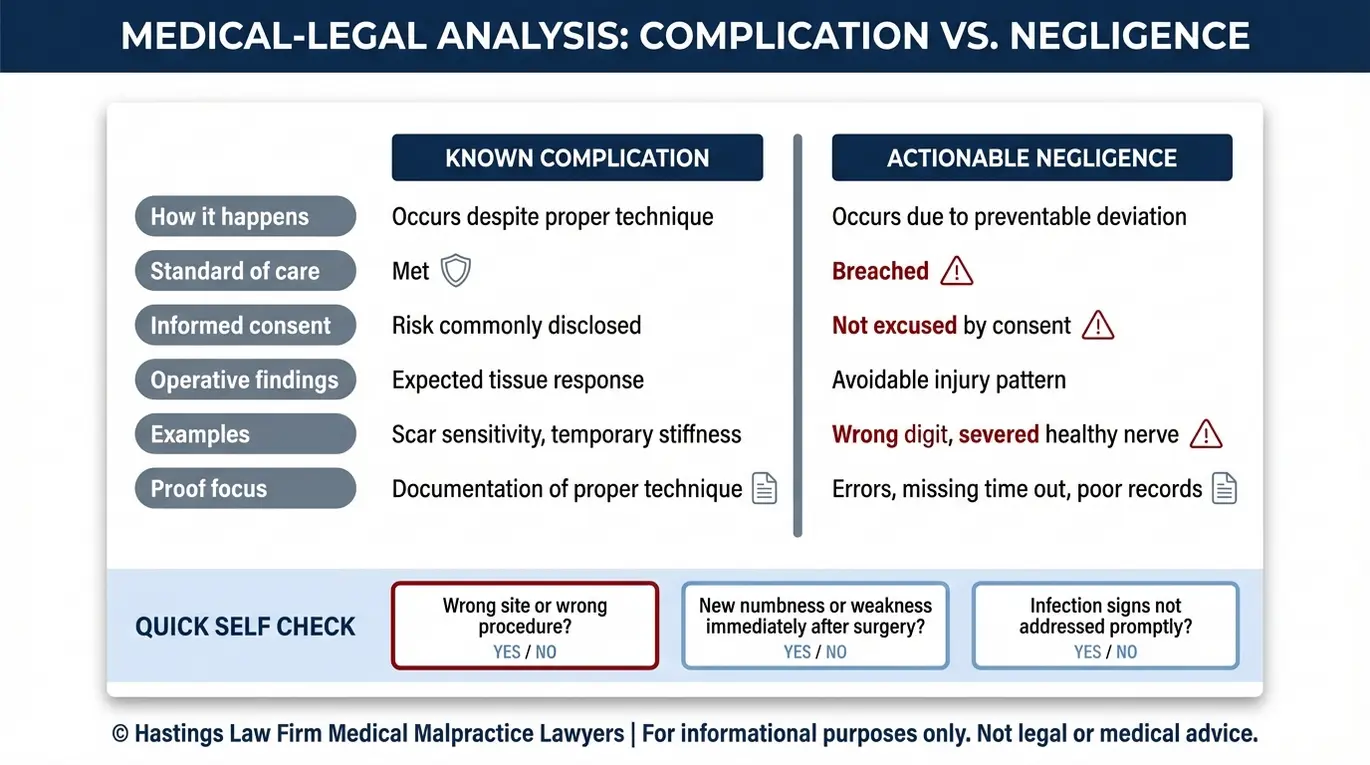
Hand surgery malpractice occurs when a surgeon deviates from the accepted standard of care, causing preventable injury, whereas a known complication is an adverse outcome discussed during informed consent that occurred despite proper technique. This type of outcome can happen even when everything is done correctly. Your surgeon should have discussed these possibilities with you before the procedure.
Understanding this distinction is the single most important step for a Texas malpractice attorney evaluating whether you have a legal claim. Not every bad outcome is negligence in hand surgery. But not every bad outcome is unavoidable, either.
The Standard of Care in Hand Surgery
The standard of care is the level of skill, attention, and treatment that a reasonably competent hand surgeon would provide under similar circumstances. In microsurgery and orthopedic hand procedures, this standard is especially demanding. These operations involve delicate structures like tendons, nerves, and small joints where even minor errors can produce lasting consequences.
A breach of this standard, meaning the surgeon failed to meet it, is the legal foundation of any malpractice claim. A hand surgery malpractice lawyer evaluates whether your surgeon’s actions fell below what the medical community considers acceptable.
The Role of Informed Consent
Before surgery, your doctor must explain the known risks of the procedure. This process is called informed consent, where your doctor describes the potential complications, alternatives, and expected outcomes, and you agree to proceed. According to MedlinePlus, this process is a fundamental patient right in any medical procedure.
Signing a consent form means you accepted the possibility of known risks, like tendon adhesions. These are scar tissue that can form around a repaired tendon and limit movement after a flexor tendon repair. But consent never covers negligence. You accepted the risk of complications from proper care, not the risk of incompetence.
Complication vs. Negligence: A Quick Comparison
| Known Complication | Actionable Negligence |
|---|---|
| Stiffness or reduced range of motion after properly performed surgery | Permanent loss of function caused by severing a healthy nerve |
| Post-surgical swelling or minor infection that responds to treatment | Undiagnosed deep tissue infection that spreads to the bone |
| Scar tissue formation (tendon adhesions) following a technically sound repair | Tendon re-rupture due to improper suturing technique |
| Temporary numbness discussed in pre-op counseling | Permanent numbness from an undisclosed or preventable surgical error |
If your outcome looks more like the right column than the left, speaking with a hand surgery malpractice lawyer in Texas can help clarify whether negligence may be involved.
Distinguishing Between Nerve Entrapment and Surgical Error
One area that causes particular confusion is nerve damage after carpal tunnel release surgery. Carpal tunnel release is a common procedure used to relieve pressure on the median nerve in the wrist. Nerve entrapment, a condition where a nerve is compressed by surrounding tissue, can sometimes recur after surgery. Re-entrapment of the median nerve is a recognized complication that may require additional treatment.
Nerve transection, a situation where the nerve is partially or fully cut during the procedure, is an entirely different matter. Severing a nerve during a carpal tunnel release is not a typical complication. It can indicate a surgical error that a qualified Texas hand surgeon malpractice lawyer would want to investigate closely.
The same distinction applies to post-operative infections. Some degree of infection risk exists with any surgery. But when an infection progresses to sepsis, a life-threatening systemic response, because warning signs were missed or ignored, that failure to act may suggest medical negligence.
Common Errors During Hand and Wrist Reconstructive Procedures
Common errors actionable in court include transected nerves during release procedures, tendon repair failures due to improper suturing, operating on the wrong digit, and failure to identify post-operative infections immediately. Hand and wrist surgeries are technically demanding, and surgical negligence in Texas is unfortunately common. The margin for error is small, and when mistakes happen, the consequences can be permanent. A hand surgeon malpractice case in Texas often centers on one or more of the following categories of error.
If you need a lawyer for hand injury claims, understanding these errors is key. Other potential errors include retained foreign objects left inside the patient or anesthesia errors that complicate recovery.
Nerve Damage
The median nerve provides sensory and motor function to the hand. During a carpal tunnel release, a surgeon must carefully divide the transverse carpal ligament without injuring this nerve. Severing or damaging the median or ulnar nerve can result in permanent numbness, weakness, or loss of grip strength. These injuries can end careers, particularly for people who depend on their hands for work.
Wrong-Site Surgery
Wrong-site surgery, the error of operating on the wrong finger, wrong hand, or wrong patient, is classified as a “never event.” Never events are serious medical errors that should not occur with proper safety protocols. The Joint Commission’s Universal Protocol for Preventing Wrong Site, Wrong Procedure, Wrong Person Surgery exists specifically to prevent these errors and wrong procedure mistakes through mandatory verification steps. When wrong-site surgery happens, it is strong evidence of a breakdown in basic safety protocols.
Improper Hardware Placement
Wrist fracture repairs often require screws, plates, or pins. Surgical hardware includes the medical implants used to stabilize bones during healing. When hardware is placed incorrectly, it can cause chronic pain, restrict movement, or damage surrounding tendons and nerves. Corrective surgery may be needed, sometimes more than once. If you are considering suing for hand surgery errors, improper hardware is a common ground for claims.
Post-Operative Neglect
After surgery, monitoring for complications is essential. Ignoring signs of compartment syndrome, a painful condition caused by dangerous pressure buildup within the muscles, or dismissing early indicators of infection can lead to tissue death or amputation. A study reported by Johns Hopkins has suggested that medical errors rank among the leading causes of death in the United States. A Texas surgical malpractice attorney can help if your post-op care was negligent.
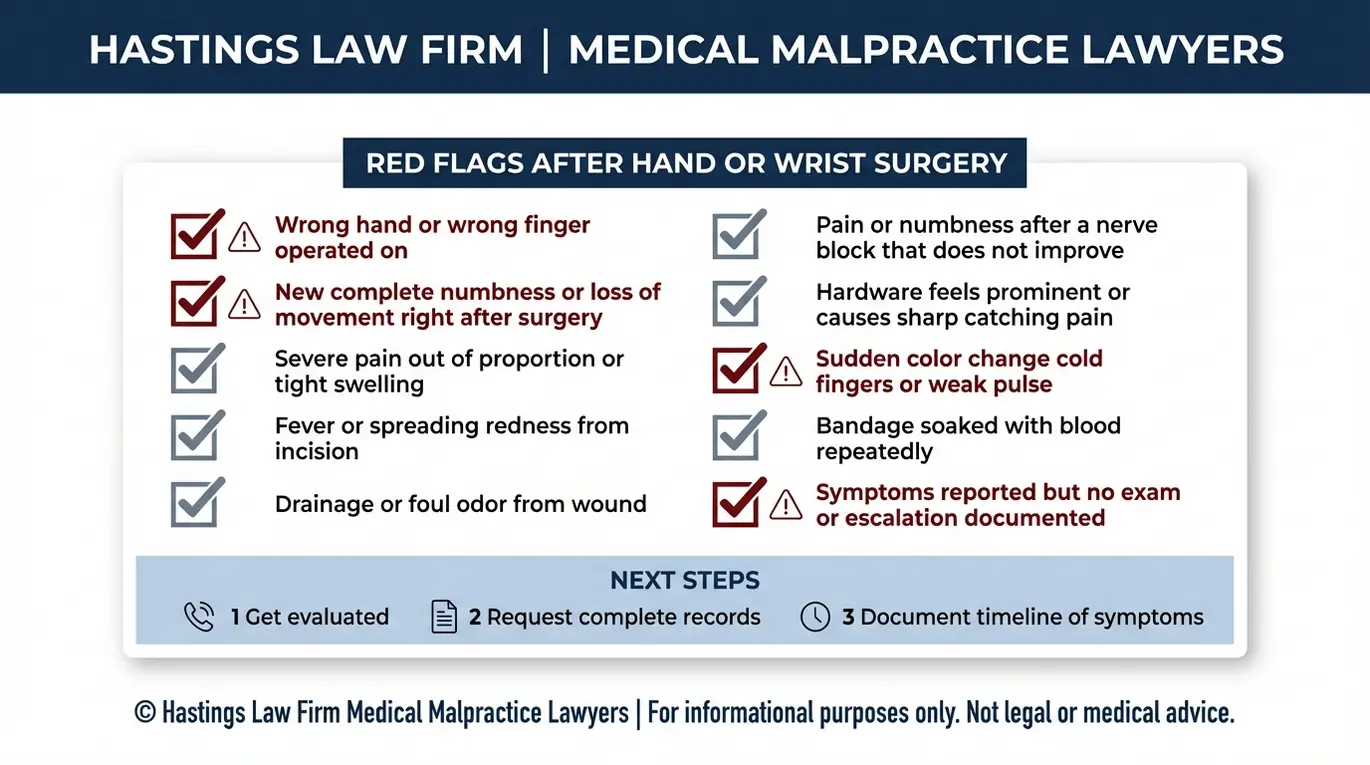
Red Flag Injuries That May Indicate Surgical Negligence:
- Complete loss of sensation in one or more fingers after surgery
- Sudden, severe swelling or discoloration in the operated hand
- Worsening pain that is dismissed or left untreated by the surgical team
- Discovery that surgery was performed on the wrong digit or hand
- Hardware visible under the skin or screws protruding into joint spaces
- Signs of spreading infection (fever, red streaking, drainage) that go unaddressed
If you experienced any of these after a hand or wrist procedure, a hand injury attorney can help determine whether a surgical error occurred.
The Hastings Law Firm Difference
Results matter, but what truly sets us apart is how we achieve them. Every verdict, every settlement, and every Texas courtroom victory comes from one guiding promise: To treat each client’s fight for justice as if it were our own.
This balance of skill, experience, and empathy reflects our core philosophy that justice should not only compensate the injured, but also make health care safer nationwide.

Root Causes of Surgical Failures in Orthopedic Hand Care
Surgical failures often stem from systemic issues such as surgeon fatigue, miscommunication between the surgical team regarding the operative site, or failure to review imaging immediately prior to the incision. Evaluating these systemic causes is part of a thorough investigation. Surgeon fatigue, miscommunication among the surgical team about the operative site, and failure to review imaging immediately before the incision are among the most common contributing factors.
Fatigue and Volume Pressure
Many hand surgeries are performed in outpatient surgery centers. A qualified medical malpractice lawyer knows that when surgeons operate back-to-back for extended hours, fatigue can impair judgment and fine motor precision. In procedures requiring microsurgical accuracy, even slight lapses in concentration can cause serious injury.
Breakdowns in the Surgical Time-Out
The surgical time-out, a mandatory pause taken by the entire operating room team just before the first incision, is supposed to confirm the correct patient, the correct procedure, and the correct surgical site. When this step is rushed, skipped, or treated as a formality, the risk of wrong-site surgery and wrong-procedure errors increases significantly. A Texas surgical error attorney often finds that failures during the time-out frequently involve miscommunication between the surgeon, anesthesiologist, and nursing staff.
Sterilization and Infection Control Failures
Inadequate sterilization of instruments or the surgical environment can introduce bacteria into deep tissue layers. In hand surgery, where tendons and nerves lie close to the surface, deep infections can cause devastating damage if not caught early. When staffing levels are insufficient, critical signs such as compartment syndrome may be missed. These failures often point to hospital negligence or facility-level protocol breakdowns rather than individual surgeon error. A hand surgery lawsuit may need to target the facility as well as the negligent hand surgeon. A surgical injury lawyer can identify all liable parties.
Identifying Liability Beyond the Orthopedic Surgeon
Liability often extends beyond the individual surgeon to include the surgical facility for inadequate staffing, the anesthesiologist for medication errors, or the nursing staff for failing to monitor post-operative vitals or signs of distress. Evaluating the roles of all healthcare providers is necessary to identify every responsible party.
The Facility
Hospitals and surgery centers can be held liable for hiring unqualified staff, failing to maintain sterile environments, or allowing unsafe patient-to-staff ratios. When a facility’s policies or practices contribute to a surgical injury, the institution itself may bear legal responsibility. The legal team includes former defense attorneys and experienced hospital nurses who previously worked for the systems they now challenge, providing a strategic advantage in identifying hospital protocol failures. You may be able to sue a surgery center directly. A Texas hand surgeon malpractice lawyer will evaluate the facility’s role alongside the surgeon’s conduct.
Anesthesiology Errors
Hand surgeries often involve a peripheral nerve block, a type of regional anesthesia that numbs a specific area by injecting medication near targeted nerves. A brachial plexus block targets the network of nerves running from the neck into the arm. When administered improperly, these blocks can cause permanent nerve damage or paralysis. Establishing medical negligence liability in these cases requires careful analysis. Research published in PubMed Central on neurological deficits following regional anesthesia highlights the risks associated with these procedures and the standard of care expected of anesthesiologists. Anesthesia errors are a serious component of many claims.
The “Independent Contractor” Defense
Texas hospitals frequently argue that surgeons and anesthesiologists are independent contractors, not employees, to avoid vicarious liability for their actions. This defense can be challenged, but it requires a careful legal analysis of the contractual relationships and how much control the facility exercised over the healthcare provider. An experienced malpractice attorney knows how to counter this argument and hold every responsible party accountable in your Texas hand surgery claim.

Calculating Damages for Loss of Manual Dexterity and Livelihood
Damages in hand malpractice cases are calculated by assessing economic losses like past and future lost wages alongside non-economic damages such as physical pain, mental anguish, and physical impairment preventing daily tasks. Seeking compensation for nerve damage or loss of hand function is essential. Hand injuries carry a uniquely high financial and personal cost.
Economic Damages
Economic damages cover the measurable financial losses caused by the injury. A hand injury lawyer will explain that these have no cap under Texas law and often form the largest portion of a medical malpractice settlement or verdict.
- Lost wages and lost earning capacity: A hand injury can end careers in trades, healthcare, music, technology, and countless other fields. Compensation accounts for both the income you have already lost and what you would have earned in the future.
- Past and future medical expenses: Corrective surgeries, physical therapy, occupational therapy, and long-term rehabilitation costs are all recoverable. Damages for hand surgery errors must cover these extensive costs.
- Assistive devices and home modifications: If the injury limits your ability to care for yourself, the cost of adaptive equipment or in-home assistance may be included.
Non-Economic Damages
Non-economic damages address the personal toll of the injury, things that do not come with a receipt but affect your life every day. Texas medical malpractice compensation rules allow for recovery of:
- Physical pain and suffering: Chronic pain from nerve damage or failed repairs.
- Mental anguish: The emotional distress of losing hand function, including anxiety, depression, and frustration.
- Physical impairment: Compensation for the permanent loss of ability to perform basic activities like writing, cooking, or dressing yourself.
- Loss of enjoyment of life: When hobbies, sports, or activities you once loved are no longer possible.
A Texas hand surgeon malpractice lawyer with experience in these cases understands how to document and present these losses to maximize the value of hand injury case. At Hastings Law Firm, our in-house medical staff works alongside our attorneys to build a detailed picture of how the injury has affected your life and your future.
Filing Deadlines for Surgical Claims Under Texas Law
In Texas, medical malpractice claims must typically be filed within two years from the date of the surgical error, though strictly limited exceptions exist for minors or cases involving fraudulent concealment.
The Statute of Limitations and the Two-Year Rule
Under the statute of limitations Texas enforces, specifically Texas Civil Practice and Remedies Code § 74.251, you have two years from the date the malpractice occurred to file your claim. This medical negligence time limit applies regardless of when you realized something went wrong. Missing this deadline to file malpractice claim almost always means losing your right to pursue compensation entirely. The discovery rule in Texas is very limited in these cases, meaning the clock rarely pauses.
The Ten-Year Statute of Repose
Texas also imposes a ten-year statute of repose under Texas Civil Practice and Remedies Code Chapter 74. This creates an absolute outer boundary for filing a claim. No matter the circumstances, claims filed more than ten years after the date of the alleged negligence are barred.
Why Waiting Can Hurt Your Case
Beyond the legal deadlines, delay erodes evidence. Medical records can be lost or altered. Witnesses forget details. Surgical staff move to other facilities. The sooner you speak with an expert about filing a malpractice suit in Texas, the stronger your case will be.
How Our Texas Hand Surgeon Malpractice Lawyers Build Your Case
We build a compelling case by securing all medical records, consulting with independent orthopedic experts to prove a breach in the standard of care, and preparing for a jury trial from day one to maximize settlement leverage.
Immediate Medical Review
When you contact Hastings Law Firm, your case is reviewed by our in-house medical staff, including nurse practitioners and board-certified patient advocates. They analyze your surgical records, post-operative notes, and imaging to identify where the standard of care may have been breached. This case investigation is thorough.
Expert Testimony from Independent Specialists
Through our national network of medical experts, we retain independent hand surgeons and orthopedic specialists who can provide objective, credible testimony about what went wrong. Expert testimony is often the determining factor in medical malpractice cases, and we work with professionals who are respected in their fields. If you need to contact a Texas malpractice lawyer, ensure they have these resources.
Trial-Ready From Day One
Every case we accept is prepared as though it will go before a jury. This level of preparation strengthens our position during settlement negotiations and signals to defense attorneys and insurance carriers that we will not accept less than fair value. This approach to the litigation process is effective. As your hand surgery negligence attorney, we fight for you. Because we work on a contingency fee basis, you pay no attorney fees or costs unless we recover compensation for you. If you are looking to hire a hand malpractice lawyer, our track record reflects our experience in this field.
Contact the Texas Surgical Error Attorneys at Hastings Law Firm Today for Help
A hand injury caused by surgical negligence can permanently change your career, your independence, and your quality of life. You do not have to figure this out alone, and you do not have to wonder in silence whether what happened to you was preventable.
At Hastings Law Firm, our medical malpractice team has the medical knowledge, legal experience, and resources to review your situation and give you honest answers. Our in-house medical staff and national network of surgical experts allow us to evaluate your case with the depth and precision it deserves.
There is no fee unless we win. Contact our Texas hand surgeon malpractice lawyers today for a free, confidential case evaluation. Let us help you understand what happened and what comes next.
Frequently Asked Questions About Hand Surgeon Malpractice in Texas


This content was researched and written by the Hastings Law Firm editorial team, which includes attorneys, medical professionals, and experienced researchers. Our writing is informed by internal knowledge and practical experience, and we cross-check critical details against authoritative sources cited throughout. Every piece undergoes human-led fact-checking and legal review. Because legal and medical information can change, if you spot an error, please contact us. Learn more about our content standards and review process on our editorial policy page.

Brady D. Williams is a nationally recognized medical malpractice attorney who has spent his career handling high-stakes litigation for injured patients and families across the country. Licensed in both Texas and California, Brady draws on experience from hundreds of resolved medical cases to break down complex legal and medical topics for the people who need that information most. His writing reflects the same attention to detail and commitment to clarity that he brings to every case he handles.
