


Texas Cardiothoracic Surgeon Malpractice Lawyer
Cardiothoracic surgery is complex and high risk, and a preventable error can leave a patient facing serious complications, long recovery, and major financial strain or worse. Malpractice concerns often involve surgical technique, anesthesia management, infection control, postoperative monitoring, or informed consent when the operating plan differs from what was agreed to. Questions can also arise when surgeries overlap or trainees perform key parts without adequate supervision. Careful review of records can clarify what happened and why. If you or a loved one were harmed or worse due to cardiothoracic surgeon malpractice in Texas, contact Hastings Law Firm for a free, confidential case review.

Last Updated: July 27, 2026
Trial-Ready Legal Representation for Surgical Injuries in Texas
When a heart or chest surgery leads to unexpected harm, the questions can feel overwhelming. You may be dealing with a difficult recovery, mounting medical bills, or the loss of someone you love, all while trying to understand whether the care you received fell below acceptable standards. A cardiothoracic surgeon, a specialist trained to operate on the heart, lungs, and other organs within the chest, holds your life in their hands during these procedures. When that trust is broken by a preventable error, you deserve honest answers and experienced legal guidance.
At Hastings Law Firm, we focus exclusively on medical malpractice. Our team of attorneys, in-house nurse consultants, and board-certified patient advocates understands both the medicine and the law behind these cases. If you or a loved one suffered harm during or after a cardiothoracic procedure, a Texas cardiothoracic surgeon malpractice lawyer at our firm can review what happened and explain your options at no cost and no obligation.

Common Heart and Chest Procedures Involving Malpractice Claims
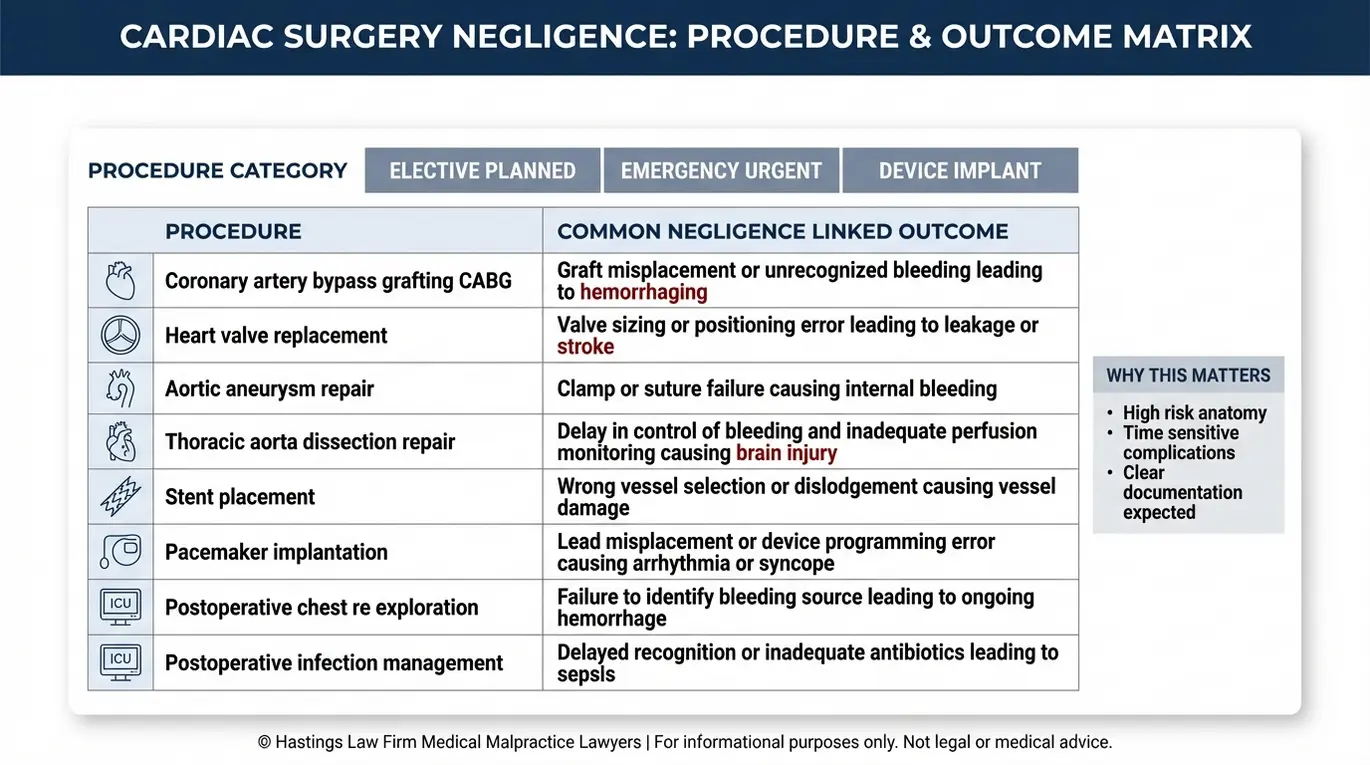
Malpractice claims in cardiothoracic medicine most frequently arise from high-risk procedures such as coronary artery bypass grafting (CABG), heart valve replacements, and aortic aneurysm repairs where precision is critical. These are among the most demanding operations in cardiothoracic surgery, and each one requires strict adherence to established protocols before, during, and after surgery.
Coronary artery bypass grafting, commonly called CABG, is a procedure in which a surgeon reroutes blood flow around blocked coronary arteries using a vessel harvested from another part of the body. Heart valve replacement involves removing a damaged or diseased valve and implanting a mechanical or biological substitute. Both procedures carry inherent risks, but when errors in technique, timing, or judgment occur, the consequences can be catastrophic.
A clear distinction exists between elective cardiac surgery procedures and emergency interventions. Elective surgeries allow time for thorough preoperative planning, imaging review, and patient evaluation. Emergency operations, such as acute aortic dissection repair (a surgery to fix a life-threatening tear in the main heart artery), demand rapid decision-making under pressure. Malpractice can occur in either setting, but the standard of care analysis differs based on the circumstances.
Device implantation procedures carry their own set of risks. Stent placements and pacemaker implantations require precise positioning and careful postoperative monitoring. According to the National Heart, Lung, and Blood Institute, patients with pacemakers need structured follow-up care to check device function and detect complications early. Failure to provide that follow-up, or errors during the implantation itself, can form the basis of a malpractice claim. A Texas cardiothoracic surgeon malpractice lawyer can help determine whether the care surrounding any of these high-risk procedures fell short.
| Procedure | Common Negligent Outcome |
|---|---|
| Coronary Artery Bypass Grafting (CABG) | Graft failure due to surgical error, uncontrolled bleeding |
| Heart Valve Replacement | Improper valve sizing, paravalvular leak |
| Aortic Aneurysm Repair | Delayed diagnosis leading to rupture, organ damage |
| Stent Placement | Malpositioning, arterial perforation |
| Pacemaker Implantation | Lead displacement, infection from improper technique |
Identifying Negligence in Cardiothoracic Surgery
Negligence in cardiac surgery occurs when a surgeon deviates from the accepted standard of care, resulting in preventable harm such as a wrong-site incision, surgical tools left inside the body, or failure to manage complications like hemorrhage. The standard of care is the level of treatment that a reasonably competent cardiothoracic surgeon would provide under similar circumstances. When that standard is not met and the patient suffers as a result, the error may be actionable as surgical malpractice.
Not every poor surgical outcome is malpractice. Cardiothoracic procedures are inherently high-risk, and known complications can occur even when the surgical team performs flawlessly. As a study published by PubMed Central on operative mortality in adult cardiac surgery discusses, defining what qualifies as an expected outcome versus a preventable one requires careful clinical analysis. The line between a recognized complication and negligence depends on whether the surgeon’s actions, or inactions, fell outside the bounds of accepted practice. Distinguishing between an unavoidable bad outcome and a preventable error often requires the insight of a cardiothoracic surgeon negligence attorney who can dissect the clinical timeline.
Several categories of error can constitute negligence during or after a cardiothoracic procedure. Accidental perforation of blood vessels during surgery can cause severe internal bleeding, also known as postoperative hemorrhage. Anesthesia negligence, including dosage errors or failures related to managing cardiopulmonary bypass (the heart-lung machine that takes over circulation during open-heart surgery), can lead to stroke or brain damage. Infection resulting from poor sterile technique is another common basis for a claim regarding a deviation from the accepted standard of care.
Here are red flags that may indicate negligence in a cardiothoracic case:
- Unexpected return to the operating room shortly after the initial procedure
- Uncontrolled hemorrhaging requiring emergency blood transfusion
- Signs of stroke or neurological deficit emerging after surgery
- Infection at the surgical site that develops rapidly post-operation
- Retained surgical instruments or sponges discovered on imaging
- Failure to recognize and treat declining vital signs during postoperative care
- Anesthesia complications that were not promptly identified or addressed
If any of these situations occurred, a Texas cardiothoracic surgeon malpractice lawyer can evaluate the medical records and determine whether a deviation from the standard of care took place.
Concurrent Surgeries and Use of Unqualified Trainees
Overlapping surgery, sometimes called concurrent surgery, refers to the practice of a surgeon managing two procedures at the same time, with critical portions of both operations taking place simultaneously. In some cases, the primary surgeon may leave a trainee or resident to perform significant parts of the operation without adequate supervision.
This raises serious liability and informed consent concerns. Informed consent means the patient was told who would be performing the surgery and agreed to the plan. If a patient consented to a specific surgeon and that surgeon was not present during key moments of the procedure, the patient’s consent may not have been valid. We examine anesthesia logs, surgical timelines, and staffing records to determine whether the attending surgeon was physically present when it mattered most to ensure the standard of care was met.

The Hastings Law Firm Difference
Results matter, but what truly sets us apart is how we achieve them. Every verdict, every settlement, and every Texas courtroom victory comes from one guiding promise: To treat each client’s fight for justice as if it were our own.
This balance of skill, experience, and empathy reflects our core philosophy that justice should not only compensate the injured, but also make health care safer nationwide.

Suing a Texas Heart Surgeon for Medical Error
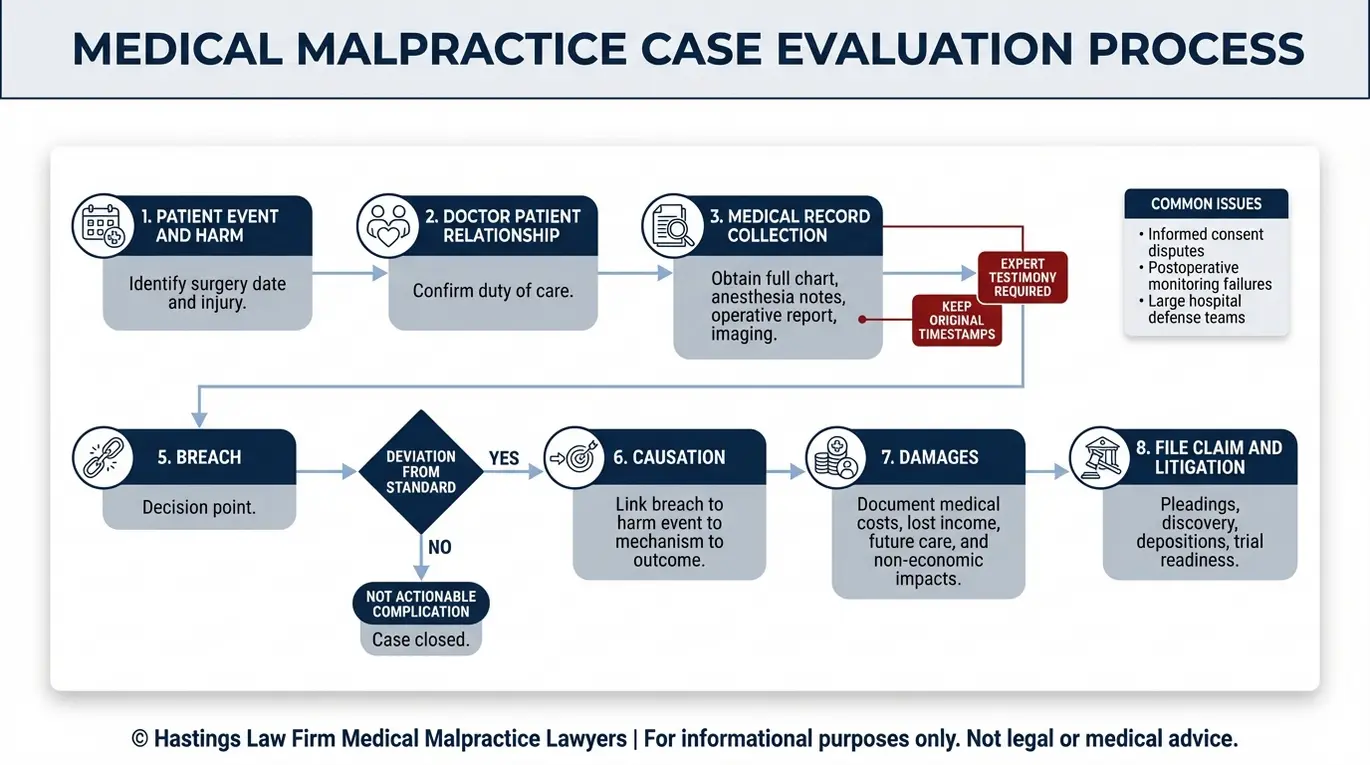
Filing a lawsuit against a heart surgeon in Texas requires establishing a doctor-patient relationship, proving a breach of the standard of care through expert testimony, and demonstrating that this breach directly caused specific damages. These four elements, including duty, breach, causation, and damages, form the foundation of every medical malpractice claim, but establishing liability in complex cardiac cases requires rigorous preparation.
Here is the general process for pursuing a cardiothoracic malpractice case in Texas:
- Establishing a doctor-patient relationship: This confirms the surgeon owed you a duty of care covering both the surgery and essential postoperative care. In most surgical cases, this element is simple to prove.
- Obtaining and analyzing medical records: A thorough review of operative reports, nursing notes, and imaging helps identify where errors may have occurred.
- Securing a qualified expert report: Texas law requires a written expert opinion early in the case. The expert must be a qualified physician who can speak to the specific standard of care involved.
- Filing suit and managing litigation: This includes discovery, which is the legal process of gathering evidence from the opposing side, depositions, and preparation for trial. The Texas Medical Disclosure Panel, established under Title 25, Part 7 of Texas regulations, sets specific disclosure requirements that apply to these cases.
- Proving causation and damages: It is not enough to show an error occurred. We must also demonstrate that the error, not the underlying disease, caused the injury or wrongful death.
Informed consent failures also arise in cardiac cases. If a surgeon did not adequately explain the risks of a procedure, or failed to disclose alternatives, that omission can support a separate claim. A lawyer for heart surgery malpractice understands how to build both negligence and informed consent arguments in these technically demanding cases.
Our firm, founded by board-certified trial attorney Tommy Hastings, includes former defense attorneys who previously represented hospitals, giving us direct insight into how the other side builds its case. We prepare every claim from day one as if it will go to a jury. Establishing a clear doctor-patient relationship is the first step in this thorough preparation.
Liability Beyond the Surgeon
The operating surgeon is not always the only responsible party. Hospitals can be held liable for hospital negligence, such as credentialing failures or granting surgical privileges to an underqualified physician. If a defective medical device contributed to the injury, such as a faulty coronary stent (a small tube placed inside a blocked artery during a procedure called percutaneous coronary intervention, or PCI) or a malfunctioning pacemaker (an implanted device that regulates heart rhythm), the device manufacturer may also bear responsibility under medical product liability theories.
We evaluate every potential source of liability to ensure that all responsible parties are held accountable.
Proving Malpractice with Medical Records and Expert Testimony
Strong malpractice cases rely on a forensic review of medical records to identify charting inconsistencies and the use of credible expert witnesses to testify on how the surgeon failed to meet the standard of care. Without solid evidence, even the most compelling story will not survive in court. A Texas cardiothoracic surgeon malpractice lawyer uses these records to build the timeline of negligence.
The first step is obtaining the complete, unedited surgical chart. This includes operative reports, anesthesia records, nursing notes, the perfusion record (the log kept by the perfusionist who operates the heart-lung machine during surgery), and postoperative monitoring data. Under federal law, you have a right to access your own health information, as outlined by the U.S. Department of Health and Human Services’ guidance on individuals’ right under HIPAA to access their health information.
Our in-house medical staff, including nurse practitioners and board-certified patient advocates, reviews every page of these records. We then work with independent medical experts, typically board-certified cardiothoracic surgeons, who can provide objective opinions on whether the care met the standard. Their testimony is what connects the evidence in the chart to the legal claim. We also consider the discovery rule, which may allow for claims where the error wasn’t immediately obvious, provided the evidence supports a hidden injury. A thorough forensic review of medical records is necessary to uncover these details.
Here is a checklist of evidence we typically gather in a Texas cardiothoracic surgeon malpractice case:
- Complete operative and surgical reports
- Anesthesia and perfusion records
- Pre-operative imaging and test results
- Postoperative nursing notes and ICU monitoring logs
- Billing records and procedure codes
- Informed consent documentation
- Hospital credentialing and staffing records
- Communications between surgical team members
Billing records deserve special attention. In some cases, charges for procedures or services that do not match the medical record can reveal important discrepancies or fraudulent billing worth investigating.
Non-Record and Altered Documentation Issues in Cardiac Care
Sometimes the most telling evidence is what is missing from the medical records. Gaps in documentation, unusually sparse operative notes, or entries that appear to have been added or modified after the fact can all suggest that something went wrong. Our team looks specifically for these patterns, comparing timestamps, identifying charting inconsistencies between different providers’ notes, and flagging records that do not align with the clinical timeline. When documentation has been altered or destroyed, that itself can become a powerful piece of evidence known as spoliation in your case.
Recovering Damages for Surgical Injuries and Wrongful Death
Patients harmed by cardiac malpractice may recover economic damages for medical bills and lost wages, as well as non-economic damages for pain, suffering, and physical impairment, subject to Texas statutory damage caps.
Economic damages cover the measurable financial losses caused by the injury. These include past and future medical expenses, rehabilitation costs, lost income, and lost earning capacity (the reduction in your ability to earn a living). For severe outcomes like brain damage caused by oxygen deprivation during surgery, the lifetime cost of care can be substantial. Economic damages are not capped under Texas law.
Non-economic damages address the human toll: physical pain, emotional suffering, disfigurement, and loss of enjoyment of life. Under Texas Civil Practice and Remedies Code, Chapter 74, non-economic damages are capped at $250,000 against all individual physicians and health care providers combined and up to $500,000 against health care institutions, for a combined maximum of $750,000. In wrongful death cases, families may also pursue damages for loss of companionship and mental anguish. Punitive damages, while rare, may apply in cases involving especially egregious conduct.
| Damage Type | Examples | Texas Cap |
|---|---|---|
| Economic Damages | Medical bills, lost wages, future care costs, lost earning capacity | No cap |
| Non-Economic Damages | Pain and suffering, mental anguish, physical impairment, loss of enjoyment | $250,000–$750,000 |
A Texas cardiothoracic surgeon malpractice lawyer can help you understand the full scope of compensation that may be available in your case.
Contact the Texas Surgical Error Attorneys at Hastings Law Firm Today for Help
If you or someone in your family has suffered harm from a cardiothoracic procedure, you do not have to face this alone. At Hastings Law Firm, our entire practice is dedicated to medical malpractice. We understand the medicine behind these cases, and we prepare every claim with the depth and precision needed to hold negligent providers accountable.
Our team includes former defense attorneys, in-house nurse consultants, and access to a national network of top-tier medical experts. We are here to help you find out what happened, why it happened, and what can be done about it.
We handle cases on a contingency fee basis, which means you pay no attorney fees or costs unless we recover compensation for you. If you need a Texas cardiothoracic surgeon malpractice lawyer, contact us today for a free, confidential case evaluation. Let us review your records and help you understand your options.
Frequently Asked Questions About Cardiothoracic Surgeon Malpractice in Texas


This content was researched and written by the Hastings Law Firm editorial team, which includes attorneys, medical professionals, and experienced researchers. Our writing is informed by internal knowledge and practical experience, and we cross-check critical details against authoritative sources cited throughout. Every piece undergoes human-led fact-checking and legal review. Because legal and medical information can change, if you spot an error, please contact us. Learn more about our content standards and review process on our editorial policy page.

Brady D. Williams is a nationally recognized medical malpractice attorney who has spent his career handling high-stakes litigation for injured patients and families across the country. Licensed in both Texas and California, Brady draws on experience from hundreds of resolved medical cases to break down complex legal and medical topics for the people who need that information most. His writing reflects the same attention to detail and commitment to clarity that he brings to every case he handles.
