


Texas Vascular Surgeon Malpractice Lawyer
Vascular surgery errors can cause sudden, life changing harm when blood flow is interrupted or bleeding is not controlled. The impact often extends beyond the operating room, with long recoveries, lasting disability, and major financial strain when additional treatment and rehabilitation are needed. This topic also involves diagnostic mistakes, surgical technique problems, and informed consent failures that can leave patients without clear answers about what went wrong. If you or a loved one were harmed or worse due to vascular surgeon malpractice in Texas, contact Hastings Law Firm for a free, confidential case review.

Last Updated: July 27, 2026
Trusted Legal Representation for Vascular Surgery Negligence in Texas
When a vascular surgeon’s error leads to a stroke, limb loss, or another life-changing injury, the physical and emotional toll can feel overwhelming. You may be dealing with mounting medical costs, an uncertain recovery, and the unsettling feeling that the care you received fell short. These concerns deserve to be taken seriously.
As a Texas vascular surgeon malpractice lawyer, Hastings Law Firm focuses exclusively on medical malpractice. Founded by Tommy Hastings, who is board-certified in Personal Injury Trial Law, our team includes in-house medical professionals and former defense attorneys who understand exactly how to investigate these cases. If you or a loved one suffered a serious injury after vascular surgery, we can review what happened, explain your legal options, and help you understand whether the care you received met the accepted medical standard. Contact us for a free, confidential case evaluation.

Understanding Malpractice in Vascular and Endovascular Surgery
Vascular malpractice occurs when a surgeon deviates from the accepted standard of care during the diagnosis or surgical management of blood vessel disorders, directly causing injury such as hemorrhage, ischemia, or death. Because vascular surgeons operate on the body’s circulatory system, including arteries that carry oxygenated blood and veins that return it, even a brief lapse in judgment can trigger catastrophic consequences. The intricate nature of the circulatory system means that there is no margin for error.
A mistake in one vessel can have cascading effects throughout the body. When a surgeon fails to account for these details, it may constitute vascular surgery negligence. The standard of care refers to the level of treatment that a reasonably competent vascular surgeon, with similar training, would have provided under the same circumstances.
This standard applies whether the procedure is an open vascular surgery, which involves direct incision and repair of blood vessels. It also applies to endovascular surgery, a less invasive approach where surgeons use catheters and imaging to treat vessels from inside the artery. Both carry distinct risks, and the expected standard shifts depending on the procedure, the patient’s condition, and the clinical setting.
Texas medical negligence claims involving vascular care are governed by Texas Civil Practice and Remedies Code Chapter 74, which imposes strict procedural requirements, including mandatory expert reports and defined filing deadlines. Working with a Texas vascular surgeon malpractice lawyer who understands these rules, and the underlying medicine, is essential to building a viable case.
Vascular Surgeons as Consultants in Emergency Trauma
Vascular surgeons are frequently called in as emergency consultants after another physician causes vascular trauma. This involves damage to blood vessels that may occur during an unrelated procedure. For example, a general surgeon or OBGYN may accidentally nick an artery during an operation, prompting an urgent call for vascular repair.
If the consulting vascular surgeon then fails to properly control hemorrhage, the uncontrolled loss of blood from a damaged vessel, or repair the injury, that surgeon may bear independent liability for the resulting harm. We examine each provider’s role in the timeline to determine where the standard of care was breached.
Common Errors Committed by Vascular Surgeons
Common errors in vascular surgery include damaging nerves or vessels during dissection, failing to diagnose clots post-operatively, performing unnecessary invasive procedures, and improper placement of stents or grafts. These mistakes often result from fatigue, lack of experience, or systemic failures in the operating room. Identifying these errors requires a deep understanding of surgical protocols.
A Texas vascular surgeon malpractice lawyer can scrutinize the operative report to find where the team deviated from safety rules. These mistakes can stem from diagnostic failures, technical errors in the operating room, or a breakdown in communication with the patient about the risks involved.
Diagnostic errors
Diagnostic errors often involve misinterpreting imaging studies used to evaluate conditions like aneurysms or atherosclerosis, a buildup of plaque inside the arteries. Missed or delayed findings on CT angiography, ultrasound, or MRI can lead a surgeon to operate on the wrong vessel, choose the wrong procedure, or fail to intervene at all when timely treatment is needed. Such misdiagnosis prevents patients from receiving the urgent care they need to prevent permanent tissue damage.
Surgical errors
Surgical errors occur during procedures like carotid stenting or bypass graft surgery. Carotid stenting involves the insertion of a small mesh tube to hold open a narrowed artery. Bypass graft surgery is where a surgeon reroutes blood flow around a blockage using a natural or synthetic vessel.
Errors during aneurysm repair, revascularization, or endovascular catheter placement can cause immediate vascular damage or delayed complications that go unrecognized. For example, during a bypass, if the sutures are not applied with precision, the vessel may leak or narrow, defeating the purpose of the surgery. Similarly, in endovascular cases, aggressive wire manipulation can dissect a fragile artery, converting a minimally invasive case into an open emergency.
Informed consent
Informed consent violations are also a basis for malpractice by a vascular surgeon. Before any procedure, the surgeon is required to explain the material risks, the available alternatives, and the expected outcomes. If a patient was not told about a less invasive endovascular option versus open surgery, or was not warned about specific risks like stroke or limb loss, the consent may be legally insufficient.
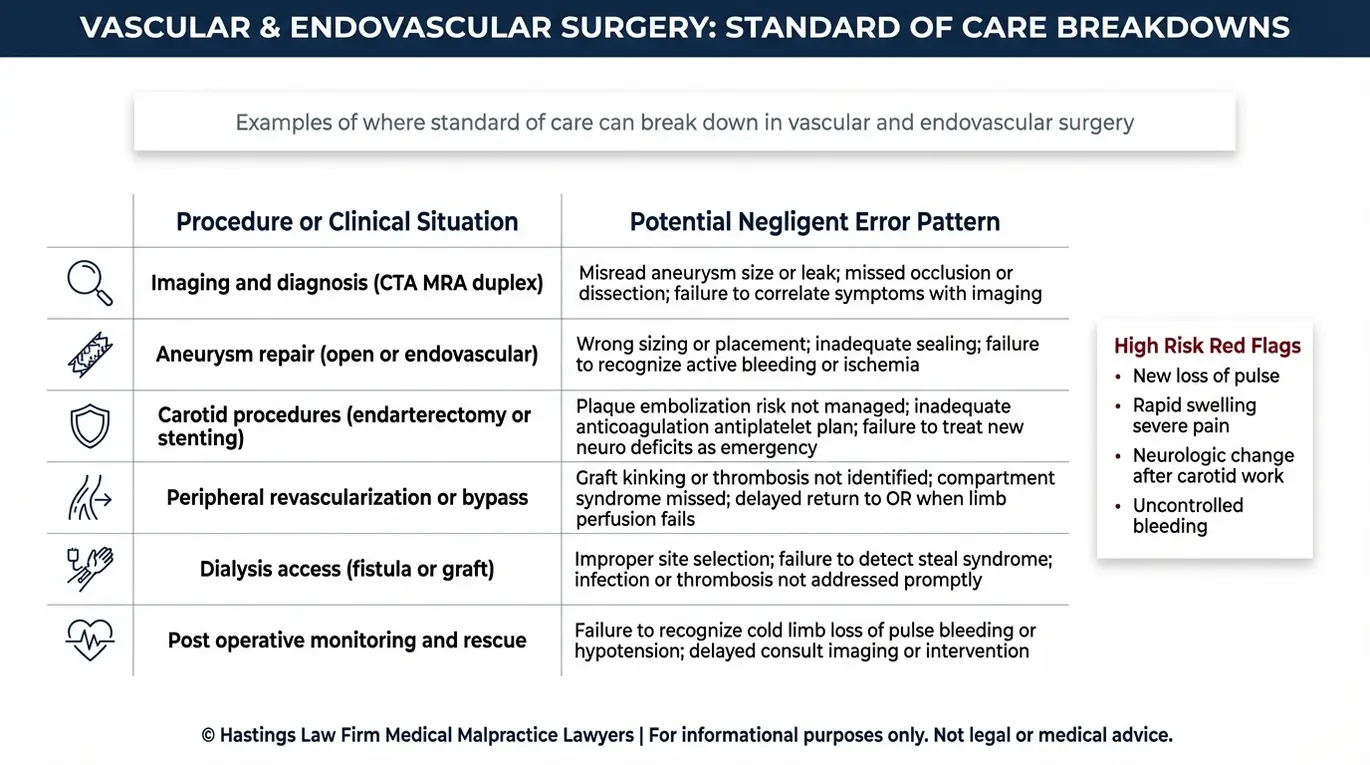
| Procedure / Condition | Potential Negligent Error |
|---|---|
| Aneurysm repair | Endograft misplacement, failure to detect endoleak |
| Carotid stenting | Dislodging plaque causing stroke, improper stent sizing |
| Peripheral artery bypass graft | Graft failure due to poor technique, inadequate post-op monitoring |
| Dialysis access creation | Fistula malformation, repeated access failure |
| Post-operative clot management | Failure to diagnose or treat blood clot formation |
| Imaging interpretation | Misreading scans for atherosclerosis or vascular occlusion |
The Hastings Law Firm Difference
Results matter, but what truly sets us apart is how we achieve them. Every verdict, every settlement, and every Texas courtroom victory comes from one guiding promise: To treat each client’s fight for justice as if it were our own.
This balance of skill, experience, and empathy reflects our core philosophy that justice should not only compensate the injured, but also make health care safer nationwide.

Catastrophic Injuries Resulting from Vascular Negligence
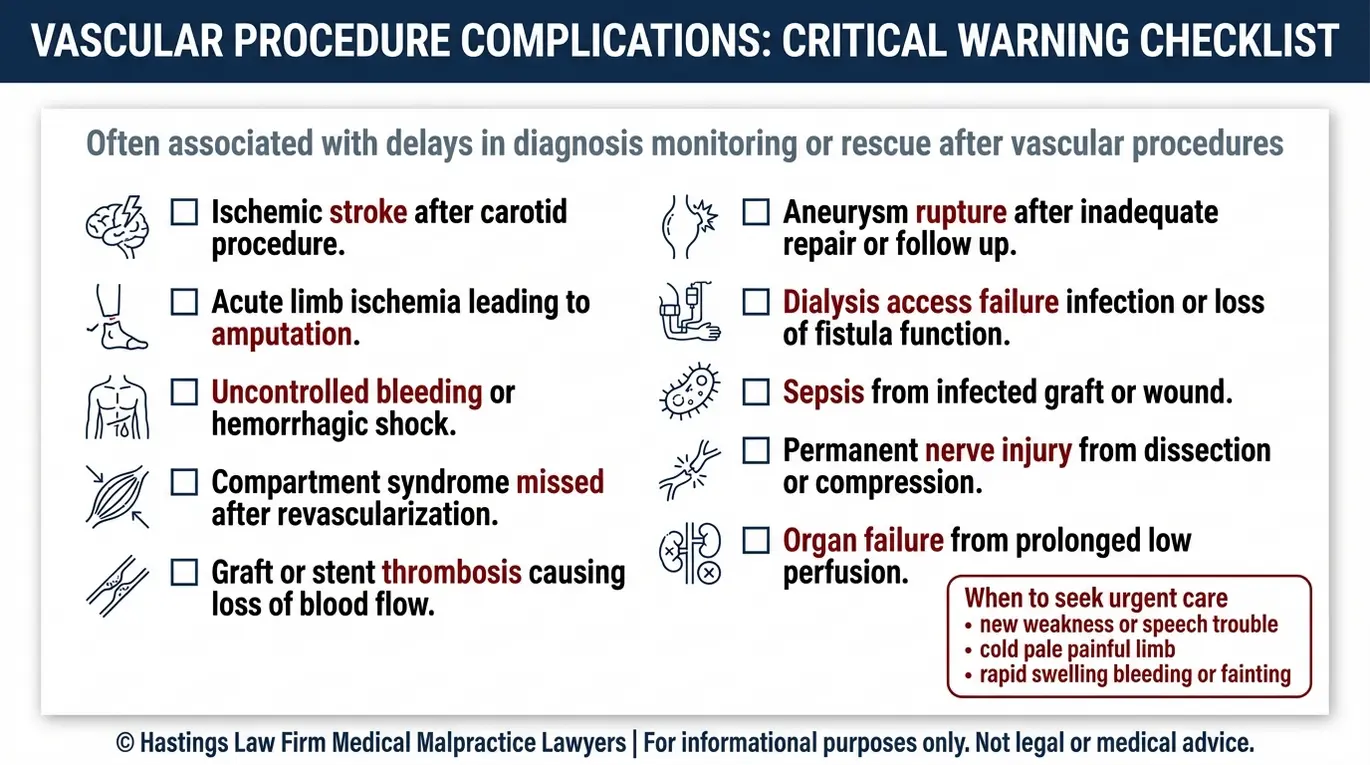
Negligence in vascular care frequently results in life-altering outcomes such as ischemic stroke, gangrene requiring amputation, massive internal bleeding, or permanent organ failure due to loss of blood flow. These are not minor complications; they represent the most severe category of preventable surgical harm. Families are often left with questions about how a routine procedure turned into a tragedy. Patients with underlying conditions like peripheral artery disease are particularly vulnerable to these errors.
When errors go unrecognized or unaddressed, patients may experience:
- Limb loss from acute limb ischemia, the sudden loss of blood flow to an arm or leg, often caused by a failure to revascularize in time or to detect a blood clot after surgery
- Stroke caused by plaque dislodged during carotid artery procedures, leading to permanent neurological damage
- Graft failure or dialysis access failure from negligence in creating or maintaining an arteriovenous fistula (AVF), a surgically created connection between an artery and a vein used for dialysis, or a synthetic graft
- Internal hemorrhage from uncontrolled bleeding during or after open or endovascular surgery
- Organ damage resulting from prolonged ischemia to the kidneys, intestines, or other vital structures
A knowledgeable vascular malpractice attorney understands the ripple effect of these injuries. The physical damage often necessitates lifetime care, home modifications for amputees, and extensive rehabilitation therapy. These costs are astronomical, and the emotional burden on the family is equally heavy.
A 2025 study published in *PubMed Central* analyzing negligence claims related to abdominal aortic aneurysm interventions found that avoidable surgical injuries remain a persistent problem, underscoring the need for accountability in vascular surgical care.
If you or a loved one experienced any of these outcomes after a vascular procedure, a Texas vascular surgeon malpractice lawyer can evaluate the medical records to determine whether the treating surgeon’s actions fell below the expected standard.
Proving Liability Under Texas Medical Malpractice Laws
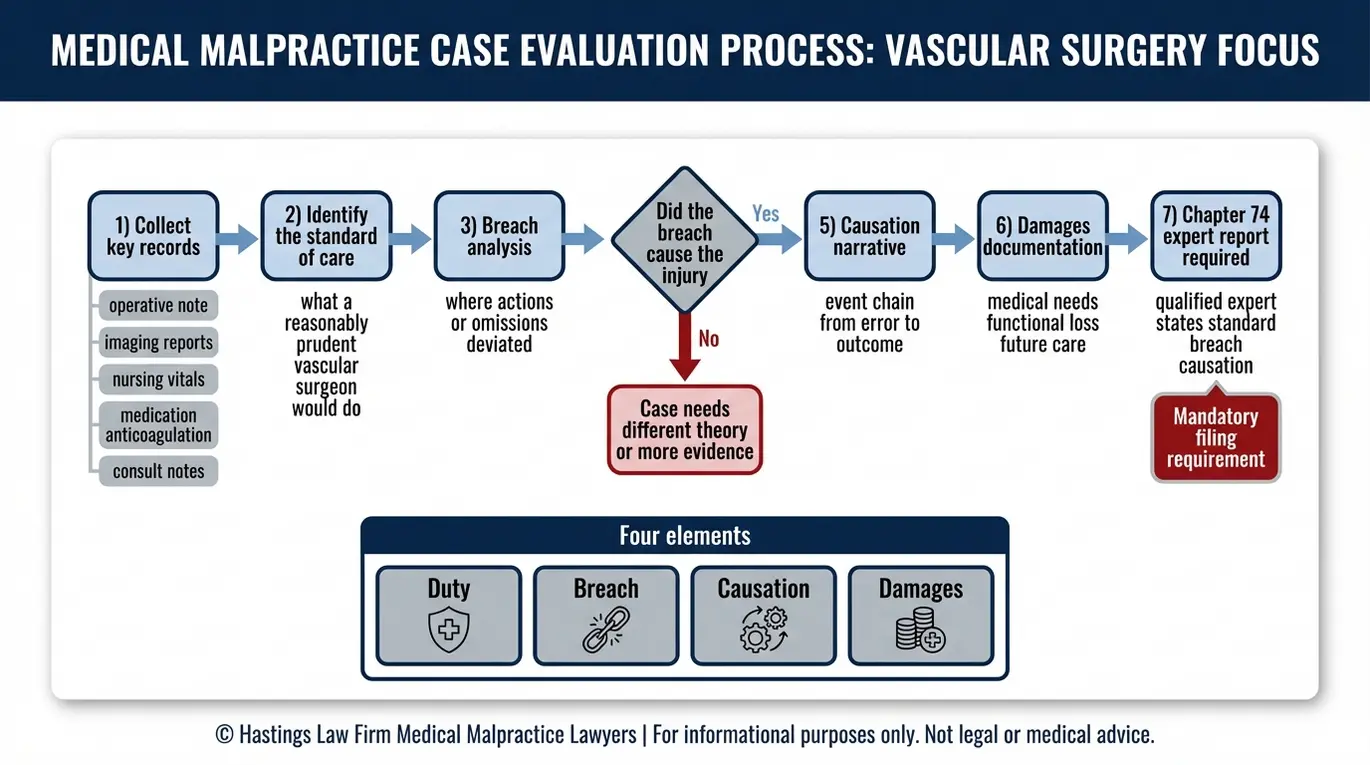
Proving a claim in Texas requires a Chapter 74 expert report from a qualified vascular surgeon stating exactly how the defendant breached the standard of care and establishing causation for the specific injury. Under Texas Civil Practice and Remedies Code § 74.351, this report must be served within 120 days of the defendant’s original answer, or the case faces automatic dismissal.
Every medical malpractice claim, including those involving suing a vascular surgeon, requires proof of four elements. You must show the surgeon owed a duty of care and that the duty was breached. You also must prove the breach directly caused the injury and resulted in actual damages. The Texas Department of Insurance also provides guidance on medical necessity disputes that can intersect with these claims.
In challenging vascular cases, expert witness testimony is often the deciding factor. Our team works with board-certified vascular surgeons nationwide who can provide credible, objective analysis of the care in question and clearly explain the failures to a jury. Working with a qualified Texas vascular surgeon malpractice lawyer is important to manage these technical requirements.
Contact the Texas Surgical Error Attorneys at Hastings Law Firm Today for Help
If a vascular procedure left you or someone you love with a devastating injury, you deserve answers and a clear path forward. Hastings Law Firm is built to handle exactly these cases. Our firm, founded by Tommy Hastings, who is board-certified in Personal Injury Trial Law, focuses exclusively on medical negligence and uses in-house nurse consultants and medical experts to investigate your care.
As your Texas vascular surgeon malpractice lawyer, we prepare every case as if it is going to trial. We work on a contingency fee basis, meaning you pay no attorney fees or costs unless we recover compensation for you.
Texas law imposes strict filing deadlines that, once missed, permanently bar your claim. Contact Hastings Law Firm today for a free, confidential case evaluation so we can review your records and explain your options.
Frequently Asked Questions About Vascular Surgeon Malpractice in Texas


This content was researched and written by the Hastings Law Firm editorial team, which includes attorneys, medical professionals, and experienced researchers. Our writing is informed by internal knowledge and practical experience, and we cross-check critical details against authoritative sources cited throughout. Every piece undergoes human-led fact-checking and legal review. Because legal and medical information can change, if you spot an error, please contact us. Learn more about our content standards and review process on our editorial policy page.

Brady D. Williams is a nationally recognized medical malpractice attorney who has spent his career handling high-stakes litigation for injured patients and families across the country. Licensed in both Texas and California, Brady draws on experience from hundreds of resolved medical cases to break down complex legal and medical topics for the people who need that information most. His writing reflects the same attention to detail and commitment to clarity that he brings to every case he handles.
