


Texas Medical Paralysis Lawyer
Paralysis caused by a medical error can disrupt independence, work, and daily life while creating long term medical and personal needs. These injuries are often linked to surgical mistakes, anesthesia complications, or failures to recognize and respond to post operative warning signs. Not every poor outcome is malpractice, and the key issue is whether care fell below the accepted standard and directly caused permanent harm. If you or a loved one were harmed or worse due to medical negligence causing paralysis in Texas, contact Hastings Law Firm for a free, confidential case review.

Last Updated: July 27, 2026
Compassionate Texas Medical Attorneys for Paralysis Negligence Claims
Paralysis caused by a medical error changes everything in an instant. Your independence, your ability to work, your daily routines, and your plans for the future are all disrupted by something that should not have happened. If you or a loved one is living with paralysis after a surgical procedure, failed diagnosis, or treatment error, the confusion and grief you feel right now are completely understandable.
At Hastings Law Firm, we focus exclusively on medical malpractice. Our team of attorneys, in-house nurse consultants, and board-certified patient advocates understands both the medicine and the law behind these cases. Our founder, Tommy Hastings, is a board-certified trial lawyer, a credential held by less than 2% of Texas attorneys. Acting as your Texas medical paralysis lawyer, we investigate what went wrong, determine whether negligence caused the injury, and pursue the full compensation our clients need to rebuild their lives.
If you believe a medical error led to paralysis, we welcome the chance to review your situation in a free, confidential consultation. There is no fee unless we recover for you.

Medical Negligence Leading to Paralysis in Texas
Medical negligence leads to paralysis when a healthcare provider fails to meet the standard of care, the accepted level of treatment a reasonably competent professional would provide under similar circumstances, and that failure directly injures the spinal cord, the bundle of nerves transmitting messages between the brain and body, or the central nervous system (CNS), the body’s command center made up of the brain and the spinal cord that controls movement and sensation throughout the body. In severe cases, this trauma results in permanent nerve damage that disrupts communication between the brain and muscles.
Not every surgery that results in paralysis is malpractice. Some procedures carry inherent risk, and a poor outcome alone does not mean the doctor was negligent. The distinction lies in whether the provider deviated from what other qualified professionals would have done in the same situation. If the injury resulted from an error, a lapse in judgment, or a failure to act, rather than a recognized and properly disclosed risk, it may be actionable negligence.
Paralysis cases demand a higher level of legal and medical scrutiny because the consequences are permanent and life-altering. Establishing the connection between a provider’s conduct and a catastrophic spinal cord injury requires detailed medical analysis, expert testimony, and a legal team that understands neurology. Unlike minor injury claims, these cases often involve complex disputes over the standard of care, distinguishing between the natural progression of a disease and the results of medical error. A medical malpractice lawyer for paralysis cases will know how to build the evidence needed to hold the responsible parties accountable and secure the resources necessary for a lifetime of care.
Common Surgical Errors That Cause Permanent Paralysis
Surgical errors such as wrong-site surgery, improper positioning, anesthesia mistakes, and accidental nerve damage are among the leading causes of preventable paralysis in medical settings. These errors represent a failure to follow established safety protocols during a procedure. They can occur during spinal surgery, orthopedic procedures, or even routine operations where the spine or nervous system is placed at risk.
The types of surgical mistakes that Texas paralysis attorneys investigate most often include:
- Direct surgical trauma: A surgeon may nick, compress, or sever the spinal cord or surrounding nerves during an operation, causing immediate and often irreversible damage.
- Anesthesia complications: Errors during epidural or spinal anesthesia can lead to a spinal epidural hematoma, a collection of blood that forms near the spinal cord and compresses it. If not identified and treated quickly, the pressure can cause permanent paralysis.
- Post-operative monitoring failures: After surgery, complications like a spinal epidural abscess, an infection that creates a pocket of pus near the spine, can develop. When surgical teams fail to recognize the warning signs, the window to intervene closes rapidly, and paralysis can result.
Each of these scenarios involves a specific point where a provider either acted below the standard of care or failed to act at all. A paralysis lawyer evaluates the surgical records, anesthesia logs, and nursing notes to identify exactly where the breakdown occurred. This investigation helps determine if surgical trauma was preventable.
Surgical Positioning Injuries
During lengthy procedures, how the patient is positioned on the operating table matters more than most people realize. Improper positioning can compress blood vessels or nerves, cutting off blood supply to the spinal cord. This condition, known as spinal cord ischemia (a loss of blood flow to spinal tissue), can cause permanent paralysis even when the surgery itself was performed correctly.
Nerve impingement, where a nerve is pinched or compressed due to positioning, is another risk. The surgical team has a responsibility to monitor and adjust positioning throughout the operation to prevent these injuries.
Wrong-Level Spinal Surgery
Wrong-level spinal surgery, an error where a surgeon operates on the incorrect vertebrae, occurs when the provider targets the wrong segment of the spine. This type of error can destabilize healthy segments of the spine and damage nerves that were functioning normally before the procedure.
Wrong-level errors are considered a never event, something that should not happen under any circumstances with proper surgical protocols. These cases often involve failures in pre-operative verification, imaging review, or surgical site marking.
The Hastings Law Firm Difference
Results matter, but what truly sets us apart is how we achieve them. Every verdict, every settlement, and every Texas courtroom victory comes from one guiding promise: To treat each client’s fight for justice as if it were our own.
This balance of skill, experience, and empathy reflects our core philosophy that justice should not only compensate the injured, but also make health care safer nationwide.

Understanding Spinal Cord Injury Classifications
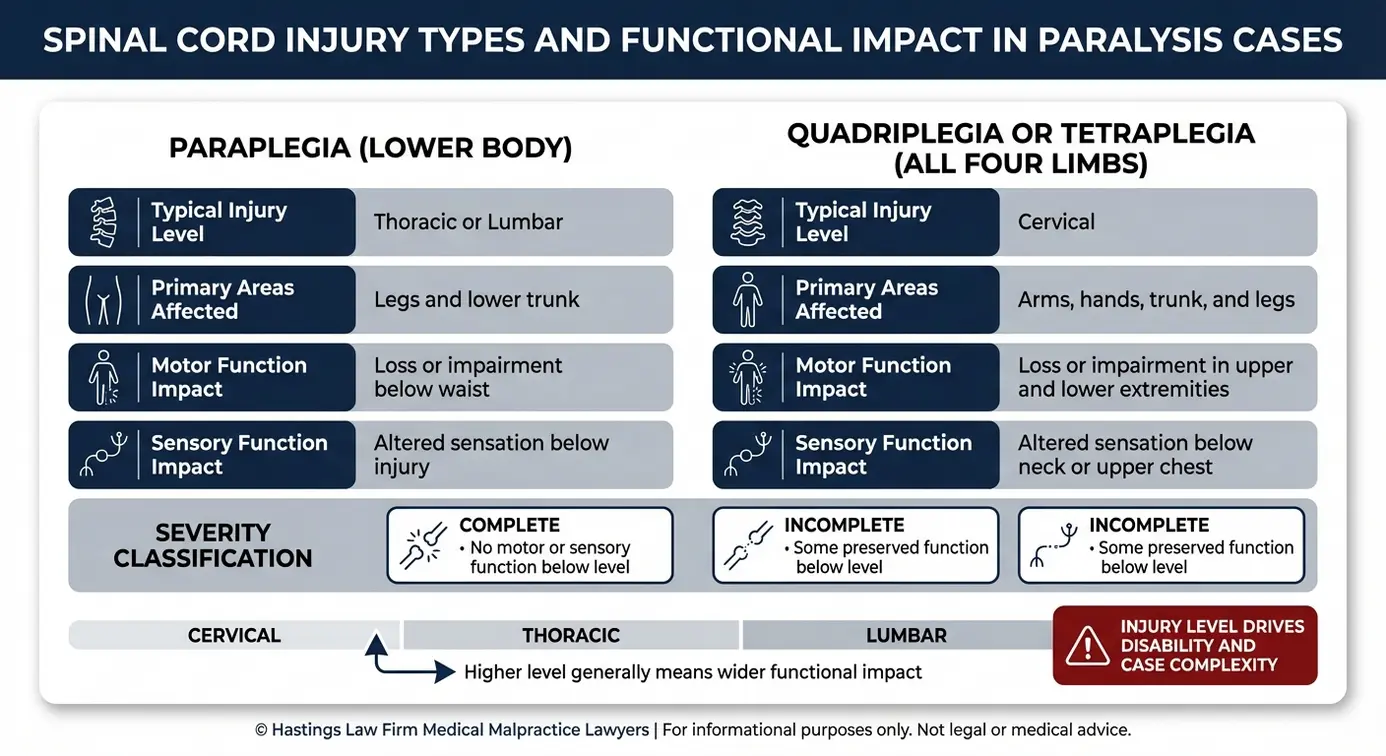
Spinal cord injuries are classified by severity as either complete or incomplete and by location as quadriplegia (also known as tetraplegia), paralysis affecting all four limbs, or paraplegia, paralysis affecting the lower body, which together determine the extent of lost motor function (the ability to move) and sensory function (the ability to feel). These medical terms help define the specific limitations a patient will face.
The level of the spine where the injury occurs dictates how much of the body is affected. Injuries higher on the spinal cord, in the cervical (neck) region, tend to affect all four limbs. Injuries lower on the cord, in the thoracic or lumbar regions, typically affect the lower body. According to the International Standards for Neurological Classification of Spinal Cord Injury (ISNCSCI), these classifications provide the medical framework used to assess injury severity and guide treatment.
| Classification | Area Affected | Typical Functional Impact |
|---|---|---|
| Paraplegia | Lower body (legs, lower trunk) | Loss of movement and sensation below the waist; may require a wheelchair |
| Tetraplegia (Quadriplegia) | All four limbs and trunk | Loss of movement and sensation in arms, legs, and torso; often requires full-time care |
| Complete Injury | All function below injury site | No motor or sensory function below the level of injury |
| Incomplete Injury | Partial function below injury site | Some motor or sensory function preserved; recovery potential varies |
Understanding these classifications matters from a legal standpoint because the severity and permanence of the injury directly shape the details of the claim and the amount of compensation needed. A paralysis injury lawyer uses this medical framework to demonstrate the full scope of quadriplegia or other conditions to a jury.
Proving Liability in Texas Paralysis Malpractice Cases
Proving liability requires showing that a doctor breached the duty of care and that this breach was the direct cause of the patient’s paralysis, a process that almost always depends on expert medical testimony. Liability is the legal responsibility one party has for the harm caused to another.
Every medical malpractice case in Texas rests on four legal elements:
- Duty: The healthcare provider owed the patient a duty of care by agreeing to treat them.
- Breach: The provider failed to meet the accepted standard of care.
- Causation: The breach directly caused the patient’s injury.
- Damages: The patient suffered real, measurable harm as a result.
Causation is often the most contested element in paralysis cases. Defense attorneys frequently argue that the patient’s underlying condition, not the provider’s actions, caused the paralysis. This is why qualified expert medical testimony is essential. Neurosurgeons, neurologists, and other specialists review the medical records and testify about what should have been done differently and how that failure led to the spinal cord injury.
Texas courts have reinforced the requirement that expert testimony must clearly link the provider’s conduct to the patient’s harm. At Hastings Law Firm, our in-house medical staff and national network of experts work together to reconstruct exactly what happened and establish that link. As a Texas medical paralysis lawyer, we prepare every case with the expectation that causation will be challenged. A skilled paralysis attorney knows how to build the evidence to withstand that challenge.
Informed Consent vs. Actionable Negligence
Signing a consent form before surgery does not waive your right to pursue a malpractice claim. Informed consent means the doctor explained the known risks associated with the procedure, and you agreed to move forward. It does not give a provider permission to perform the procedure negligently.
If paralysis resulted from a deviation from the standard of care, such as a technical error, a failure to respond to complications, or operating on the wrong surgical site, the consent form does not shield the provider from liability. The question is not whether you accepted risk. The question is whether the provider caused harm through substandard care.

Calculating Damages for a Lifetime of Care
Damages in paralysis cases cover immediate medical costs, projected lifetime care needs, lost earning capacity, and non-economic harm like pain, suffering, and loss of quality of life. These financial awards are intended to provide the resources necessary for a patient to live as independently as possible.
Economic damages in these cases typically include:
- Emergency medical treatment and surgeries
- Ongoing rehabilitation and physical therapy
- 24/7 nursing or attendant care
- Home and vehicle modifications for accessibility
- Assistive devices such as wheelchairs and adaptive technology
- Lost wages and diminished future earning capacity
Non-economic damages address the harm that does not come with a receipt: mental anguish, physical impairment, loss of independence, and the impact on personal relationships (sometimes called loss of consortium).
A medical paralysis attorney will work with life-care planning specialists to develop a Life Care Plan, a detailed projection of every medical need, service, and cost the patient will require for the rest of their life. This comprehensive document accounts for inflation, rising medical costs, and the patient’s specific life expectancy. It is one of the most important pieces of evidence in a paralysis claim because it translates the reality of daily living into a figure that reflects the true cost of the injury.
The Texas Statute of Limitations for Paralysis Claims
In Texas, the statute of limitations for medical malpractice claims is generally two years from the date the injury occurred or was discovered. This is the legal deadline for filing a lawsuit. Missing this deadline can permanently bar you from filing a claim, regardless of how strong the evidence may be.
Texas also imposes a statute of repose, which sets an absolute 10-year outer limit from the date of the negligent act. Even if the injury was not discovered until years later, no claim can be filed after that 10-year window closes. This statute of limitations and the repose period are strict; even if you could not have discovered the negligence earlier, the court will dismiss a claim filed after this period.
In limited circumstances, the discovery rule may extend the two-year deadline if the injury could not reasonably have been identified sooner. Because these deadlines are strict and fact-specific, speaking with a Texas paralysis malpractice lawyer early protects your ability to pursue a claim.

Contact the Texas Surgical Error Attorneys at Hastings Law Firm Today for Help
Living with paralysis caused by a medical error is overwhelming, and you do not have to sort through the legal and medical questions alone. At Hastings Law Firm, our team of attorneys, nurses, and patient advocates is ready to review your case, explain your options, and help you understand what happened.
As a Texas medical paralysis lawyer, we charge no fees unless we secure a recovery for you. Contact us today for a free, confidential case evaluation, and let us help you take the first step toward protecting your future.
Frequently Asked Questions About Medical Paralysis in Texas


This content was researched and written by the Hastings Law Firm editorial team, which includes attorneys, medical professionals, and experienced researchers. Our writing is informed by internal knowledge and practical experience, and we cross-check critical details against authoritative sources cited throughout. Every piece undergoes human-led fact-checking and legal review. Because legal and medical information can change, if you spot an error, please contact us. Learn more about our content standards and review process on our editorial policy page.

Brady D. Williams is a nationally recognized medical malpractice attorney who has spent his career handling high-stakes litigation for injured patients and families across the country. Licensed in both Texas and California, Brady draws on experience from hundreds of resolved medical cases to break down complex legal and medical topics for the people who need that information most. His writing reflects the same attention to detail and commitment to clarity that he brings to every case he handles.
