


What is the Standard of Care in Arizona Medical Malpractice Cases?
Doubts about medical care often surface after the fact, when a patient or family begins to wonder whether the harm they live with could have been prevented. Those doubts are hard to settle, because not every bad result comes from a mistake. The law draws that line with the standard of care, which compares what happened with what a reasonable provider in the same profession would have done. Understanding how that measure works in Arizona can make it easier to see whether the care a patient received fell short.

Last Updated: November 4, 2026
What You Should Know About the Standard of Care in Arizona Medical Malpractice Cases:
- Under Section 12-563 of the Arizona Revised Statutes, the standard of care is the degree of care, skill and learning expected of a reasonable, prudent health care provider in the same profession or class, within Arizona, acting in the same or similar circumstances.
- Arizona’s standard of care asks for reasonable care under the circumstances, not the highest possible degree of care or skill.
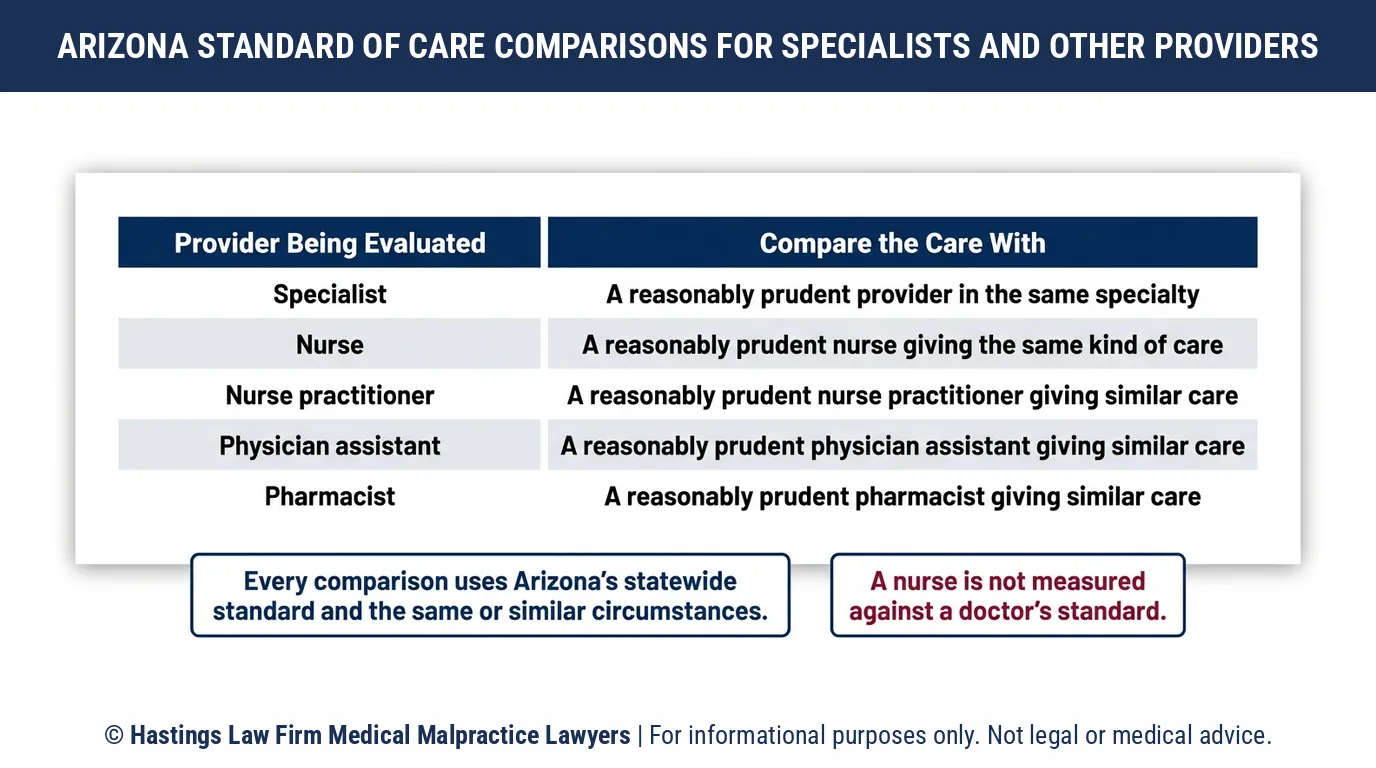
- Arizona applies one statewide standard of care to every health care provider, comparing a specialist with a reasonably prudent provider in the same specialty and a nurse with a reasonably prudent nurse.
- In Arizona, a bad medical outcome or a choice between accepted treatments does not by itself show that a provider breached the standard of care.
- A breach of the standard of care is usually proven in Arizona through a qualified medical expert, and when a case reaches a jury, the jurors decide whether the standard was met.
- In Arizona, clinical guidelines, hospital policies, and FDA drug warnings do not set the standard of care on their own, and breaking a hospital protocol does not automatically prove malpractice.
- Falling below the standard of care is ordinary negligence, so an Arizona medical malpractice claim does not require proof of gross negligence.
- An Arizona patient proves negligence, causation, and damages by a preponderance of the evidence, and A.R.S. § 12-572 raises the proof of breach and causation to clear and convincing evidence for care that complies with EMTALA or is given as a result of a disaster.
- A patient or family can request the medical records in writing under A.R.S. § 12-2293 to have the care reviewed, and an Arizona medical malpractice claim generally must be filed within two years after it accrues.
How Does Arizona Law Define the Standard of Care in Medical Malpractice?
In Arizona, the standard of care in medical malpractice is the degree of care, skill and learning expected of a reasonable, prudent health care provider in the same profession or class, within the state, acting in the same or similar circumstances. Section 12-563 of the Arizona Revised Statutes sets that measure. A patient must prove that the provider fell below it and that the failure caused the injury.
The standard of care in Arizona medical malpractice cases asks for reasonable care. In Smethers v. Campion, the Arizona Court of Appeals said the standard is not the highest degree of care or skill. What matters is what a reasonably prudent provider would have done.
The statute’s words “same or similar circumstances” bring the setting of the care into the comparison. A provider is compared with a reasonable member of the same profession or class who faced a similar situation.
Which Standard of Care Applies to a Specialist or Other Provider in Arizona?
Arizona applies one statewide standard of care to specialists, nurses, and every other provider, not a local one. A decision of the Arizona Court of Appeals, McGuire v. DeFrancesco, explains that A.R.S. § 12-563 replaced the older split between local and broader standards with a statewide standard for all providers. Evidence may show the Arizona standard matches a national one, though the statute does not adopt a national standard.
Within that statewide standard, a specialist’s care is compared with what a reasonably prudent provider in the same specialty would do in similar circumstances. The expert who testifies about that care must share the specialty, and the board certification where the provider has one, under A.R.S. § 12-2604.
The statewide standard reaches beyond doctors. Hospitals and their staff, physician assistants, nurse practitioners, and other licensed providers owe it too, and each is compared with others in the same profession.
Does Arizona Hold a Nurse to the Same Standard of Care as a Doctor?
Arizona does not hold a nurse to a doctor’s standard of care. A nurse’s care is measured against what a reasonably prudent nurse would do in the same or similar circumstances, because A.R.S. § 12-563 compares each provider with others in the same “profession or class.” The Arizona Supreme Court applied that wording to nursing care in Rasor v. Northwest Hospital.
The kind of nursing care involved is part of that comparison, so no single nursing standard covers every setting. A nurse is compared with nurses giving the same kind of care in similar circumstances, which is why a nursing malpractice claim looks closely at the care a particular patient needed.
Nurse practitioners, physician assistants, and pharmacists are measured the same way, against others in their own profession giving similar care. A registered nurse practitioner makes independent decisions within an authorized specialty and must consult or refer when the law requires it. A physician assistant’s supervision requirements depend on the clinical experience the board certifies, and pharmacists can face claims for negligent pharmaceutical care.
Whatever the provider’s profession, the expert who testifies about that provider’s standard of care must have spent most of the year before the care in active clinical practice or teaching in the same health profession. That means the expert who explains a nurse’s care comes from nursing, not from a related field.
Does a Bad Medical Outcome in Arizona Mean the Care Was Negligent?
A bad medical outcome in Arizona does not by itself mean the care was negligent, because the standard of care measures the care, not the result. A ruling of the Arizona Supreme Court, Boyce v. Brown, holds that negligence cannot be presumed from the mere fact that a treatment was unsuccessful.
At the same time, calling an injury a complication does not rule negligence out. Medicine carries risk, but when an injury was preventable, the providers responsible should be held accountable.
A provider’s choice between treatments is measured by the same standard. Where more than one method of care is approved, a provider must select and follow one of them, as the commentary to the Revised Arizona Jury Instructions (Civil) on medical negligence explains. Picking one accepted method over another does not, on its own, establish negligence, although whether the method fit the patient and was carried out properly still matters.
When care is not carried out properly, it can fall below the standard in many ways. A test result that called for follow-up and never got it can support a failure to diagnose claim. A wrong drug or dose can be a medication error, and an operation on the wrong body part is wrong-site surgery.
How Do You Prove a Breach of the Standard of Care in Arizona?
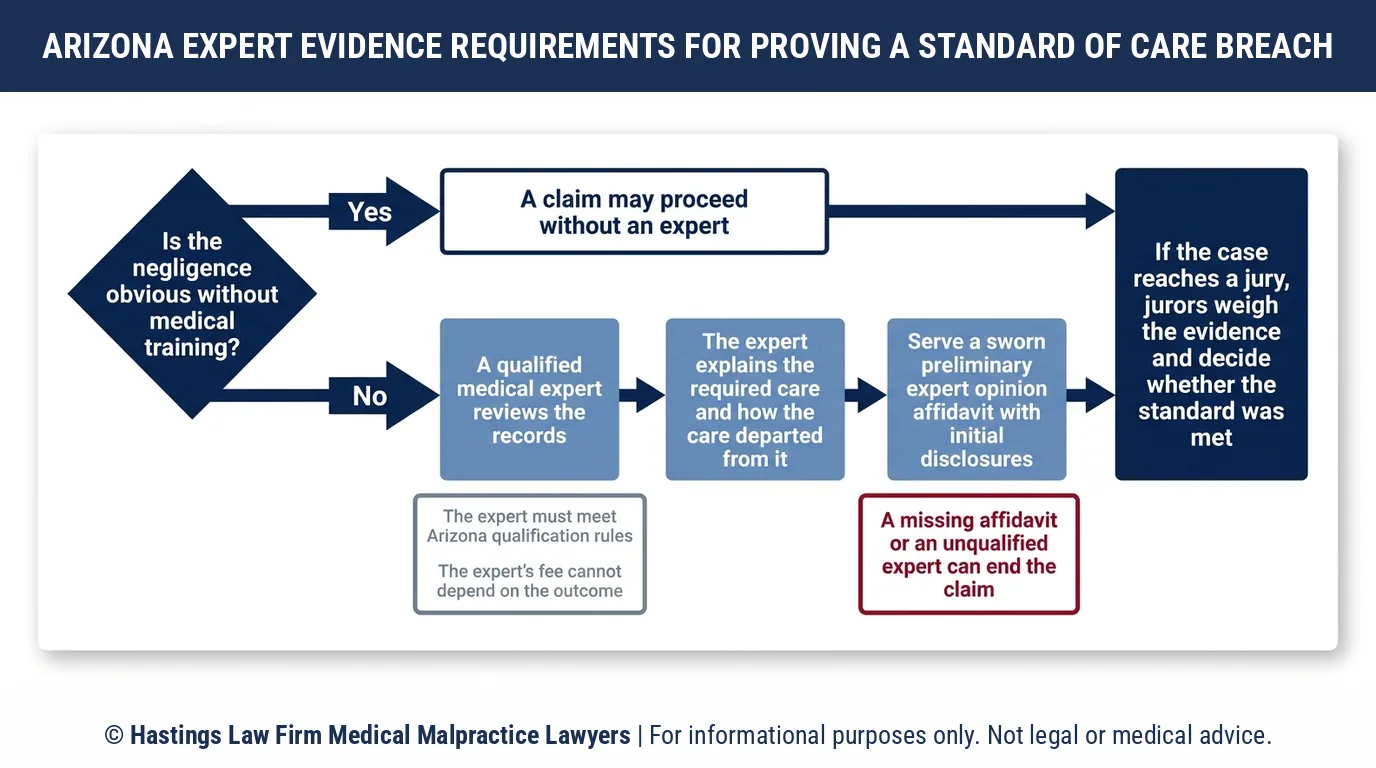
A breach of the standard of care is usually proven in Arizona through a qualified medical expert, who reviews the records, explains what the standard required, and shows how the care departed from it. An opinion of the Arizona Supreme Court, Seisinger v. Siebel, confirmed that the standard normally must be established by expert medical testimony.
Whether the provider met the standard is a question of fact, as the Arizona Supreme Court recognized in Riedisser v. Nelson. When a case reaches a jury, the jurors weigh the expert evidence and answer that question themselves. A claim without the evidence it needs can end before it ever reaches trial.
When experts disagree, jurors judge how believable each one is and may accept or reject any opinion, and the jury instructions caution against deciding by the number of experts. Each side is generally limited to one retained expert per issue unless the parties agree or the court allows more, and the provider being sued can also testify about the standard that applied to their own care.
Arizona tests that expert evidence early. When an expert is needed, the patient must serve a sworn preliminary expert opinion affidavit with the initial disclosures under A.R.S. § 12-2603, from an expert who meets the qualifications in § 12-2604 and whose fee does not depend on the outcome. A missing affidavit or an unqualified expert can end the claim. A case can go forward without an expert only when the negligence would be obvious to someone with no medical training.
Do Medical Guidelines and Hospital Policies Set the Standard of Care in Arizona?
Clinical practice guidelines and hospital policies do not set the standard of care on their own in Arizona. A relevant guideline or protocol can be evidence the jury weighs alongside expert testimony. Under a decision of the Arizona Court of Appeals, Peacock v. Samaritan Health Service, breaking a hospital protocol does not automatically prove negligence.
Prescription-drug warnings follow a similar rule. In Francisco v. Affiliated Urologists, the Arizona Supreme Court held that a U.S. Food and Drug Administration (FDA) drug warning cannot by itself establish the standard or replace needed expert testimony. In the other direction, following a policy does not automatically defeat a claim. A hospital can also answer for its own negligence in selecting, credentialing, or supervising doctors.
How Does the Standard of Care Compare With Duty of Care and Negligence in Arizona?
The duty of care asks whether a provider owed the patient care at all, the standard of care measures what level of care was owed, and negligence is the failure to meet that standard. A duty usually comes from the provider-patient relationship. Whether a legal duty exists is a question for the court to decide, as a ruling of the Arizona Supreme Court, Gipson v. Kasey, explains.
Medical malpractice is negligence by a licensed health care provider. Arizona measures it against the professional standard in A.R.S. § 12-563, the care a reasonably prudent member of the same profession would have given.
Falling below that professional standard is ordinary negligence, so a malpractice claim does not have to prove gross negligence. Punitive damages, which punish rather than compensate, ask for more. In Swift Transportation v. Carman, the Arizona Supreme Court confirmed that they require clear and convincing proof of an evil mind, and that negligence or gross negligence alone falls short.
What Else Must You Prove in an Arizona Medical Malpractice Claim?
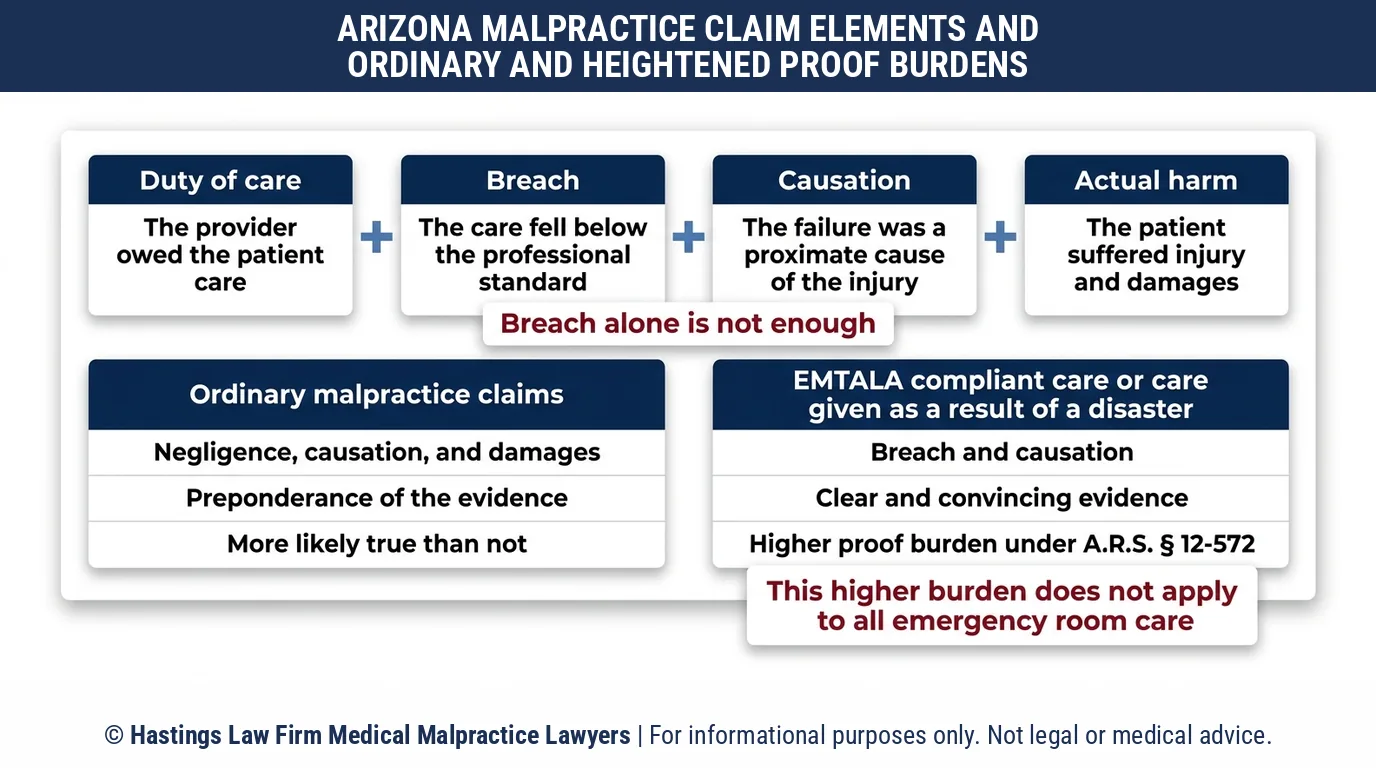
An Arizona medical malpractice claim requires proof of a duty of care, causation, and actual harm, along with a breach of the standard of care. Under A.R.S. § 12-563, the patient must prove both the breach and that it caused the injury, so showing that the care fell short is not enough on its own.
Causation requires that the failure was a proximate cause of the injury, meaning it led to the injury through a natural and continuous chain of events. Medical evidence usually has to show that connection as probable, not merely possible, and the negligence does not have to be the injury’s only cause. Timing alone does not prove it, which is why proving causation after a medical error in Arizona takes careful work.
The patient proves negligence, causation, and damages by a preponderance of the evidence, which means showing that each is more likely true than not. The Arizona Court of Appeals described that ordinary civil burden in Pfeil v. Smith, and an ordinary malpractice claim does not require proof beyond a reasonable doubt.
For some emergency care, Arizona raises that burden. Under A.R.S. § 12-572, when care complies with the federal Emergency Medical Treatment and Labor Act (EMTALA) or is given as a result of a disaster, the patient must prove the breach and causation by clear and convincing evidence. That higher standard applies to claims against both the health professional and the hospital. The rule does not cover all emergency room care, and claims about care outside those conditions use the ordinary burden.
The professional standard also applies to what a patient is told before a procedure. When a patient agreed to a procedure but was not adequately told its risks, a failure to obtain informed consent claim is a negligence claim, judged against what a reasonably prudent provider in that field would have disclosed.
The Hastings Law Firm Difference
Results matter, but what truly sets us apart is how we achieve them. Every verdict, every settlement, and every courtroom victory comes from one guiding promise: To treat each client’s fight for justice as if it were our own.
This balance of skill, experience, and empathy reflects our core philosophy that justice should not only compensate the injured, but also make health care safer nationwide.

What Should You Do if You Think an Arizona Provider Fell Below the Standard of Care?
If you think an Arizona provider fell below the standard of care, write down what happened and when, request the medical records, and have an attorney and a medical expert in the same field review them against the standard. The records show what was done, and the review shows whether it met what a reasonably prudent provider would have done.
You or your health care decision maker can request the records in writing under A.R.S. § 12-2293. For a request made for litigation, Arizona sets a response period of 30 calendar days, and reasonable copy charges may apply. Asking early gives that review the time it needs.
A complaint to the Arizona Medical Board is a separate process from that review. The board investigates and disciplines physicians, but a complaint does not start a malpractice claim, and the board does not award damages for an injury.
A malpractice claim runs on its own filing deadline. Arizona’s statute of limitations, A.R.S. § 12-542, generally requires a claim to be filed within two years after it accrues, which can be later than the date of care. Under the discovery rule, the clock starts when the patient knew or reasonably should have known enough to suspect the injury was caused by negligence.
Talk to an Arizona Medical Malpractice Attorney About the Care You Received
When you contact Hastings Law Firm, a member of our intake team asks about the care, when it happened, and who provided it. We then request the medical records at no cost to you, and our attorneys and medical professionals review them, bringing in a medical expert when a case needs one. Once that review is complete, we contact you with an honest answer about whether you have a claim.
Our medical malpractice lawyers are experienced in handling Arizona claims that depend on what the standard of care required. We understand what it means for a patient and family to learn that the care they received fell short, often while they are still living with its effects. Our team includes former defense attorneys who understand how medical injury claims are defended, and Hastings Law Firm has been dedicated exclusively to medical malpractice since 2005.
That first review costs you nothing. We handle every case on a contingency fee, so you pay no attorney fees or costs unless we win, and we advance the cost of experts and everything else it takes to build the claim. Our Arizona medical malpractice lawyers are here for you. Contact us now for a free, confidential case review.
Sources
- A.R.S. § 12-563 on the elements of proof in a medical malpractice case | Arizona State Legislature
- Smethers v. Campion opinion on reasonable care, specialty comparison and guidelines | Justia
- McGuire v. DeFrancesco opinion on Arizona’s statewide standard of care | Justia
- A.R.S. § 12-2604 on who may testify about the standard of care | Arizona State Legislature
- Rasor v. Northwest Hospital opinion applying the standard to nursing care | Arizona Supreme Court
- A.R.S. § 32-1601 defining the registered nurse practitioner’s scope | Arizona State Legislature
- Boyce v. Brown opinion on unsuccessful treatment and negligence | Justia
- Revised Arizona Jury Instructions (Civil) on medical negligence and their comments | State Bar of Arizona
- Seisinger v. Siebel opinion on expert testimony and the standard of care | Arizona Supreme Court
- Riedisser v. Nelson opinion on a physician’s skill as a question of fact | Justia
- A.R.S. § 12-2603 on the preliminary expert opinion affidavit | Arizona State Legislature
- Peacock v. Samaritan Health Service opinion on hospital protocols as evidence | Justia
- Francisco v. Affiliated Urologists opinion on FDA drug warnings and expert testimony | Justia
- Gipson v. Kasey opinion holding that the court decides whether a duty exists | Justia
- Swift Transportation v. Carman opinion on the proof punitive damages require | Arizona Supreme Court
- Pfeil v. Smith opinion on the preponderance burden in civil actions | Justia
- A.R.S. § 12-572 on the burden of proof for EMTALA and disaster care | Arizona State Legislature
- A.R.S. § 12-2293 on patient requests for medical records | Arizona State Legislature
- A.R.S. § 12-542 on the two-year deadline for medical malpractice claims | Arizona State Legislature

This content was researched and written by the Hastings Law Firm editorial team, which includes attorneys, medical professionals, and experienced researchers. Our writing is informed by internal knowledge and practical experience, and we cross-check critical details against authoritative sources cited throughout. Every piece undergoes human-led fact-checking and legal review. Because legal and medical information can change, if you spot an error, please contact us. Learn more about our content standards and review process on our editorial policy page.

Tommy Hastings, founder of Hastings Law Firm, is a board-certified personal injury trial lawyer (by the Texas Board of Legal Specialization) dedicated exclusively to healthcare injury cases. Since 2001, he has represented injured patients and families in litigation against major hospital systems, pharmaceutical companies, and negligent healthcare providers nationwide. He has handled numerous high-profile cases that have drawn national media attention and resulted in multi-million dollar recoveries.
