


What is the Statute of Limitations for Medical Malpractice in Arizona?
Some medical injuries surface only after the care has ended, leaving patients and families with unanswered questions about what went wrong. The first sign may come from a new doctor or from a condition that keeps getting worse, while medical bills and the strain of recovery continue to build. On top of everything else, many people in that position worry that they have already waited too long. Understanding how Arizona law treats an injury that comes to light later is often the first step toward a clear answer about what happened.

Last Updated: November 4, 2026
What You Should Know About the Arizona Medical Malpractice Statute of Limitations:
- Under A.R.S. § 12-542, Arizona generally gives two years to file a medical malpractice lawsuit, counted from when the claim accrues.
- The two years usually start when the patient knew, or reasonably should have known, enough to investigate whether negligence caused the injury, not necessarily on the day of treatment (Walk v. Ring).
- A physician’s concealment of facts about negligence can pause the Arizona filing deadline.
- A child whose medical malpractice claim accrues before age 18 generally has until age 20 to file, but a parent’s own claim keeps its ordinary two years.
- A patient of unsound mind when the claim accrues, meaning unable to manage daily affairs or understand legal rights, gets a pause in the Arizona deadline, but a serious illness or hospital stay alone does not qualify.
- An Arizona wrongful death claim based on medical negligence generally must be filed within two years of the death, though a child’s own claim for a parent’s death can be paused while the child is under 18.
- Claims against an Arizona public hospital or public employee need a written notice of claim with a specific settlement amount within 180 days after the claim accrues, and the lawsuit within one year.
- Arizona has no general medical malpractice statute of repose, an outer cutoff measured from the treatment, so the deadline depends on when the clock started and on any pause that applies, not on how long ago the treatment was.
How Long Do You Have to Sue for Medical Malpractice in Arizona?
Arizona generally gives a patient two years after a medical malpractice claim accrues to file a lawsuit, under A.R.S. § 12-542. “Accrues” is the legal word for the point at which that two-year clock starts. The same statute covers other personal injury claims, so Arizona has no separate, shorter deadline for medical malpractice.
Section 12-542 says the lawsuit must be brought within two years “and not afterward,” so a claim filed later is generally barred. In most cases, two years is how long you have to sue for medical malpractice in Arizona, and it is less time than it sounds.
When expert testimony is needed, A.R.S. § 12-2603 requires a sworn preliminary expert opinion affidavit early in the case, in which a qualified expert explains how the care fell short and how that caused the harm. Gathering the medical records and having a medical expert review them takes time, so that work usually needs to start well before the deadline.
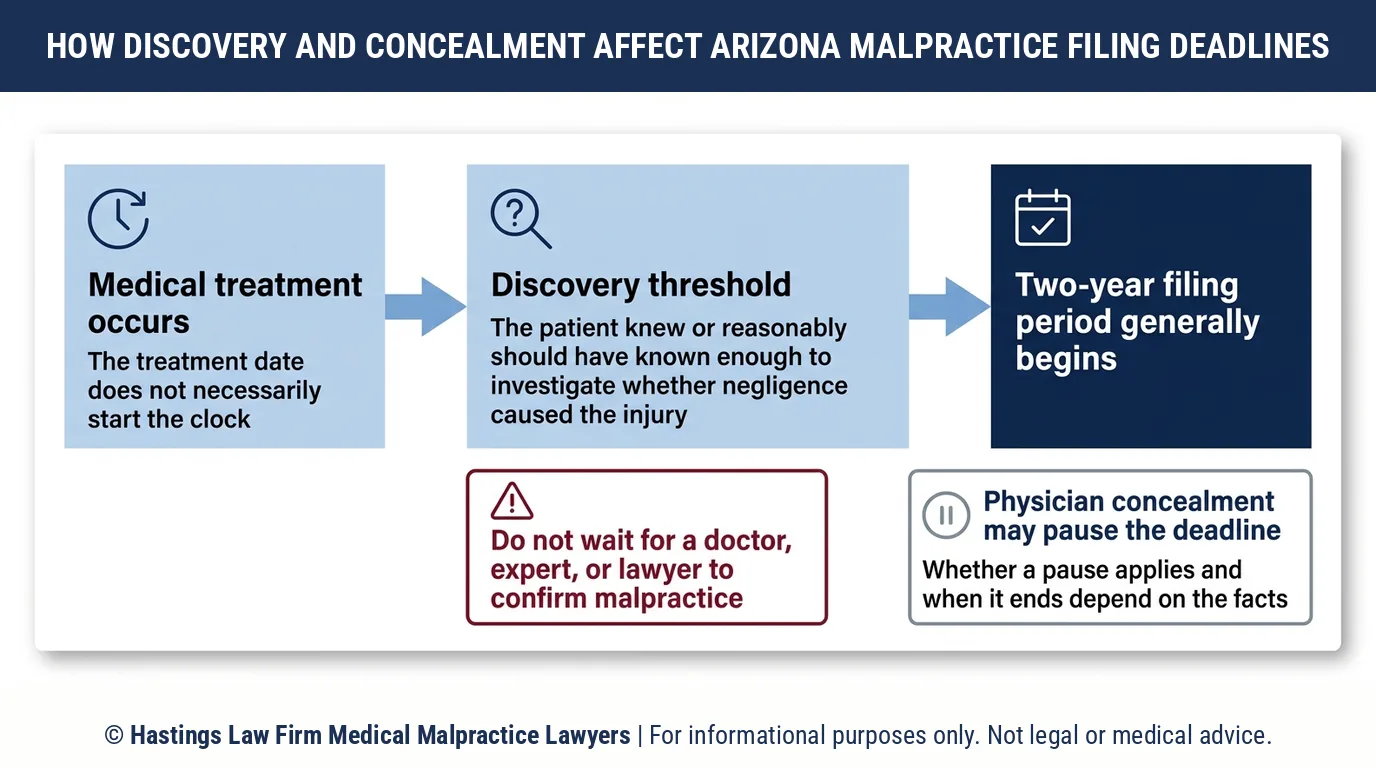
Under the Arizona medical malpractice statute of limitations, the two years do not always begin on the day of the surgery, the missed test, or the hospital stay. A patient who learns about a problem later may still have time to file.
When Does the Filing Deadline Start for an Arizona Medical Negligence Claim?
The filing deadline for an Arizona medical negligence claim usually starts when the patient knew, or reasonably should have known, enough to suspect that negligence caused the injury, not necessarily on the date of treatment. The Arizona Supreme Court set out this rule, known as the discovery rule, in Walk v. Ring.
A delayed diagnosis is a good example. A patient may learn on a later visit, from a different physician, that a serious condition was missed months earlier. Under Arizona’s medical malpractice statute of limitations, that later visit may be when the two years begin, depending on what the patient knew and when. That timing question comes up in many delayed diagnosis claims in Arizona.
The clock can start before anyone has confirmed that malpractice happened. Walk v. Ring rejected the idea that it waits for a doctor, a medical expert, or a lawyer to say so. When the two sides disagree about when the patient should have known, a jury ordinarily decides.
Concealment can also change the timing. Physicians owe their patients a duty of disclosure, and the same decision recognized that a physician’s concealment of facts about negligence can toll, or pause, the deadline. Whether that happened, and when the patient learned enough to end the pause, depends on the facts. The rules shift again when the patient is a child.
How Long Does a Child Have to File a Medical Malpractice Lawsuit in Arizona?
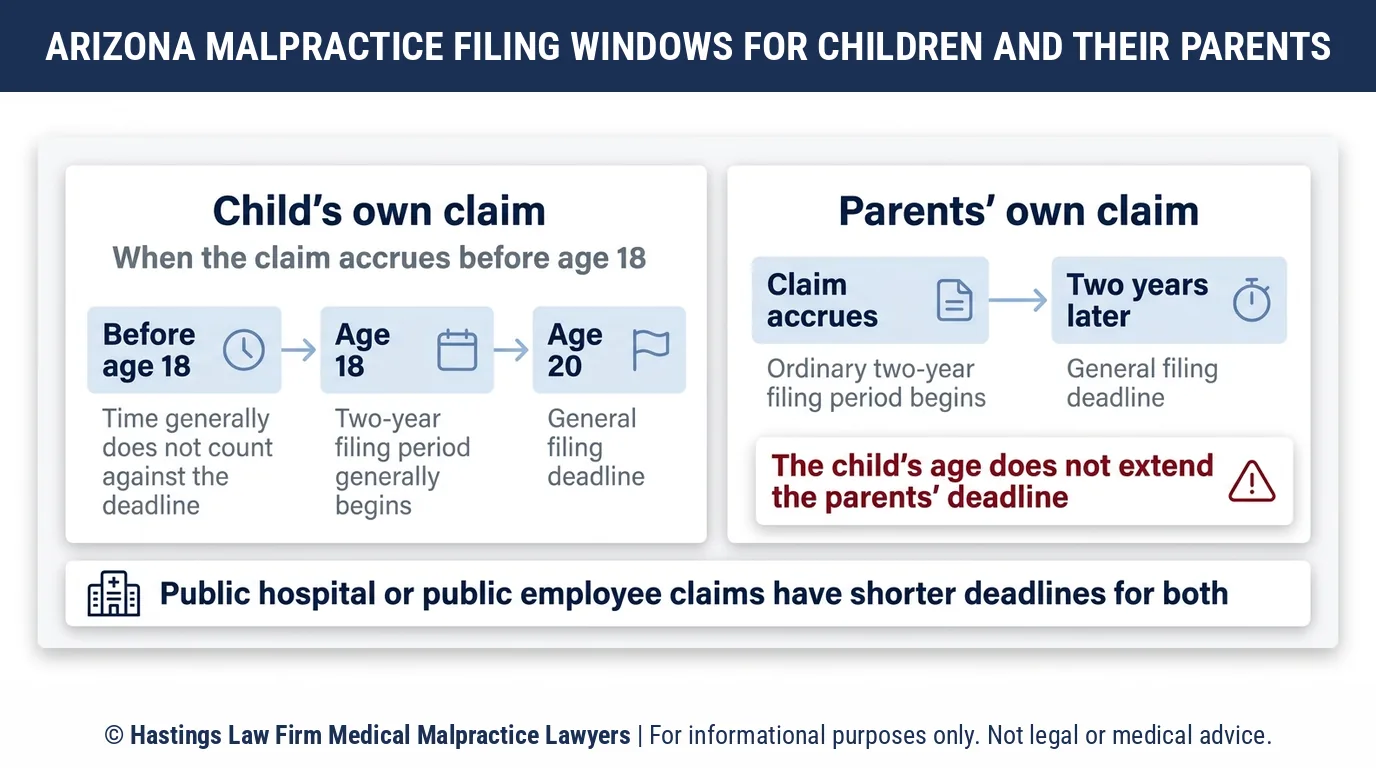
A child in Arizona generally has until age 20 to file a medical malpractice lawsuit when the child’s own claim accrues before age 18. Under A.R.S. § 12-502, the years before 18 do not count against Arizona’s two-year medical malpractice deadline, so the two years usually begin on the child’s 18th birthday.
That longer window belongs only to the child’s claim. The parents’ own claim runs on a different clock and keeps its ordinary two years. The Arizona Court of Appeals explained in Porter v. Triad of Arizona that a child’s age does not extend an adult parent’s deadline. This often comes up in birth injury claims in Arizona, where a family that waits for the child’s later deadline can let the parents’ deadline pass.
The child’s medical bills before age 18 are a separate question. Under the Arizona Supreme Court’s decision in Estate of DeSela, either the parent or the child may recover those expenses, but the same expense cannot be recovered twice. Both the child’s and the parents’ deadlines are shorter when the claim is against a public hospital or public employee.
Does a Mental Incapacity Pause the Filing Deadline for an Arizona Medical Injury Claim?
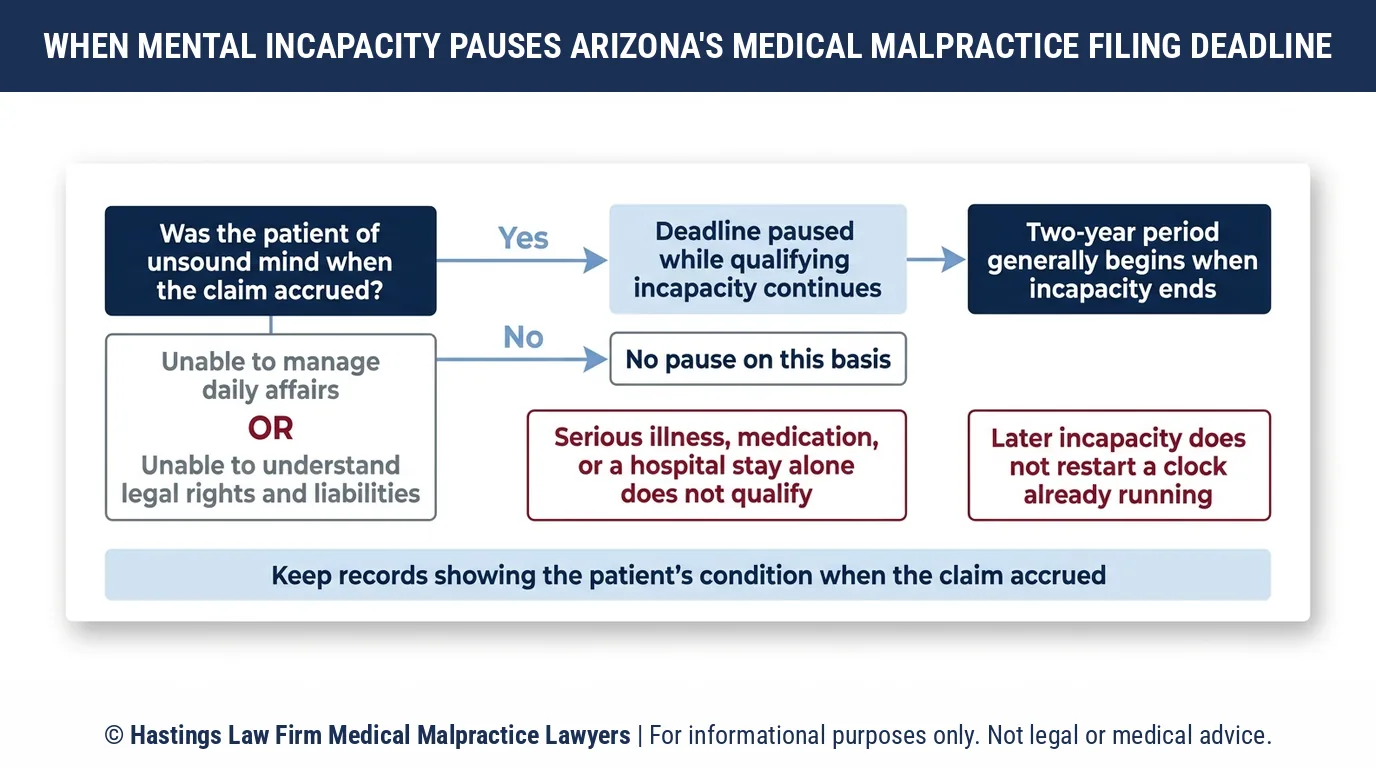
A mental incapacity can pause the filing deadline for an Arizona medical injury claim if the patient was of “unsound mind” when the claim accrued. Under Section 12-502 and the Arizona Supreme Court’s test in Doe v. Roe, unsound mind means being unable to manage daily affairs or to understand legal rights and liabilities. The two-year deadline then begins to run only when that incapacity ends.
The test calls for specific evidence. Under Kopacz v. Banner Health, an Arizona Court of Appeals decision, a serious illness, medication, or a hospital stay does not pause the deadline by itself. A later incapacity also does not restart a clock that is already running. A family whose loved one was very ill at the time should keep the records from that period, because the patient’s condition then is what the test looks at.
What is the Deadline for a Wrongful Death Claim After Medical Malpractice in Arizona?
A wrongful death claim based on medical negligence in Arizona generally must be filed within two years of the death, because A.R.S. § 12-542(2) treats the claim as accruing at the death of the patient. The surviving spouse, a child, a parent, a guardian, or the personal representative of the estate may bring the claim.
Some families learn only later that the care may have played a part in the death. When the cause was not clear at first, our attorneys review whether learning it later could affect the deadline for each family member.
A child who loses a parent has added protection. In Porter v. Triad of Arizona, the Arizona Court of Appeals held that the pause for children under A.R.S. § 12-502 can apply to a child’s own wrongful death claim for a parent’s death. That protection belongs to the child and does not extend every family member’s deadline. When the patient was a baby, the parents’ infant wrongful death claim in Arizona generally runs two years from the death.
The patient’s own injury claim is separate from the family’s. A claim the patient could still have brought at the time of death generally survives, and A.R.S. § 14-3109 pauses its deadline so it cannot expire sooner than four months after the death. Under A.R.S. § 14-3110, that surviving claim does not include the patient’s own pain and suffering damages. Each of the two claims carries its own deadline, so both are worth checking.
What Are the Deadlines for a Malpractice Claim Against a Public Hospital in Arizona?
A malpractice claim against an Arizona public hospital, other public entity, or public employee carries two deadlines shorter than the general two years: a written notice of claim within 180 days after the claim accrues, under A.R.S. § 12-821.01, and the lawsuit within one year of accrual, under A.R.S. § 12-821. The notice must state the facts and a specific amount for which the claim can be settled.
A notice of claim against a public hospital in Arizona that is filed after the 180 days is barred under Section 12-821.01. Relief from that bar is exceptional, as the Arizona Court of Appeals decision in Little v. State shows. The notice goes to the person authorized to accept legal papers for the entity under the Arizona court rules, and if the entity sends no written denial within 60 days of the filing, the law treats the claim as denied.
Both deadlines run from accrual, and a discovery standard applies here too. The clock starts when the patient realizes they were harmed and knows, or reasonably should know, what caused it. A claim that must first go through a required dispute resolution or administrative review process does not accrue for the notice until that process ends. When the claim accrues before the patient turns 18, Estate of DeSela generally allows until one year after the 18th birthday to file the lawsuit, and Section 12-821.01 allows until 180 days after that birthday to file the notice.
These deadlines apply only when the provider is public, which depends on its legal status, not the kind of care it gives. Arizona’s definition of a public entity covers the State and its political subdivisions, units of government such as a county. Valleywise Health Medical Center, for example, is operated by the Maricopa County Special Health Care District, which describes itself as a political subdivision of the State of Arizona. Whether a physician group working there is covered is a separate question, so it helps to have each provider’s status checked early.
Can You Sue for Medical Negligence in Arizona Years After the Treatment?
A patient can sometimes sue for medical negligence in Arizona years after the treatment, because the deadline depends on when the claim accrued, not only on how long ago the care took place. Arizona’s general deadline has no statute of repose, an outer cutoff measured from the date of care. In Kenyon v. Hammer, the Arizona Supreme Court also protected the discovery rule that sets when the clock starts.
In that decision, the court held the former medical malpractice limitations statute unconstitutional to the extent it abolished or limited the discovery rule. That means care given many years ago can still support a timely lawsuit when the patient had no reason to look into it until recently. An old claim is not timely just because there is no outer cutoff, though. Whether it is timely still depends on when the two years started and on any pause that applies, such as for a child or for a physician’s concealment.
The Hastings Law Firm Difference
Results matter, but what truly sets us apart is how we achieve them. Every verdict, every settlement, and every courtroom victory comes from one guiding promise: To treat each client’s fight for justice as if it were our own.
This balance of skill, experience, and empathy reflects our core philosophy that justice should not only compensate the injured, but also make health care safer nationwide.

What Should You Do Now if You Are Worried About the Arizona Malpractice Deadline?
The first steps for anyone worried about the Arizona malpractice deadline are to write down the key dates, request the complete medical records, and have the timeline reviewed early, because the deadline depends on those dates. The dates that matter most are when the care happened and when something first seemed wrong, and it helps to note the name of each provider involved.
The records come first because every later step builds on them, including a medical expert’s review, which takes time. While the request is out, note whether the hospital or clinic is run by the state, a county, or another public body, since claims against public providers carry a much shorter notice deadline.
Many families ask for help before they have every date or document. Working out the timeline is part of a case review, so gaps in what a family remembers can be filled in from the records.
Talk to an Arizona Medical Malpractice Attorney About Your Filing Deadline
Hastings Law Firm has been dedicated exclusively to medical malpractice since 2005. Our Arizona medical malpractice lawyers are experienced in handling medical negligence claims for patients and families throughout the state. We understand what it means for a family to learn late that the care may have gone wrong, and to worry that the time to act has already passed.
When you contact us, a member of our intake team takes the first call and asks about the care, when it happened, and who provided it. Members of our intake staff speak Spanish. We listen to what happened, request and review the medical records, and give you an honest answer about whether there is a claim, including the dates that decide your deadline.
If there is a claim, we advance the cost of medical experts and of everything else it takes to build it, and because we work on a contingency fee, you pay no attorney fees or costs unless we win. Our team is here for you. Contact us now for a free, confidential case review to find out whether you have a case.
Sources
- A.R.S. § 12-542, the two-year deadline and wrongful death accrual at death | Arizona State Legislature
- A.R.S. § 12-2603, the preliminary expert opinion affidavit in claims against providers | Arizona State Legislature
- Walk v. Ring, Arizona’s discovery rule and concealment by a physician | CourtListener (Arizona Supreme Court)
- A.R.S. § 12-502, pausing the deadline for minors and persons of unsound mind | Arizona State Legislature
- Porter v. Triad of Arizona, minority tolling for a child’s wrongful death claim | CourtListener (Arizona Court of Appeals)
- Estate of DeSela, a minor’s medical expenses and the public-entity suit deadline | Justia (Arizona Supreme Court)
- Doe v. Roe, the test for unsound mind under Arizona law | CourtListener (Arizona Supreme Court)
- Kopacz v. Banner Health, the evidence needed to show unsound mind | CourtListener (Arizona Court of Appeals)
- A.R.S. § 14-3109, how a death pauses the deadline on an existing claim | Arizona State Legislature
- A.R.S. § 14-3110, claims that survive death and the pain and suffering exclusion | Arizona State Legislature
- A.R.S. § 12-821.01, the 180-day notice of claim against a public entity | Arizona State Legislature
- A.R.S. § 12-821, the one-year limit for suits against public entities | Arizona State Legislature
- A.R.S. § 12-820, which entities count as public under Arizona law | Arizona State Legislature
- Audited financial statements describing the district as a political subdivision of Arizona | Valleywise Health
- Little v. State, equitable relief from the public notice of claim deadline | CourtListener (Arizona Court of Appeals)
- Kenyon v. Hammer, the former malpractice statute and the discovery rule | CourtListener (Arizona Supreme Court)

This content was researched and written by the Hastings Law Firm editorial team, which includes attorneys, medical professionals, and experienced researchers. Our writing is informed by internal knowledge and practical experience, and we cross-check critical details against authoritative sources cited throughout. Every piece undergoes human-led fact-checking and legal review. Because legal and medical information can change, if you spot an error, please contact us. Learn more about our content standards and review process on our editorial policy page.

Tommy Hastings, founder of Hastings Law Firm, is a board-certified personal injury trial lawyer (by the Texas Board of Legal Specialization) dedicated exclusively to healthcare injury cases. Since 2001, he has represented injured patients and families in litigation against major hospital systems, pharmaceutical companies, and negligent healthcare providers nationwide. He has handled numerous high-profile cases that have drawn national media attention and resulted in multi-million dollar recoveries.
