


How Do You Get Medical Records for a Malpractice Case in Arizona?
Patients and families who believe medical care went wrong often find that the fullest account of what happened sits in files kept by the providers involved. After a serious injury or worse, tracking down those files can feel like one more burden alongside recovery, bills, and worry. Those records show the care as it was given, written down by the people who gave it. Having a complete set in hand gives a family a steady place to begin looking for answers. Knowing how to get medical records for a malpractice case in Arizona can make that search more manageable.

Last Updated: November 4, 2026
What You Should Know About Getting Your Medical Records in Arizona:
- Under A.R.S. 12-2293, an Arizona patient or the patient’s health care decision maker can get copies of the patient’s medical and billing records by asking each provider in writing.
- Ask for the complete record, the billing records, and any x-rays or other diagnostic images by name, because Arizona law lets diagnostic images be stored apart from the chart.
- Arizona providers may charge reasonable copy fees under A.R.S. 12-2295, and federal law limits the fee for a patient’s own copy to a reasonable, cost-based charge.
- Under A.R.S. 12-2294, a lawyer can get a patient’s records with a written authorization signed by the patient or the patient’s health care decision maker.
- An Arizona provider may deny access only on the narrow grounds A.R.S. 12-2293 lists and must explain a denial in writing, and federal law does not allow copies to be withheld over an unpaid treatment bill.
- Arizona requires a response within 30 calendar days to a records request made for a lawsuit.
- An Arizona hospital’s internal peer-review files are generally confidential, but that confidentiality does not block a patient’s own treatment records.
- A.R.S. 12-2297 requires Arizona providers to keep an adult patient’s records for at least six years after the last treatment, so older records are worth requesting early.
- Arizona generally allows two years to file a medical malpractice lawsuit, counted from when the patient knew or reasonably should have known the injury may have been caused by negligence.
How Do You Request Your Medical Records From an Arizona Doctor or Hospital?
To get medical records for a malpractice case in Arizona, send a written request to each doctor, hospital, and facility involved in the care. Section 12-2293 of the Arizona Revised Statutes gives a patient and the patient’s health care decision maker access to copies of the medical and billing records a provider holds, and a provider may refuse only on limited grounds.
Each provider keeps its own record of the care it gave. The hospital, each doctor’s office, an imaging center, a pharmacy, and a rehabilitation or nursing facility can each hold part of the story. A separate request to every provider is how the full record comes together.
A patient portal does not replace those requests. It is a quick way to see some notes and test results, but providers are not required to post everything to it. Once a patient asks for electronic access, federal rules bar a provider from putting up barriers it knows are unreasonable.
Federal law also gives patients a right to their records. The Privacy Rule of the Health Insurance Portability and Accountability Act (HIPAA) lets a patient inspect, review, and receive a copy of their medical and billing records held by a provider HIPAA covers, with limited exceptions.
Those copies are not always free. Under A.R.S. 12-2295, Arizona providers may charge reasonable fees for copies, though certain information requested for health care purposes must be provided without charge. Federal law limits the fee for a patient’s own copy to a reasonable, cost-based charge, and the fee can differ when the records go straight to a lawyer.
Which Medical Records Can You Get for an Arizona Malpractice Case?
For an Arizona malpractice case, ask for the complete record of the care, including doctors’ and nurses’ notes, orders, medication records, test results, operative and anesthesia reports, discharge papers, and the billing records. A.R.S. 12-2291 defines medical records broadly, as communications in any form about a patient’s condition kept for diagnosis or treatment, and defines billing records separately as payment records, which a patient can also request.
Diagnostic images need their own line in the request. Arizona law treats x-rays and other diagnostic images as source data, the material a chart summarizes, and allows that data to be stored apart from the chart. A chart copy may leave the images out unless the request names them.
Records from before and after the care in question belong in the request too, because they show the patient’s condition before the harm and what followed. The electronic audit trail, a log of who opened or changed an entry and when, is worth asking about separately. Whether a provider must hand it over depends on what the log holds and how it is used. Once a case is filed, a lawyer can seek relevant logs through discovery, the exchange of evidence in a lawsuit.
Not every file is open to a patient or family. Arizona hospitals must have their physicians review the care given there, and the records of that peer review are generally confidential, though that confidentiality does not reach a patient’s own treatment records. Federal law excludes separately kept psychotherapy notes and information compiled for a lawsuit from a patient’s access right. Filing a claim does not put the rest of the chart off limits.
Within the records a family does receive, pages that look changed, have gaps, or show entries added after the fact deserve close attention. Write down the page, the date, and what looks wrong. When a record appears to have been altered, our Arizona altered hospital records lawyers can explain what that may mean for a claim.
Who Can Request a Patient’s Records in Arizona?
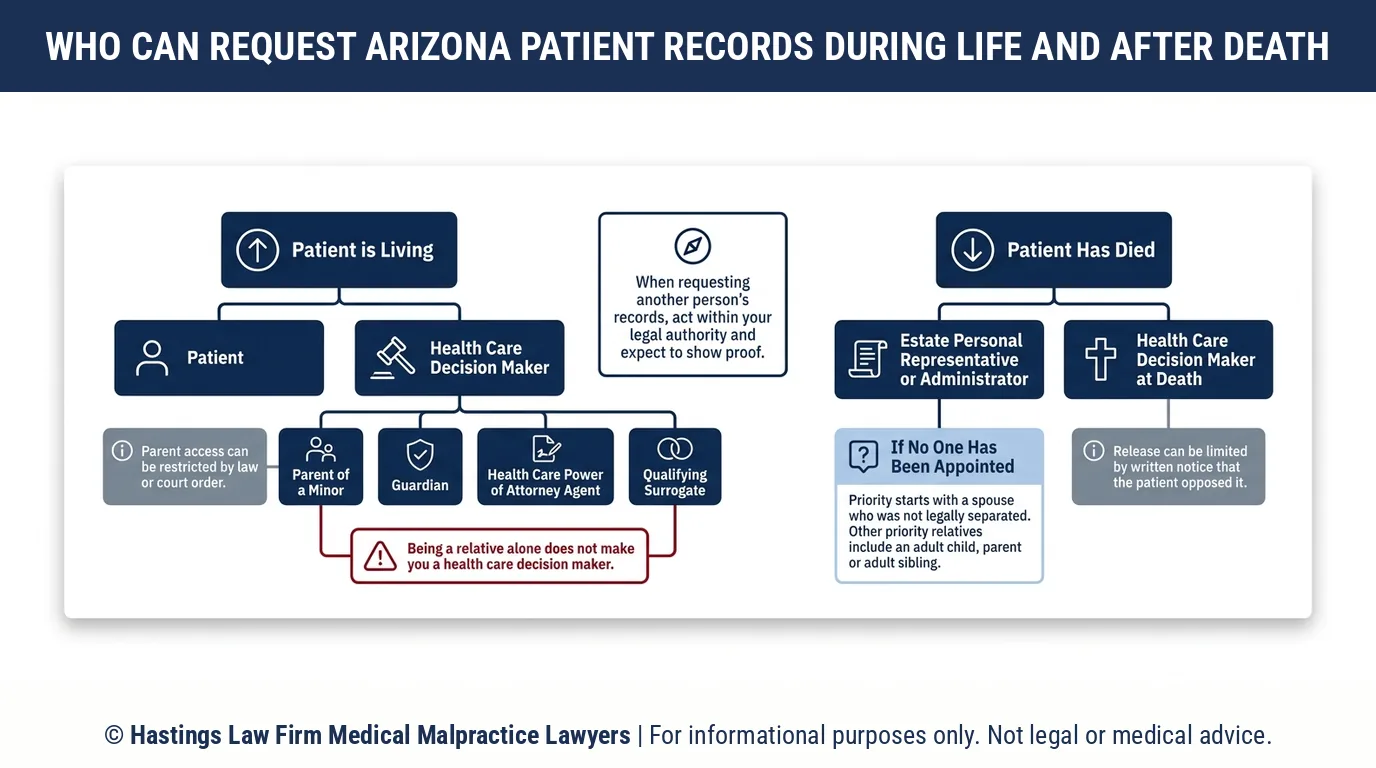
In Arizona, a patient can request their own medical records, and so can the patient’s health care decision maker. A.R.S. 12-2291 defines that person as someone authorized to make treatment decisions for the patient, such as a parent of a minor, a guardian, an agent under a health care power of attorney, or a qualifying surrogate. Being a relative does not by itself make someone a decision maker.
A parent’s access to a minor’s records has exceptions, such as a court order or another law that restricts it. Anyone asking for another person’s records can act only within their legal authority and should expect to show proof of it.
After a patient has died, the records can be released to the personal representative or administrator of the estate, or to the person who was the patient’s health care decision maker at death. If no one has been appointed, Arizona sets an order of priority that starts with a spouse who was not legally separated from the patient, followed by others such as an adult child, a parent, or an adult sibling. That release can be limited by written notice that the patient opposed it. Families can also request an existing autopsy report, which is a separate request from the medical records.
Can a Lawyer Get Your Records in Arizona?
Yes, a lawyer can get your medical records in Arizona with a written authorization signed by you or your health care decision maker. A.R.S. 12-2294 allows a provider to release records on that signed authorization, so a lawyer does not always need a court order to request them.
Under HIPAA, that authorization must be written in plain language and carry certain information and notices. It describes the records, names who releases them and who receives them, states the purpose, gives an end date, and is signed and dated. A patient can also have an electronic copy of their electronic health record sent straight to the lawyer through a signed written request that names the lawyer and where to send it.
Once a lawsuit is filed, the lawyer can request records from the other parties and use a subpoena, a formal legal demand for documents, to reach others who hold them. In Arizona, a subpoena for medical records must be served on the provider and every party at least ten days before the records are produced, and it still does not automatically override confidentiality. In depositions, the lawyer can then question parties and treating physicians under oath.
What Can You Do if an Arizona Provider Refuses or Delays Your Medical Records?
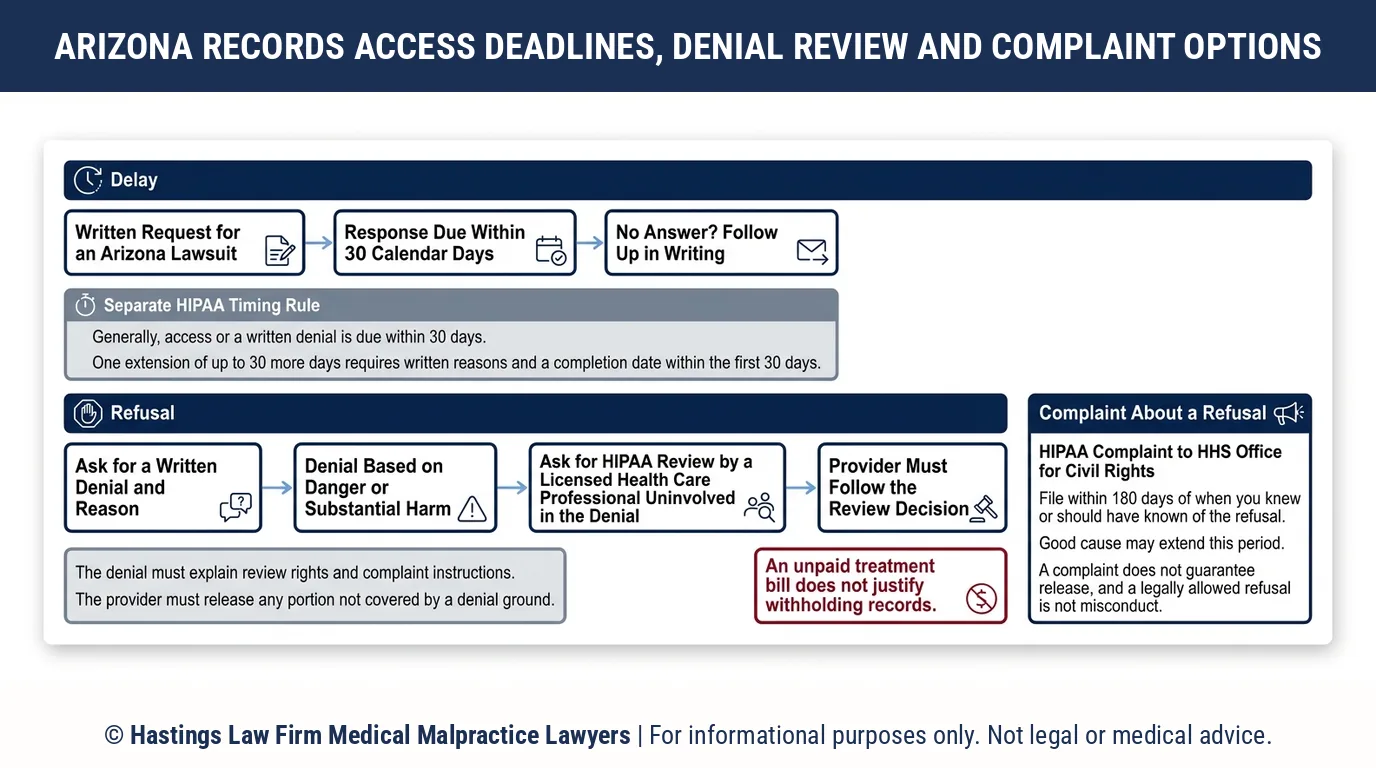
When an Arizona provider refuses to release your medical records, ask for the refusal and its reason in writing. A.R.S. 12-2293 lets a provider deny access only on the grounds it lists, such as a likely danger to someone’s life or physical safety, and a denial must come with a written explanation.
Those grounds are narrow, and most rest on harm. Beyond a danger to life or safety, they cover substantial harm to someone named in the record who is not a health professional, or to the patient or another person when a decision maker’s access is likely to cause it. Other grounds protect a confidential source who is not a health professional and cover some records kept in research studies or correctional facilities, but money owed for care is not one of them, under Arizona law or HIPAA. The provider must still release any part of the record no ground covers.
A denial that does rest on danger or substantial harm can be reviewed. Under HIPAA, the patient can ask the provider to refer it to a licensed health care professional who took no part in the first decision, and the provider must follow that professional’s decision. Arizona’s statute adds no separate appeal. The denial itself must explain any review rights and how to file a complaint.
A HIPAA complaint can be filed with the federal Office for Civil Rights of the U.S. Department of Health and Human Services within 180 days of when the patient knew or should have known of the refusal, and good cause can extend that time. An improper refusal by a medical doctor can also be reported to the Arizona Medical Board, and concerns about a licensed facility’s records practices can go to the Arizona Department of Health Services. A complaint does not guarantee the records will be released, and a refusal the law allows is not misconduct.
Records a complaint does not produce can still be sought through the courts. A.R.S. 12-2294 requires a provider to disclose records when a court orders it, and once a lawsuit is filed, a lawyer can seek them through discovery.
For a delay rather than a refusal, Arizona gives a provider 30 calendar days to respond to a request made for a purpose other than upcoming medical treatment, including a lawsuit, while records needed for upcoming treatment have shorter limits. Under HIPAA, a covered provider generally must give access or a written denial within 30 days, with one extension of up to 30 more days if it gives you written reasons and a completion date within the first 30 days.
What Can Medical Records Show in an Arizona Malpractice Case?
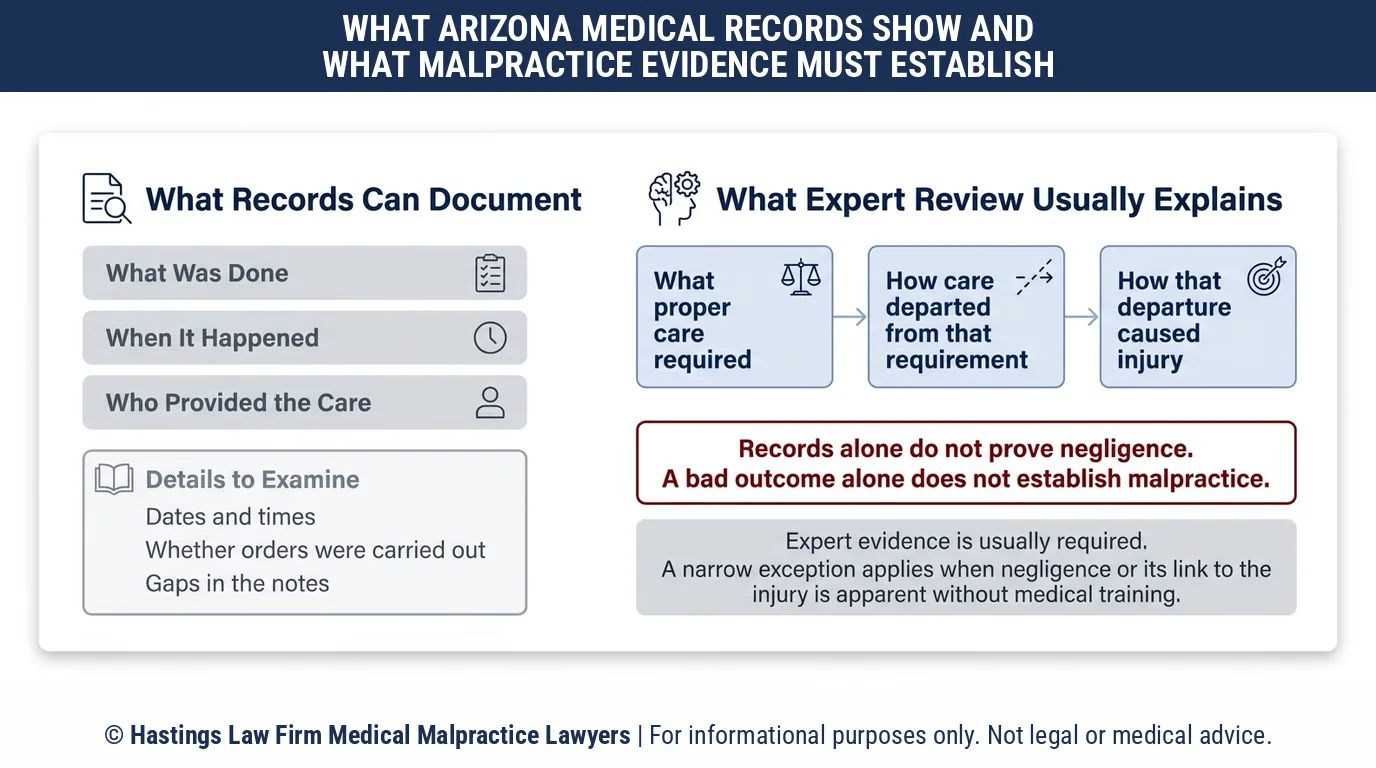
Medical records show what was done, when, and by whom, which makes them the starting point for an Arizona malpractice case. A record does not prove negligence by itself, and a bad outcome alone does not establish malpractice. What matters is whether the evidence shows negligent care, and answering that takes a close reading of the records.
That reading means checking dates and times, whether orders were carried out, and where the notes have gaps. Medical experts then usually explain what proper care required, how the provider departed from it, and how that departure caused the injury. An Arizona Supreme Court opinion confirms that expert evidence is required, except in the narrow case where the negligence, or its link to the injury, is apparent without medical training.
The Hastings Law Firm Difference
Results matter, but what truly sets us apart is how we achieve them. Every verdict, every settlement, and every courtroom victory comes from one guiding promise: To treat each client’s fight for justice as if it were our own.
This balance of skill, experience, and empathy reflects our core philosophy that justice should not only compensate the injured, but also make health care safer nationwide.

What Steps Should You Take to Collect Your Records for an Arizona Malpractice Claim?
To collect your medical records for an Arizona malpractice claim, start by listing every provider and facility involved and the dates of care. Send each records department a written request, on its own form or in a signed letter, that names the patient and the dates and asks for the complete medical record, the billing records, and the diagnostic images. Keep a dated copy of each request.
In the same request, ask for an electronic copy in a format you can use. When a provider keeps the record electronically, federal law requires it to supply the copy in the format you request if it can readily produce it, or in another readable electronic format you agree to.
Once the requests are out, track the response time for each one. Arizona allows 30 calendar days for a request made for a lawsuit, so mark the date each one is due and follow up in writing if it passes without an answer.
When the records arrive, keep them exactly as they came. Do not mark up, discard, or change the originals, and write any notes on a separate page. Store a second copy somewhere safe.
Providers are not required to keep records forever, so ask early. Under A.R.S. 12-2297, Arizona providers must keep an adult patient’s records for at least six years after the last treatment, and records of a child’s care until the later of three years after the child turns 18 or six years after the last treatment. Those are minimums, and other laws can set different periods.
The filing deadline is another reason not to wait. In Arizona, a medical malpractice lawsuit generally must be filed within two years from when the patient knew or reasonably should have known the injury may have been caused by negligence. Gathering records early leaves time for the review a claim needs before that deadline.
Talk to an Arizona Medical Malpractice Attorney About Your Case
We understand how hard it is to chase paperwork from several providers while recovering from an injury or grieving a loss. When you reach out, we listen to what happened, request and review the records at no cost, and give you an honest answer about whether you have a claim. Our attorneys are experienced in gathering and reading the medical records behind malpractice claims for patients and families across Arizona.
Hastings Law Firm has been dedicated exclusively to medical malpractice since 2005. Our Arizona medical malpractice lawyers work on a contingency fee, so you pay no fee unless we win, and we advance the costs of building a claim, the records included. Contact us now for a free, confidential case review.
Sources
- A.R.S. 12-2293, patient requests for medical and payment records, response times, and denial grounds | Arizona State Legislature
- A.R.S. 12-2295, what Arizona providers may charge for copies of medical records | Arizona State Legislature
- A.R.S. 12-2291, Arizona definitions of medical records, payment records, and health care decision makers | Arizona State Legislature
- A.R.S. 36-3231, surrogate decision makers who may act for an Arizona patient | Arizona State Legislature
- A.R.S. 12-2294, release of medical records to third parties and after a patient dies | Arizona State Legislature
- How to file a HIPAA complaint with the HHS Office for Civil Rights | U.S. Department of Health and Human Services
- Arizona Supreme Court opinion on expert evidence of standard of care and causation | Arizona Supreme Court
- HHS guide to a patient’s right to access their medical records under HIPAA | U.S. Department of Health and Human Services
- A.R.S. 12-2297, how long Arizona providers must keep medical records | Arizona State Legislature

This content was researched and written by the Hastings Law Firm editorial team, which includes attorneys, medical professionals, and experienced researchers. Our writing is informed by internal knowledge and practical experience, and we cross-check critical details against authoritative sources cited throughout. Every piece undergoes human-led fact-checking and legal review. Because legal and medical information can change, if you spot an error, please contact us. Learn more about our content standards and review process on our editorial policy page.

Tommy Hastings, founder of Hastings Law Firm, is a board-certified personal injury trial lawyer (by the Texas Board of Legal Specialization) dedicated exclusively to healthcare injury cases. Since 2001, he has represented injured patients and families in litigation against major hospital systems, pharmaceutical companies, and negligent healthcare providers nationwide. He has handled numerous high-profile cases that have drawn national media attention and resulted in multi-million dollar recoveries.
