


What Evidence Do You Need for a Medical Malpractice Case in Arizona?
A patient harmed or worse by medical care, and the family around them, often sense that something went wrong long before anyone explains how. That sense is a reasonable place to start, but a clear answer depends on evidence of what was done, the harm it caused, and how daily life has changed since. Much of that evidence begins with what a patient and family already have, and with what they remember while the details are still fresh. Knowing what proof a medical malpractice claim in Arizona relies on shows why those things are worth keeping now.
Last Updated: November 4, 2026
What You Should Know About Evidence in an Arizona Medical Malpractice Case:
- Arizona patients can request their medical and billing records in writing under A.R.S. 12-2293, and a request made for a lawsuit gets a response within 30 calendar days.
- Arizona providers must keep an adult patient’s records for at least six years after the last treatment, so older records are worth requesting promptly.
- Under A.R.S. 12-563, an Arizona malpractice claim must prove that the provider fell below the accepted standard of care and that this failure caused the injury, and a bad outcome alone is not proof of malpractice.
- In almost every Arizona malpractice case, a qualified medical expert must explain what proper care required, how the provider departed from it, and how that caused the injury, unless the negligence is apparent without medical knowledge.
- Each kind of loss in an Arizona malpractice case needs its own proof, and future medical care is compensated only with evidence of its probable need, nature, and cost.
- Under A.R.S. 12-2605, an Arizona provider’s apology, sympathy, or statement accepting responsibility for an unexpected outcome cannot be used in court as an admission of fault.
- When malpractice may have caused a death, the next of kin who take custody of the body can authorize a private autopsy under A.R.S. 36-832, subject to the medical examiner’s authority, and it is best raised before burial or cremation.
- The patient must prove each part of an Arizona malpractice claim by a preponderance of the evidence, meaning more likely true than not.
- An Arizona medical negligence lawsuit generally must be filed within two years from when the patient knew, or reasonably should have known, that the injury may have been caused by negligence.
What Does the Evidence Have to Prove in an Arizona Medical Malpractice Claim?
The evidence you need for a medical malpractice case in Arizona has to prove that the healthcare provider failed to use the care a reasonable, prudent provider in the same field would have used, and that the failure caused the injury, as Section 12-563 of the Arizona Revised Statutes requires. That proof comes mainly from the medical records, a qualified medical expert’s opinion, and evidence of the harm itself.
A bad outcome is not proof on its own. Arizona law does not presume negligence because a treatment failed or a patient died, so the evidence has to show that the care itself fell short.
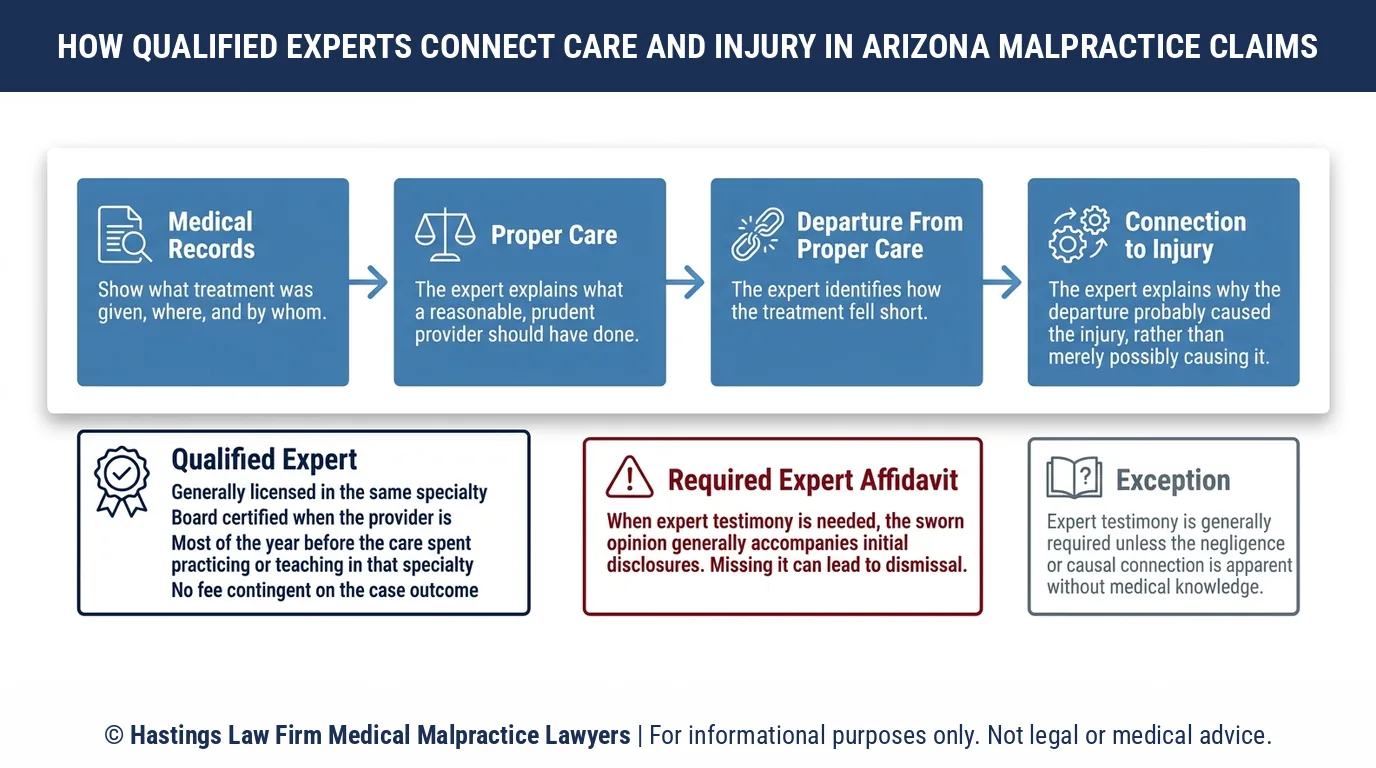
The medical records come first. They show what treatment was given, where, and by whom, though they do not prove negligence by themselves.
A medical expert turns those records into proof by comparing the treatment with what proper care required and connecting any shortfall to the injury. The expert does not have to show that the provider’s negligence was the only cause of the harm.
The harm needs proof as well. Negligent care that causes no injury is not a claim, so the evidence also has to show the losses the injury caused, from medical bills to lost income and pain.
In short, the evidence you need for a medical malpractice case in Arizona has to prove four things together: the provider owed the patient a duty of care, the care fell short, that failure caused the injury, and losses followed. A duty of care usually comes from the provider-patient relationship. A gap in any one of the four can stop a claim even when the others are strong.
Which Medical Records Matter in an Arizona Medical Malpractice Case?
The medical records that matter in an Arizona medical malpractice case are the complete records from every provider involved, plus earlier records that show the patient’s health before the care. A.R.S. 12-2291 defines medical records broadly, as communications about a patient’s health or condition kept for diagnosis or treatment, in any form. Billing records and diagnostic images matter as well, and the images may be stored apart from the chart.
A patient can get these records by sending a written request to each provider under A.R.S. 12-2293, and so can a person with legal authority to make the patient’s health care decisions. A request made for a lawsuit gets a response within 30 calendar days, and reasonable copy charges may apply. A hospital’s internal peer-review files are generally confidential and out of reach in a lawsuit, but that protection does not block a patient from getting their own records.
Those records deserve a close look once they arrive. Entries that seem altered, gaps where notes should be, or notes added long after the care can matter to a claim, and an Arizona altered hospital records lawyer can explain what those signs may mean. Keep the first copy you receive, so it can be compared with any later copy.
Why Do You Need a Medical Expert to Prove Medical Malpractice in Arizona?
You need a medical expert to prove medical malpractice in Arizona in almost every case, because expert testimony has to establish what proper care required and how the provider departed from it. A decision of the Arizona Supreme Court, Sampson v. Surgery Center of Peoria, confirmed that expert evidence must also link that departure to the injury, unless the negligence or the connection is apparent to jurors without medical knowledge.
The standard of care is the measure the expert holds the records against. Arizona defines it as the care, skill, and learning expected of a reasonable, prudent provider in the same field, acting in the same or similar circumstances.
Causation, the link between the care and the injury, needs expert support of its own. The expert generally has to show that the connection is probable, not merely possible, though absolute certainty is not required. Proving causation in an Arizona medical malpractice case explains how that link is built from the records and the medicine.
The expert must also meet Arizona’s qualification rule. Under A.R.S. 12-2604, the expert generally must be a licensed health professional in the same specialty as the provider, board certified in that specialty when the provider is, and must have spent most of the year before the care practicing or teaching in it. An expert whose fee depends on the outcome of the case cannot testify.
The same rule shapes what a later doctor’s concerns can do for a claim. A doctor who treats the patient afterward and questions the earlier care can flag a problem for review, but proof of the standard of care has to come from an expert who meets the rule. That doctor’s notes stay useful, because they show what was found and when.
The qualified expert’s opinion is needed early in the case. Under A.R.S. 12-2603, a patient who states in the lawsuit that expert testimony is needed must deliver a sworn statement from the expert, called a preliminary expert opinion affidavit, along with the initial disclosures. The affidavit covers the expert’s qualifications, the facts, how the care fell short, and how that caused the harm, and a claim without it can be dismissed. Initial disclosures, the first formal exchange of case information between the sides, are generally due 30 days after the first responsive pleading is filed, unless the parties agree otherwise or the court orders a different date.
What Evidence Proves Your Losses in an Arizona Malpractice Case?
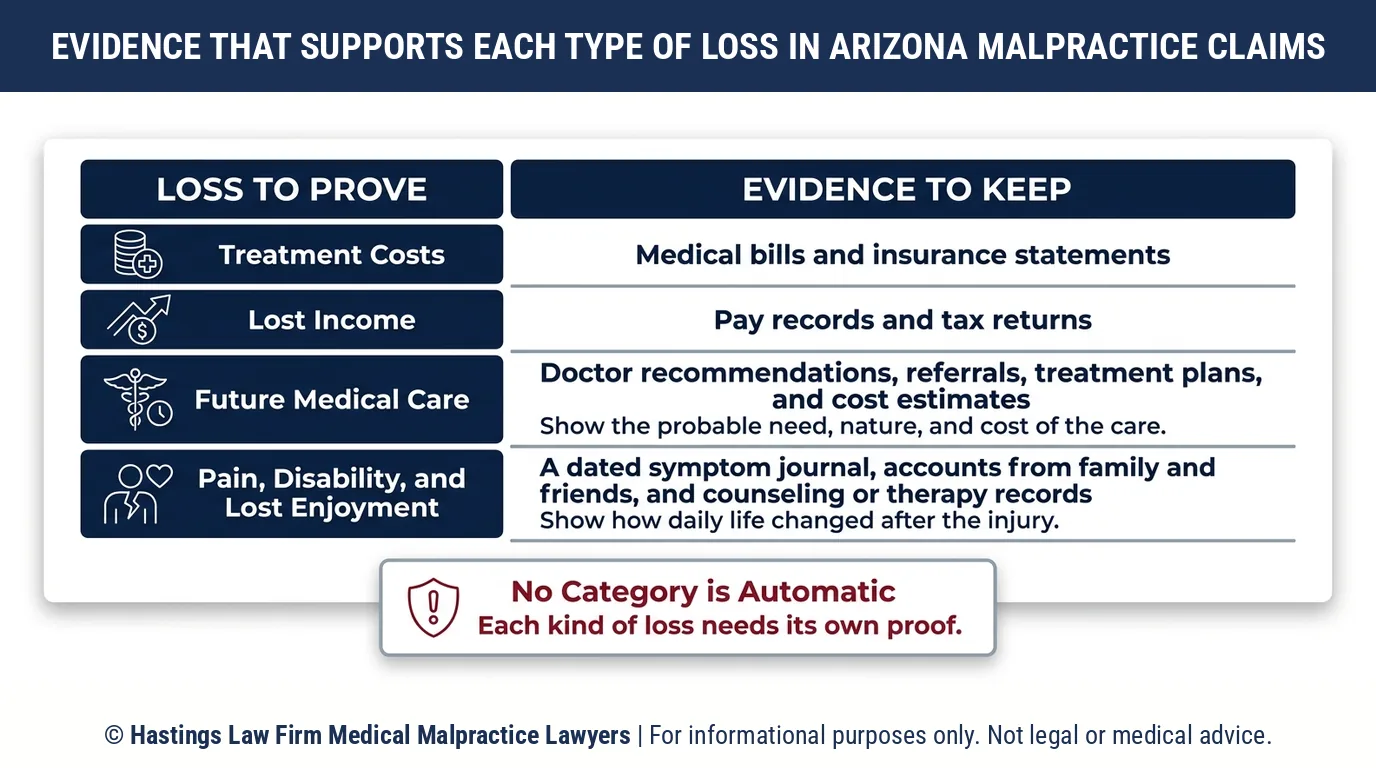
Losses in an Arizona malpractice case are proved one kind at a time, with medical bills and insurance statements for treatment costs, pay records and tax returns for lost income, and medical evidence for care still to come. The Revised Arizona Jury Instructions (RAJI Medical Negligence 1) place the burden of proving these losses, called damages, on the patient, and no category is awarded automatically.
Care still to come is compensated only when the evidence shows its probable need, nature, and cost. Treating doctors’ recommendations and cost estimates help show that, so keep every referral and treatment plan.
Losses that carry no bill, such as pain, disability, and lost enjoyment of life, are proved by showing how life changed. A dated journal of symptoms and limits, accounts from family and friends, and records of counseling or therapy help a jury see what the injury took away. Depending on the evidence, these losses can be part of the compensation alongside the bills.
What Other Evidence Can Support a Medical Negligence Claim in Arizona?
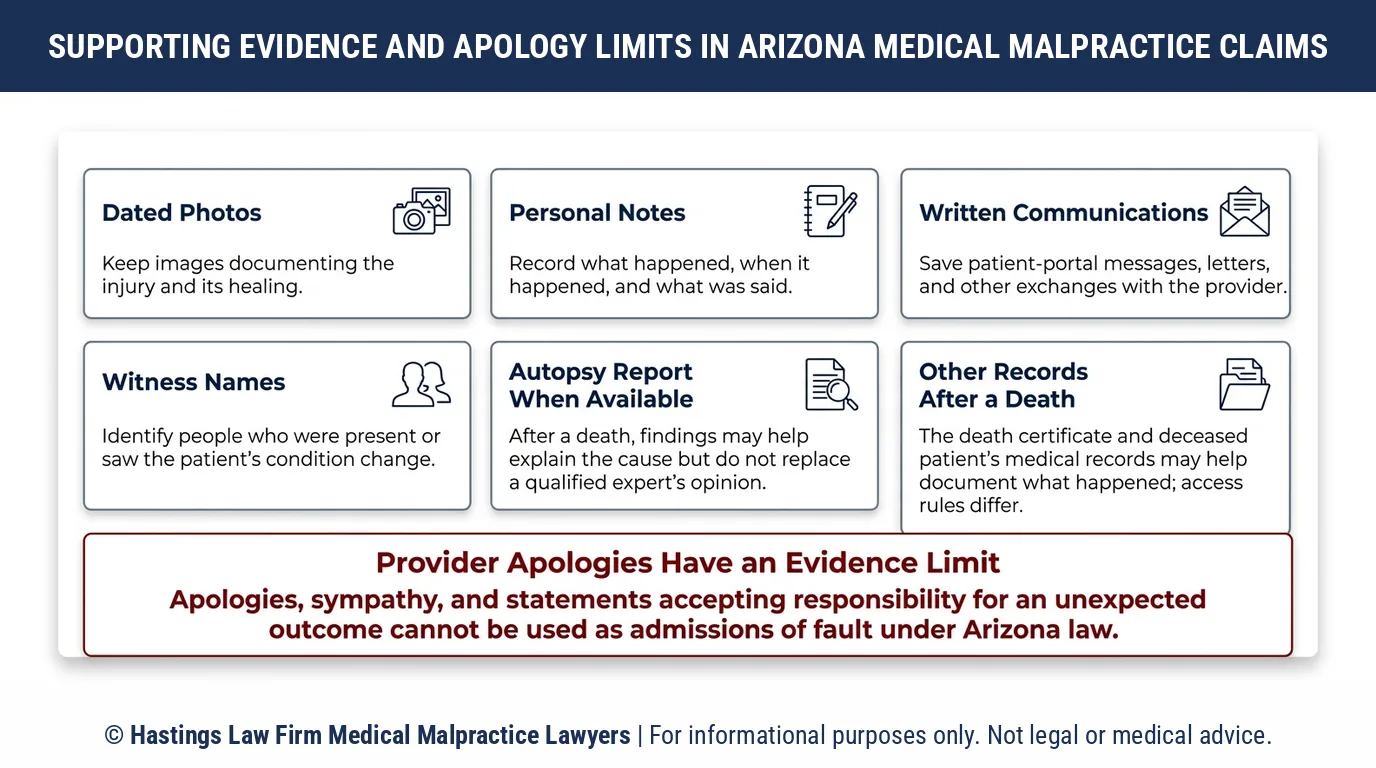
Beyond the medical records and an expert’s opinion, evidence that can support a medical negligence claim in Arizona includes dated photos of the injury and its healing, the patient’s own notes of what happened and what was said, and the names of people who were present. Patient-portal messages, letters, and other written exchanges with the provider help as well, because they capture the conversation as it happened.
What a provider says once something has gone wrong is a different matter. Under A.R.S. 12-2605, an Arizona provider’s apology, sympathy, or even a statement accepting responsibility for an unexpected outcome cannot be used in court as an admission of fault. A family may hear words that sound like an admission, but the proof still has to come from the records and the expert.
Witnesses fill in what the records leave out. Family members who were in the room, or who saw the patient’s condition change, can describe what they saw and when, and the staff named in the records can be identified for questioning later.
That questioning happens after a lawsuit is filed, in discovery, the stage where each side gathers evidence from the other. Depositions allow questioning under oath of the parties, the treating physicians, and the disclosed experts, and other witnesses can be deposed with the parties’ agreement or a court’s permission. Written questions called interrogatories go to the other side and are generally answered in writing under oath.
Should You Get an Autopsy if You Suspect Medical Malpractice Caused a Loved One’s Death in Arizona?
A family that suspects medical malpractice caused a loved one’s death in Arizona should ask about an autopsy early, and Arizona law gives two routes to one. The county medical examiner investigates a reportable death, though not always with an autopsy, and the next of kin can authorize a private post-mortem examination by a licensed physician under A.R.S. 36-832.
Whichever route it comes from, an autopsy report can help document why someone died and inform a qualified medical expert’s opinion about whether negligent care caused the death. The report does not prove malpractice or replace the expert, who may read the findings differently.
The medical examiner’s route applies to certain deaths that must be reported for investigation under A.R.S. 11-593, including unexpected or unexplained deaths and deaths resulting from anesthetic or surgical procedures. The examiner decides whether an autopsy is needed, and a death from natural disease during surgery or anesthesia does not require one unless the examiner finds it necessary. A family may ask for one, but the examiner weighs the request rather than granting it automatically.
The family’s route is open to a parent, spouse, adult child, guardian, or next of kin who takes custody of the body for burial. When the examiner must investigate, though, the body cannot be moved or altered without the examiner’s permission. Arizona sets no general deadline for a private autopsy, but it is best raised before burial or cremation, because an examination after burial needs further legal steps.
Three records can help a family after a death, and each has its own rules. A completed county autopsy report can be requested as a public record once the examiner’s case is final, though autopsy photographs carry separate restrictions. The deceased patient’s medical records go to the person appointed to handle the estate or, without one, to family in the order Arizona law sets, starting with the spouse. The death certificate records the certified cause of death, which may first be listed as pending and later amended, and close relatives such as a surviving spouse, parent, or adult child can request a certified copy.
Not having an autopsy does not by itself stop an Arizona wrongful death claim. Without one, the medical records and a qualified expert’s opinion can still prove what caused the death, as long as that evidence is strong enough.
What Happens if There is Not Enough Evidence for an Arizona Malpractice Case?
Without enough evidence, an Arizona malpractice claim fails, because the patient has to prove negligence, causation, and damages. The standard is the ordinary civil burden of proof stated in a decision of the Arizona Court of Appeals, Pfeil v. Smith. A case that needs an expert’s opinion and has none can be dismissed early, and jurors cannot fill a medical gap by guessing.
The ordinary civil burden is called a preponderance of the evidence. It means the patient must show each part of the claim is more likely true than not, a lower bar than proof beyond a reasonable doubt. Certainty is not required, but the evidence has to tip the balance on every part.
A gap found early can be worked on before a case is filed. Records missing from one provider may sit with another, diagnostic images can be requested on their own, and a review by another qualified expert can be sought. All of that has to happen before the filing deadline runs out.
The Hastings Law Firm Difference
Results matter, but what truly sets us apart is how we achieve them. Every verdict, every settlement, and every courtroom victory comes from one guiding promise: To treat each client’s fight for justice as if it were our own.
This balance of skill, experience, and empathy reflects our core philosophy that justice should not only compensate the injured, but also make health care safer nationwide.

How Can You Preserve Evidence for a Medical Negligence Claim in Arizona?
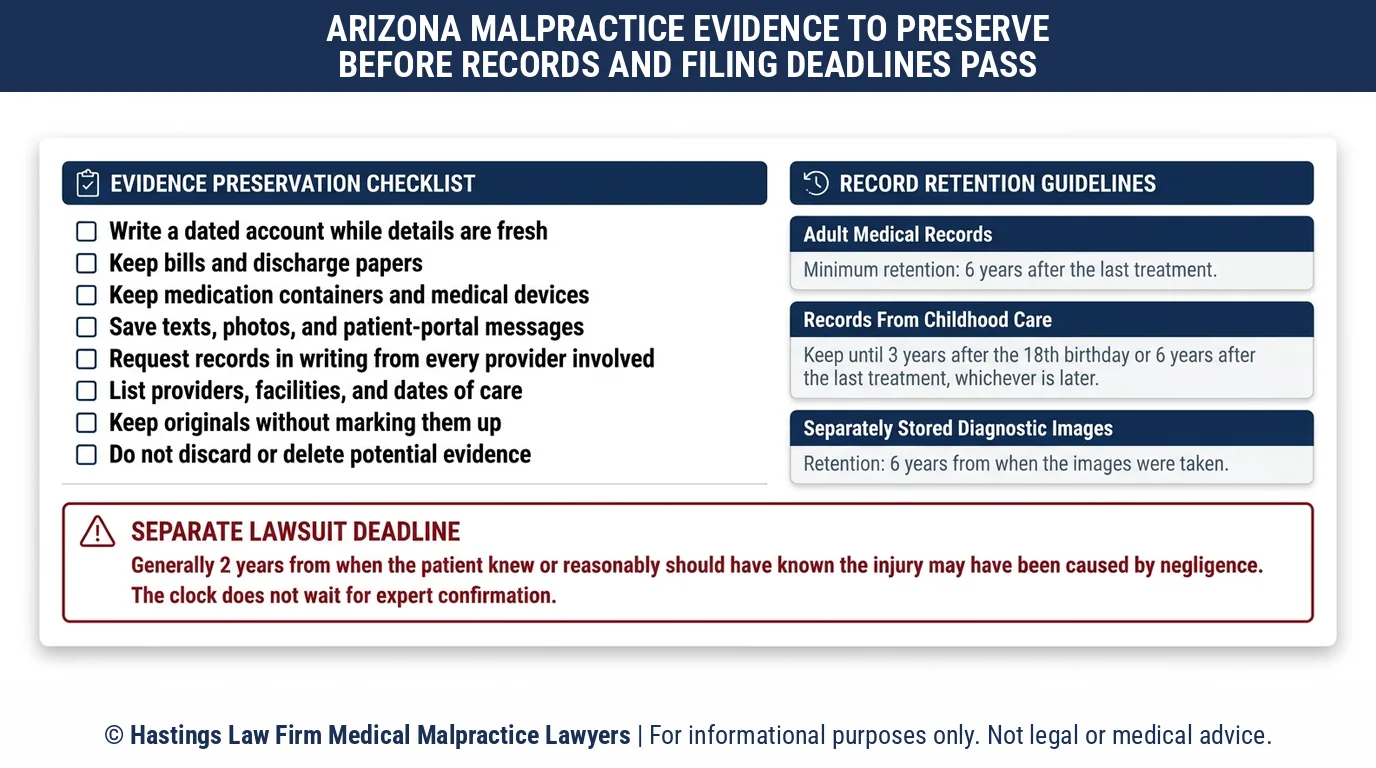
To preserve evidence for an Arizona medical malpractice claim, write down what happened and when while it is fresh, and keep every bill, discharge paper, medication container, and medical device. Save texts, photos, and patient-portal messages, and request copies of the medical records in writing from each provider involved in the care.
Asking early matters because records are kept for set periods, not forever. Under A.R.S. 12-2297, Arizona providers must keep an adult’s records for at least six years after the last treatment, and a child’s records until three years after the 18th birthday or six years after the last treatment, whichever is later. Diagnostic images stored apart from the chart must be kept for six years from when they were taken, so older images are worth requesting promptly.
While those requests are out, keep the originals you already have exactly as they are, without marking them up, throwing them out, or deleting anything. A running list of every provider, facility, and date of care makes each records request easier to track.
The filing deadline is the other reason to act early. Under A.R.S. 12-542, an Arizona lawsuit for medical negligence generally must be filed within two years. Those two years run from when the patient knew, or reasonably should have known, that the injury may have been caused by negligence, which is not always the date of the care. The clock does not wait for an expert to confirm malpractice.
Talk to an Arizona Medical Malpractice Attorney About Your Case
Our lawyers are experienced in building the evidence for medical negligence claims by patients and families across Arizona. We understand how hard it is to gather records and paperwork while recovering from an injury or grieving a loss.
That is why we take on the work ourselves. A member of our intake team asks about the care, when it happened, and who provided it, and we request the medical records at no cost. Our attorneys and medical professionals review them, find a medical expert in the right specialty when a case needs one, and give you an honest answer about whether you have a valid claim.
Hastings Law Firm has been dedicated exclusively to medical malpractice since 2005. Our Arizona medical malpractice lawyers work on a contingency fee, so you pay no fee unless we win, and we advance the cost of medical experts and everything else it takes to build a claim. Contact us now for a free, confidential case review.
Sources
- A.R.S. 12-563, the elements of proof in an Arizona medical malpractice action | Arizona State Legislature
- A.R.S. 12-2291, Arizona’s definitions of medical records, payment records, and source data | Arizona State Legislature
- A.R.S. 12-2293, patient requests for medical and payment records and response times | Arizona State Legislature
- Arizona Supreme Court opinion on expert evidence of standard of care and causation | Arizona Supreme Court
- Arizona civil jury instructions on medical negligence and the burden of proof | State Bar of Arizona
- A.R.S. 12-2605, provider apologies and statements inadmissible as admissions of liability | Arizona State Legislature
- A.R.S. 36-832, who may authorize a post-mortem examination in Arizona | Arizona State Legislature
- A.R.S. 11-593, deaths that must be reported to the medical examiner | Arizona State Legislature
- Arizona Court of Appeals opinion stating the preponderance burden in civil actions | Justia
- A.R.S. 12-2297, how long Arizona providers must keep medical records | Arizona State Legislature
- A.R.S. 12-542, Arizona’s two-year deadline for medical malpractice lawsuits | Arizona State Legislature

This content was researched and written by the Hastings Law Firm editorial team, which includes attorneys, medical professionals, and experienced researchers. Our writing is informed by internal knowledge and practical experience, and we cross-check critical details against authoritative sources cited throughout. Every piece undergoes human-led fact-checking and legal review. Because legal and medical information can change, if you spot an error, please contact us. Learn more about our content standards and review process on our editorial policy page.

Tommy Hastings, founder of Hastings Law Firm, is a board-certified personal injury trial lawyer (by the Texas Board of Legal Specialization) dedicated exclusively to healthcare injury cases. Since 2001, he has represented injured patients and families in litigation against major hospital systems, pharmaceutical companies, and negligent healthcare providers nationwide. He has handled numerous high-profile cases that have drawn national media attention and resulted in multi-million dollar recoveries.
