


Proving Causation in an Arizona Medical Malpractice Case
Written by: Hastings Law Firm | Reviewed by: Tommy Hastings | Updated: July 27, 2026
Proving causation is often the hardest part of an Arizona medical malpractice claim because a mistake alone is not enough. The central issue is showing that a provider breach directly led to the injury rather than a pre existing condition, the natural progression of disease, or an intervening event. The discussion also highlights how foreseeability affects proximate cause and why medical evidence is critical when the defense disputes the link between error and harm. If you or a loved one were harmed or worse due to proving causation in an Arizona medical malpractice case in Arizona, contact Hastings Law Firm for a free, confidential case review.
Establishing the Critical Link Between Medical Error and Injury
What You Should Know About Claims in Arizona:
- Recovery can be denied even when negligence seems clear if the harm cannot be tied directly to the provider error.
- Options can narrow when the defense attributes the outcome to a pre existing condition or the natural progression of disease.
- A claim can fail when the injury is treated as an unforeseeable result because proximate cause depends on foreseeability.
- A case can be dismissed before trial without qualified expert medical testimony linking the breach to the injury.
- Compensation can be reduced when the patient is found partially responsible under comparative negligence.
- The ability to pursue compensation can be permanently lost when special notice requirements apply to public entities and are not met.
- Legal options can be limited when filing deadlines apply, even when an injury is not discovered right away.
- Causation disputes often turn on whether negligence probably caused the harm rather than possibly contributed.
- The strength of causation opinions can depend on detailed medical records such as imaging and lab trends.
- Expert selection can be constrained because Arizona rules limit how many experts may testify on a given issue.

A Healthcare Focused Law Firm
Not every medical error leads to a viable legal claim. Even when a doctor makes a clear mistake, an Arizona malpractice case depends on proving that the mistake actually caused the harm. This distinction is what makes proving causation in an Arizona medical malpractice case one of the most challenging steps for injured patients and their families.
Defense teams regularly argue that the patient’s injury resulted from a pre-existing condition. They may also claim the harm came from the natural progression of a disease, meaning the condition would have worsened regardless of what the doctor did. Overcoming those arguments requires specific medical evidence and experienced legal guidance.
If you believe a medical provider’s error caused real harm to you or someone you love, we can review what happened and explain your legal options during a free, confidential evaluation.
The Four Pillars of Liability Under Arizona Law
To establish liability, a plaintiff must prove four distinct elements: a professional duty of care existed, the provider breached that duty, the breach was the direct cause of the injury, and quantifiable damages resulted from the harm.
The first element, professional duty of care, is typically established through the doctor-patient relationship. Once a healthcare provider agrees to treat you, they owe you a legal obligation to deliver care that meets accepted medical standards. If you were under a provider’s care, this element is usually simple.
The second element is breach of duty. A breach occurs when the provider’s actions fall below the standard of care, the level of treatment that a reasonably competent professional in the same specialty would have provided under similar circumstances. The State Bar of Arizona’s medical negligence standards outline how this standard is applied in Arizona courts against a defendant.
The third element, causation, often determines whether a case is successful. Defense attorneys contest this element aggressively because without it, even obvious medical negligence does not lead to compensation. You must show that the breach directly caused the injury, not just that a mistake happened.
The fourth element is damages. These are the measurable losses you suffered, including medical bills, lost income, and pain and suffering. The Arizona Judicial Branch Glossary provides helpful definitions for many of these legal terms.
Here is a quick checklist of what proving causation in Arizona requires:
- A recognized duty of care between the provider and patient
- A breach of the accepted standard of care
- Direct causation linking the breach to the injury
- Documented, quantifiable damages resulting from that injury
Distinguishing Between Actual Cause and Proximate Cause
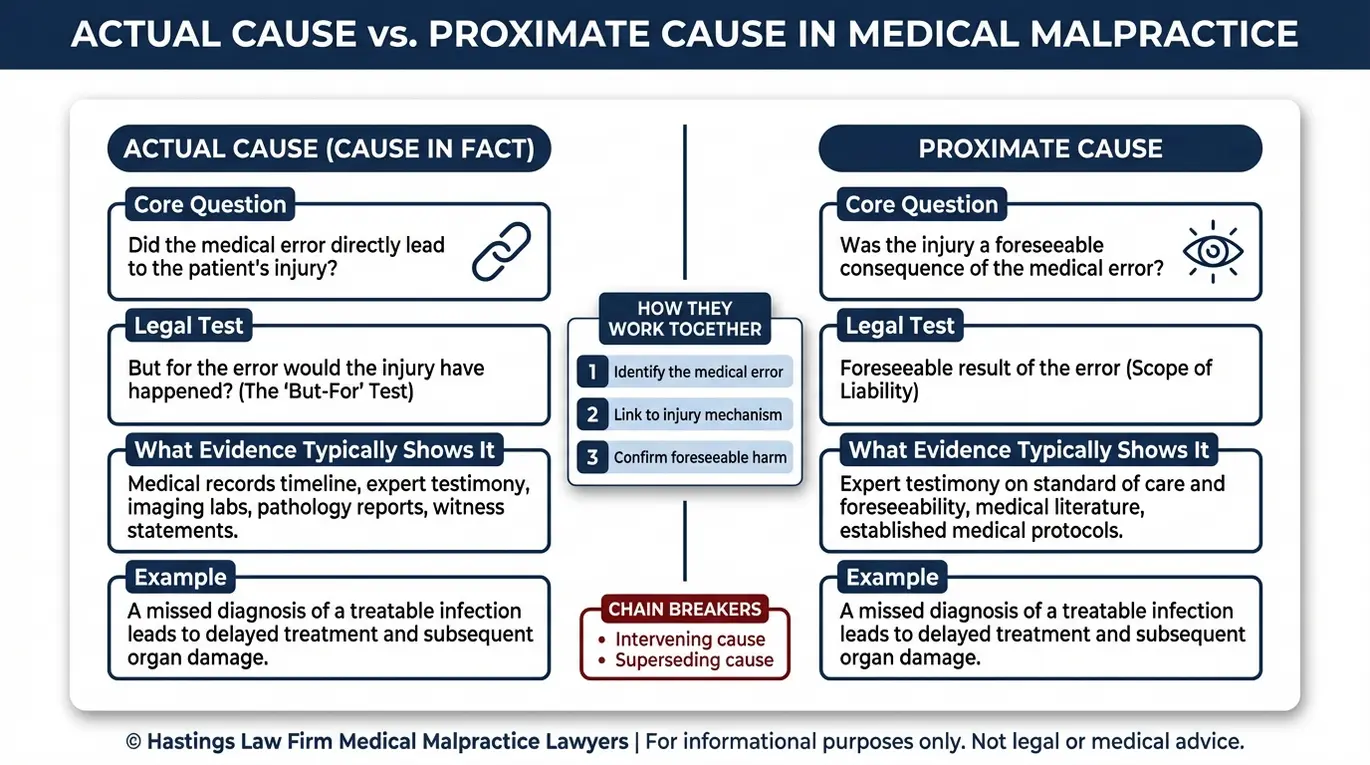
Arizona law requires plaintiffs to prove two types of causation: “cause-in-fact,” meaning the injury would not have occurred “but for” the negligence, and “proximate cause,” meaning the injury was a foreseeable consequence of the error.
Cause-in-fact relies on what courts call the “but-for” test. The question is simple: would the patient have suffered this injury if the provider had not been negligent? If the answer is no, cause-in-fact is established. For example, if a surgeon operates on the wrong limb, the resulting harm would not have occurred “but for” that specific error.
Proximate cause adds a second layer. It asks whether the type of injury that occurred was a foreseeable result of the provider’s negligence. The law does not hold providers responsible for bizarre, unforeseeable chain reactions. Instead, the harm must be a reasonably predictable outcome of the error.
These two types of causation work together in the courtroom. To prove causation in a medical malpractice claim, a client satisfies both tests. It is not enough to show that an error happened and an injury followed; the connection must be logical and predictable.
For instance, if a patient proves cause-in-fact but fails to establish proximate cause because the outcome was a freak occurrence, the case will likely fail. Establishing foreseeability without proving the specific act caused the harm is also insufficient. A superseding cause, an unforeseeable event that breaks the chain between the negligence and the injury, can defeat proximate cause even when cause-in-fact is clear. An intervening cause, a separate event occurring after the negligence, may or may not break the chain depending on whether it was foreseeable.
| Cause-in-Fact (Actual Cause) | Proximate Cause | |
|---|---|---|
| Core Question | Would the injury have happened “but for” the negligence? | Was the injury a foreseeable result of the negligence? |
| Legal Test | The “But-For” Test | Foreseeability Analysis |
| What Defeats It | Proof the same outcome would have occurred regardless | A superseding cause that was unforeseeable |
| Example | A missed diagnosis delayed treatment that would have prevented harm | An infection following a surgical error is foreseeable; a lightning strike is not |
The Hastings Law Firm Difference
Results matter, but what truly sets us apart is how we achieve them. Every verdict, every settlement, and every Arizona courtroom victory comes from one guiding promise: To treat each client’s fight for justice as if it were our own.
This balance of skill, experience, and empathy reflects our core philosophy that justice should not only compensate the injured, but also make healthcare safer nationwide.

The Role of Expert Witnesses in Proving Causation
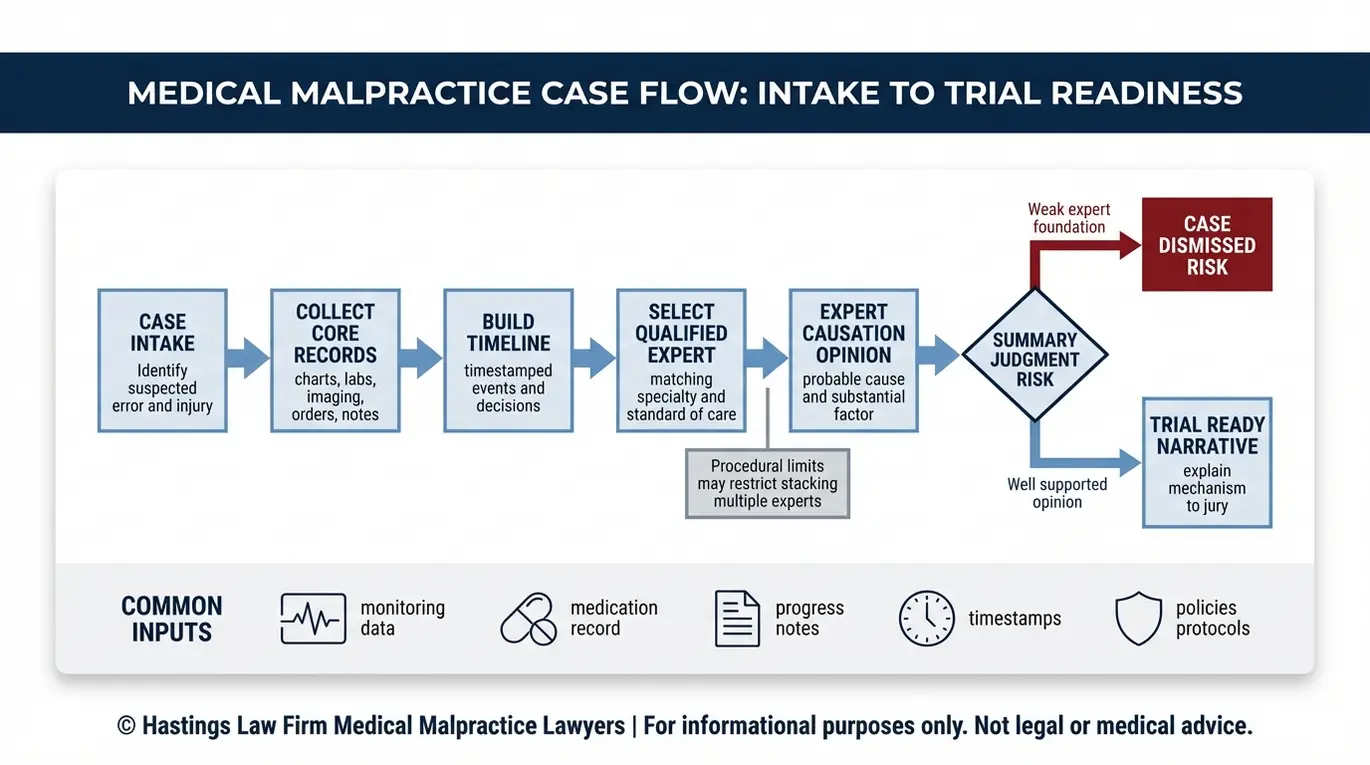
Under Arizona statutes, expert medical testimony is almost always mandatory to explain complex medical mechanisms to a jury and to certify that the defendant’s breach of the standard of care was the probable cause of the patient’s injury.
Without a qualified expert witness, most medical malpractice claims will not survive summary judgment, a pretrial motion where the defense asks the court to dismiss the case for insufficient evidence. Judges generally require expert medical testimony to confirm that the provider deviated from accepted practices and that the deviation caused the specific injury claimed. The Arizona Supreme Court’s civil rules and the Arizona Rules of Civil Procedure govern how expert testimony is submitted and challenged.
Experts form their opinions by conducting a detailed review of the patient’s medical records, imaging, lab work, surgical notes, and treatment timelines. They then compare what happened against what the standard of care required. This analysis is what allows them to state, with reasonable medical probability, whether negligence caused the harm. The expert’s role is not just to critique the defendant but to educate the jury on how the breach specifically led to the injury.
Arizona procedural rules also limit the number of expert witnesses a party may present. This “one expert per issue” rule presumptively limits each party to one standard-of-care expert and each side to one expert on any other issue, preventing parties from stacking witnesses to overwhelm the jury. Your legal team must choose the most qualified and articulate expert to present the standard of care arguments effectively.
When proving causation in an Arizona case, the expert must meet specific qualifications:
- Licensed to practice in the relevant medical specialty
- Actively practicing or teaching in that specialty
- Familiar with the standard of care applicable to the defendant’s actions
- Able to articulate opinions based on reasonable medical probability, not speculation
Arizona’s Substantial Factor Test and the Sampson Ruling
In Arizona medical malpractice claims, courts also apply what is known as the substantial factor test, which asks whether the provider’s negligence was a substantial factor in bringing about the patient’s injury. This becomes especially important in cases involving multiple potential causes.
Expert witnesses must distinguish between “probable” and “possible” outcomes. In *Sampson v. Surgery Center of Peoria*, the court reinforced that an expert must testify that negligence *probably* caused the harm, not merely that it *possibly* did. Reasonable medical probability, the standard requiring that something is more likely true than not, is the threshold. An opinion framed as “it’s possible the error contributed” will not hold up. The expert must cross the line into “it is probable.”
Common Defense Tactics Used to Break the Chain of Causation
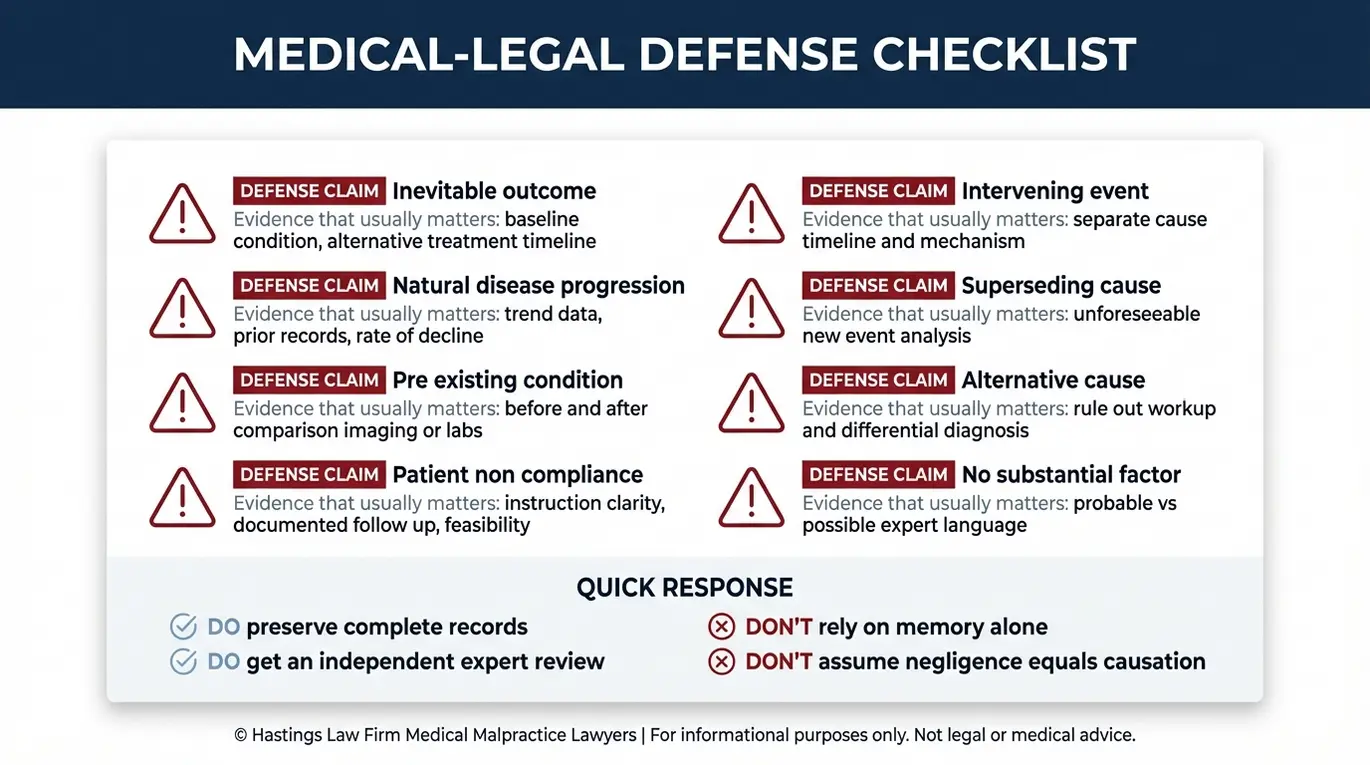
Defense attorneys frequently attempt to sever the link between negligence and injury by blaming pre-existing conditions, asserting the natural progression of a disease, or claiming an intervening event was the actual cause of harm.
Understanding these defense tactics helps you recognize what you may face and how a prepared legal team responds to each one.
The “Inevitable Outcome” Defense: The defense argues that the patient would have suffered the same injury or died regardless of what the provider did. This is common in cases involving cancer or advanced disease. This tactic aims to reduce the potential payout for economic damages like medical bills by suggesting the costs were unavoidable. Rebutting this argument requires detailed medical evidence showing that earlier intervention would have changed the outcome. National benchmarking data, such as the Patient Safety Indicators from the Agency for Healthcare Research and Quality, can help establish expected outcomes when care is delivered properly.
The “Patient Non-Compliance” Defense: Here, the defense blames the patient for not following medical instructions, such as missing follow-up appointments or not taking prescribed medication. Our team examines whether the provider gave clear, documented instructions and whether non-compliance, if it occurred, actually contributed to the outcome.
The “Pre-Existing Condition” Defense: The defense claims the injury existed before the alleged negligence and was not caused by the provider. Establishing the link in a malpractice suit against this argument requires a careful comparison of the patient’s condition before and after the incident, often supported by imaging, lab trends, and specialist records.
- Defense Claim: “The patient’s condition was already deteriorating.”
What we examine: Medical records from before and after the incident to identify measurable changes tied to the alleged error.
- Defense Claim: “The patient did not follow discharge instructions.”
What we examine: Whether instructions were clearly documented and whether non-compliance was actually a contributing factor.
- Defense Claim: “An unrelated event caused the harm.”
What we examine: We examine the full timeline to see if an intervening cause or a superseding cause broke the chain of causation. This includes looking for unforeseeable events that occurred after the original negligence.
Meeting the Burden of Proof in Civil Litigation
In a civil medical malpractice trial, the plaintiff must prove their case by a “preponderance of the evidence,” which simply means demonstrating that it is more likely than not (a greater than 50% certainty) that the provider’s negligence caused the injury.
Meeting this preponderance of the evidence burden of proof is significantly different than the “beyond a reasonable doubt” standard used in criminal cases. In a civil court, the burden of proof rests entirely on the client, but the threshold is attainable with solid evidence.
Jurors are instructed to weigh the evidence and decide if the client’s version of events is more probable. Unlike criminal cases where doubt exonerates the defendant, here, a slight tipping of the scales is sufficient. The Arizona Standard Jury Instructions published by the State Bar of Arizona explain how jurors are guided to apply this standard during deliberation.
There is also a narrow exception called *res ipsa loquitur*, a Latin phrase meaning “the thing speaks for itself.” This doctrine, known as the obvious negligence exception, applies in situations where the negligence is so obvious that causation can be inferred without expert testimony. A classic example is a surgical sponge left inside a patient. In those cases, proving causation becomes more simple because the error and the harm are self-evident.
Contact the Arizona Healthcare Malpractice Attorneys at Hastings Law Firm Today for Help
Proving causation in an Arizona medical malpractice case requires medical knowledge, experienced legal strategy, and the right expert support. It is the element defense teams challenge most aggressively, and it is the reason so many patients need a firm that focuses exclusively on medical malpractice litigation.
At Hastings Law Firm, founded by board-certified trial lawyer Tommy Hastings, we focus exclusively on medical negligence. Our team includes former defense attorneys and board-certified patient advocates who understand hospital protocols from the inside. We prepare every case from day one as if it will go to a jury, which positions our clients for the strongest possible outcome at every stage.
If you or a loved one suffered harm that you believe resulted from a medical error, we encourage you to reach out for a free, confidential case evaluation. There is no fee unless we recover compensation on your behalf. Contact us today, and let us help you find the answers you deserve.
Frequently Asked Questions About Proving Causation in Arizona


This content was researched and written by the Hastings Law Firm editorial team, which includes attorneys, medical professionals, and experienced researchers. Our writing is informed by internal knowledge and practical experience, and we cross-check critical details against authoritative sources cited throughout. Every piece undergoes human-led fact-checking and legal review. Because legal and medical information can change, if you spot an error, please contact us. Learn more about our content standards and review process on our editorial policy page.

Tommy Hastings, founder of Hastings Law Firm, is a board-certified personal injury trial lawyer dedicated exclusively to healthcare injury cases. Since 2001, he has represented injured patients and families in litigation against major hospital systems, pharmaceutical companies, and negligent healthcare providers nationwide. He has handled numerous high-profile cases that have drawn national media attention and resulted in multi-million dollar recoveries. He draws on that experience in his writing, helping readers understand how these cases work and what options may be available to them.
