


What Are the Four Elements of a Medical Malpractice Claim in Arizona?
Being hurt during medical care can leave a patient and their family facing pain, additional recovery time, and lasting uncertainty about whether the harm could have been prevented. Unlike most injuries, that harm happens during treatment meant to help, so finding out what went wrong means asking careful questions about the care itself. The law organizes those questions into the four elements of a malpractice claim, and each one covers a different part of what happened. Understanding them is often the first step toward a straight answer about a medical injury in Arizona.
Last Updated: November 4, 2026
What You Should Know About the Four Elements of an Arizona Medical Malpractice Claim:
- To win a medical malpractice claim in Arizona, a patient must prove duty, breach, causation, and damages, and Section 12-563 of the Arizona Revised Statutes writes breach and causation into state law.
- A duty of care usually comes from the provider-patient relationship, but in Arizona a physician who advises on a patient’s care, knowing the treating physician will rely on that advice, can owe a duty without a traditional treatment visit.
- In Arizona, a bad outcome or an unsuccessful treatment does not by itself show negligence, so the evidence must show that the care itself fell below the standard of care.
- Causation in Arizona means the provider’s failure was a proximate cause of the injury, which a medical expert usually shows as a probability, not a mere possibility.
- An Arizona malpractice claim needs actual harm, so a medical error caught and corrected before it caused injury does not meet the damages element.
- Causation is often the hardest element to prove in a malpractice claim, because the defense can argue that the patient’s underlying condition, not the care, caused the harm.
- Under A.R.S. § 12-2505, a patient who was partly at fault can still recover in Arizona, with the damages reduced by the patient’s share of fault, unless the patient caused or contributed to the injury intentionally, willfully, or wantonly.
- An Arizona patient must prove the claim by a preponderance of the evidence, meaning more likely true than not, and A.R.S. § 12-572 raises that to clear and convincing evidence for qualifying emergency and disaster care.
- Arizona generally allows two years from the date a claim accrues to file it, and under the discovery rule that clock can start later than the date of the care.
What Do You Have to Prove in a Medical Malpractice Case in Arizona?
A patient has to prove four things to win a medical malpractice case in Arizona: a healthcare provider owed the patient a duty of care, the provider fell below the accepted standard of care, that failure caused an injury, and the injury left the patient with real losses. Section 12-563 of the Arizona Revised Statutes writes the breach and causation requirements into state law.
Together, they make up the four elements of a medical malpractice claim in Arizona, usually shortened to duty, breach, causation, and damages. A plain-language way to remember them is the four Ds, which stand for duty, dereliction, direct cause, and damages, where dereliction means falling short of the duty.
Breach is judged by the ordinary negligence standard, not a higher bar such as gross negligence. The question is whether the provider failed to use reasonable care.
All four must be proven, and a claim missing any one of them fails. A mistake that caused no harm is not enough, and neither is harm with no link to the mistake. The first element, duty, comes from the relationship between the patient and the provider.
When Does a Healthcare Provider Owe a Patient a Duty of Care in Arizona?
A healthcare provider usually owes a patient a duty of care in Arizona once the provider agrees to treat that patient, which creates the provider-patient relationship. Whether a legal duty exists is a question for the court to decide, under a ruling of the Arizona Supreme Court, Gipson v. Kasey.
That duty is not limited to physicians. Under A.R.S. § 12-561, a licensed health care provider can be a person, corporation, or institution, which includes hospitals and the supervised employees and agents who work for them, such as nursing staff. Appointment records, admission papers, and billing statements can show that a relationship with any of these providers existed.
A duty can exist even without a traditional treatment visit. In Stanley v. McCarver, the Arizona Supreme Court recognized that a physician who advises on a patient’s care, knowing the treating physician will rely on that advice, owes the patient reasonable care. The same opinion also accepts that a physician can take on responsibilities for a patient without seeing or treating that patient in person, though not every informal conversation between physicians creates a duty.
Responsibility can also extend past the provider who gave the care. A hospital can be held liable for the negligence of physicians, nurses, or other staff who are its actual employees acting within the scope of their jobs. Sometimes a hospital can answer for an independent contractor physician as well, under a rule called apparent agency, when the hospital’s own conduct led the patient to reasonably believe that physician was its employee or agent.
What Counts as a Breach of the Standard of Care in Arizona?
A breach of the standard of care happens when a healthcare provider fails to use the care, skill, and learning expected of a reasonable, prudent provider in the same profession in Arizona, acting in the same or similar circumstances. Under A.R.S. § 12-563, a claim compares what the provider actually did with what that standard required.
A bad outcome alone is not a breach. Medicine carries risk, and a complication or a treatment that does not work can happen even when the care was sound. In Boyce v. Brown, the Arizona Supreme Court held that negligence cannot be assumed from the mere fact that a treatment was unsuccessful, so the evidence has to show that the care itself was negligent.
Calling an injury a complication does not rule negligence out, though. What matters is whether the care behind it met that standard, a question a medical expert usually answers. When an injury was preventable, the providers responsible should be held accountable.
Preventable errors take many forms. A provider might fail to follow up on a test result that called for action, leading to a misdiagnosis. A patient might receive the wrong drug or dose in a medication error, or a surgeon might operate on the wrong site, one form of surgical malpractice.
Consent raises its own version of the breach question. When a provider fails to warn a patient about the risks of a procedure the patient agreed to, Arizona treats that failure to obtain informed consent as negligence, judged against what a reasonably prudent provider in that field would have disclosed. A procedure the patient never agreed to at all can support a separate claim, called battery.
What is Causation in an Arizona Medical Malpractice Case?
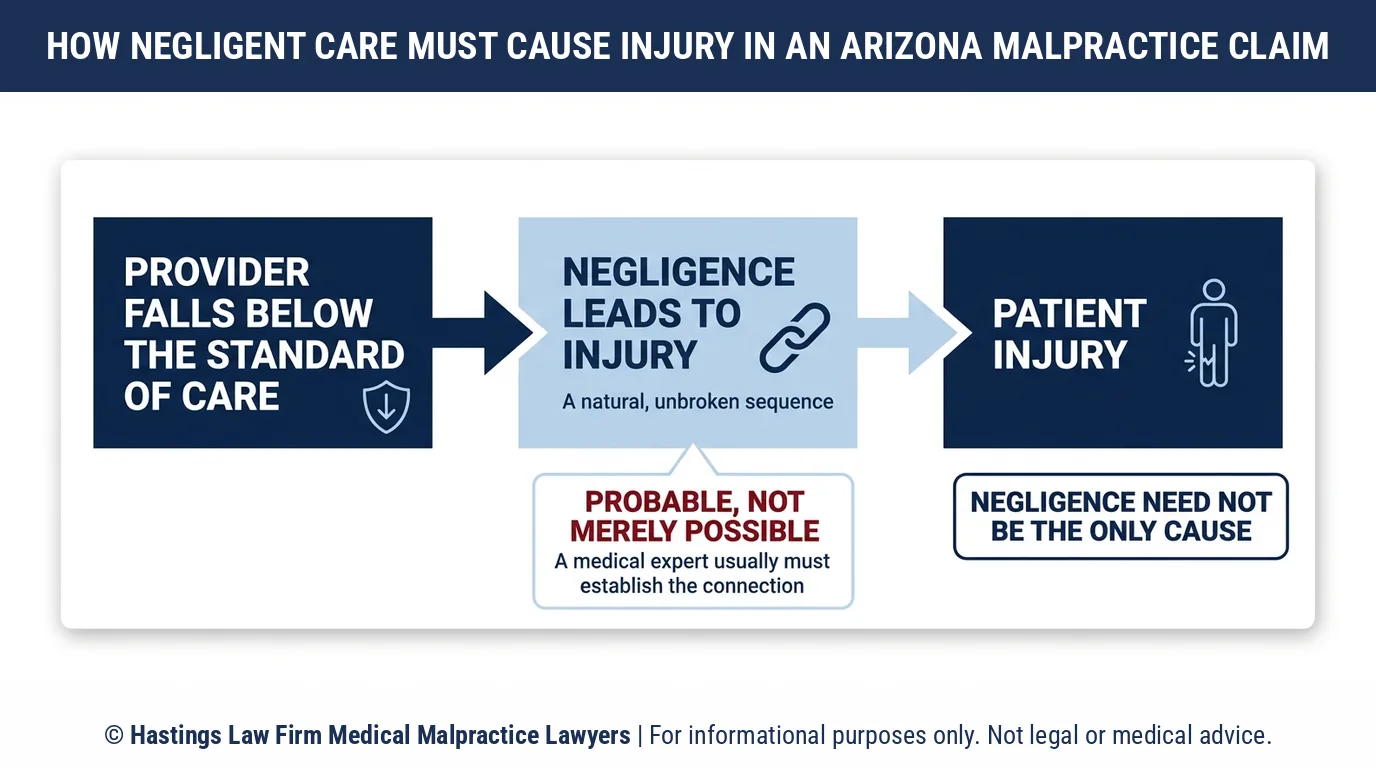
Causation in an Arizona medical malpractice case means that a healthcare provider’s negligence was a proximate cause of the injury, and the patient must prove it, as A.R.S. § 12-563 requires. The negligence must have led to the injury in a natural, unbroken sequence, and a medical expert usually has to establish that connection as probable, not merely possible. Negligence does not have to be the injury’s only cause.
Some cases leave real doubt about what proper treatment would have achieved, and Arizona handles a limited group of them under a rule often called loss of chance. In Thompson v. Sun City Community Hospital, the Arizona Supreme Court held that when a provider took on the job of protecting a patient against a harm and negligent care increased the risk of that harm, the jury may decide whether the negligence caused it. The jury must still find that the negligence probably caused the harm, so a lost chance does not by itself guarantee recovery.
Does an Arizona Medical Malpractice Claim Require Actual Harm?
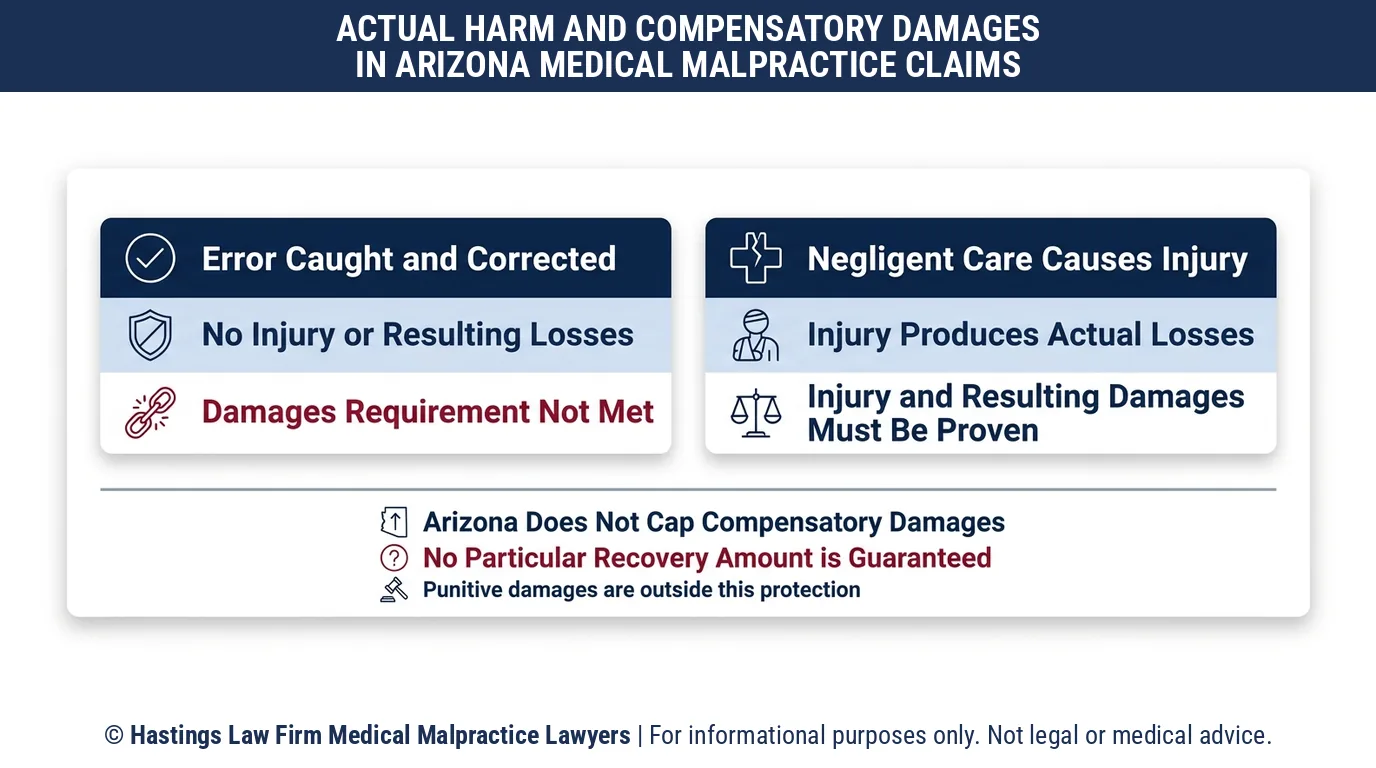
An Arizona medical malpractice claim requires actual harm: the patient must show that negligent care caused an injury. Under the Revised Arizona Jury Instructions (Civil), Medical Negligence 1, the patient has to prove both an injury caused by the negligence and the damages that resulted, so an error caught and corrected before it did any harm does not meet the damages requirement.
Once that harm is proven, Arizona has no damage caps on what a patient can recover in these claims. Article 2, Section 31 of the Arizona Constitution bars any law limiting the amount of damages recovered for causing a person’s death or injury. That protection does not guarantee any particular amount, and it does not cover punitive damages, which are meant to punish rather than repay a loss.
When negligent care leads to a patient’s death, Arizona allows a medical malpractice wrongful death claim. The surviving spouse, a child, a parent or guardian, or the personal representative may file it, generally within two years, with the clock running from the date of death rather than the date of the care.
Which of the Four Elements is Hardest to Prove in an Arizona Malpractice Lawsuit?
Causation, the link between the care and the injury, is often the hardest element to prove in an Arizona malpractice lawsuit. A patient may already be sick or injured when the care begins, and the defense can argue that the underlying condition, not the care, caused the harm. A review in Seminars in Interventional Radiology calls causation “the most troubling and legally challenging” element of a malpractice claim.
Breach is frequently disputed as well, because medical experts can disagree about what the standard of care required in a given situation. That disagreement is why an expert’s qualifications and specialty carry so much weight.
Can You Still Recover if You Were Partly at Fault for a Medical Injury in Arizona?
A patient who was partly at fault for a medical injury can still recover damages in Arizona. Under A.R.S. § 12-2505, Arizona’s comparative fault statute, the patient’s share of fault reduces the damages rather than barring the claim, unless the patient caused or contributed to the injury intentionally, willfully, or wantonly.
In a medical case, the patient’s share of fault comes up when the defense raises it. A provider may argue that the patient’s own conduct helped cause the injury, for example by not following discharge instructions. Whether the patient was at fault, and by how much, is for the jury to decide on the evidence, so the argument alone does not reduce what a patient recovers.
What Proof Does an Arizona Medical Malpractice Lawsuit Need?
In an Arizona medical malpractice lawsuit, the patient must prove negligence, causation, and damages by a preponderance of the evidence, meaning more likely than not. That standard is the ordinary civil burden, stated in an opinion of the Arizona Court of Appeals, Pfeil v. Smith. For emergency care that complies with federal emergency treatment law, and for disaster care, A.R.S. § 12-572 raises the bar to clear and convincing evidence.
Medical experts usually establish what proper care required, how the provider departed from it, and how that departure caused the injury, except in the narrow cases where the negligence or its link to the injury is apparent without medical knowledge. When an expert is needed, A.R.S. § 12-2603 requires the patient to serve a preliminary expert opinion affidavit, a sworn statement from the expert, early in the case. Under § 12-2604, the expert generally must share the provider’s specialty and have spent most of the prior year practicing or teaching in it. A missing affidavit or an unqualified expert can each end the claim.
Every one of those expert opinions rests on the evidence, starting with the medical records, which show what was done and when. Witness testimony and proof of the losses, such as medical bills and missed paychecks, fill in the rest.
The Hastings Law Firm Difference
Results matter, but what truly sets us apart is how we achieve them. Every verdict, every settlement, and every courtroom victory comes from one guiding promise: To treat each client’s fight for justice as if it were our own.
This balance of skill, experience, and empathy reflects our core philosophy that justice should not only compensate the injured, but also make health care safer nationwide.

How Can You Find Out if You Have a Medical Malpractice Case in Arizona?
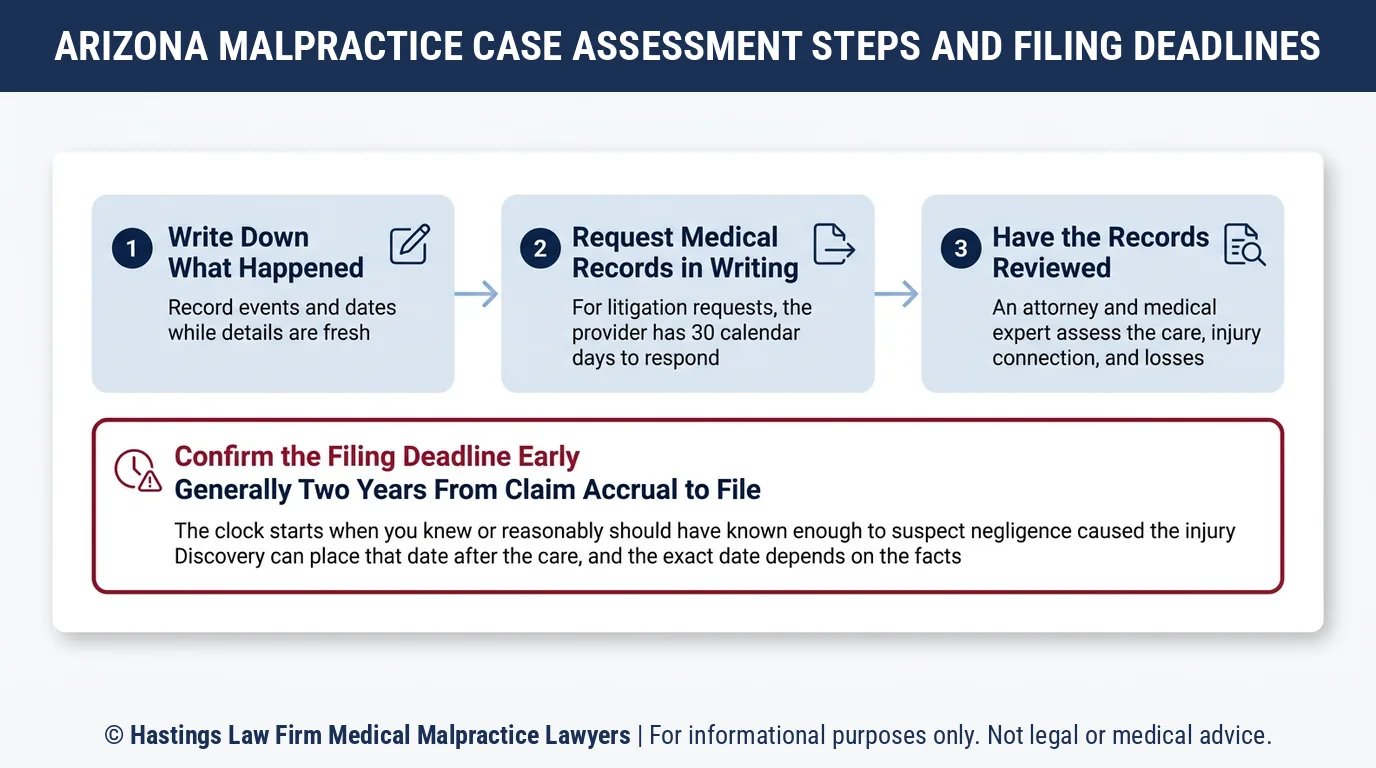
The first steps to find out if you have a medical malpractice case in Arizona are to write down what happened and when, request the medical records, and have an attorney and a medical expert review those records against what the law requires a patient to prove. Notes written while the details are fresh help that review connect what the patient experienced with what the records show.
Everything starts with the medical records. You or your health care decision maker can request them in writing, and under A.R.S. § 12-2293 a provider has 30 calendar days to respond to a request made for litigation, though reasonable copy charges may apply.
Read by an attorney and a medical expert, those records answer three questions: whether the care fell below the standard a reasonable provider would have met, whether that shortfall caused the injury, and what the injury has cost the patient and the family. Sometimes the honest answer is that the care met the standard, and that answer gives a family clarity as well.
Getting those answers runs against a deadline, because Arizona generally gives a patient two years from the date a claim accrues to file it. Under the discovery rule, that clock starts when the patient knew, or reasonably should have known, enough to suspect the injury was caused by negligence, which can be later than the date of the care. The exact start date depends on the facts, so it is worth confirming with an attorney early.
Talk to an Arizona Medical Malpractice Attorney About Your Case
When you contact Hastings Law Firm about care you or a loved one received in Arizona, a member of our intake team asks what happened, when it happened, and who provided the care. We request your medical records at no cost, and our attorneys and medical professionals review them, bringing in a medical expert when a case needs one. Once that review is complete, we always contact you with an honest answer about whether you have a claim.
Our Arizona medical malpractice lawyers are experienced in handling these claims for patients and families across the state. We understand what a medical injury can mean at home, from additional treatment and recovery time to lost income and an uncertain future.
We handle these cases on a contingency fee, which means there is no fee unless we win, and we advance the cost of experts and everything else it takes to build the claim. Hastings Law Firm has been dedicated exclusively to medical malpractice since 2005. Our team is here for you. Contact us now for a free, confidential case review.
Sources
- A.R.S. § 12-563, the elements of proof in a medical malpractice action | Arizona State Legislature
- Gipson v. Kasey, Arizona Supreme Court opinion on when a legal duty exists | Justia
- A.R.S. § 12-561, who counts as a licensed health care provider | Arizona State Legislature
- Stanley v. McCarver, Arizona Supreme Court opinion on duty without a treatment relationship | Justia
- Boyce v. Brown, Arizona Supreme Court opinion on unsuccessful treatment and negligence | Justia
- Thompson v. Sun City Community Hospital, Arizona Supreme Court opinion on increased risk | Justia
- Revised Arizona Jury Instructions (Civil), Medical Negligence instructions and source notes | State Bar of Arizona
- Arizona Constitution Article 2, Section 31, barring limits on injury damages | Arizona State Legislature
- A medical-journal primer on the elements of medical malpractice, including causation | National Library of Medicine
- A.R.S. § 12-2505, how a patient’s own fault reduces damages | Arizona State Legislature
- Pfeil v. Smith, Arizona Court of Appeals opinion stating the civil burden of proof | Justia
- A.R.S. § 12-572, the clear and convincing standard for qualifying emergency care | Arizona State Legislature
- A.R.S. § 12-2603, the preliminary expert opinion affidavit in malpractice cases | Arizona State Legislature
- A.R.S. § 12-2604, who can testify as a standard-of-care expert | Arizona State Legislature
- A.R.S. § 12-2293, patient requests for medical records and response times | Arizona State Legislature
- A.R.S. § 12-542, the two-year filing deadline for malpractice claims | Arizona State Legislature

This content was researched and written by the Hastings Law Firm editorial team, which includes attorneys, medical professionals, and experienced researchers. Our writing is informed by internal knowledge and practical experience, and we cross-check critical details against authoritative sources cited throughout. Every piece undergoes human-led fact-checking and legal review. Because legal and medical information can change, if you spot an error, please contact us. Learn more about our content standards and review process on our editorial policy page.

Tommy Hastings, founder of Hastings Law Firm, is a board-certified personal injury trial lawyer (by the Texas Board of Legal Specialization) dedicated exclusively to healthcare injury cases. Since 2001, he has represented injured patients and families in litigation against major hospital systems, pharmaceutical companies, and negligent healthcare providers nationwide. He has handled numerous high-profile cases that have drawn national media attention and resulted in multi-million dollar recoveries.
