


Who Can Be Held Liable for Medical Malpractice in Arizona?
A patient hurt by medical care is often left with a serious injury, additional recovery time, and no clear sense of who made the mistake. Treatment in a hospital or clinic tends to pass through many hands, so the harm may trace back to one person, to the team around that person, or to the place where it happened. Families focused on healing or on caring for someone they love may see only part of that picture. Learning who can be held responsible for negligent care in Arizona helps fill in the rest.

Last Updated: November 4, 2026
What You Should Know About Who Can Be Held Liable for Medical Malpractice in Arizona:
- Under A.R.S. 12-561, an Arizona medical malpractice claim can be brought against any licensed health care provider, which means a person, corporation, or institution licensed by the state to provide health care, along with the employees and agents working under its supervision.
- To hold an Arizona provider liable for its own care, A.R.S. 12-563 requires proof that the care fell below the accepted standard of care and caused the injury, and a bad outcome alone is not enough.
- Doctors, nurses, nurse practitioners, physician assistants, and pharmacists can each be sued in Arizona for their own negligent care, and a supervising physician assumes legal responsibility for a physician assistant with fewer than 8,000 hours of clinical practice.
- An Arizona hospital is responsible for the negligence of its actual employees acting within the scope of their jobs, and it can face a separate claim for its own negligence in selecting, credentialing, or supervising doctors.
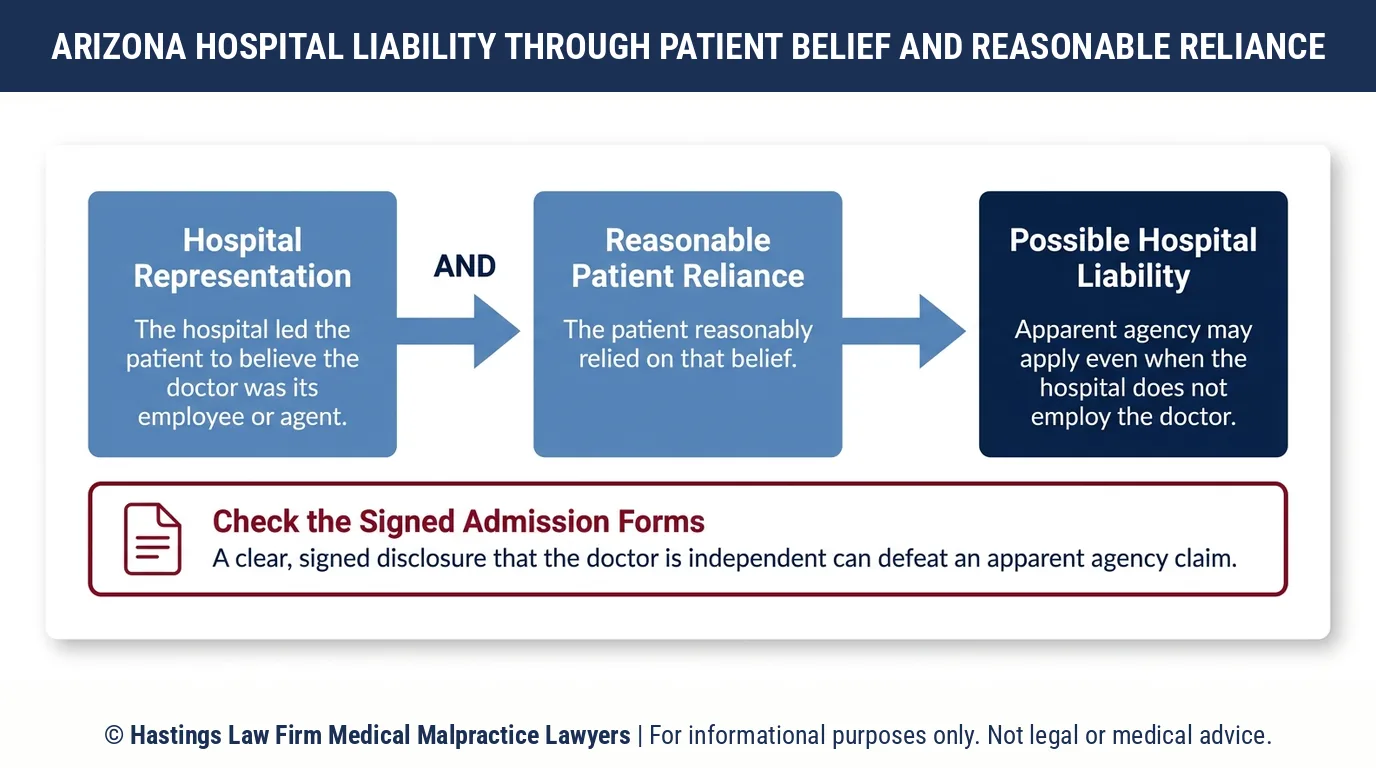
- An Arizona hospital can be liable for a doctor it does not employ if it led the patient to believe the doctor was its employee or agent and the patient reasonably relied on that belief, but a clear, signed disclosure that the doctor is independent can defeat that claim.
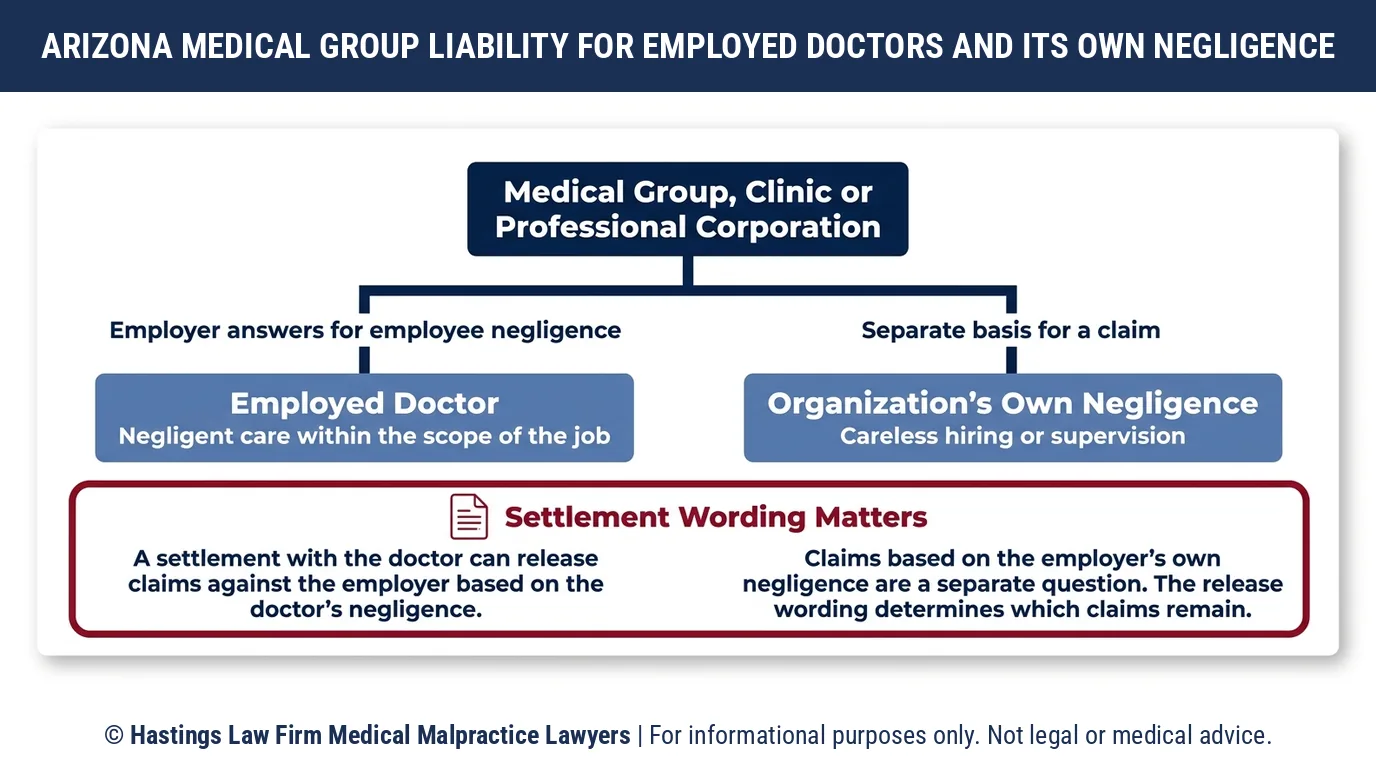
- An Arizona medical group, clinic, or professional corporation can be responsible for the negligence of a doctor it employs, and the wording of a settlement with that doctor decides which claims against the employer the patient keeps.
- Under A.R.S. 12-2506, each defendant in an Arizona malpractice case generally pays only its own percentage of fault, and a defendant can ask the jury to assign fault to someone outside the lawsuit, which can reduce what the patient recovers.
- The medical and billing records from every provider and facility show who ordered, performed, and charted each part of the care, and an Arizona records request made for a lawsuit must receive a response within 30 calendar days.
- An Arizona medical malpractice lawsuit generally must be filed within two years after the claim accrues, while a claim against a public hospital needs a written notice of claim within 180 days, stating a specific dollar amount, and a lawsuit within one year.
Who is Legally Responsible for Medical Negligence in Arizona?
Any licensed health care provider can be legally responsible for medical negligence in Arizona. Section 12-561 of the Arizona Revised Statutes defines that provider as a person, corporation, or institution licensed by the state to provide health care, including its supervised employees and agents. The parties who can be held liable for medical malpractice in Arizona include individual clinicians as well as hospitals, clinics, and other licensed facilities.
Fitting that definition does not make a provider liable by itself. Under A.R.S. 12-563, a claim must show that a particular provider’s care fell below the accepted standard of care and that this failure caused the injury. A bad outcome alone does not make anyone liable, because the evidence has to establish negligent care.
Responsibility can reach beyond the person whose hands made the mistake. An employer answers for the negligence of its employees on the job, and a hospital or other facility can answer for its own failures as an institution. One injury can therefore involve more than one responsible party.
A claim must prove four elements against every party it names: a duty of care owed to the patient, a failure to meet it, an injury caused by that failure, and real losses from the injury. Showing that one provider was careless does not show that another was.
A patient’s own conduct can become an issue as well. A defendant may argue that the patient contributed to the injury, such as by not following medical advice, but that argument does not automatically reduce compensation or defeat the claim. Whether the patient shares any fault depends on the evidence and the jury’s decision, and in Arizona a share of fault reduces recovery rather than barring it.
Which Medical Professionals Can Be Sued for Their Own Mistakes in Arizona?
Doctors, nurses, nurse practitioners, physician assistants, pharmacists, and other licensed clinicians can be sued in Arizona for their own negligent care. Under A.R.S. 32-2501, a physician assistant with fewer than 8,000 clinical practice hours has a supervising physician who assumes legal responsibility for the assistant’s health care tasks.
After the board certifies those 8,000 hours, an assistant may practice without a supervision agreement, and one who does is legally responsible for their own services under A.R.S. 32-2531. A doctor who only collaborates with an experienced physician assistant does not have to be in the room and is not automatically liable for the assistant’s care.
Nurse practitioners work under different rules. Within their certified specialty, they make their own decisions about diagnosis, treatment, and prescribing, and they must consult another provider or refer the patient when a condition goes beyond their knowledge and experience.
A provider’s duty of care usually comes from treating the patient. A consulting specialist can take on that duty without ever seeing the patient, by advising the treating doctor knowing the advice will be relied on. The court decides whether a legal duty exists in a given case.
Nurses owe that duty to the patients they treat, and a nurse’s negligence, such as a medication given in error, can support a claim. The hospital or other employer answers for that negligence when the nurse was acting within the scope of the job, so a claim for nurse malpractice in Arizona can involve both the nurse and the employer.
The same pairing can arise at a pharmacy. Licensed pharmacists and pharmacy businesses can each face malpractice claims for negligent pharmaceutical care, including errors in dispensing a prescription. Not every injury at a pharmacy is medical malpractice, though, because a pharmacist malpractice claim in Arizona has to arise from the pharmaceutical care itself.
Whichever of these professionals a lawsuit names, the claim against each one has to meet Arizona’s expert rules. Under A.R.S. 12-2603, a patient suing a health care provider must certify whether expert testimony is needed and, if it is, serve an expert’s sworn statement, called a preliminary expert opinion affidavit, early in the case or risk dismissal. A.R.S. 12-2604 then requires the expert who testifies about the provider’s care to share the provider’s specialty and, if the provider is board certified, the same board certification.
Can You Sue a Hospital for Malpractice in Arizona?
A patient can sue a hospital for malpractice in Arizona. A hospital is a licensed health care provider, and it is responsible for the negligence of its actual employees acting within the scope of their jobs. A decision of the Arizona Supreme Court, Kopp v. Physician Group of Arizona, restated that employer rule, known as respondeat superior.
That rule covers the nurses, doctors, and other staff who are true hospital employees. It does not reach every doctor who treats a patient there, because a doctor who works at a hospital as an independent contractor is not its employee. A hospital malpractice claim in Arizona therefore looks closely at whether each person involved was a hospital employee.
Employment also matters when the jury assigns fault. Arizona generally makes each defendant pay only its own share, with an exception for a person at fault who was acting as a party’s agent or servant. That exception keeps a hospital responsible for its employee’s share of the fault.
A hospital can face a separate claim for its own negligence, apart from anything an employee did. That claim can rest on failures in selecting, credentialing, or supervising the doctors who practice there. Granting a doctor privileges, the permission to practice at the hospital, does not by itself make the hospital liable for that doctor’s care.
Claims against a hospital run by a public entity face shorter deadlines. A written notice of claim must be filed with the public entity within 180 days after the claim accrues, which is when the deadline starts to run. The notice must name a specific dollar amount that would settle the claim, and the lawsuit itself must follow within one year. Whether a hospital counts as public depends on whether the entity is the state itself or one of its political subdivisions, not on the public service it provides.
When is an Arizona Hospital Liable for a Doctor It Does Not Employ?
An Arizona hospital can be held liable for a doctor it does not employ when the hospital led the patient to believe the doctor was its employee or agent and the patient reasonably relied on that belief. That rule is called apparent agency, and it was applied in a decision of the Arizona Court of Appeals, Fadely v. Encompass Health Valley of the Sun Rehabilitation Hospital.
Apparent agency does not make a hospital liable for every specialist who works there. A contract calling the doctor an independent contractor does not settle the question by itself, though. Under Beeck v. Tucson General Hospital, whether a doctor counts as a hospital employee can depend on how much control the hospital actually had over the doctor’s work.
The papers a patient signs at admission matter as well. A clear, signed form disclosing that a doctor is independent of the hospital can defeat an apparent agency claim.
Emergency room malpractice claims raise the same questions. Arizona courts have found hospitals liable for the negligence of an emergency group’s doctors where the hospital controlled the emergency room staffing and the patient had no real choice of doctor, though a signed disclosure can change that result today. The Emergency Medical Treatment and Labor Act (EMTALA) is the federal law that requires hospitals with emergency departments that take part in Medicare to screen people who come seeking treatment and to stabilize or properly transfer anyone with an emergency medical condition. For care that qualifies as EMTALA-compliant emergency treatment, A.R.S. 12-572 sets a higher bar, and the patient must prove the claim by clear and convincing evidence against both the treating professional and the hospital.
Can You Sue a Medical Group or Clinic Over a Physician’s Mistake in Arizona?
A patient can sue a medical group, clinic, or professional corporation in Arizona over a doctor’s mistake when the group employs that doctor. In Kopp v. Physician Group of Arizona, the Arizona Supreme Court confirmed that an employer answers for its employees’ negligence on the job. Clinics, outpatient surgery centers, and other licensed institutions can also be sued for their own negligent care.
Settling with the doctor can change who remains responsible. That settlement can release the claims against the employer that rest on the doctor’s negligence, while a claim for the employer’s own negligence, such as careless hiring or supervision, is a separate question. The exact wording of any release matters, because it decides which claims the patient gives up and which the patient keeps.
Long-term care facilities can face the same kinds of claims. Negligence in the nursing or health-related care of an Arizona nursing home or assisted living facility licensed by the state can be treated as medical malpractice, although not every incident on the premises qualifies. What matters is the care the facility and its staff provided, not only where the injury happened.
Can More Than One Health Care Provider Be Held Responsible for the Same Injury in Arizona?
A patient can sue more than one doctor or hospital for medical negligence in Arizona. One claim can name every licensed provider and facility whose care fell below the standard of care and caused the injury, such as a surgeon and the hospital together. Under A.R.S. 12-2506, each defendant is generally liable only for its own percentage of fault, not for the whole judgment.
Fault can be shared this way because one provider’s negligence does not have to be the injury’s only cause. The medical evidence generally has to show a probable link between each provider’s care and the injury, not just a possible one.
When the case reaches a verdict, the jury assigns each defendant a percentage of fault, and a separate judgment is entered against each one for its share. One defendant pays another’s share only when the two acted in concert or one was the other’s agent or servant.
A settlement with one provider does not erase that provider’s share of the fault. The jury can still assign a percentage to the provider who settled, and the defendants left in the case generally pay only their own shares.
A defendant can also ask the jury to assign fault to a provider left out of the lawsuit, after giving notice that names that person and the facts behind the request. Naming someone does not prove fault, and a person outside the case who is assigned a share does not have to pay it. That share can still reduce what the patient recovers from the named defendants, so leaving a responsible provider out of the claim can cost the patient.
The Hastings Law Firm Difference
Results matter, but what truly sets us apart is how we achieve them. Every verdict, every settlement, and every courtroom victory comes from one guiding promise: To treat each client’s fight for justice as if it were our own.
This balance of skill, experience, and empathy reflects our core philosophy that justice should not only compensate the injured, but also make health care safer nationwide.

How Do You Find Out Who is Responsible for a Medical Injury in Arizona?
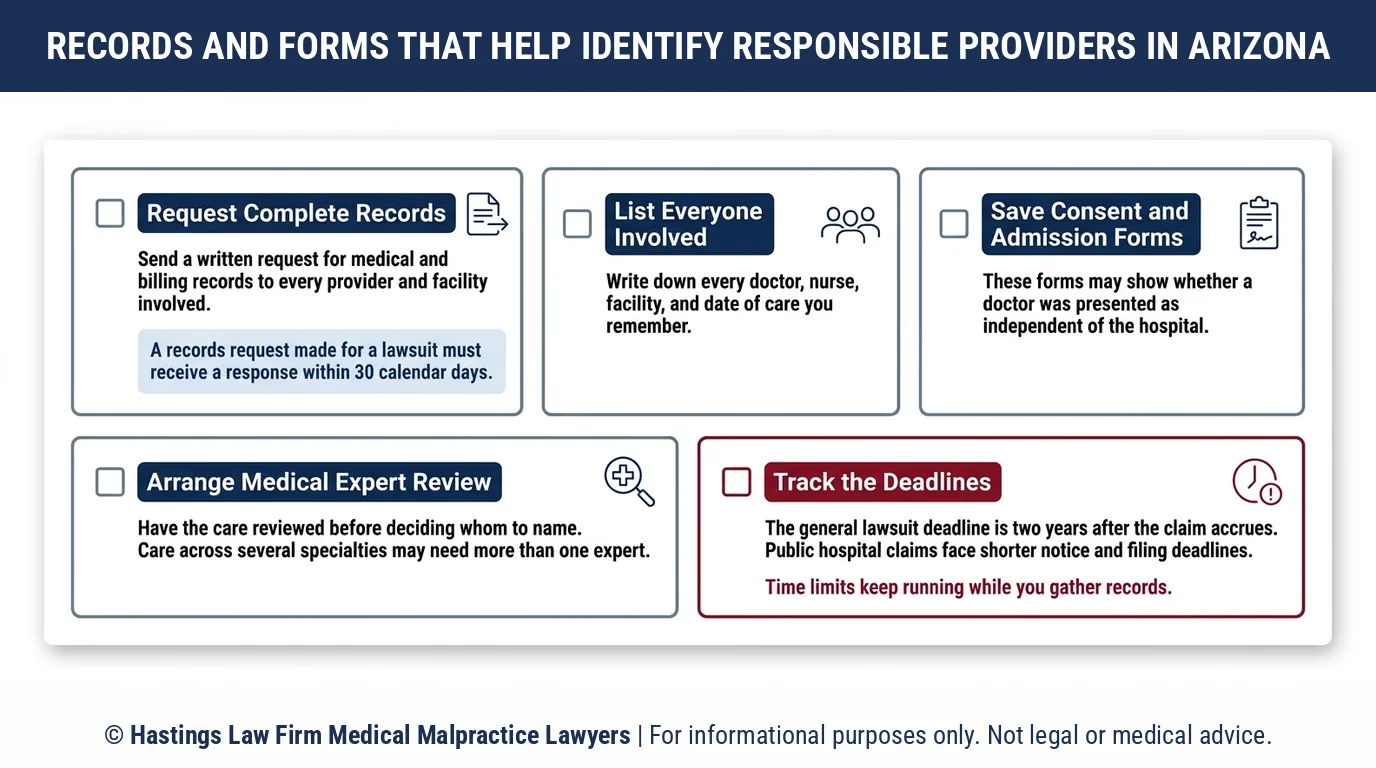
The first step in finding out who is responsible for a medical injury in Arizona is a written request for the complete medical and billing records from every provider and facility involved. The records show who ordered, performed, and charted each part of the care, and a request made for a lawsuit must receive a response within 30 calendar days.
The patient or the patient’s health care decision maker can make that request under A.R.S. 12-2293. Alongside the records, keep a list of every doctor, nurse, facility, and date of care you remember. Save the consent and admission forms as well, because they can show whether a doctor was presented as independent of the hospital.
With the records and that list in hand, have the care reviewed by a medical expert before deciding whom to name. The review can show which providers’ care fell below the standard and which did not, and care that crossed several specialties may need more than one expert.
Time limits keep running while this work goes on. An Arizona medical malpractice lawsuit generally must be filed within two years after the claim accrues, and a claim against a public hospital faces the shorter notice and filing deadlines for public entities. Identifying everyone involved should therefore start early.
Talk to an Arizona Medical Malpractice Attorney About Your Case
When you contact Hastings Law Firm about care you or a loved one received in Arizona, a member of our intake team asks what happened, when it happened, and who provided the care. We request the medical records at no cost to you, our attorneys and medical professionals review them, and we give you an honest answer about whether there is a claim and against whom.
We understand how hard it is for a family to sort out who did what while a loved one is recovering or after a loss. Our Arizona medical malpractice lawyers are experienced in handling these claims, and our team includes former defense attorneys who understand how medical injury claims are defended. That team will find every provider and facility whose care played a part, so you do not have to work it out alone.
We handle these cases on a contingency fee, which means there is no fee unless we win, and we advance the cost of medical experts and everything else it takes to build a claim. Hastings Law Firm has been dedicated exclusively to medical malpractice since 2005, and our team is here for you. Contact us now for a free, confidential case review.
Frequently Asked Questions About Medical Malpractice Liability in Arizona
Can You Sue the Maker of a Defective Drug or Medical Device in Arizona?
You can sue the maker of a defective drug or medical device in Arizona, but that is a product liability claim, not a medical malpractice claim. Under A.R.S. 12-681, a claim against a manufacturer over a product’s design, manufacture, or inadequate warnings falls under Arizona’s product liability law.
A provider’s negligent treatment with that same drug or device is a separate malpractice claim, and which kind of claim applies depends on who is sued and what they did. Defective medical device claims and dangerous drug injury claims against a manufacturer follow those product liability rules in Arizona.
Is a Medical Professional Who Gives Free Help at an Emergency Scene Liable for Malpractice in Arizona?
A medical professional who gives free emergency help at the scene of an emergency in Arizona generally cannot be held liable for ordinary negligence in that care. A.R.S. 32-1471 protects health care providers and other people who give emergency care at the scene of an emergency or at a public gathering for free and in good faith.
The protection does not cover gross negligence or care given for payment. Emergency treatment in general is not immune, because the free care, the emergency setting, and good faith all have to be present.
Does a Complaint to the Arizona Medical Board Hold a Doctor Liable for Malpractice?
A complaint against a medical doctor in Arizona is filed with the Arizona Medical Board, but that complaint does not hold the doctor liable for malpractice or start a lawsuit. Under A.R.S. 32-1451, the board investigates medical doctors and can discipline them, including restricting or suspending a license, and in some disciplinary actions it can require a doctor to return fees to a patient.
The board does not award malpractice damages. Compensation for an injury comes from a separate malpractice lawsuit filed in court, and a board complaint neither files nor replaces it.
Sources
- A.R.S. § 12-561, who counts as a licensed health care provider | Arizona State Legislature
- A.R.S. § 32-2501, supervising physicians and physician assistant definitions | Arizona State Legislature
- Kopp v. Physician Group of Arizona, Arizona Supreme Court opinion on employer liability | Arizona Judicial Branch
- Fadely v. Encompass Health, opinion on apparent agency for independent contractor doctors | CourtListener
- A.R.S. § 12-2506, how fault is divided among several defendants | Arizona State Legislature
- A.R.S. § 12-2293, a patient’s right to medical and payment records | Arizona State Legislature
- A.R.S. § 36-431, the license requirement for Arizona health care institutions | Arizona State Legislature
- A.R.S. § 12-681, definitions for product liability claims against manufacturers | Arizona State Legislature
- A.R.S. § 32-1471, protection for free emergency care given in good faith | Arizona State Legislature
- A.R.S. § 32-1451, Arizona Medical Board investigations and discipline of doctors | Arizona State Legislature

This content was researched and written by the Hastings Law Firm editorial team, which includes attorneys, medical professionals, and experienced researchers. Our writing is informed by internal knowledge and practical experience, and we cross-check critical details against authoritative sources cited throughout. Every piece undergoes human-led fact-checking and legal review. Because legal and medical information can change, if you spot an error, please contact us. Learn more about our content standards and review process on our editorial policy page.

Tommy Hastings, founder of Hastings Law Firm, is a board-certified personal injury trial lawyer (by the Texas Board of Legal Specialization) dedicated exclusively to healthcare injury cases. Since 2001, he has represented injured patients and families in litigation against major hospital systems, pharmaceutical companies, and negligent healthcare providers nationwide. He has handled numerous high-profile cases that have drawn national media attention and resulted in multi-million dollar recoveries.
