


Arizona Pharmacist Malpractice Lawyer
Pharmacy errors can cause serious harm when the wrong medication, dose, or instructions reach a patient. Pharmacists are expected to check for safety issues such as interactions and allergies, provide clear counseling, and follow verification safeguards even in busy settings. Some reactions are not preventable when a medication is correctly dispensed, but preventable mistakes can break trust and leave lasting physical and emotional impacts. If you or a loved one were harmed or worse due to pharmacist malpractice in Arizona, contact Hastings Law Firm for a free, confidential case review.

Last Updated: July 27, 2026
Trusted Legal Representation for Pharmacy Negligence in Arizona
When a pharmacist makes a preventable error, the consequences can be devastating. You trusted a trained professional to dispense the right medication at the right dose, and that trust was broken. The confusion, the fear, and the physical harm that follow a medication error are real, and you deserve answers about what went wrong.
At Hastings Law Firm, we focus exclusively on medical malpractice, including cases involving pharmacist negligence. Our team includes in-house medical professionals who understand how pharmacy errors happen, and former defense attorneys who know how pharmacies and their insurers respond to claims. If you or a loved one was harmed by a medication error, an experienced Arizona pharmacist malpractice lawyer at our firm can review what happened and explain your legal options at no cost to you.

Understanding Pharmacist Malpractice and the Standard of Care
Pharmacist malpractice occurs when a licensed pharmacist deviates from the accepted professional standard of care, resulting in a preventable medication error that causes patient harm. To pursue a claim, we must show that the pharmacist owed you a duty of care, that they breached that duty, and that the breach directly caused your injury.
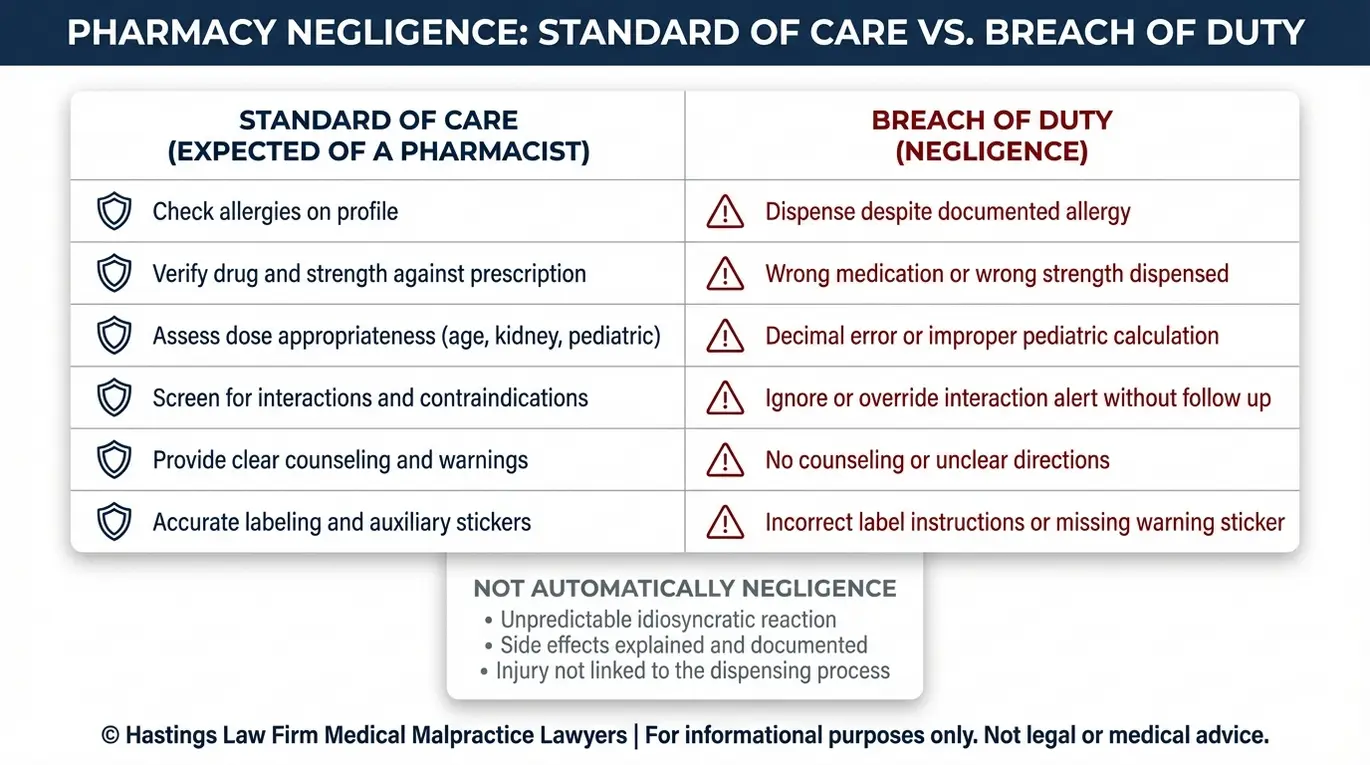
Under Arizona Revised Statutes Section 32-1901, a pharmacist’s professional responsibilities go well beyond handing you a bag at the counter. Pharmacists are required to perform a drug utilization review, or DUR, which is the process of checking your prescription for correct dosage, potential drug interactions, and allergies before dispensing. They also have a duty to counsel patients on how to safely take their medication and what side effects to watch for.
A breach of duty in cases of pharmacist negligence can take many forms. A pharmacist may override or ignore a computer-generated safety alert, skip the final verification step, or fail to counsel a patient about a known risk. Understaffing and production pressure at high-volume pharmacies can contribute to these errors, but they do not excuse them. The standard of care remains the same regardless of how busy the pharmacy is.
Distinguishing between actionable negligence and an adverse drug reaction, sometimes called an ADR, helps clarify the grounds for a legal claim. An ADR is an unforeseeable, non-preventable reaction to a properly dispensed medication. If the right drug was given at the right dose with proper warnings, and the patient still had a reaction, that is generally not malpractice. An Arizona malpractice lawyer can help determine whether the harm you experienced was the result of a true ADR or a preventable error.
Common Types of Pharmacy Malpractice Claims in Arizona
Common pharmacy errors include dispensing the wrong medication, providing the incorrect dosage, failing to identify dangerous drug interactions, and labeling errors that give patients incorrect usage instructions. Since 2005, our firm has focused exclusively on medical malpractice litigation. Founder Tommy Hastings is a board-certified trial lawyer, a credential held by fewer than 2% of attorneys, and he applies this specialized knowledge to every case.
Many dispensing errors involve what are called sound-alike, look-alike medications, or SALA drugs. These are medications with similar names or packaging that are easily confused, such as hydroxyzine and hydralazine. A pharmacy malpractice attorney can investigate whether the pharmacy had proper safeguards in place to prevent this type of mix-up. According to the Agency for Healthcare Research and Quality’s Patient Safety Network (PSNet), medication errors and adverse drug events remain a leading source of preventable patient harm.
The most common error types we see include:
- Dispensing the wrong medication: Confusing SALA drugs or selecting the wrong drug from a drop-down menu or automated system.
- Dosage errors: A misplaced decimal point, sometimes called a decimal point error, can result in a patient receiving ten times the intended dose, potentially causing a fatal overdose. Pediatric dosing calculations are especially vulnerable to this mistake.
- Failure to screen for drug interactions: Ignoring or overriding system alerts warning that a new prescription conflicts with a medication the patient already takes.
- Labeling errors: Providing incorrect instructions on the label, such as wrong frequency or route of administration.
- Auto-fill and technology errors: Selecting the wrong patient profile or allowing auto-fill software to populate incorrect information without manual verification.
Preserving Evidence: The Importance of Pill Bottles
Preserving physical evidence is a necessary step in an Arizona pharmacy negligence case. If you suspect a pharmacy error, keep the pill bottle, blister pack, and any packaging you received. These items contain critical evidence, including the prescription directions (often abbreviated as the “Sig”), the National Drug Code (NDC) that identifies the exact manufacturer and product dispensed, and the pharmacist’s initials. Do not return the medication to the pharmacy. Instead, store everything in a safe place and bring it to your lawyer for pharmacist negligence as soon as possible.
The Hastings Law Firm Difference
Results matter, but what truly sets us apart is how we achieve them. Every verdict, every settlement, and every Arizona courtroom victory comes from one guiding promise: To treat each client’s fight for justice as if it were our own.
This balance of skill, experience, and empathy reflects our core philosophy that justice should not only compensate the injured, but also make health care safer nationwide.

Who is Liable? Identifying Responsible Parties
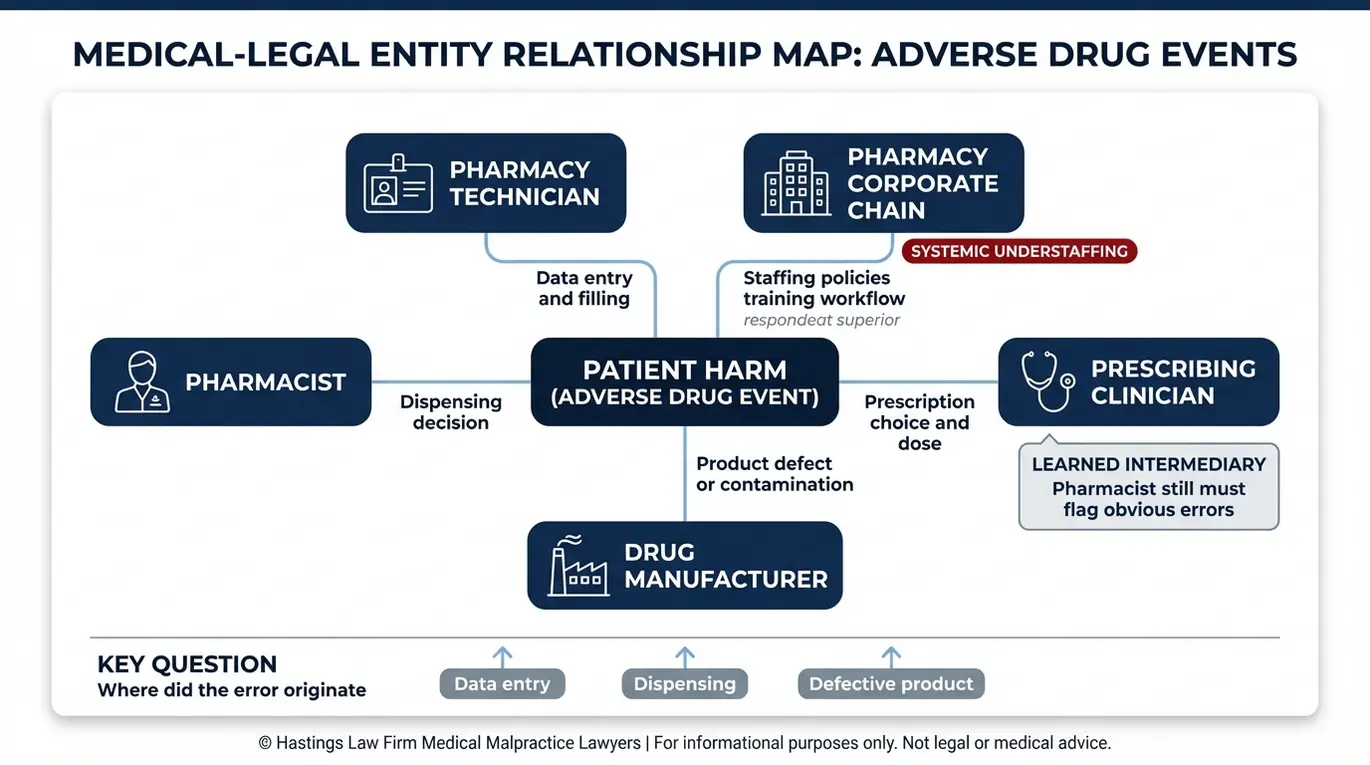
Liability may extend beyond the individual pharmacist to include the pharmacy corporate chain, pharmacy technicians (the support staff who assist in counting and preparing medications), the prescribing physician, or pharmaceutical manufacturers, depending on where the error originated.
When a pharmacist makes an error while working for a corporate chain like CVS or Walgreens, the company itself can be held liable under a legal principle called respondeat superior, which holds employers responsible for the actions of their employees. If you are considering suing a pharmacist in Arizona due to systemic issues like chronic understaffing or unrealistic prescription quotas, the corporate entity may bear significant responsibility. An Arizona pharmacist malpractice lawyer can investigate whether institutional policies contributed to the mistake.
In some instances, the prescribing doctor and the pharmacist share fault for a medication error. Pharmacists have an independent duty to catch obvious errors on a prescription, even if a doctor wrote it. This is sometimes discussed in terms of the learned intermediary concept. The pharmacist’s final check, known as pharmacist verification, exists specifically as a safety net. If a doctor prescribed a dangerous dose and the pharmacist filled it without question, both may be liable.
When the harm was caused by a defective drug itself rather than a filling error, the pharmaceutical manufacturer may be the proper target. We examine every link in the chain to determine who is responsible, establishing proximate cause and causation for medical malpractice or wrongful death.
How to Prove Negligence: The Affidavit of Merit Requirement
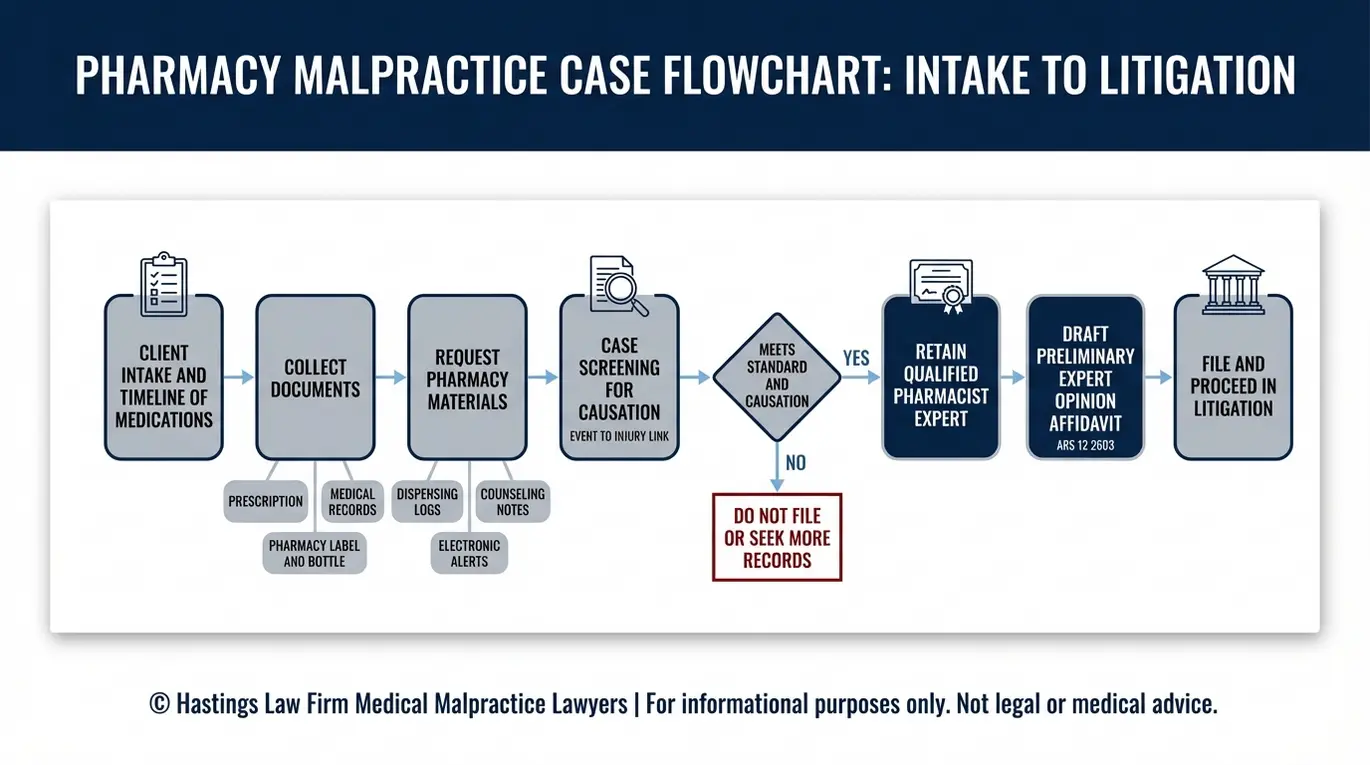
The Arizona Revised Statutes require plaintiffs to provide a preliminary expert opinion affidavit under ARS § 12-2603, certifying that the claim has merit and that the pharmacist fell below the standard of care. Without this affidavit, the court can dismiss your case, which is one reason why working with an experienced medication error attorney early in the process matters.
The affidavit must come from a qualified expert, typically another licensed pharmacist, who has reviewed the facts and can confirm that a breach of duty occurred. This expert also evaluates whether a drug-drug interaction (a harmful reaction between two or more medications) or a contraindication (a condition or factor that makes a particular treatment inadvisable) should have been caught before the medication was dispensed.
Our team follows a structured investigation process to build the foundation for this expert witness testimony:
- Obtain and analyze complete pharmacy dispensing logs and electronic records
- Request surveillance footage from the pharmacy, if available
- Review the patient’s full medication history for interaction risks
- Identify the specific point in the workflow where the error occurred
- Retain a qualified pharmacy expert to prepare the required affidavit
This preparation begins from day one. We build every case as though it will go to a jury, and that level of readiness strengthens our position whether the case resolves through negotiation or at trial.
Compensation for Medication Injuries in Arizona
Patients harmed by pharmacy errors can recover economic damages for medical bills and lost wages, as well as non-economic damages for pain, suffering, and permanent impairment. Arizona law allows recovery in both categories, and the specific value of a claim depends on the severity and duration of the injury.
Economic damages cover the measurable financial losses tied to the error. These include medical expenses for emergency room visits, hospitalization, corrective treatments, prescription costs, and income lost during recovery. Non-economic damages compensate for the harm that does not come with a receipt: chronic pain, emotional distress, loss of enjoyment of life, and the anxiety that often follows a betrayal of medical trust.
| Economic Damages | Non-Economic Damages |
|---|---|
| Medical bills and future treatment costs | Physical pain and suffering |
| Lost wages and reduced earning capacity | Emotional distress and anxiety |
| Rehabilitation and long-term care expenses | Loss of enjoyment of life |
| Out-of-pocket costs for corrective medication | Permanent impairment or disability |
The Arizona Constitution prohibits caps on damages in personal injury and wrongful death cases. Unlike many other states that limit non-economic recovery, Arizona protects your right to full compensation based on the actual harm you suffered.
When a medication error causes long-term organ damage or disability, a lawyer for pharmacy error cases will work with medical and economic experts to calculate the full cost of future care, ensuring that your recovery accounts for needs that may extend years or decades into the future.
Contact the Arizona Healthcare Malpractice Attorneys at Hastings Law Firm Today for Help
Medication errors are preventable. When a pharmacist’s mistake causes serious harm, you have the right to find out what happened and hold the responsible parties accountable.
At Hastings Law Firm, our medical-legal team includes in-house nurse consultants, Board Certified Patient Advocates, and former defense attorneys who understand how pharmacies and their insurers operate. We handle pharmacy negligence cases on a contingency fee basis, which means you pay no attorney fees or costs unless we recover compensation for you.
If you or a loved one was injured by a pharmacy error in Arizona, we are here to listen. Contact us for a free, confidential case evaluation. Let us help you seek the truth and the accountability you deserve.
Frequently Asked Questions About Pharmacist Malpractice in Arizona


This content was researched and written by the Hastings Law Firm editorial team, which includes attorneys, medical professionals, and experienced researchers. Our writing is informed by internal knowledge and practical experience, and we cross-check critical details against authoritative sources cited throughout. Every piece undergoes human-led fact-checking and legal review. Because legal and medical information can change, if you spot an error, please contact us. Learn more about our content standards and review process on our editorial policy page.

Tommy Hastings, founder of Hastings Law Firm, is a board-certified personal injury trial lawyer dedicated exclusively to healthcare injury cases. Since 2001, he has represented injured patients and families in litigation against major hospital systems, pharmaceutical companies, and negligent healthcare providers nationwide. He has handled numerous high-profile cases that have drawn national media attention and resulted in multi-million dollar recoveries. He draws on that experience in his writing, helping readers understand how these cases work and what options may be available to them.
