


Does Arizona Have a Cap on Medical Malpractice Damages?
Negligent medical care can change a life well beyond the first hospital bill. Ongoing treatment, lost income, and the daily strain of a serious injury or worse keep adding up long after the harm was done, and the weight often falls on a whole household. Many patients and families in that position wonder whether the law would recognize the full extent of what they have lost. In Arizona, understanding how each of those losses is counted can make it easier to decide whether a claim is worth pursuing.

Last Updated: November 4, 2026
What You Should Know About Medical Malpractice Damages in Arizona:
- Arizona has no cap on medical malpractice damages, because Article 2, Section 31 of the Arizona Constitution bars any law limiting the damages a jury may award for causing a death or an injury.
- With no cap on Arizona malpractice damages, every loss counts as far as it is proved, from medical bills and lost earnings to pain, disability, and loss of enjoyment of life, so each loss needs records behind it.
- Arizona could add a cap only through a constitutional amendment approved by its voters, and in 1994 voters rejected Proposition 103, which proposed allowing laws limiting damages for death or personal injury.
- Arizona wrongful death damages have no cap either, and under A.R.S. § 12-613 the jury awards what it finds fair and just for the surviving family’s proved losses.
- No Arizona statute caps punitive damages against a private healthcare provider, but they require clear and convincing proof of an evil mind, and negligence or gross negligence alone is not enough.
- Compensatory damages against an Arizona public hospital have no statutory cap, but A.R.S. § 12-820.04 bars punitive damages, and a notice of claim stating a specific dollar amount is due within 180 days.
- A patient’s own share of fault generally reduces an Arizona malpractice award without barring the claim, and a judge can order a new trial on excessive damages unless the patient accepts a reduced award.
- Future damages in an Arizona malpractice case are paid in installments only if the patient agrees, because the Arizona Supreme Court held the statutory payment scheme unconstitutional in Smith v. Myers (1994).
Does Arizona Law Limit Compensation in a Medical Negligence Case?
Arizona does not have a cap on medical malpractice damages. Article 2, Section 31 of the Arizona Constitution bars any state law from limiting the dollar amount a jury may award for causing a death or a personal injury. Because there are no medical malpractice damage caps in Arizona, an award can cover every loss the evidence proves.
A cap is a law that sets the most a jury can award, and Arizona’s ban reaches both kinds of compensatory damages, the money that makes up for a patient’s losses. Economic damages include medical expenses, reasonably probable future care, lost earnings, and reduced earning capacity. Non-economic damages include pain and suffering, disability, and loss of enjoyment of life.
Each of those losses still has to be proved, and the negligent care must have caused real harm. Future treatment, for example, is recovered when the evidence shows its probable need, nature, and cost. The Constitution does not promise any particular amount. The jury decides damages at trial, so the size of an award rests on the evidence, not on a limit set by statute.
Which Parts of the Arizona Constitution Protect Malpractice Awards?
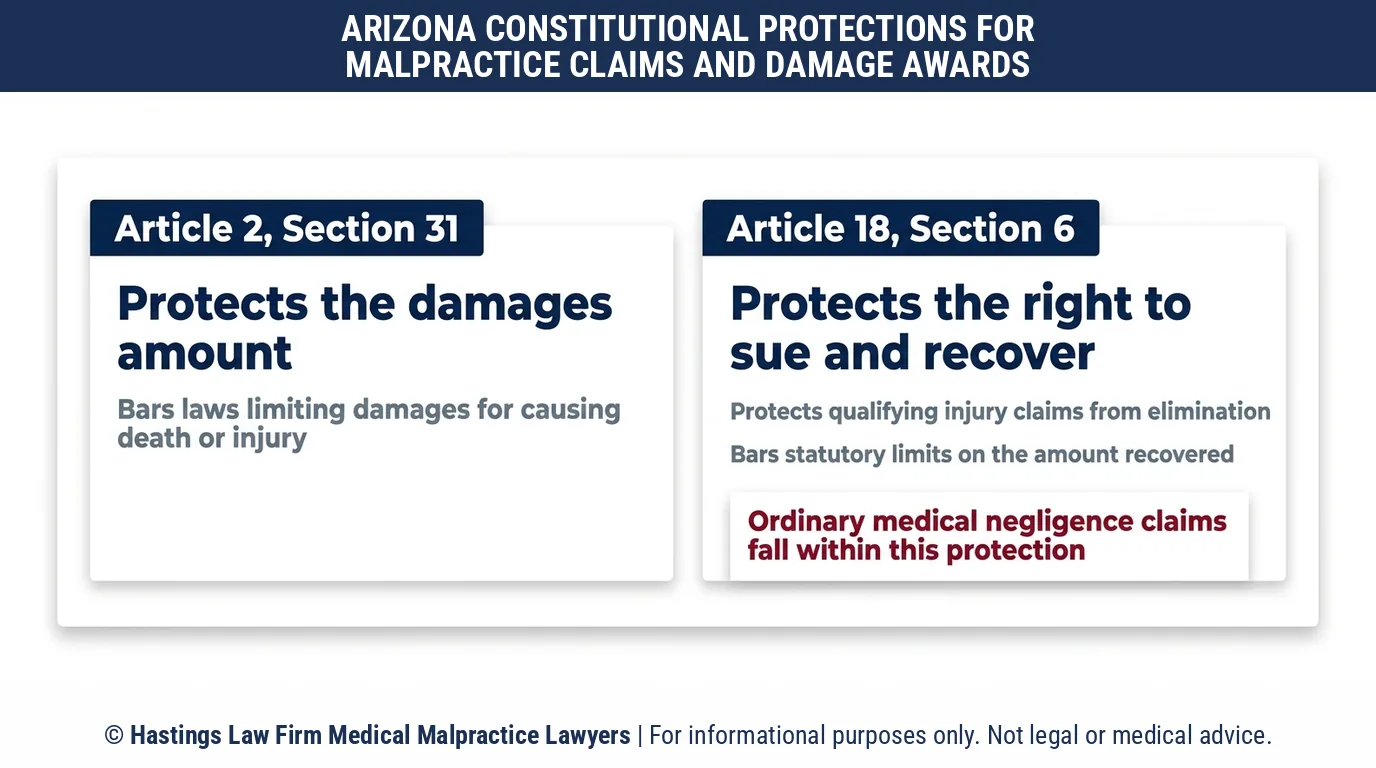
Article 2, Section 31 of the Arizona Constitution bars any law limiting the damages recovered for causing a death or an injury. A second clause, Article 18, Section 6 of the Arizona Constitution, protects the injured person’s right to sue and keeps the amount a jury awards from being cut down by statute. Together, the two clauses shield Arizona malpractice awards from limits set by lawmakers.
The right-to-sue clause covers claims that already existed under court-made law in 1912, along with claims based on them. Arizona courts have confirmed that ordinary negligence claims against healthcare providers fall within that protection, so no statute can eliminate them.
The Arizona Supreme Court has also held a malpractice statute unconstitutional under Article 2, Section 31. In Smith v. Myers (1994), the court ruled that a statutory scheme for paying future damages in installments was effectively a damage limitation the Constitution forbids. The scheme set no dollar ceiling, but the court struck it down because it reduced what a patient’s award was worth.
Can the Arizona Legislature Limit Medical Negligence Damages?
The Arizona Legislature cannot limit medical negligence damages by passing an ordinary law. A limit would require a constitutional amendment, and under Article 21, Section 1 of the Arizona Constitution, an amendment needs the approval of a majority of the voters who vote on it. Lawmakers can refer an amendment to the ballot, and citizens can propose one through an initiative.
Arizona voters have been asked before. In 1994, voters rejected Proposition 103, which proposed constitutional changes allowing laws limiting damages for death or personal injury, and both protections remain in place.
The Arizona Supreme Court enforces those protections when a statute cuts back malpractice claims. In 2025, in Roebuck v. Mayo Clinic, the court invalidated a pandemic statute’s restriction barring ordinary medical negligence claims, while keeping its higher standard of proof.
Arizona also requires clear and convincing evidence for emergency treatment that complies with the Emergency Medical Treatment and Labor Act (EMTALA), the federal emergency care law, and for disaster-response care, under Section 12-572 of the Arizona Revised Statutes. Both rules change what a patient must prove, not how much the patient can recover.
Is There a Cap on Wrongful Death Damages in Arizona?
There is no cap on wrongful death damages in Arizona. Article 2, Section 31 of the Arizona Constitution bars any law limiting damages for causing a death as well as an injury, so no statute can restrict what a family recovers in a wrongful death claim arising from medical negligence.
Under Section 12-613 of the Arizona Revised Statutes, the jury awards what it finds fair and just for the surviving family’s proved personal and financial losses. Those can include lost companionship, grief, lost support, and medical and funeral expenses. A spouse, child, parent, guardian, or personal representative may bring the wrongful death claim. Separately, a claim the patient held before death may continue if it had not expired, though it no longer covers the patient’s own pain and suffering.
Does Arizona Limit Punitive Damages in a Medical Malpractice Case?
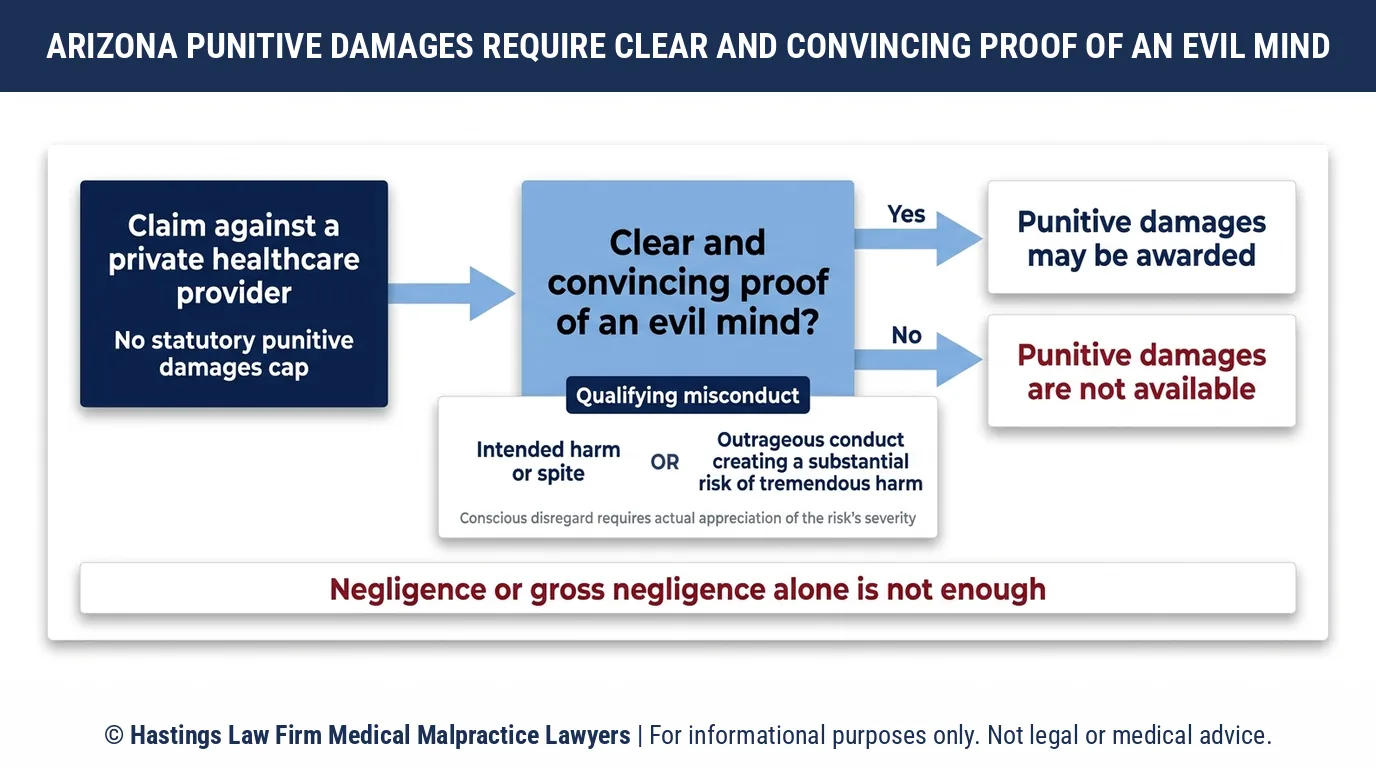
No Arizona statute caps punitive damages in a medical malpractice case against a private healthcare provider. Punitive damages may be awarded only on clear and convincing proof of an evil mind, the standard the Arizona Supreme Court reaffirmed in Swift Transportation v. Carman (2022).
Punitive damages stand apart from the compensatory damages that cover a patient’s losses. Arizona courts have said the Constitution does not protect them the way it protects compensatory damages, so its ban on limits reaches only the losses a patient proves.
To recover punitive damages, a patient must meet the evil-mind standard, which calls for intended harm, spite, or outrageous conduct creating a substantial risk of tremendous harm. A claim that the provider consciously disregarded a risk needs proof that the provider actually appreciated how severe that risk was. Simply failing to recognize the risk does not qualify. Negligence alone, or even gross negligence, is not enough, however serious the injury.
What Damages Can You Recover From a Public Hospital in Arizona?
An Arizona public hospital can be held responsible for compensatory damages with no statutory cap, but not for punitive damages. Section 12-820.04 of the Arizona Revised Statutes bars punitive damages against a public entity or a public employee acting within the scope of employment, which removes that one category without limiting the rest.
That bar protects only true public entities and their employees. A private company that runs a public hospital under a public district’s lease does not inherit the protection just because it operates the facility. Who ran the hospital is one of several questions that matter in hospital malpractice claims in Arizona.
A claim against a public hospital also runs on a shorter clock. Under Section 12-821.01 of the Arizona Revised Statutes, a written notice of claim stating the facts and a specific dollar amount must be filed within 180 days after the claim accrues, the point when the deadline starts to run. The lawsuit itself must follow within one year of accrual under Section 12-821, and a late or incomplete notice can bar the claim.
What Can Still Change a Medical Malpractice Award in Arizona?
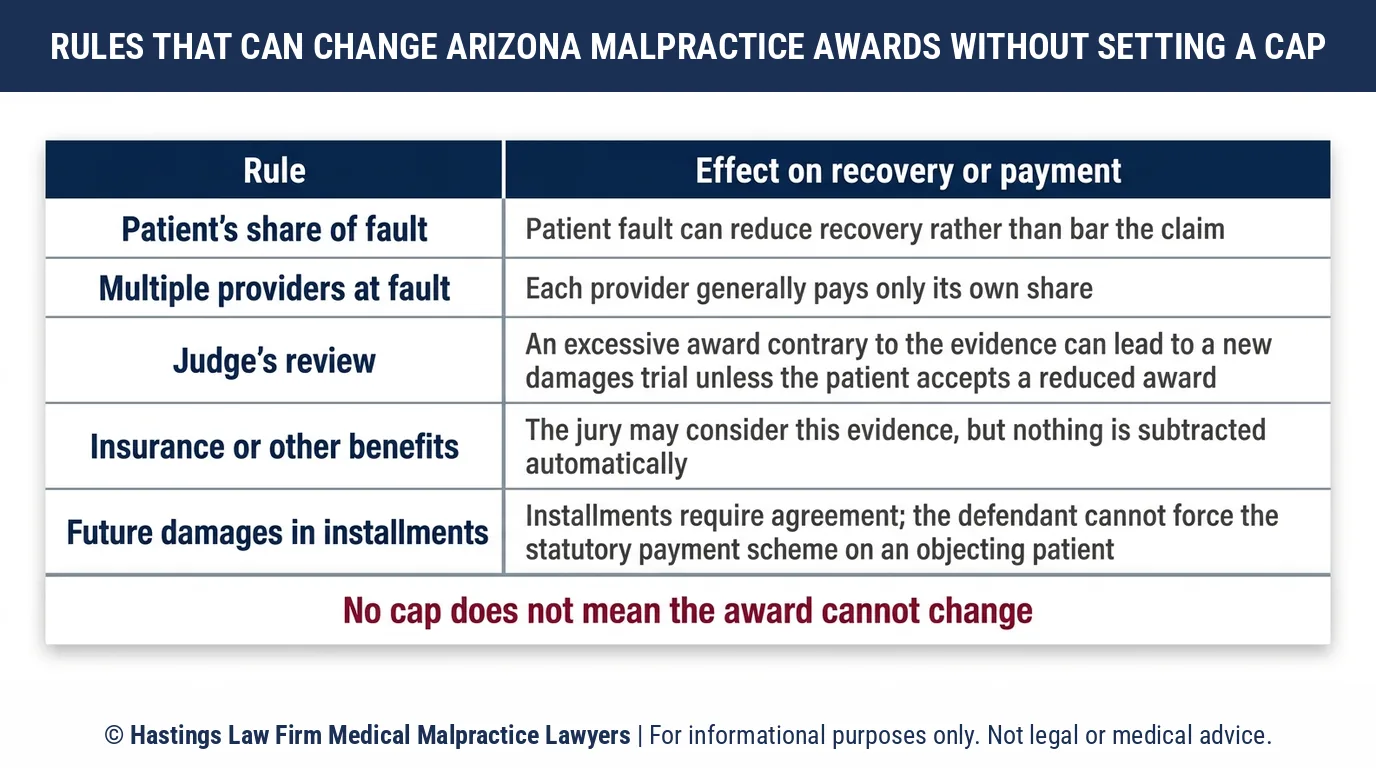
An Arizona medical malpractice award can be reduced by the patient’s own share of fault or by a judge’s review under Rule 59 of the Arizona Rules of Civil Procedure, and its future damages are paid in installments only if the patient agrees. None of those rules sets a maximum in advance the way a cap would.
The judge’s review is narrow. A judge can order a new trial on damages unless the patient accepts a reduced award, a step known as remittitur. That step is allowed only when the judge is firmly convinced the award is excessive and contrary to the weight of the evidence at trial. As the Arizona Supreme Court explained in Soto v. Sacco (2017), a high award alone is not enough, and the reasons must be specific.
How Does Shared Fault Affect an Arizona Malpractice Recovery?
A patient’s own share of fault reduces an Arizona malpractice recovery rather than barring the claim, because Arizona follows pure comparative fault under Section 12-2505 of the Arizona Revised Statutes. Whether the patient shares any fault is for the jury to decide from the evidence. When more than one healthcare provider is found at fault, Section 12-2506 generally makes each pay only its own share.
Can an Arizona Jury Hear That Insurance Paid Your Bills in a Malpractice Case?
An Arizona jury can hear that health insurance or other benefits paid a patient’s bills in a medical malpractice case. Under the collateral source rule in Section 12-565 of the Arizona Revised Statutes, the defense may offer that evidence, and the jury decides how much weight it deserves. Nothing is subtracted automatically, and the source of those benefits cannot seek repayment from the patient unless another statute allows it.
Can Future Damages Be Paid in Installments in an Arizona Medical Negligence Case?
Future damages in an Arizona medical negligence case are paid in installments only by agreement. Arizona still publishes its periodic-payment statutes, but the Arizona Supreme Court held in Smith v. Myers that the statutory scheme was unconstitutional, so a defendant cannot rely on it to force installments on a patient who objects.
A patient who wants installments can still choose them. Under Section 12-594 of the Arizona Revised Statutes, the parties may agree to spread future damages over time, an arrangement known as a structured settlement. Some families facing long-term care needs prefer that steady schedule.
The Hastings Law Firm Difference
Results matter, but what truly sets us apart is how we achieve them. Every verdict, every settlement, and every courtroom victory comes from one guiding promise: To treat each client’s fight for justice as if it were our own.
This balance of skill, experience, and empathy reflects our core philosophy that justice should not only compensate the injured, but also make health care safer nationwide.

How Should You Document Your Losses for an Arizona Malpractice Claim?
Keep a record of every loss from a medical malpractice injury, from medical bills and missed pay to changes in daily life. Arizona places no cap on malpractice damages, so each loss counts only as far as the evidence proves it. Receipts, pay stubs, and a simple journal of symptoms and daily limits all help show what the injury has cost.
The filing deadline matters as much as the records. Arizona’s statute of limitations, Section 12-542 of the Arizona Revised Statutes, requires most malpractice claims to be filed within two years. The clock starts when the patient knew or reasonably should have known enough to suspect negligence caused the injury, which can be later than the date of care. A claim against a public hospital carries the shorter 180-day notice.
The records gathered before either deadline also shape the value of a claim. That value depends on the losses the records prove and how clearly they show that negligent care caused them.
Talk to an Arizona Medical Malpractice Attorney About Your Claim
When you contact Hastings Law Firm, a member of our intake team listens to what happened, and we request the medical records at no cost to you. Our attorneys and medical professionals review those records, bringing in a medical expert when a case calls for one, and we give you an honest answer about whether there is a claim.
Our Arizona medical malpractice lawyers are experienced in handling claims for injured patients and their families across the state. We understand what a lasting medical injury can cost a family, from ongoing care and lost income to a changed daily life, and why each of those losses deserves to be documented in full.
If we take your case, you pay no attorney fees or costs unless we win. We advance the cost of experts and everything else it takes to build the case. Hastings Law Firm has been dedicated exclusively to medical malpractice since 2005, and our team is here for you. Contact us now for a free, confidential case review.
Sources
- Arizona Constitution Article 2, Section 31, barring laws that limit injury damages | Arizona State Legislature
- Arizona Constitution Article 18, Section 6, protecting the right to recover injury damages | Arizona State Legislature
- Smith v. Myers, Arizona Supreme Court opinion on periodic payment of malpractice damages | Justia
- Arizona Constitution Article 21, Section 1, on how voters approve amendments | Arizona State Legislature
- Arizona Supreme Court opinion recording the 1994 rejection of Proposition 103 | Justia
- Roebuck v. Mayo Clinic, 2025 ruling on the pandemic statute’s negligence restriction | Arizona Supreme Court
- A.R.S. § 12-613, how a jury measures wrongful death damages | Arizona State Legislature
- Swift Transportation v. Carman, the evil-mind standard for punitive damages | Arizona Supreme Court
- A.R.S. § 12-820.04, barring punitive damages against public entities and employees | Arizona State Legislature
- A.R.S. § 12-821.01, the 180-day notice of claim against a public entity | Arizona State Legislature
- Soto v. Sacco, when a judge may order a new trial on damages | Arizona Supreme Court
- A.R.S. § 12-2505, Arizona’s comparative fault rule for injury claims | Arizona State Legislature
- A.R.S. § 12-565, collateral source evidence in medical malpractice cases | Arizona State Legislature
- A.R.S. § 12-594, settlement agreements paying future damages in installments | Arizona State Legislature
- A.R.S. § 12-542, the two-year deadline for personal injury claims | Arizona State Legislature

This content was researched and written by the Hastings Law Firm editorial team, which includes attorneys, medical professionals, and experienced researchers. Our writing is informed by internal knowledge and practical experience, and we cross-check critical details against authoritative sources cited throughout. Every piece undergoes human-led fact-checking and legal review. Because legal and medical information can change, if you spot an error, please contact us. Learn more about our content standards and review process on our editorial policy page.

Tommy Hastings, founder of Hastings Law Firm, is a board-certified personal injury trial lawyer (by the Texas Board of Legal Specialization) dedicated exclusively to healthcare injury cases. Since 2001, he has represented injured patients and families in litigation against major hospital systems, pharmaceutical companies, and negligent healthcare providers nationwide. He has handled numerous high-profile cases that have drawn national media attention and resulted in multi-million dollar recoveries.
