


What is the Average Medical Malpractice Settlement in Arizona?
A serious medical injury, or something worse, can leave a patient and family facing mounting bills, lost income, and an uncertain future. Many people in that position want a realistic sense of what a claim like theirs might pay before deciding what comes next. Public payment figures offer a starting point, yet they describe many past payments at once and cannot speak to any one person’s harm. Understanding what those numbers show and where they fall short is often the first step toward knowing the value of a medical malpractice claim in Arizona.

Last Updated: November 4, 2026
What You Should Know About Medical Malpractice Settlements in Arizona:
- Among National Practitioner Data Bank (NPDB) payment reports originally processed from 2016 through 2025 that listed Arizona as the practitioner’s work state, the median reported payment was about $295,000 for physicians and $220,000 across all professions, without adjusting for inflation.
- The median is a better guide than the Arizona averages of about $381,000 across all professions and $465,000 for physicians, because large payments at the top pull an average up.
- About 35.3% of the Arizona all-professions NPDB reports recorded payments of $100,000 or less, and about 5.4% recorded payments over $1 million.
- The NPDB figures are approximate reported payments, not complete totals for individual cases, and none of them predicts the value of an individual claim.
- Article 2, Section 31 of the Arizona Constitution bars any state law from capping the dollar amount a jury may award for causing death or personal injury.
- In the Arizona NPDB reports, median payments ran from about $52,500 for reports coded as minor temporary injuries to about $995,000 for the combined quadriplegia, brain damage, or lifelong-care category, and were about $325,000 in the death category.
- Under Section 12-565 of the Arizona Revised Statutes, the jury in a malpractice case may hear about the patient’s insurance and other outside benefits, which are not automatically subtracted from the award.
- A settlement can be funded by a liability insurer or a self-insured hospital or other healthcare entity, and when several providers are at fault, each is generally responsible only for its own share under Section 12-2506 of the Arizona Revised Statutes.
- About 1.33% of the Arizona all-professions NPDB payment reports and 1.76% of the physician reports were coded as resulting from judgments.
What Are Typical Arizona Medical Malpractice Settlement Amounts?
No official source publishes a single average for Arizona medical malpractice settlement amounts, and the closest public measure is the median physician payment of about $295,000 in the National Practitioner Data Bank (NPDB), the federal malpractice payment database of the Health Resources and Services Administration (HRSA). That median covers payment reports originally processed from 2016 through 2025 that listed Arizona as the physician’s work state, without adjusting for inflation.
The median is the middle payment, with half of the reports above it and half below. Our analysis of the June 30, 2026 release of the NPDB Public Use Data File, from HRSA of the U.S. Department of Health and Human Services, found 1,356 Arizona work-state payment reports, 907 of them for physicians, and a median of about $220,000 across all professions. In 2025 dollars, the medians were about $259,000 across all professions and $350,000 for physicians.
People asking about the average medical malpractice settlement in Arizona often mean a simple average. In these reports, that figure ran higher, at about $381,000 across all professions and $465,000 for physicians, without adjusting for inflation. That gap comes from how widely the payments spread.
About 35.3% of the all-professions reports recorded payments of $100,000 or less, and about 5.4% recorded payments over $1 million. For physicians, those shares were 24.1% and 7.4%. Large payments at the top raise the average far more than the median, which makes the median the better guide.
Even the median is only approximate, since the NPDB records payments in ranges. Each report is also a payment made for one practitioner, and one case can produce several, so none is a complete settlement total for a case. Reports without a work state are left out, and the NPDB does not capture every payment. No statistic from these reports predicts the value of an individual claim.
Arizona also has no damage caps. Article 2, Section 31 of the Arizona Constitution bars any state law from capping the dollar amount a jury may award for causing death or personal injury. The bar does not guarantee any amount, and an award still follows the losses the evidence proves.
Whatever its size, a reported payment is a gross amount. Attorney fees, case costs, and other deductions come out before a family receives its share, which depends on its own fee agreement and the facts of its case.
What Affects the Value of a Medical Negligence Claim in Arizona?
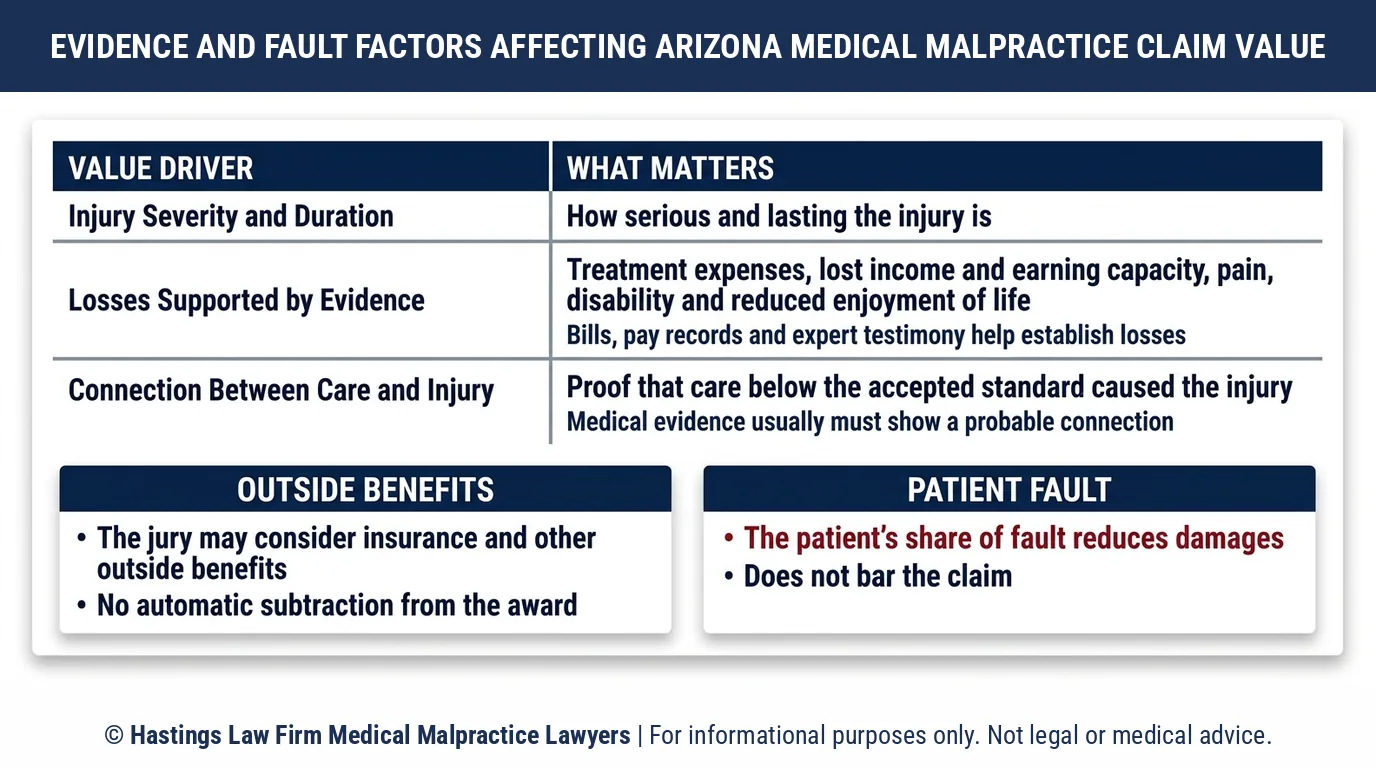
The value of an Arizona medical negligence claim depends most on how serious and lasting the injury is, the losses the evidence can prove, and how clearly the injury can be tied to the care. Across all professions in the NPDB’s Arizona reports, the median payment was about $52,500 for reports coded as minor temporary injuries, $395,000 for significant permanent injuries, and $995,000 for quadriplegia, brain damage, or lifelong care.
Those severity groups are categories of alleged injury coded by the payer that filed each report, not settlement ranges or valuations of any one case. Within any group, each kind of harm still has to be proved. Depending on the evidence, compensation can cover treatment expenses, lost income and earning capacity, pain, disability, and reduced enjoyment of life. Bills and pay records show the financial losses, and expert testimony shows the cost of future care and lost future earnings.
Pain and suffering has no such paper trail. A jury decides it based on how the injury changed the patient’s life.
The third factor is how clearly the injury can be tied to the care. Arizona law requires proof that the provider fell below the accepted standard of care and that the failure caused the injury, which the law calls proximate cause. Usually, medical evidence must show a probable connection, although the negligence does not have to be the injury’s only cause. Where that connection is disputed, both sides weigh the risk that a jury will find no link when they value the claim.
The patient’s own insurance can affect value too. Under Section 12-565 of the Arizona Revised Statutes, the jury in a malpractice case may hear about that insurance and other outside benefits and decide what weight to give them. Those benefits are not automatically subtracted from the award.
A patient’s own share of fault, unlike outside benefits, does reduce the damages under Section 12-2505, but it does not bar the claim. Whether the patient was at fault at all is for the jury to decide from the evidence.
When a loved one has died, the damages are measured by the surviving family members’ proved losses under Section 12-613. The death category made up about 24% of the NPDB’s Arizona reports, with a median payment of about $325,000. Under the Arizona civil jury instructions on damages, a family’s losses can include lost companionship, grief, lost support, and applicable medical and funeral expenses, though not every family recovers every category. A claim the patient had before death may also survive, but it no longer includes the patient’s own pain and suffering.
Who Pays a Medical Malpractice Settlement in Arizona?
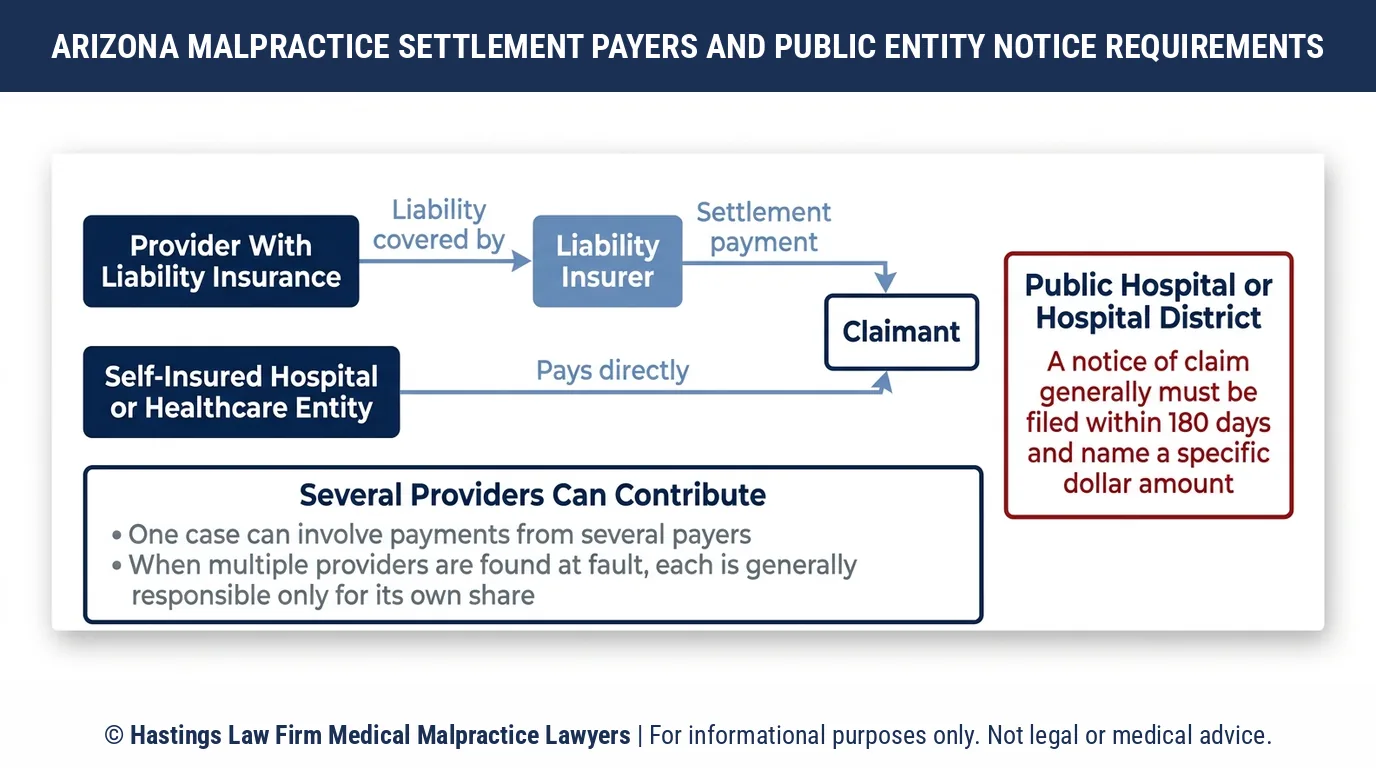
An Arizona medical malpractice settlement is paid by whoever covers the provider’s liability, which can be an insurance company or a hospital or other healthcare entity that insures itself. Under the federal reporting rules in the NPDB Guidebook, those payers must report qualifying payments made for a practitioner.
One case can bring payments from several payers. When a hospital and a physician are both found at fault, each is generally responsible only for its own share under Section 12-2506 of the Arizona Revised Statutes, not the whole judgment.
The payer can also be a public hospital or hospital district. A claim against one starts with a notice of claim, which generally must be filed within 180 days and name a specific dollar amount. A public entity itself cannot be made to pay punitive damages. Claims against hospitals raise other questions too, which our page on hospital malpractice in Arizona explains.
Is a Jury Verdict Worth More Than Settling a Medical Negligence Case in Arizona?
Medical malpractice jury verdicts in Arizona are not reliably worth more than settlements, because a jury can award more, less, or nothing, while a valid settlement fixes an amount both sides have agreed to. Judgments are also a small share of reported payments, since about 1.33% of the Arizona all-professions payment reports in the NPDB and 1.76% of the physician reports were coded as resulting from judgments.
That judgment share does not measure how often cases settle, reach trial, or are won. Arizona courts do build settlement into the case schedule, which generally includes a settlement conference or private mediation. An ordered conference requires the parties, their lawyers, and representatives with actual settlement authority to attend, unless an exception applies.
When a case does reach trial, a superior court civil jury ordinarily has eight jurors under Section 21-102 of the Arizona Revised Statutes, and six must agree on the verdict unless the parties decide otherwise. Jurors evaluate the expert evidence, decide whether the provider fell below the standard of care, and set damages from the evidence of the patient’s losses.
Punitive damages are separate from the damages that compensate those losses. In Swift Transportation Co. of Arizona v. Carman, the Arizona Supreme Court reaffirmed that they require clear and convincing proof of an evil mind, and negligence or gross negligence alone is not enough. No statute caps punitive damages in a malpractice case against a private provider.
At the other end, a jury can find for the provider, and the patient then recovers nothing. In a 2012 study of claims closed from 2002 to 2005 at one nationwide liability insurer, 79.6% of the cases that reached a verdict favored the physician. No verdict is certain, so our firm prepares every case as if it were going to trial, as our verdicts and settlements reflect.
A multimillion-dollar verdict in the news is one case’s result and does not show what a typical Arizona claim pays. The NPDB figures are reported payments, not jury awards, and only about 5.4% of the Arizona all-professions reports recorded payments over $1 million.
A verdict can still change after trial. A judge can order a new trial on damages unless the patient accepts a reduced award when the evidence does not support the jury’s excessive damages. A final superior court judgment can also be appealed to the Arizona Court of Appeals. A valid settlement and release, by contrast, can end the claims they cover on the agreed terms.
The Hastings Law Firm Difference
Results matter, but what truly sets us apart is how we achieve them. Every verdict, every settlement, and every courtroom victory comes from one guiding promise: To treat each client’s fight for justice as if it were our own.
This balance of skill, experience, and empathy reflects our core philosophy that justice should not only compensate the injured, but also make health care safer nationwide.

How Can You Find Out What Your Medical Injury Case is Worth in Arizona?
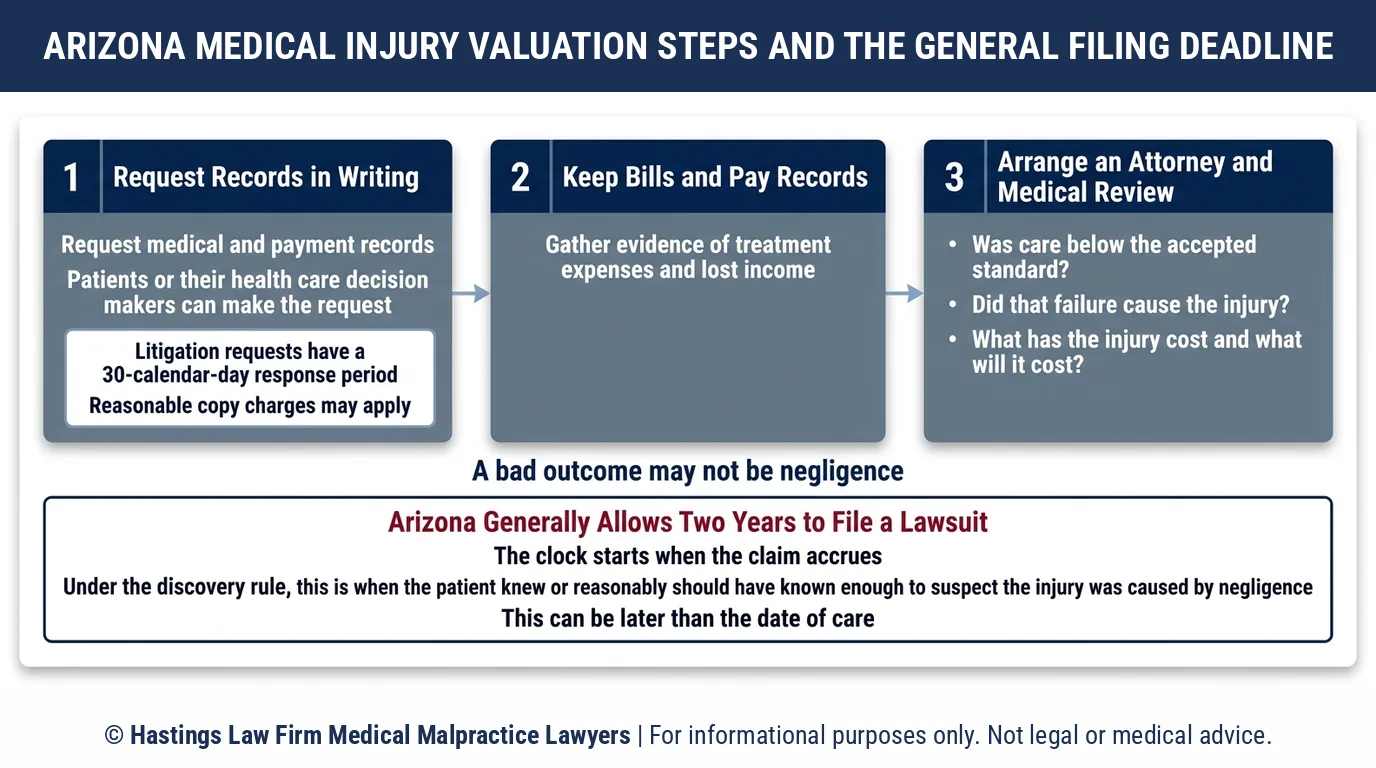
To find out what an Arizona medical malpractice case is worth, request the medical records, keep the bills and pay records, and have an experienced attorney and medical experts review them. An average cannot answer that question, because the value of one claim comes from the patient’s own records and losses.
A patient or the patient’s health care decision maker can request medical and payment records in writing under Section 12-2293 of the Arizona Revised Statutes. Arizona sets a 30-calendar-day response period for requests made for litigation, and reasonable copy charges may apply.
A review of those records answers three questions: whether the care fell below the standard of care, whether that caused the injury, and what the injury has cost and will cost. Medicine carries risk, and an honest answer may be that a bad outcome was not negligence. Our Phoenix medical malpractice lawyers and Tucson medical malpractice attorneys perform that review for free, so asking costs a family nothing. It is worth having before weighing any offer, since an insurer’s early offer can come before the full extent of the injury and its future costs are known.
The law also limits how long a family can wait. Arizona generally gives two years to file a lawsuit, and the clock starts when the claim accrues. Under the discovery rule, that is when the patient knew or reasonably should have known enough to suspect the injury was caused by negligence, which can be later than the date of care.
Talk to an Arizona Medical Malpractice Attorney About Your Claim
Talking with us about your claim starts with a member of our intake team listening to what happened. We request the medical records at no cost, our attorneys and medical professionals review them, and we give you an honest answer about whether there is a claim.
Our lawyers are experienced in handling medical malpractice claims in Arizona. We understand what a lasting medical injury can mean for a patient and the family, from ongoing treatment and time away from work to the changes it brings to daily life.
We work on a contingency fee and advance the cost of experts and everything else it takes to build the claim, so you pay no attorney fees or costs unless we win. Hastings Law Firm has been dedicated exclusively to medical malpractice since 2005. Learn more about our Arizona medical malpractice lawyers, or contact us now for a free, confidential case review.
Sources
- NPDB Public Use Data File, the federal malpractice payment report data | HRSA, U.S. Department of Health and Human Services
- Arizona Constitution Article 2, Section 31, barring limits on damages for death or injury | Arizona State Legislature
- A.R.S. § 12-565 on collateral source benefits in medical malpractice cases | Arizona State Legislature
- A.R.S. § 12-2505 on how a patient’s comparative fault reduces damages | Arizona State Legislature
- A.R.S. § 12-613 on the measure of wrongful death damages | Arizona State Legislature
- Revised Arizona Jury Instructions (Civil) on personal injury and wrongful death damages | State Bar of Arizona
- NPDB Guidebook on who must report medical malpractice payments | HRSA, U.S. Department of Health and Human Services
- A.R.S. § 12-2506 on each defendant’s several liability for its share of fault | Arizona State Legislature
- A.R.S. § 21-102 on civil jury size and how many jurors must agree | Arizona State Legislature
- Arizona Supreme Court opinion setting the evil mind standard for punitive damages | Arizona Judicial Branch
- A.R.S. § 12-2293 on patient requests for medical and payment records | Arizona State Legislature

This content was researched and written by the Hastings Law Firm editorial team, which includes attorneys, medical professionals, and experienced researchers. Our writing is informed by internal knowledge and practical experience, and we cross-check critical details against authoritative sources cited throughout. Every piece undergoes human-led fact-checking and legal review. Because legal and medical information can change, if you spot an error, please contact us. Learn more about our content standards and review process on our editorial policy page.

Tommy Hastings, founder of Hastings Law Firm, is a board-certified personal injury trial lawyer (by the Texas Board of Legal Specialization) dedicated exclusively to healthcare injury cases. Since 2001, he has represented injured patients and families in litigation against major hospital systems, pharmaceutical companies, and negligent healthcare providers nationwide. He has handled numerous high-profile cases that have drawn national media attention and resulted in multi-million dollar recoveries.
