


Tucson Medical Malpractice Lawyer
Medical negligence can leave lasting harm when a preventable error occurs during diagnosis, surgery, childbirth, emergency care, or medication management. Arizona law focuses on whether a provider fell below the accepted standard of care and whether that failure directly caused injury or worse. Claims often turn on medical records, expert review, and clear proof of causation and damages, including financial losses and personal suffering. Arizona also allows recovery without state imposed caps on damages. If you or a loved one were harmed or worse due to medical malpractice in Tucson, Arizona, contact Hastings Law Firm for a free, confidential case review.

Last Updated: September 28, 2026
Trial-Ready Legal Representation for Victims of Medical Negligence in Tucson
When a doctor, surgeon, or hospital makes a preventable error, the consequences can change your life in an instant. From surgical complications and misdiagnosis to birth injuries involving hypoxia (oxygen deprivation to the brain) or a delayed cesarean delivery (C-section), the harm caused by medical negligence extends far beyond the physical. You may be left with unanswered questions, mounting medical bills, and a deep sense that the people you trusted failed you.
If that describes where you are right now, you are not alone, and your instincts deserve to be taken seriously. Led by board-certified trial lawyer Tommy Hastings, we represent patients and families across Southern Arizona who have been injured by preventable medical errors. Our team of attorneys, in-house nurses, and medical consultants can review what happened and explain your legal options at no cost and with no obligation.

Understanding Medical Malpractice Under Arizona Law
Medical malpractice occurs when a healthcare professional deviates from the accepted standard of care, directly causing injury or death to a patient. Under Arizona medical malpractice law, the standard of care is the level of treatment a reasonably competent provider in the same specialty would deliver under similar circumstances. Not every bad outcome qualifies as malpractice. We must show that the injury was preventable and resulted from doctor negligence, not simply from the inherent risks of treatment. Our Tucson hospital malpractice lawyers handle claims involving hospitals across the Tucson area, including Banner – University Medical Center Tucson Campus and Carondelet St. Joseph’s Hospital.
These rules apply broadly to every licensed provider, including surgeons, nurses, anesthesiologists, and emergency physicians. A sentinel event, which is an unexpected occurrence resulting in serious harm or death, may signal negligence but still requires proof. Likewise, a failure to obtain informed consent, meaning the doctor did not adequately explain the risks before a procedure, can form the basis of a claim. A.R.S. § 12-563 outlines the elements a patient must establish to bring a medical malpractice case in Arizona. We can help you determine whether those elements are present.
Common Medical Errors Committed by Tucson Healthcare Providers
Frequent medical errors in Tucson include surgical mistakes, failure to diagnose critical conditions like cancer or stroke, and birth injuries resulting from delayed C-sections. These errors occur across hospitals, clinics, urgent care centers, and specialty practices throughout Pima County.
Surgical errors include wrong-site surgery, where a procedure is performed on the wrong body part, and retained surgical items (RSIs), such as sponges or instruments left inside a patient’s body after an operation. These are considered “never events,” meaning mistakes that should not happen under any circumstances. Our team can review these cases to determine liability.
Diagnostic errors are among the most common and most dangerous forms of medical negligence. According to the AHRQ Patient Safety Network’s primer on diagnostic errors, missed or delayed diagnoses of conditions like heart attack, stroke, and cancer are a leading cause of patient harm. We typically find that when warning signs are overlooked or test results are not followed up on, a treatable condition can become life-threatening.
Birth injuries can result from failures in fetal monitoring, delayed decisions to perform emergency C-sections, or improper use of delivery instruments. The consequences, including cerebral palsy and brain damage from oxygen deprivation, are often permanent.
Medication errors involve prescribing the wrong drug, the wrong dosage, or a medication that dangerously interacts with another prescription. In a hospital setting, these errors can escalate rapidly, often leading to hospital malpractice claims. At Hastings Law Firm, we investigate each of these categories with the support of in-house medical professionals who understand clinical protocols and charting standards.
| Type of Error | Examples | Potential Impact |
|---|---|---|
| Surgical Errors | Wrong-site surgery, retained surgical items | Organ damage, infection, additional surgeries |
| Diagnostic Errors | Missed cancer, delayed stroke diagnosis | Disease progression, preventable death |
| Birth Injuries | Delayed C-section, improper fetal monitoring | Cerebral palsy, hypoxia, developmental delays |
| Medication Errors | Wrong dosage, dangerous drug interactions | Organ failure, allergic reactions, overdose |
| Emergency Room Errors | Premature discharge, missed fractures | Worsened conditions, secondary complications |

The Hastings Law Firm Difference
Results matter, but what truly sets us apart is how we achieve them. Every verdict, every settlement, and every Tucson courtroom victory comes from one guiding promise: To treat each client’s fight for justice as if it were our own.
This balance of skill, experience, and empathy reflects our core philosophy that justice should not only compensate the injured, but also make health care safer nationwide.

Proving Negligence and The Four Elements of Liability
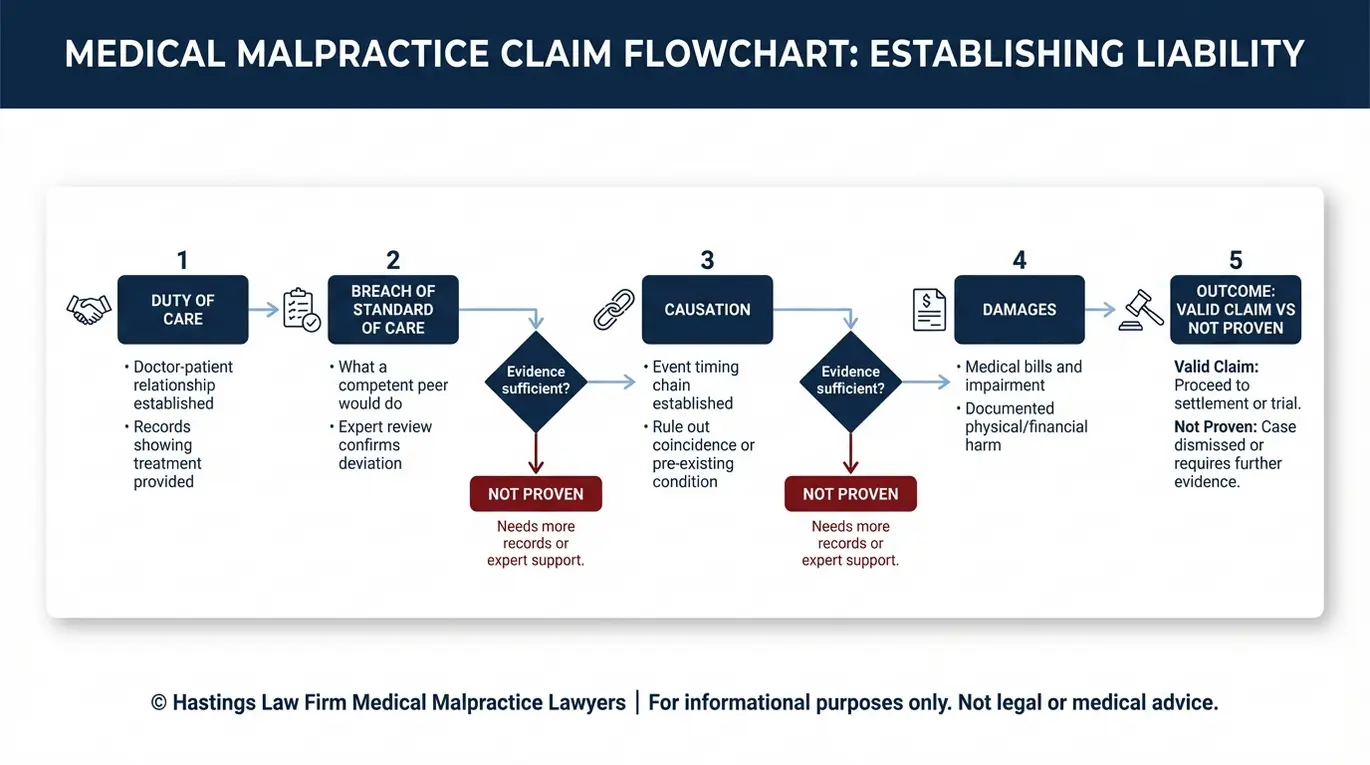
To win a claim, a patient must prove four elements: a professional duty existed, the provider breached that duty, the breach caused specific injury, and the injury resulted in damages. Each one builds on the last, and all four must be established through evidence and qualified medical expert testimony in an Arizona courtroom.
- Duty of Care: A doctor-patient relationship existed, creating a professional obligation to provide competent treatment.
- Breach of Duty: The provider failed to act as a reasonably competent peer in the same specialty would have. The differential diagnosis, the systematic process of ruling out conditions, is often where a breach is identified.
- Causation: The breach directly caused the patient’s injury. Correlation alone is not enough. We must demonstrate a direct link between the error and the harm, ruling out other possible causes, including any contraindication, a pre-existing condition or factor that would have made a treatment inadvisable.
- Damages: The injury resulted in measurable harm, whether physical, financial, or emotional.
Meeting the burden of proof requires detailed medical records, expert analysis, and a thorough reconstruction of the clinical timeline. As described by the AHRQ Patient Safety Network’s overview of root cause analysis, identifying exactly where and why a failure occurred is central to establishing liability. A medical malpractice law firm with medical resources on staff is better positioned to build this proof from the start. We know that proving these elements is essential for a successful outcome.
Recoverable Damages and Arizona Compensation Laws
Arizona victims can recover economic damages for medical bills and lost wages, as well as noneconomic damages for pain and suffering, with no state-imposed cap on the amount awarded.
Economic damages cover the financial losses tied directly to the injury:
- Past and future medical expenses, including surgeries, rehabilitation, and ongoing care
- Lost wages and diminished earning capacity
- Home modifications or assistive equipment
Noneconomic damages address the personal toll of the injury:
- Physical pain and suffering
- Emotional distress and mental anguish
- Loss of enjoyment of life
- Loss of consortium for spouses and family members or wrongful death
The Advantage of No Damage Caps in Arizona
Arizona is one of the few states where the Constitution explicitly prohibits the legislature from limiting personal injury damages. Article 2, Section 31 of the Arizona Constitution guarantees that the right to recover full compensation cannot be restricted by statute. This protection allows juries to award what they believe the harm is truly worth, not an amount constrained by an arbitrary ceiling. We prepare every case with no state-imposed caps in mind, building a full picture of how the injury has affected and will continue to affect your life. We can also help calculate these costs.
Arizona Statute of Limitations and The Discovery Rule
In Arizona, medical malpractice claims must generally be filed within two years from the date the injury occurred or was discovered. Missing this deadline can permanently bar your right to seek compensation, regardless of how strong your case may be.
The two-year rule applies in most situations, but Arizona also recognizes the discovery rule. This exception adjusts the filing deadline when an injury was not immediately apparent. For example, if a surgical sponge is discovered inside a patient several years after an operation, the two-year clock begins when the patient learns of the retained object, not when the original surgery took place.
Separate rules may apply when the injured patient is a minor. In those cases, the filing deadline may be extended. Because strict time limits apply and these deadlines vary based on the specific facts, speaking with our team early gives you the best opportunity to preserve your claim. Our attorneys can evaluate your timeline and determine exactly how much time you have to act, as understanding these legal deadlines is important.

Why Choose Hastings Law Firm for Your Tucson Claim
Hastings Law Firm offers a unique combination of board-certified legal expertise, in-house medical staff, and a no-fee guarantee, ensuring victims have the resources to challenge powerful hospital systems. Every attorney on our team focuses exclusively on medical negligence cases, giving you the depth of knowledge these claims demand.
The Hastings Difference:
- Former defense attorneys on our team who understand how hospitals and insurers build their cases, allowing us to anticipate and counter their strategies early.
- In-house nurses and patient advocates who analyze medical records, identify charting inconsistencies, and translate clinical data into clear evidence.
- A selective caseload that allows us to invest significant time and resources into each client’s case rather than processing high volumes.
- Zero financial risk. We work on a contingency fee basis, meaning there is no fee unless recovery is obtained for you.
We prepare every case as if it is going to trial. That level of preparation sends a clear message to the defense and positions our clients for the strongest possible outcome, whether through settlement or a jury verdict.
Contact the Tucson Healthcare Malpractice Attorneys at Hastings Law Firm Today for Help
If you believe that you or a loved one was harmed by a medical error, the answers you need are within reach. Our medical-legal team can review your records, identify whether negligence occurred, and explain what options are available to you.
Arizona’s filing deadlines are strict, and evidence can become harder to obtain as time passes. Taking that first step now helps protect your right to pursue a claim.
Hastings Law Firm offers a free, confidential case evaluation. There is no fee unless we win. Contact our Tucson office today by phone or through our online form to speak with a patient advocate who can help you understand what happened and what comes next.
Frequently Asked Questions About Medical Malpractice in Tucson


This content was researched and written by the Hastings Law Firm editorial team, which includes attorneys, medical professionals, and experienced researchers. Our writing is informed by internal knowledge and practical experience, and we cross-check critical details against authoritative sources cited throughout. Every piece undergoes human-led fact-checking and legal review. Because legal and medical information can change, if you spot an error, please contact us. Learn more about our content standards and review process on our editorial policy page.

Tommy Hastings, founder of Hastings Law Firm, is a board-certified personal injury trial lawyer (by the Texas Board of Legal Specialization) dedicated exclusively to healthcare injury cases. Since 2001, he has represented injured patients and families in litigation against major hospital systems, pharmaceutical companies, and negligent healthcare providers nationwide. He has handled numerous high-profile cases that have drawn national media attention and resulted in multi-million dollar recoveries.
