


How Much of a Medical Malpractice Settlement Will I Get in Arizona?
For a patient hurt or worse by negligent medical care and the family beside them, any settlement is measured against ongoing treatment, missed work, and a daily life that has changed. A large amount can sound like relief, but part of it goes to others who are owed a share before anything reaches the patient. Families deciding whether to move forward deserve a clear picture of what would remain for them. Understanding how a medical malpractice settlement is divided is often the first step toward knowing what a claim in Arizona could provide.

Last Updated: November 4, 2026
What You Should Know About How Much of a Medical Malpractice Settlement You Keep in Arizona:
- What reaches the patient from an Arizona medical malpractice settlement is the amount left after the attorney’s fee, the case costs, and any valid liens or repayment claims are paid.
- Arizona’s rules of professional conduct (ER 1.15) require a lawyer to keep settlement funds separate from the firm’s money and promptly pay the client the amounts the client is entitled to receive, and a dispute over one part does not automatically hold up the rest.
- Under A.R.S. § 12-568, any party in an Arizona medical malpractice case can ask the court to review whether attorney fees are reasonable, including a contingency fee, and the court must then do so.
- Hospitals and other qualifying providers can hold liens under A.R.S. § 33-931, AHCCCS has its own lien under A.R.S. § 36-2915, and federal repayment rules can apply to Medicare and some employer health plans.
- In an Arizona malpractice case, A.R.S. § 12-565 lets the jury hear about benefits that insurance already paid and bars those sources from seeking reimbursement from the patient unless another law expressly allows it.
- Compensation for a physical injury or physical sickness is generally not taxed as federal income under Section 104(a)(2) of the Internal Revenue Code, and Arizona income tax for residents starts from federal adjusted gross income, but punitive damages and settlement interest are generally taxable.
- A structured settlement pays scheduled amounts that the person receiving them cannot speed up, delay, increase, or decrease, and in Arizona a defendant cannot use the state’s periodic-payment statute to force installments on a patient who objects.
- Under A.R.S. § 14-5424, an Arizona conservator needs court approval to settle a child’s injury claim. After a death, A.R.S. § 12-612 divides a wrongful death recovery in proportion to each family member’s damages, not equally.
- Before signing a settlement, ask for a written breakdown that starts with the gross settlement, lists the fee, each case cost, and each lien, shows what is left for you, and matches your fee agreement.
What Share of an Arizona Medical Malpractice Settlement Goes to the Patient?
The share of an Arizona medical malpractice settlement that reaches you is what remains after the attorney’s fee, the case costs, and any valid liens or repayment claims are paid. Under Arizona’s rules of professional conduct (Ethical Rule 1.15, or ER 1.15), your lawyer must keep the settlement separate from the firm’s own money and promptly pay you the amount you are entitled to receive.
How much of a medical malpractice settlement you will get in Arizona changes from case to case, because it depends on the fee agreement, what the case cost to build, and which medical bills others paid and now claim back.
The money moves in a clear order. The gross settlement, meaning the full amount the case settles for, is paid into the lawyer’s client trust account. The attorney’s fee, the case costs the lawyer advanced, and the lien amounts are paid from that account, and the balance goes to you. Before you sign a fee agreement, ask whether case costs come off before or after the fee is calculated, because that order changes what reaches you.
Those deductions are why two settlements of the same size can leave two patients with different amounts. A case that needed several medical experts, extensive records, and sworn witness testimony costs more to build than one that resolved early. A patient whose treatment was paid by a health plan, the Arizona Health Care Cost Containment System (AHCCCS), or Medicare may also face repayment claims that another patient does not.
While those repayment claims are sorted out, a dispute over one part of the money does not automatically hold up the rest. The disputed part generally stays separate under the procedures in ER 1.15, so the part no one questions can reach you without waiting on it.
Even that part waits until the settlement is final and the money arrives. The gross settlement itself has no standard value in Arizona, because it depends on the losses a patient can prove and the strength of the evidence that the care was negligent. Medical costs, lost income, and how the injury has changed the patient’s life all shape it.
Whatever the amount, the settlement is paid by or on behalf of the party the claim is brought against, whether a physician, another healthcare professional, or a facility. In Arizona hospital malpractice claims, that party can be the hospital itself. Who pays does not change how the deductions come out of the payment.
How Are Attorney Fees and Case Costs Paid From an Arizona Malpractice Settlement?
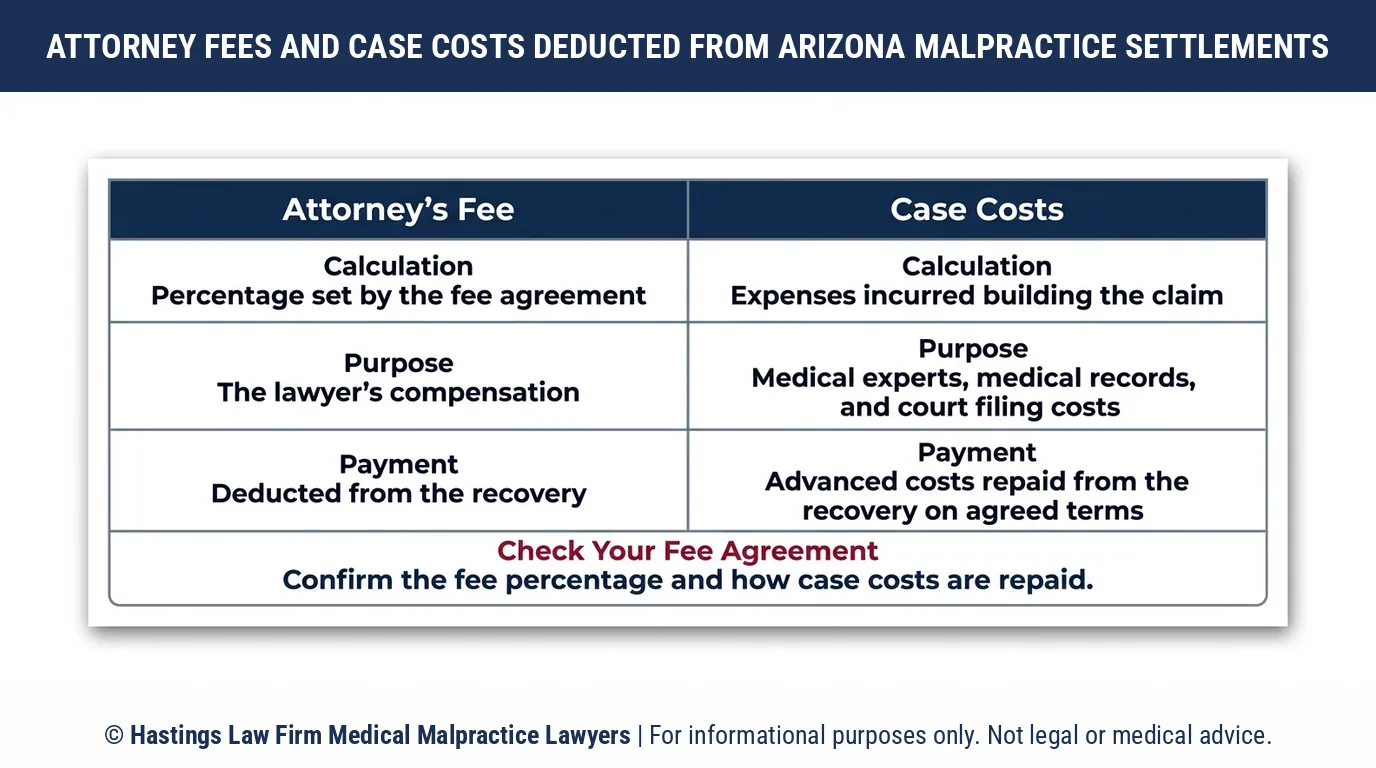
The typical contingency fee a lawyer takes for medical malpractice in Arizona is 40 percent of the recovery, and case costs are then repaid from the client’s remaining 60 percent. The percentage varies slightly by firm and fee agreement, and an early settlement can change it. Under Section 12-568 of the Arizona Revised Statutes, any party can ask the court to review whether those fees are reasonable.
Case costs are separate from that fee. They are the money spent building the claim, such as paying medical experts, copying records, and filing in court. When a lawyer advances those costs, they are repaid from the recovery on the agreed terms, which is why they appear as their own lines when the settlement is paid out.
Do Medical Bills and Liens Come Out of a Medical Negligence Settlement in Arizona?
Yes, medical bills can come out of a medical negligence settlement in Arizona when a provider, or a program that paid for the care, holds a lien on the recovery. Under Section 33-931 of the Arizona Revised Statutes, qualifying providers such as hospitals can hold these liens, and AHCCCS has its own under Section 36-2915. Federal repayment rules can also apply to Medicare and some employer plans.
Health insurance payments are treated differently in an Arizona malpractice case. Section 12-565 lets the defense tell the jury about benefits that insurance and similar sources paid, and the jury decides how much weight to give them. The same statute bars those sources from seeking reimbursement from the patient unless another law expressly grants that right. That is why each repayment claim should be checked before any of the settlement is paid out.
Do You Pay Taxes on a Medical Malpractice Settlement in Arizona?
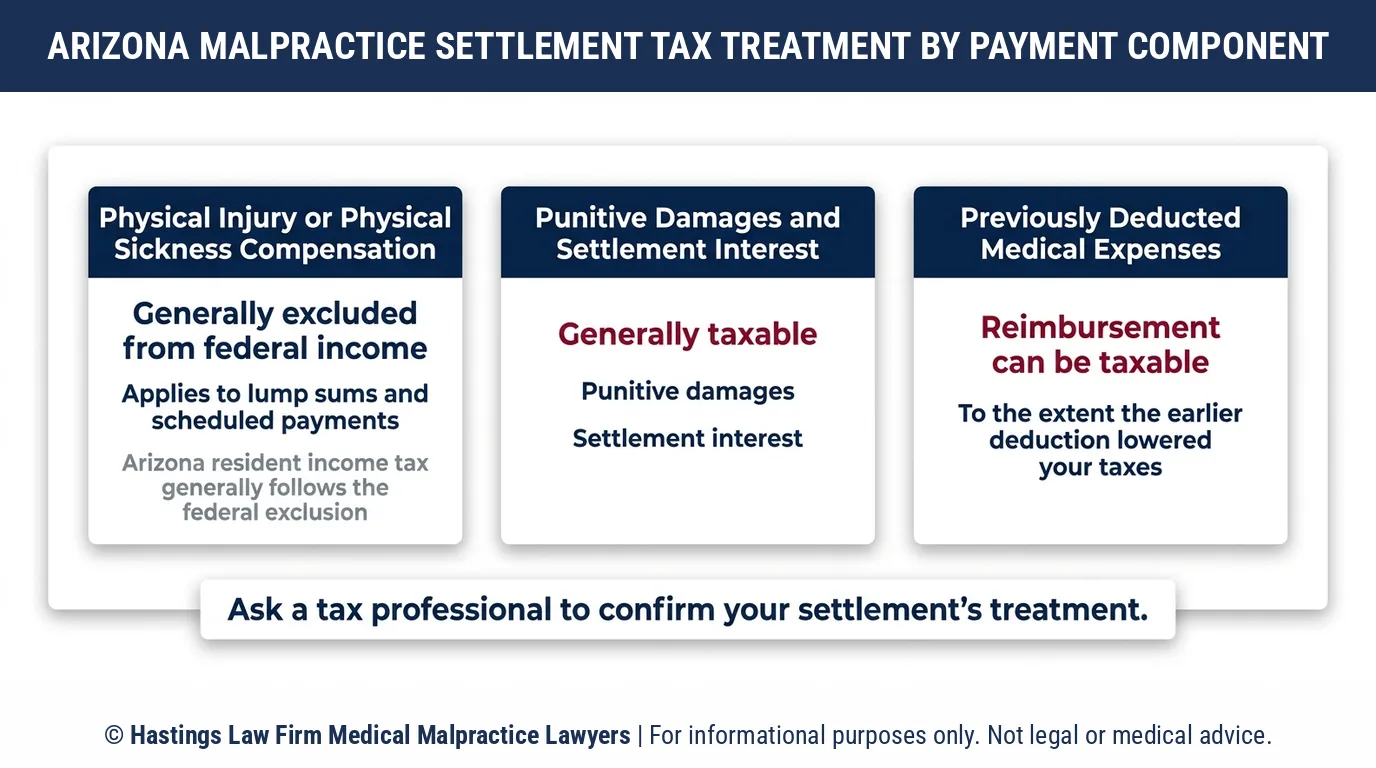
You generally do not pay federal income tax on the part of a medical malpractice settlement that compensates a physical injury or physical sickness, whether paid at once or over time. Section 104(a)(2) of the Internal Revenue Code sets that rule, and Arizona starts its resident income tax from federal adjusted gross income, so that compensation generally stays out of state tax. Punitive damages and settlement interest are usually taxable.
Money that reimburses medical expenses you deducted in earlier years can also be taxable, to the extent the deduction lowered your taxes. A tax professional can confirm how a specific settlement is treated.
How and When is an Arizona Malpractice Settlement Paid Out?
An Arizona malpractice settlement is paid as a lump sum or as a structured settlement, which pays scheduled amounts over time and may be funded by an annuity from an insurance company. Under Section 5891 of the Internal Revenue Code, qualifying structured payments keep their federal tax exclusion, and the person receiving them cannot speed up, delay, increase, or decrease them.
In Arizona, scheduled payments are a choice the parties make together. A defendant cannot rely on the state’s periodic-payment statute to force them on a patient who objects, because the Arizona Supreme Court held that statutory scheme unconstitutional in Smith v. Myers.
Whichever form is chosen, payment begins after the settlement agreement and release are signed and the money reaches the lawyer’s trust account. Any part tied up by an unresolved lien or repayment claim follows once that claim is resolved. The wait varies from case to case, because each payment and each claim moves on its own timeline.
Who Gets the Money From an Arizona Malpractice Case When the Patient is a Child or Has Died?
A conservator settling a child’s medical malpractice claim in Arizona needs court approval, and when the patient has died, a wrongful death recovery is divided among family members in proportion to each one’s damages, not equally. Section 14-5424 of the Arizona Revised Statutes sets that requirement for conservators, and Arizona courts can also approve a protective arrangement for the child without a permanent conservatorship.
The same approval applies in Arizona birth injury claims whenever a conservator settles the child’s claim. After a death, the division under Section 12-612 does not follow the will. Arizona law also protects the survivors’ share from the deceased person’s debts, while a recovery brought for the estate becomes an estate asset.
The Hastings Law Firm Difference
Results matter, but what truly sets us apart is how we achieve them. Every verdict, every settlement, and every courtroom victory comes from one guiding promise: To treat each client’s fight for justice as if it were our own.
This balance of skill, experience, and empathy reflects our core philosophy that justice should not only compensate the injured, but also make health care safer nationwide.

What Should You Check Before Signing a Medical Negligence Settlement in Arizona?
To check a medical negligence settlement in Arizona before signing, first ask your lawyer for a written breakdown, often called a settlement disbursement statement, that starts from the gross settlement and lists the attorney’s fee, each case cost, each lien or repayment claim, and the amount left for you. Then compare it line by line with the fee agreement you signed, so every deduction matches what you agreed to.
Next, ask how each lien and repayment claim was confirmed and whether any was reduced. What a provider, a health plan, Medicare, or AHCCCS under its own lien statute can recover depends on the law and the coverage behind its claim, so the amount claimed is not always the amount owed.
Future care deserves the same attention before you choose how to be paid. The money may need to cover treatment, lost income, and daily needs for years. Because a structured schedule stays fixed once it is set, the choice between a lump sum and scheduled payments is worth making with your lawyer before the release is signed.
Ask for the same breakdown on any settlement offer before you accept it. Whether an offer is good enough comes down to what it would leave you after the fee, the case costs, and the liens are paid, not the gross figure alone.
Talk to an Arizona Medical Malpractice Attorney About Your Case
If you contact Hastings Law Firm, a member of our intake team will ask about the care you received, when it happened, and who provided it. We request the medical records at no cost, our attorneys and medical professionals review them, and we give you an honest answer about whether you have a claim.
Our lawyers are experienced in handling medical malpractice claims in Arizona, from building the case to settling it. We understand that a settlement may have to carry a family through years of care and recovery, and that you deserve a clear answer about how much of it will reach you.
Our own fee is a contingency fee, and we advance the cost of experts and everything else it takes to build the claim, so you pay no attorney fees or costs unless we win. Hastings Law Firm has been dedicated exclusively to medical malpractice since 2005. Learn more about our Arizona medical malpractice attorneys, or contact us now for a free, confidential case review.
Sources
- Arizona ER 1.15 on how lawyers hold and pay out client settlement funds | Thomson Reuters Westlaw, Arizona Court Rules
- A.R.S. § 12-568 on court review of attorney fees in malpractice cases | Arizona State Legislature
- A.R.S. § 33-931 on health care provider liens against injury recoveries | Arizona State Legislature
- A.R.S. § 12-565 on collateral source benefits in medical malpractice cases | Arizona State Legislature
- 26 U.S.C. § 104 on excluding physical injury damages from income | Legal Information Institute, Cornell Law School
- 26 U.S.C. § 5891 defining structured settlement payments | Legal Information Institute, Cornell Law School
- A.R.S. § 14-5424 on court approval for a conservator’s injury settlement | Arizona State Legislature
- A.R.S. § 12-612 on dividing an Arizona wrongful death recovery | Arizona State Legislature
- A.R.S. § 36-2915 on the AHCCCS lien against injury damages recovered | Arizona State Legislature

This content was researched and written by the Hastings Law Firm editorial team, which includes attorneys, medical professionals, and experienced researchers. Our writing is informed by internal knowledge and practical experience, and we cross-check critical details against authoritative sources cited throughout. Every piece undergoes human-led fact-checking and legal review. Because legal and medical information can change, if you spot an error, please contact us. Learn more about our content standards and review process on our editorial policy page.

Tommy Hastings, founder of Hastings Law Firm, is a board-certified personal injury trial lawyer (by the Texas Board of Legal Specialization) dedicated exclusively to healthcare injury cases. Since 2001, he has represented injured patients and families in litigation against major hospital systems, pharmaceutical companies, and negligent healthcare providers nationwide. He has handled numerous high-profile cases that have drawn national media attention and resulted in multi-million dollar recoveries.
