


How Long Does It Take to Get Paid After a Medical Malpractice Settlement in Arizona?
Life after a serious medical injury often leaves a patient and their family juggling treatment, lost income, and household bills while a claim runs its course. Reaching a settlement can bring real relief, along with the hope that the money for care and daily life will soon follow. The stretch between that agreement and the money actually arriving is unfamiliar to many families, and it can be hard to know what to expect along the way. A clear picture of how a medical malpractice settlement in Arizona becomes a payment makes it easier to plan ahead with confidence.
Last Updated: November 4, 2026
What You Should Know About Getting Paid After a Medical Malpractice Settlement in Arizona:
- Section 20-461 of the Arizona Revised Statutes and related insurance regulations require prompt claims handling, but they give a medical malpractice claimant no fixed payment deadline starting when the release is signed.
- In Arizona, a valid settlement and release can end the claims they cover, while claims the release expressly preserves may remain.
- Under Rule 1.15 of the Arizona Rules of Professional Conduct, a lawyer must keep settlement money separate from the firm’s own and promptly pay the client the amounts the client is entitled to receive, and a dispute over part of the money does not automatically hold up the rest.
- Health care providers and AHCCCS may hold liens on an Arizona malpractice recovery under A.R.S. § 33-931 and § 36-2915, and Medicare may need to be repaid, with interest accruing from the date of its demand letter.
- When a conservator settles a child’s injury claim in Arizona, A.R.S. § 14-5424 requires a court to approve the settlement.
- In an Arizona wrongful death claim, the statutory plaintiff must obtain the beneficiaries’ consent to settle their claims, and each beneficiary’s share reflects that person’s damages.
- Arizona lawyers generally wait for a settlement deposit to clear before paying it out, and under Regulation CC a bank can hold the part of a day’s check deposits above $6,725 longer than the ordinary schedule allows.
- After an Arizona court enters judgment on a verdict, either side generally has 15 days to ask for a new trial, and a notice of appeal is generally due within 30 days after entry of judgment.
- An Arizona judgment carries a default interest rate of the lower of 10% a year or the prime rate plus one percentage point, fixed when the judgment is entered, with exceptions and exclusions.
When Will You Receive Your Money After Settling a Medical Malpractice Case in Arizona?
Getting paid after a medical malpractice settlement in Arizona takes no fixed number of days, because the wait depends on how quickly the release is signed, the money arrives, the deposit clears, and liens are resolved. Section 20-461 of the Arizona Revised Statutes and related insurance regulations require prompt claims handling but give a malpractice claimant no fixed payment deadline starting when the release is signed.
Because those rules set no payment date, how long it takes to get paid after a medical malpractice settlement in Arizona depends on the steps in your own case. The first of those steps is the settlement itself.
The wait for the money starts once that settlement is final and documented, not when an offer is first discussed. Investigating the care, building the claim, and negotiating with the other side all come first, and that stage of a case can take far longer than the payment steps. Arizona courts enforce valid settlements, so the agreement’s terms carry real weight.
If the payer is slow to send the money, your lawyer follows up under those terms. Before you sign, ask your lawyer what the agreement says about payment and what happens if the money is late.
What Happens Between Agreeing to a Medical Negligence Settlement and Getting Paid in Arizona?
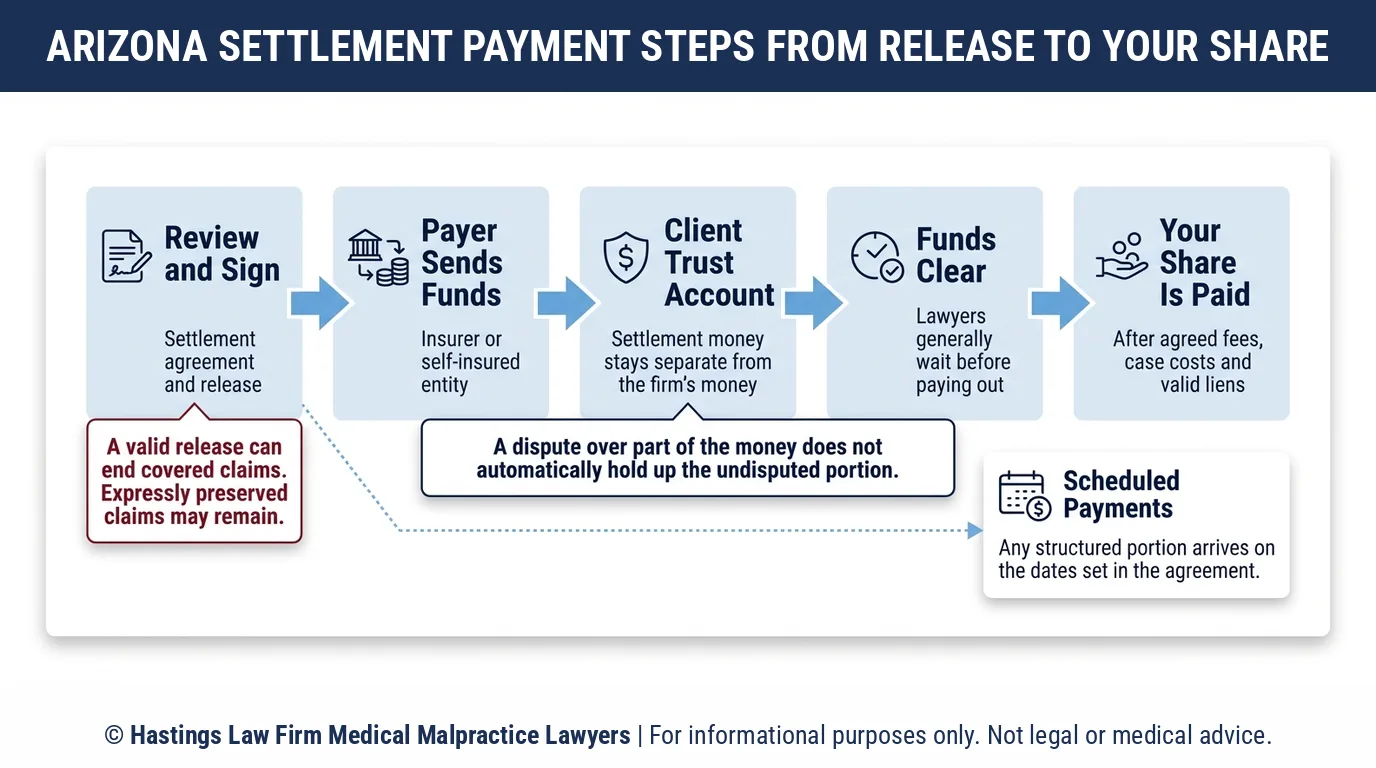
After both sides agree to a medical negligence settlement in Arizona, the patient reviews and signs a settlement agreement and release with their lawyer. The payer then sends the money to the lawyer’s client trust account, where Rule 1.15 of the Arizona Rules of Professional Conduct requires it to be kept separate from the firm’s own money. Finally, the lawyer pays out the client’s share after the agreed deductions.
Before any of these steps begins, you decide whether to accept the offer at all. That choice depends on what the offer covers, what the claim may be worth, and what going to trial would involve, so it is worth talking through with your lawyer first.
Once you accept, the release is the document to read most closely. A valid settlement and release can end the claims they cover, while claims the release expressly preserves may remain. The Arizona Supreme Court treats the enforcement of a settlement as a matter of contract law in Robertson v. Alling, so read the release with your lawyer and understand exactly what it covers before you sign.
With the release signed, the payer can send the money. A malpractice settlement can be funded by a liability insurer or a self-insured hospital or other entity. Whichever one pays, the check or wire goes to the lawyer’s trust account, not to you directly.
After the money reaches that trust account, Rule 1.15 also requires your lawyer to pay you promptly the amounts you are entitled to receive. A dispute over part of the money does not automatically hold up the undisputed portion, so the rest of what you are owed can still move ahead.
That payment is not always a single lump sum. Some settlements are paid partly over time, through a structured settlement. When part of the money is scheduled for later, that part arrives on the dates the agreement sets rather than with the first payment.
What Can Delay a Medical Malpractice Settlement Payment in Arizona?
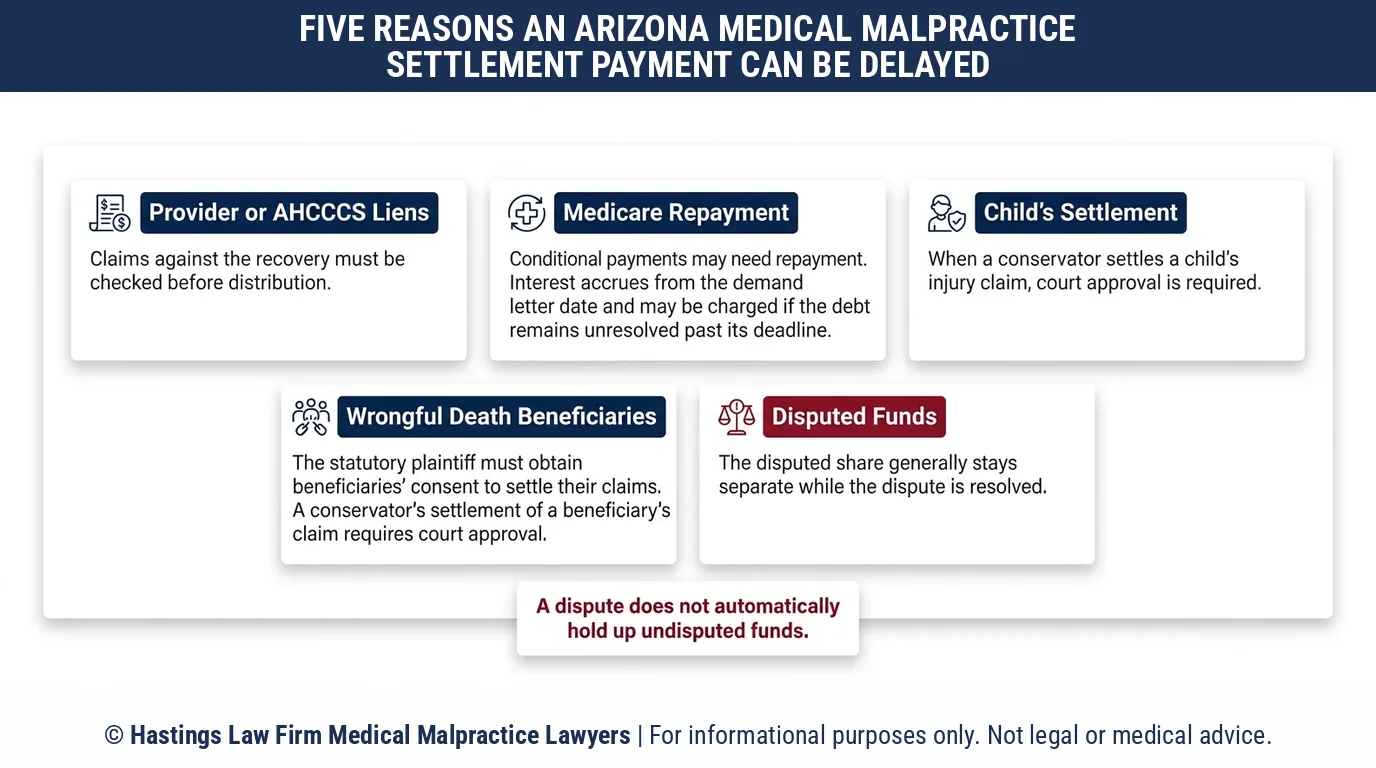
A medical malpractice settlement payment in Arizona can take longer when medical providers or the plans and programs that paid for the care have claims on the money, when a child’s settlement needs court approval, or when part of the funds is disputed. Providers and the Arizona Health Care Cost Containment System (AHCCCS) may hold liens against the recovery under A.R.S. § 33-931 and § 36-2915.
Medicare has its own repayment rules. When Medicare has made what it calls conditional payments for injury-related care, it may need to be repaid, and the repayment follows its demand letter. The Centers for Medicare & Medicaid Services (CMS) says interest builds from the date of that letter and may be charged if the debt is still unresolved past the letter’s deadline, so meeting that deadline matters.
Before any money is distributed, your lawyer checks each claim on the settlement, whether it comes from a provider, AHCCCS, Medicare, or a health plan. That review matters, because medical bills and benefit payments can affect how much of the recovery you keep.
A child’s claim adds its own step. When a conservator, the person a court appoints to manage a child’s money, settles the child’s injury claim, A.R.S. § 14-5424 requires court approval, and the child’s recovery must be protected. Arizona separately allows certain payments owed to a minor, including settlement money, through a statutory payment procedure for up to $10,000 a year, subject to its conditions.
A wrongful death claim involves other steps. The statutory plaintiff, the person who brings the claim for the family, must obtain the beneficiaries’ consent to settle their claims, and a court must approve the settlement when a conservator settles a beneficiary’s claim. Each beneficiary’s share reflects that person’s damages, so the shares are worked out before the money is distributed.
When someone disputes part of the money, the disputed share generally stays separate, subject to Rule 1.15’s procedure for distributing it. It can reach you later than the rest of the settlement, so ask your lawyer what is needed to resolve the dispute.
How Long Does It Take for a Settlement Check to Clear in an Arizona Medical Negligence Case?
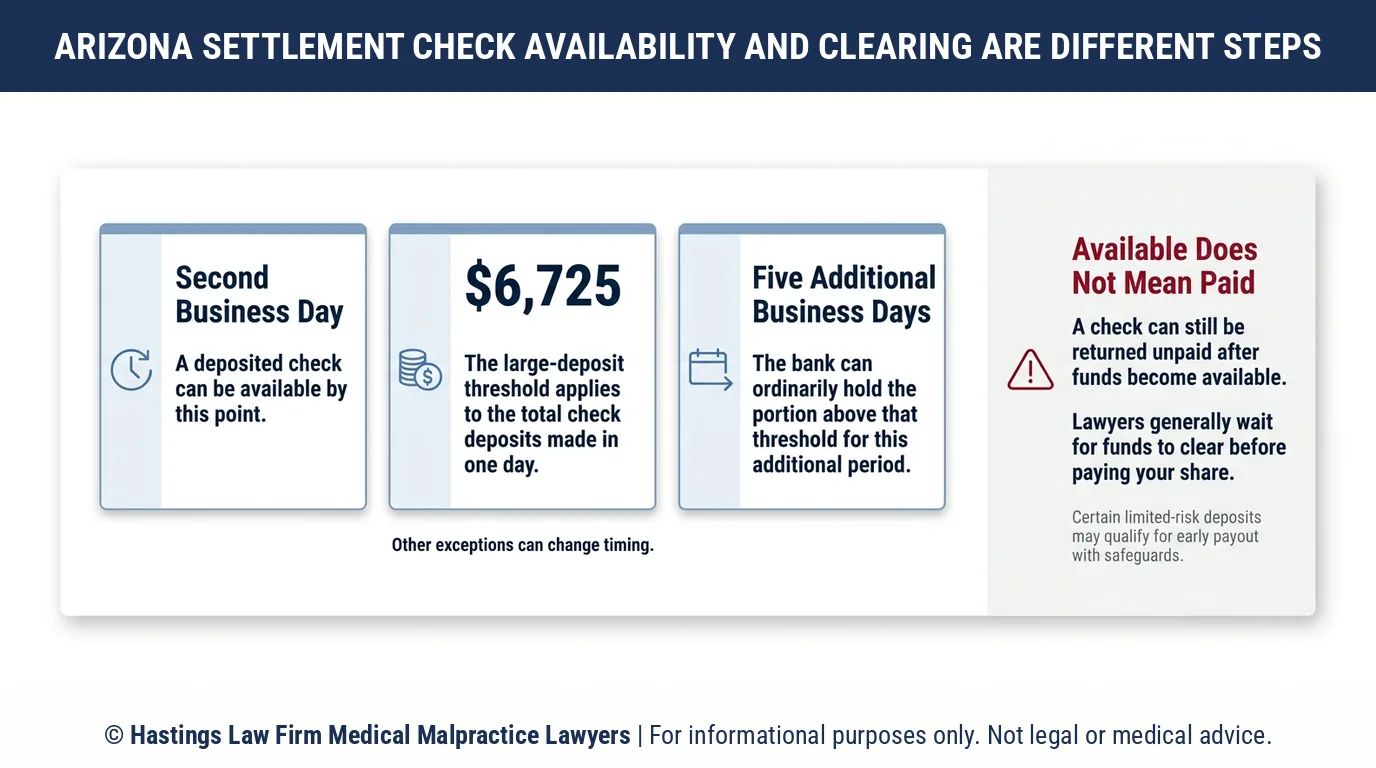
A deposited settlement check can be available by the second business day, but the bank can ordinarily hold part of a large check for five more business days. Under the Federal Reserve’s Regulation CC, that longer hold covers the part of a day’s check deposits above $6,725, and other exceptions can change the timing. Lawyers generally wait for the funds to clear before paying them out.
Funds the bank makes available are not the same as a check that has been paid. A check can still come back unpaid after the funds become available, and that risk is why lawyers wait. The State Bar of Arizona explains that Arizona permits early payout for certain limited-risk deposits, subject to safeguards.
Whether a deposit counts as limited-risk depends on how the payer sends the money, so not every settlement payment can be paid out early. Your lawyer can tell you how the payment in your case was sent and what that means for the timing.
Some of the wait comes before the deposit. After the signed release reaches the insurer, hospital, or other entity paying the settlement, its own steps to issue the check can add time before the money arrives in the trust account. Some settlements covered by Arizona’s state liability program also need government approvals before they are settled and paid.
Once the funds clear, your share is what remains after the attorney’s fee, the case costs, and any valid liens. How much each one takes varies from case to case, so two settlements of the same size can leave two families with different amounts.
When is a Medical Malpractice Verdict Paid in Arizona?
Getting paid after winning a medical malpractice lawsuit in Arizona is not immediate, because the money is owed only once the court enters judgment, and post-trial motions or an appeal can push payment back further. Either side generally has 15 days after judgment to ask for a new trial. If the losing side appeals, an appeal bond set under A.R.S. § 12-2108 can stop collection while the appeal runs.
That deadline runs from the entry of judgment, the court’s final written decision, not from the day the jury decides. Within the same 15 days, a party can also renew a motion for judgment as a matter of law, which asks the judge to decide the case despite the verdict.
An appeal is the next point where payment can wait. A final superior court judgment can be appealed to the Arizona Court of Appeals, and the notice of appeal is generally due within 30 days after entry of judgment. Certain post-judgment motions and other exceptions can change that deadline.
Arizona law sets the appeal bond that can pause collection at the lowest of three figures: the damages awarded, not counting punitive damages, half of the appealing party’s net worth, or $25 million. A court can adjust that amount in specified circumstances.
While a judgment goes unpaid, it can earn interest. Under A.R.S. § 44-1201, Arizona’s default rate for judgment interest is the lower of 10% a year or the prime rate plus one percentage point. The judgment states the rate, and it stays fixed after entry, although exceptions and exclusions apply.
How the award is paid is a separate question from when. Arizona’s statutes still contain provisions for paying future damages, the losses yet to come, over time, but the Arizona Supreme Court held that scheme unconstitutional in Smith v. Myers. A defendant cannot rely on it to force installment payments on a patient who objects, though the parties may agree to installments in a voluntary structured settlement.
The Hastings Law Firm Difference
Results matter, but what truly sets us apart is how we achieve them. Every verdict, every settlement, and every courtroom victory comes from one guiding promise: To treat each client’s fight for justice as if it were our own.
This balance of skill, experience, and empathy reflects our core philosophy that justice should not only compensate the injured, but also make health care safer nationwide.

What Can You Do While Waiting for Your Arizona Medical Injury Settlement to Pay Out?
While waiting for an Arizona medical injury settlement to pay out, sign and return the release and any lien or payment forms promptly once your lawyer has gone over them with you. Tell your lawyer about every health plan, any AHCCCS or Medicare coverage, and every medical bill tied to the injury, so each claim on the money can be checked before the funds are distributed.
Keep copies of everything you sign and every letter you receive about the bills for your injury. Those papers help answer any question a health plan raises later, or any question Medicare raises under its rules for recovering conditional payments. Before any money goes out, ask your lawyer to walk you through how your share is figured.
When something seems to stall, ask your lawyer what the payment is waiting on. It may be a signature, a lien, a court approval, or the deposit clearing, and knowing which step is still open tells you what has to happen next and who needs to act.
If the wait is straining your budget, you may come across companies that offer money in advance against a pending settlement. Before you sign anything with one, talk with your lawyer, because the terms of that agreement can affect how much of the settlement you receive once it is paid.
Talk to an Arizona Medical Malpractice Attorney About Your Case
When you contact Hastings Law Firm, we listen to what happened, request and review the medical records with our medical professionals and experts, and give you an honest answer about whether you have a claim. Our lawyers are experienced in handling medical malpractice claims in Arizona, from the first look at the records through settlement or trial and the payment that follows. We understand that a family often waits on this money to pay for care and replace lost income, and that knowing what each step involves makes the wait easier to plan around.
Every case is prepared as if it were going to trial, and we advance the cost of the experts and everything else it takes to build the claim. Our Arizona medical malpractice lawyers work on a contingency fee, so you pay no attorney fees or costs unless we win. Hastings Law Firm has been dedicated exclusively to medical malpractice since 2005. Contact us now for a free, confidential case review.
Sources
- A.R.S. § 20-461 on unfair claim settlement practices by insurers | Arizona State Legislature
- Arizona ER 1.15 on how lawyers hold and distribute client funds | Arizona Court Rules
- Robertson v. Alling, Arizona Supreme Court opinion on enforcing settlements | Arizona Judicial Branch
- A.R.S. § 33-931 on health care provider liens against damages recovered | Arizona State Legislature
- Medicare’s recovery process for conditional payments and demand-letter interest | Centers for Medicare & Medicaid Services
- 42 C.F.R. § 411.24 on Medicare’s recovery of conditional payments | Electronic Code of Federal Regulations
- A.R.S. § 14-5424 on court approval of a conservator’s injury settlement | Arizona State Legislature
- Regulation CC rules on check holds and funds availability, 12 C.F.R. part 229 | Electronic Code of Federal Regulations
- Trust account rules for Arizona lawyers handling client funds | State Bar of Arizona
- A.R.S. § 12-2108 on the appeal bond needed to stay a judgment | Arizona State Legislature
- A.R.S. § 44-1201 on the interest rate for Arizona judgments | Arizona State Legislature

This content was researched and written by the Hastings Law Firm editorial team, which includes attorneys, medical professionals, and experienced researchers. Our writing is informed by internal knowledge and practical experience, and we cross-check critical details against authoritative sources cited throughout. Every piece undergoes human-led fact-checking and legal review. Because legal and medical information can change, if you spot an error, please contact us. Learn more about our content standards and review process on our editorial policy page.

Tommy Hastings, founder of Hastings Law Firm, is a board-certified personal injury trial lawyer (by the Texas Board of Legal Specialization) dedicated exclusively to healthcare injury cases. Since 2001, he has represented injured patients and families in litigation against major hospital systems, pharmaceutical companies, and negligent healthcare providers nationwide. He has handled numerous high-profile cases that have drawn national media attention and resulted in multi-million dollar recoveries.
