


Arizona Medication Error Lawyer
Written by: Hastings Law Firm | Reviewed by: Tommy Hastings | Updated: July 27, 2026
Medication errors can be preventable failures in prescribing, dispensing, administering, or monitoring a drug, and they can leave patients facing serious harm and lasting uncertainty. Arizona law distinguishes between a known side effect and an error that falls below the accepted standard of care, and that distinction can shape whether negligence is involved. Responsibility may extend beyond one clinician to include a hospital or pharmacy entity when unsafe systems contribute to the mistake. If you or a loved one were harmed or worse due to medication errors in Arizona, contact Hastings Law Firm for a free, confidential case review.

Trusted Legal Representation for RX Drug Errors in Arizona
What You Should Know About Wrong Drug or Dosage Error Claims in Arizona:
- Lasting harm can follow a medication error because preventable mistakes can occur across prescribing, dispensing, administration, and monitoring.
- Options can depend on whether the injury is tied to a known side effect or to care that fell below the accepted standard of care.
- Responsibility can extend beyond one person because physicians, pharmacists, nurses, and hospitals or pharmacy entities may share liability.
- Recovery can include both financial losses and personal harms because Arizona recognizes economic and non economic damages for medication negligence.
- Full compensation may be available because Arizona does not allow caps on damages in personal injury cases.
- The ability to pursue a claim can be lost because Arizona imposes strict filing deadlines for medical malpractice cases.
- A claim can be dismissed because Arizona requires an early expert affidavit tied to the merits of the case.
- Proof can hinge on documentation because prescriptions, medical records, pharmacy logs, and medication packaging can be central evidence.

A Healthcare Focused Law Firm
When a medication error causes harm, the shock can feel overwhelming. You trusted your doctor, pharmacist, or hospital to get something as fundamental as your medication right, and that trust was broken. The injury you or your loved one suffered was not a risk you agreed to accept. It was preventable.
At Hastings Law Firm, we focus exclusively on medical malpractice. Founded by Tommy Hastings, a board-certified trial lawyer with over 20 years of experience, our team includes in-house nurse consultants and former defense attorneys who previously worked for the systems they now challenge. This insider perspective helps us know exactly where to look in medical records, pharmacy logs, and hospital protocols to determine what went wrong.
If you believe a prescription mistake or drug administration error caused harm, an experienced Arizona medication error lawyer at our firm can review what happened and explain your options at no cost.
Defining Medication Errors and Adverse Drug Events in Arizona
A medication error is any preventable event that may cause or lead to inappropriate medication use or patient harm while the medication is under the control of a healthcare professional, patient, or consumer. This definition, established by the National Coordinating Council for Medication Error Reporting and Prevention (NCC MERP), covers a wide scope of failures, from the moment a drug is prescribed to the point it reaches your body.
These errors can happen at any stage: prescribing, order communication, product labeling, compounding, dispensing, distribution, administration, or patient education. An adverse drug event (ADE), which is any injury resulting from medication use, may or may not involve negligence. The legal distinction matters.
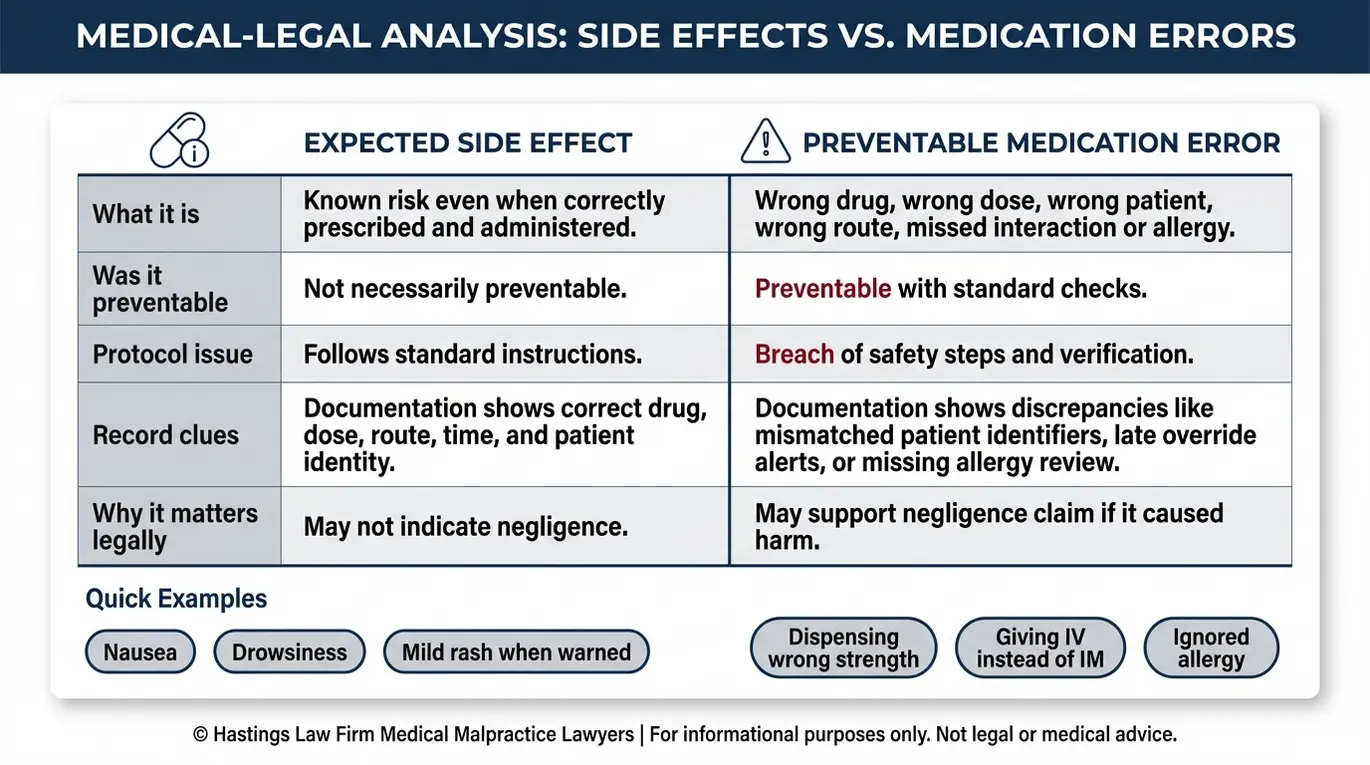
A known side effect listed on a drug’s labeling is a recognized risk of proper use. A medication error, on the other hand, results from a failure to meet the accepted standard of care, something a careful professional should have prevented. That difference is the foundation of a negligence claim.
For many people, learning that their injury did not have to happen is the hardest part. As an Arizona medication error lawyer, we understand that weight, and we help our clients channel it toward accountability.
Common Types of Medication and Prescription Errors
Common medication errors include prescribing the wrong drug, administering an incorrect dosage, failing to identify drug interactions, and pharmacy dispensing mistakes. Distinguishing between these errors and a side effect, a known risk listed on the label, helps clarify your legal options. These errors fall into several broad categories:
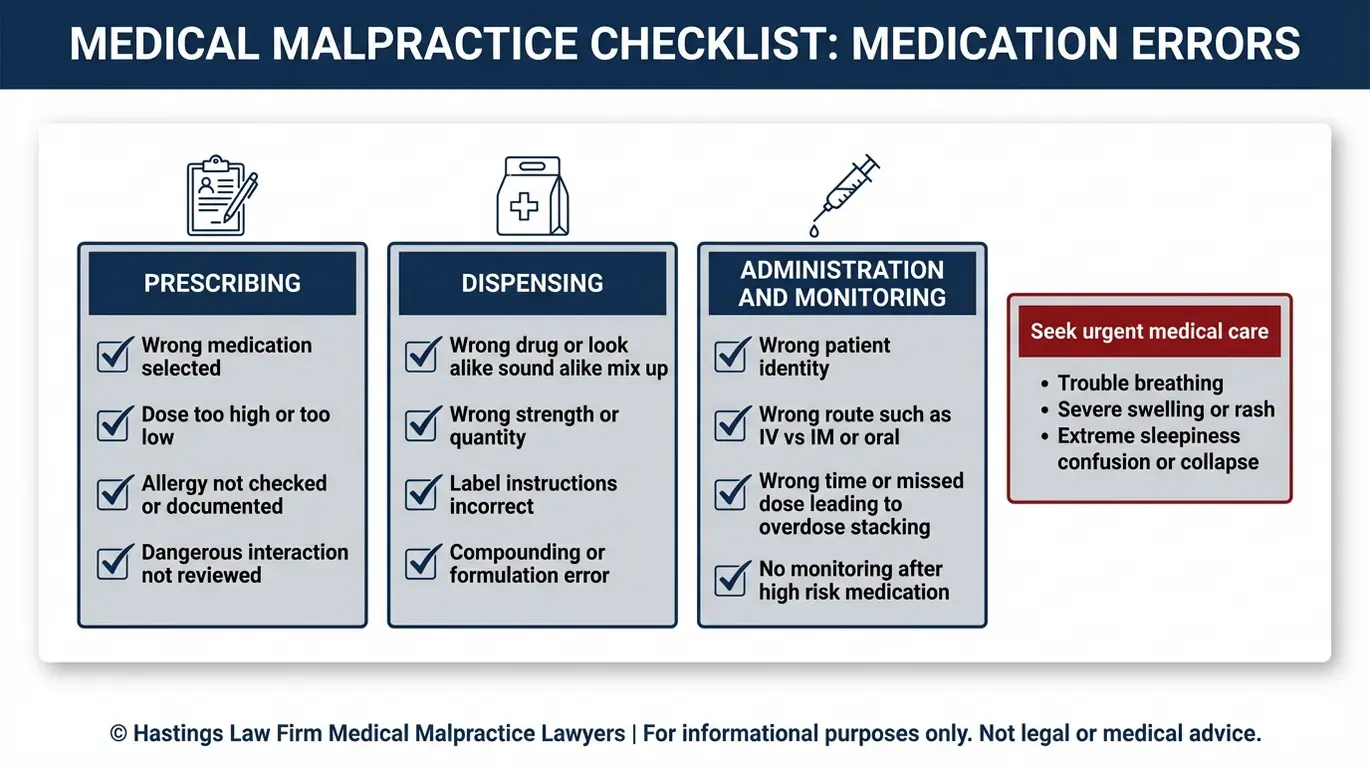
- Prescription Errors. A physician may write an improper prescription for the wrong medication, select an inappropriate dosage, or fail to review a patient’s chart for documented drug allergies. A drug allergy is a known sensitivity to a specific medication that should be flagged before any prescription is written.
- Dispensing Errors. A pharmacist may fill a prescription with the wrong pill or incorrect strength. Pharmacy negligence of this kind can stem from understaffing, rushed workflows, or simple misreading of a prescription.
- Administration Errors. At the bedside, a registered nurse may administer an overdose, give a medication to the wrong patient, or use the wrong route (such as intravenously instead of intramuscularly). The Nursing Rights of Medication Administration outline the safety checks that should prevent these failures.
- Monitoring Errors. After a drug is administered, healthcare providers have a duty to track the patient’s response. Failure to monitor vitals or recognize signs of a drug-drug interaction, which occurs when two or more medications interfere with each other in harmful ways, can turn a treatable reaction into a catastrophic one.
An Arizona medication error lawyer evaluates which of these categories applies and identifies every responsible party. Under ARS § 12-542, these claims are subject to strict filing deadlines, so early investigation is essential.
Electronic Health Record (EHR) and Technology-Based Errors
Not all medication errors are handwritten mistakes. Modern healthcare relies heavily on Electronic Health Records (EHRs), digital systems that store and manage patient data, and Computerized Physician Order Entry (CPOE) systems, software that allows doctors to enter medication orders electronically. While these tools were designed to reduce errors, they introduce new risks.
A common example is a drop-down menu selection error, where a physician accidentally clicks the wrong medication or dosage from a digital list. Two drugs with similar names can appear adjacent on screen, and a single misclick can send the wrong order to the pharmacy. These technology-based errors are still medical malpractice when they result from negligence, and the medical records themselves often contain the digital footprint we need to prove it.
The Hastings Law Firm Difference
Results matter, but what truly sets us apart is how we achieve them. Every verdict, every settlement, and every Arizona courtroom victory comes from one guiding promise: To treat each client’s fight for justice as if it were our own.
This balance of skill, experience, and empathy reflects our core philosophy that justice should not only compensate the injured, but also make healthcare safer nationwide.

How Preventable Medication Errors Occur
Errors frequently stem from system-level failures such as miscommunication between providers, distracted or overworked staff, and inadequate safety protocols. Understanding the root cause helps build a stronger case.
Communication breakdowns are one of the most common triggers. A verbal order given over the phone can be misheard. A handwritten prescription can be misread. When critical drug information does not transfer clearly between a physician and a pharmacist, the patient bears the consequence. Medication reconciliation, the process of comparing a patient’s current medications against new orders at every transition of care, is designed to catch these gaps. When it is skipped or done carelessly, errors slip through.
Staffing failures also contribute. Pharmacists working excessive hours or managing high prescription volumes without adequate support are more likely to make dispensing mistakes. This type of pharmacy negligence represents a breach of duty by the hospital or corporate entity that owes a duty of care to patients. According to NCBI’s review of Medication Dispensing Errors and Prevention, system-level safeguards are critical to reducing these risks.
Look-alike/sound-alike (LASA) medications, drugs with names that are visually or phonetically similar, account for a significant number of mix-ups. Confusing hydroxyzine with hydralazine, for example, can cause serious harm. An Arizona medication error lawyer examines these system failures closely because they often point to institutional negligence, not just individual mistakes.
Identifying Liability: Who Is Responsible for a Prescription Mistake?
Liability may extend to the prescribing physician, the dispensing pharmacist, the nurse who administered the drug, or the hospital or pharmacy entity for failing to implement safe protocols. In many cases, more than one party shares responsibility. Identifying every person or entity responsible for a mistake is a necessary step in building a case.
Physician liability can arise when a doctor prescribes a medication without reviewing the patient’s history, selects the wrong dosage (a dosing error), or ignores a documented drug allergy, a known sensitivity that should have appeared in the patient’s chart.
Pharmacy liability is not limited to the individual pharmacist. Corporate pharmacy chains can be held accountable for systemic problems like understaffing, inadequate training, or pressure to fill prescriptions at unsafe speeds. Under ARS § 12-561, Arizona law defines healthcare providers broadly, which can include institutional defendants.
Nurse and hospital liability often involves bedside administration errors. A registered nurse who fails to verify patient identity, confirm the correct route, or monitor the patient afterward may be individually liable, and the hospital may bear responsibility for inadequate supervision or flawed protocols.
An Arizona medication error lawyer identifies every potentially liable party so that no avenue of recovery is overlooked.
Establishing Negligence: The Elements of a Medication Error Claim
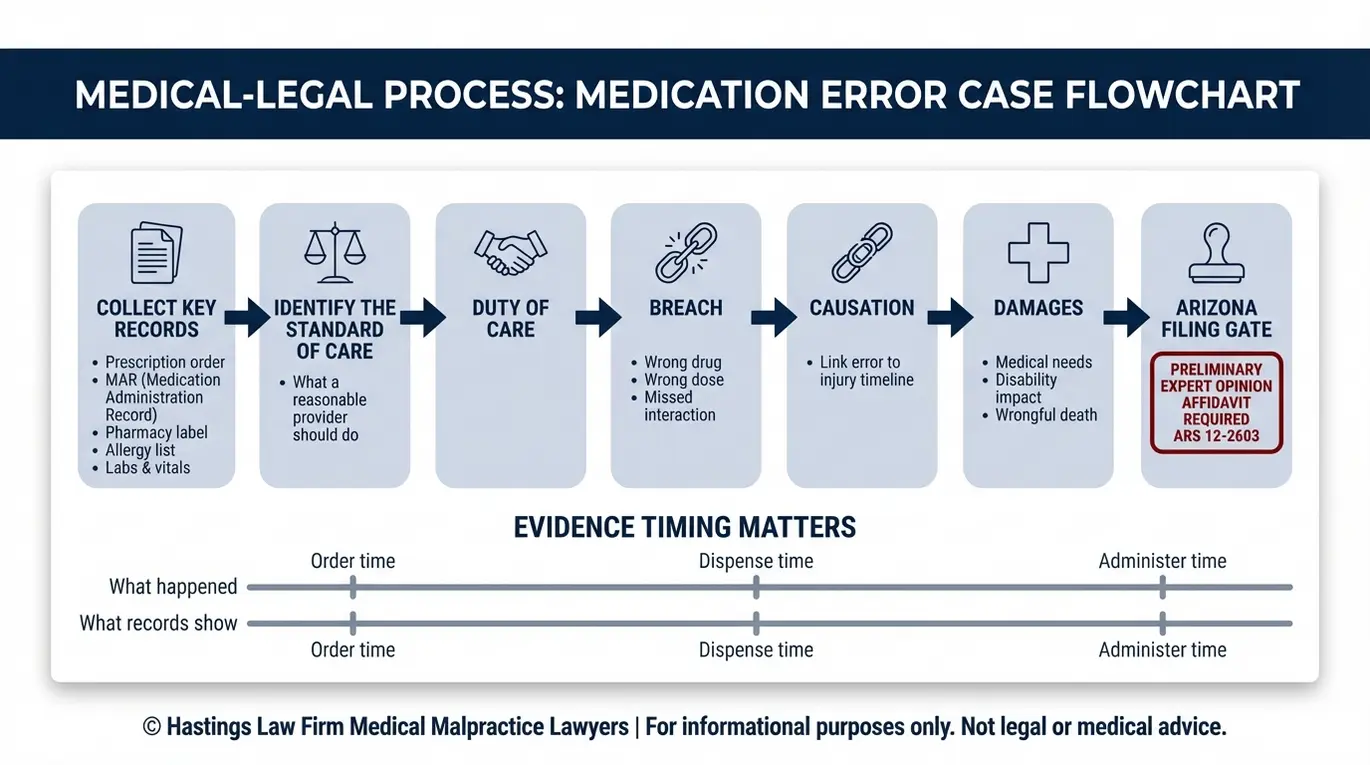
To prove a medication error claim, the injured patient must demonstrate that a duty of care existed, that the healthcare provider breached that duty through a medication error, and that this breach directly caused specific damages or injury. These four elements, which include duty, breach, causation, and damages, form the legal framework for every medical malpractice case in Arizona.
Duty is usually the simplest element. Once a doctor-patient or pharmacist-patient relationship exists, the provider owes a duty to meet the accepted standard of care.
Breach means the provider’s conduct fell below that standard. An experienced Arizona medication error lawyer works with qualified medical experts to define exactly what a reasonably competent professional would have done under the same circumstances, and then demonstrates how the defendant failed to meet that benchmark using medical records.
Causation connects the breach to the injury. It is not enough to show that an error occurred; we must prove the error directly caused the patient’s harm.
Damages encompass the actual losses suffered, from medical bills to pain and diminished quality of life.
Arizona imposes an additional requirement that makes early legal counsel especially important. Under ARS § 12-2603, the patient must serve a Preliminary Expert Opinion Affidavit. This affidavit is a written statement from a qualified medical expert confirming that the claim has merit. It must be served with the initial disclosures required by the Arizona Rules of Civil Procedure, and failure to comply can result in dismissal.
Our firm staffs in-house medical professionals and maintains a national network of expert witnesses to meet these requirements. From the day we accept a case, our team begins building the expert foundation required under Arizona law. An Arizona medication error lawyer at Hastings Law Firm prepares every case with this requirement in mind from the start.
Compensation for Injuries Caused by Medication Negligence
Patients harmed by medication negligence may recover economic damages for medical bills and lost wages, as well as non-economic damages for pain, suffering, and permanent disability. The type and amount of compensation depends on the severity of the injury, its long-term impact, and our firm’s history of verdicts and settlements in similar cases.
Economic damages cover measurable financial losses: past and future medical costs, rehabilitation, lost income, and diminished earning capacity. These are calculated based on documentation like billing records, employment history, and expert projections.
Non-economic damages address the personal toll: physical pain, emotional distress, loss of enjoyment of life, and loss of consortium for spouses. These losses are harder to quantify but no less real.
In cases where a medication error results in death, surviving family members may pursue a wrongful death claim for funeral expenses, loss of financial support, and loss of companionship. An Arizona medication error lawyer can help families understand what compensation may be available based on their specific circumstances.
Arizona Statute of Limitations for Medication Error Claims
In Arizona, medical malpractice claims, including those involving medication errors, typically must be filed within two years from the date the injury occurred or was discovered, per ARS § 12-542. The statute of limitations is the strict legal deadline for filing a claim.
Arizona also recognizes the Discovery Rule, which means the two-year clock may not start running until the patient knew, or reasonably should have known, that a medication caused their injury. This can matter in cases involving latent side effects or errors that were not immediately apparent. The Discovery Rule is fact-specific and courts apply it narrowly, so it should never be treated as a reason to delay.
Missing this deadline almost always means losing the right to file a claim entirely. If you suspect a medication error caused harm to you or a loved one, speaking with a lawyer for medication errors as early as possible protects your ability to seek accountability.
Contact the Arizona Healthcare Malpractice Attorneys at Hastings Law Firm Today for Help
A medication error can change the course of your life in an instant, and finding out it was preventable only deepens that pain. You deserve clear answers about what happened and whether the professionals responsible can be held accountable.
At Hastings Law Firm, our legal and medical team investigates every case with trial-ready preparation from day one. Our in-house nurse consultants, former defense attorneys, and national network of medical experts give us the insight needed to uncover the truth in your medical records. We handle medication error cases exclusively within the field of medical malpractice because this level of focus produces better outcomes for our clients.
Tommy Hastings is a board-certified trial lawyer and an inductee into the American Board of Trial Advocates (ABOTA) with over two decades of experience. You pay no attorney fees or costs unless we secure a recovery on your behalf.
Contact Hastings Law Firm today for a free, confidential case evaluation. Let us help you find the answers you deserve and explain the options available to you and your family.
Frequently Asked Questions About Medication Error in Arizona


This content was researched and written by the Hastings Law Firm editorial team, which includes attorneys, medical professionals, and experienced researchers. Our writing is informed by internal knowledge and practical experience, and we cross-check critical details against authoritative sources cited throughout. Every piece undergoes human-led fact-checking and legal review. Because legal and medical information can change, if you spot an error, please contact us. Learn more about our content standards and review process on our editorial policy page.

Tommy Hastings, founder of Hastings Law Firm, is a board-certified personal injury trial lawyer dedicated exclusively to healthcare injury cases. Since 2001, he has represented injured patients and families in litigation against major hospital systems, pharmaceutical companies, and negligent healthcare providers nationwide. He has handled numerous high-profile cases that have drawn national media attention and resulted in multi-million dollar recoveries. He draws on that experience in his writing, helping readers understand how these cases work and what options may be available to them.
