


Arizona Failure to Obtain Informed Consent Lawyer
Written by: Hastings Law Firm | Reviewed by: Tommy Hastings | Updated: July 27, 2026
A medical procedure should be based on a real understanding of the risks, benefits, and alternatives, not just a signature on a form. In Arizona, informed consent focuses on what a reasonable patient would need to know to make a meaningful choice, and claims often turn on whether a material risk was omitted or minimized and whether that omission led to an injury. Disputes can also involve whether consent was valid under pressure, sedation, or limited capacity, or whether the situation was truly an emergency. If you or a loved one were harmed or worse due to failure to obtain informed consent in Arizona, contact Hastings Law Firm for a free, confidential case review.

Trusted Arizona Medical Attorneys for Informed Consent Malpractice Claims
What You Should Know About Informed Consent Malpractice Claims in Arizona:
- Recovery can depend on whether a material risk, benefit, or alternative was not meaningfully disclosed before a procedure.
- Liability can turn on whether a reasonable patient would have declined the treatment if properly informed.
- A claim can fail without an actual injury that matches the undisclosed risk that later occurred.
- Options may remain even with a signed consent form when the form was vague or the circumstances involved duress, sedation, or limited decision making capacity.
- The legal theory can change the required proof when the procedure was never authorized, since unauthorized treatment is treated differently than inadequate disclosure.
- A provider may avoid responsibility in true emergencies when the patient cannot consent and no surrogate is available.
- Recovery can include medical expenses, lost wages, and non economic harms tied to the complication that proper consent would have avoided.
- Punitive damages may be possible in limited situations when conduct goes beyond negligence and shows gross disregard for patient rights.
- Options can be lost if time limits are missed, and the start of the time period can depend on when the harm was or should have been discovered.
- Proof can hinge on expert medical testimony about what risks are standard to disclose for the procedure and whether the disclosure fell short.

A Healthcare Focused Law Firm
You trusted your doctor to explain what was about to happen to your body, and that trust may not have been honored. If you or a loved one underwent a medical procedure without being fully informed of the risks, alternatives, or potential outcomes, you are not alone in feeling confused and betrayed by the process.
At Hastings Law Firm, we focus exclusively on medical malpractice. Our founder, Tommy Hastings, is a board-certified trial attorney who has dedicated his career to representing patients across the country. Our legal and medical team, including in-house nurse consultants and former defense attorneys, understands how failures in informed consent happen and how to hold the responsible parties accountable. As an experienced Arizona failure to obtain informed consent lawyer, we are prepared to investigate what went wrong and protect your right to answers.
If something does not feel right about how your consent was obtained, we encourage you to reach out for a free, confidential case evaluation. There is no fee unless we recover compensation for you.
Legal Definition of Informed Consent in Arizona
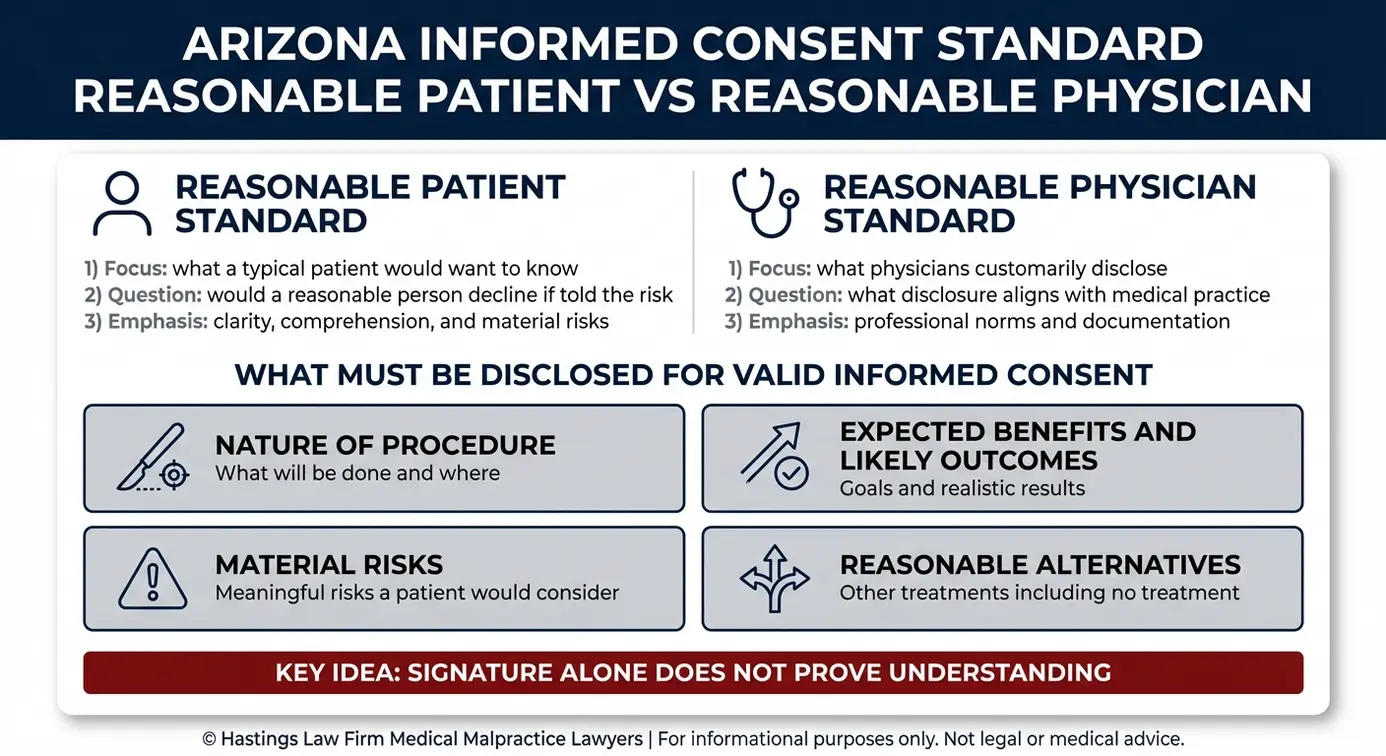
Informed consent is the legal requirement that a physician must disclose all material risks, benefits, and alternatives of a proposed treatment to a patient before proceeding. It is more than a signature on a clipboard. True informed consent means that a doctor had a meaningful conversation with the patient, explained what the procedure involves, and gave the patient enough information to make a genuine decision about their own care.
There is an important difference between simple permission and actual informed consent. A patient who says “okay” to a procedure without understanding what could go wrong has not truly consented. The duty of care requires that physicians provide enough detail for the patient to weigh the decision thoughtfully.
Arizona courts generally evaluate informed consent through what is known as the “reasonable patient” standard, which asks what information a reasonable person in the patient’s position would need to make an informed decision. This differs from the “reasonable physician” standard, which focuses on what a typical doctor in the same specialty would disclose. A detailed analysis published in the Tulsa Law Review on informed consent standards explores how these two frameworks lead to different outcomes in court. Under the reasonable patient standard, the focus stays on the patient’s need for information rather than the doctor’s customary disclosure habits.
The distinction between these standards is critical. In states that follow the reasonable physician standard, a doctor only needs to disclose what other doctors would typically mention. Arizona’s adherence to the reasonable patient standard shifts the power to the individual. It acknowledges that patients, not doctors, bear the burden of the risks.
The law mandates that you receive every piece of information necessary to shape your own destiny. This includes a clear explanation of success rates, potential long-term side effects, and the realities of recovery. For consent to be legally valid in Arizona, a physician must generally disclose:
- The nature of the proposed procedure or treatment, including what it involves and why it is being recommended.
- The material risks, meaning any risks that could influence a reasonable person’s decision, even if they are statistically uncommon.
- The likely outcomes, both with and without the proposed treatment.
- Reasonable alternatives, including other treatment options, watchful waiting, or the option to decline treatment entirely.
An Informed Consent Lawyer in Arizona can evaluate whether the information you received before your medical procedure met these requirements. If your physician glossed over material risks or failed to discuss alternatives, you may have grounds for a medical malpractice claim. An Arizona informed consent attorney can review your records, identify what was or was not disclosed, and help determine whether the standard of care was met.
Proving a Failure to Obtain Informed Consent Claim
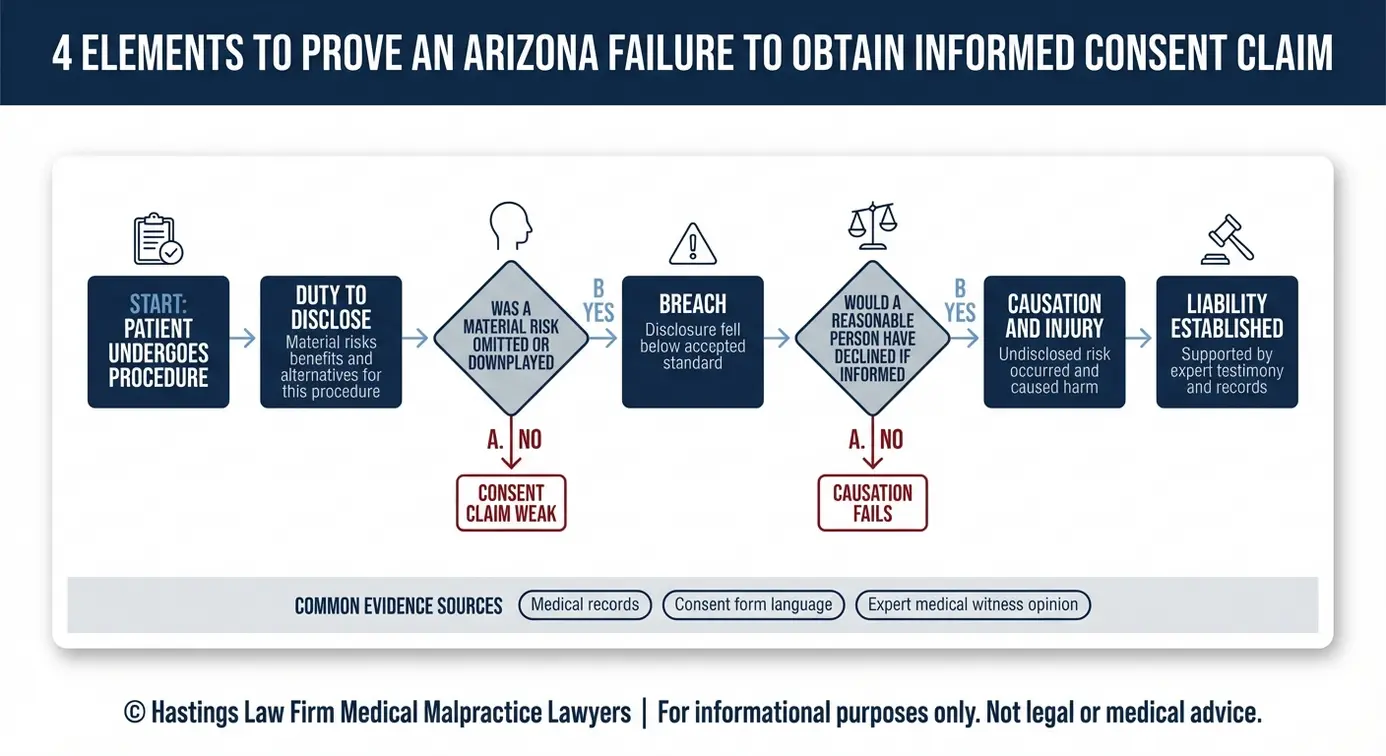
To prove this claim, a patient must demonstrate that the doctor had a duty to disclose a known risk, that the doctor failed to adequately disclose that risk, that a reasonable person would have declined the treatment if informed, and that the undisclosed risk caused actual injury. Each of these elements builds on the last, and all four must be established for a case to succeed. Proving an informed consent claim in Arizona requires showing that the lack of information led to an actual injury.
Duty to Disclose
The first step is showing that the physician had a legal duty to disclose the specific risk in question. Not every possible complication needs to be mentioned. A material risk, meaning one that could reasonably affect a patient’s decision about whether to proceed, must be communicated clearly before the medical procedure begins.
Breach of That Duty
Next, you must show that the physician either omitted the risk entirely or downplayed it in a way that prevented you from understanding its significance. Medical records, pre-operative notes, and testimony from the care team become essential evidence to support this claim. This form of medical negligence requires demonstrating that the provider failed to meet the accepted standard.
Causation: The “But-For” Test
This is often the most contested element. Establishing liability for a lack of consent requires showing that if you had known about the undisclosed risk, you would have chosen a different treatment path or declined the procedure altogether. Courts apply this through the lens of a reasonable person.
The question is not just whether you would have refused, but whether a reasonable person in your position would have made a different choice. This concept of proximate cause connects the physician’s failure to disclose directly to your decision to proceed. Reasonable alternatives, including the option of no treatment at all, are central to this analysis.
Actual Injury
Finally, the undisclosed risk must have actually occurred. If a doctor failed to disclose the specific risks of the procedure like nerve damage, and nerve damage resulted from the procedure, this element may be satisfied. Without actual injury tied to the undisclosed risk, there is no actionable claim.
A malpractice attorney for lack of consent will typically work with expert testimony to establish each element. Medical experts can confirm what risks are standard to disclose, whether the physician deviated from that standard, and whether the injury was a direct result of the undisclosed complication.
Burden of Proof Checklist:
- The physician had a duty to disclose the specific material risk.
- The risk was not disclosed or was inadequately explained.
- A reasonable patient would have refused or chosen differently if informed.
- The undisclosed risk actually materialized, causing injury.
- Expert testimony must support the connection between the omission and the harm.
The Hastings Law Firm Difference
Results matter, but what truly sets us apart is how we achieve them. Every verdict, every settlement, and every Arizona courtroom victory comes from one guiding promise: To treat each client’s fight for justice as if it were our own.
This balance of skill, experience, and empathy reflects our core philosophy that justice should not only compensate the injured, but also make healthcare safer nationwide.

Can You Sue If You Signed a Consent Form?
Yes. Signing a consent form does not automatically bar a lawsuit if the form was vague, the patient was under duress, or the doctor failed to verbally explain the specific risks detailed in the document. Many people assume that their signature eliminates any legal option, but that is not how Arizona courts view it.
A common defense strategy is to point to a signed informed consent form and argue that the patient agreed to everything. But many of these forms are boilerplate consent forms, meaning they contain generic, pre-printed language that covers a broad range of possible complications without specifying the particular risks of the actual procedure. These standardized documents often fail to reflect the real conversation, or lack of conversation, that took place between the doctor and patient.
A study published in PubMed Central on surgical informed consent practices found significant gaps between what consent forms contain and what patients actually understand about their procedures. There are also situations where a signed form may be considered invalid.
If the patient lacked medical decision-making capacity, the ability to understand and process the information being presented, the consent may not hold up. This can happen when a patient was already sedated, medicated, or in significant distress at the time they signed. Consent obtained under coercion or extreme time pressure can also be challenged. Even with written consent, the law requires that the permission be knowing and voluntary.
Patients often feel trapped by the paperwork they signed, believing it is an ironclad contract. However, these forms are often presented at the last minute or while the patient is already prepped for surgery, creating an environment of coercion. If the document was thrust upon you without a real discussion, it may not stand up in court. The context matters just as much as the signature.
The most telling evidence in these cases is often the gap between what is written on the form and what was actually discussed in the exam room. A form might list “nerve damage” as a potential risk, but if the doctor never explained what that means or how likely it is, the disclosure was not meaningful. An Arizona failure to obtain informed consent lawyer examines the full picture, not just the paperwork.
Lack of Consent vs Medical Battery and Assault
While negligence involves a failure to warn of risks, medical battery occurs when a doctor performs a completely different procedure than what was authorized or treats the wrong body part entirely. These are distinct legal theories with different consequences, and understanding the difference matters if you are considering legal action.
In a standard informed consent case based on medical negligence, the physician performed the procedure the patient agreed to but failed to adequately explain the risks. The patient consented to the general treatment; the problem is that the consent was not fully informed.
Medical battery, on the other hand, involves unauthorized treatment. This means the doctor performed a procedure the patient never agreed to. Consider a scenario where a patient consents to removal of a cyst and wakes up to discover an entirely different surgery was performed.
That goes beyond a failure to disclose risks. It is an unauthorized touching, and Arizona law treats it as an intentional tort (a legal term for a wrongful act) rather than simple negligence. This distinction carries real legal weight.
In battery cases, the patient does not need to prove that they would have refused the procedure if better informed. The lack of any authorization is the harm itself. Damages in battery cases can also differ from standard negligence claims and may support more aggressive recovery.
The psychological impact of medical battery is often profound. Waking up to an altered body or an unwanted procedure is a violation of trust that goes deeper than a simple error. Unlike negligence, where the focus is on a breach of standard care, battery focuses on the lack of permission itself. This can sometimes open the door to punitive damages if the conduct was particularly egregious.
| Informed Consent (Negligence) | Medical Battery | |
|---|---|---|
| What Happened | Procedure was authorized but risks were not adequately disclosed | Procedure was never authorized or a different procedure was performed |
| Legal Theory | Negligence | Intentional Tort |
| Causation Requirement | Must prove a reasonable patient would have declined if informed | No causation analysis needed; the unauthorized act is the harm |
| Damage Implications | Economic and non-economic damages | May support broader damage recovery |
A medical battery attorney Arizona patients trust or an unauthorized treatment lawyer can assess which legal theory applies to your situation and build the appropriate case.
Exceptions When Arizona Doctors Do Not Need Consent
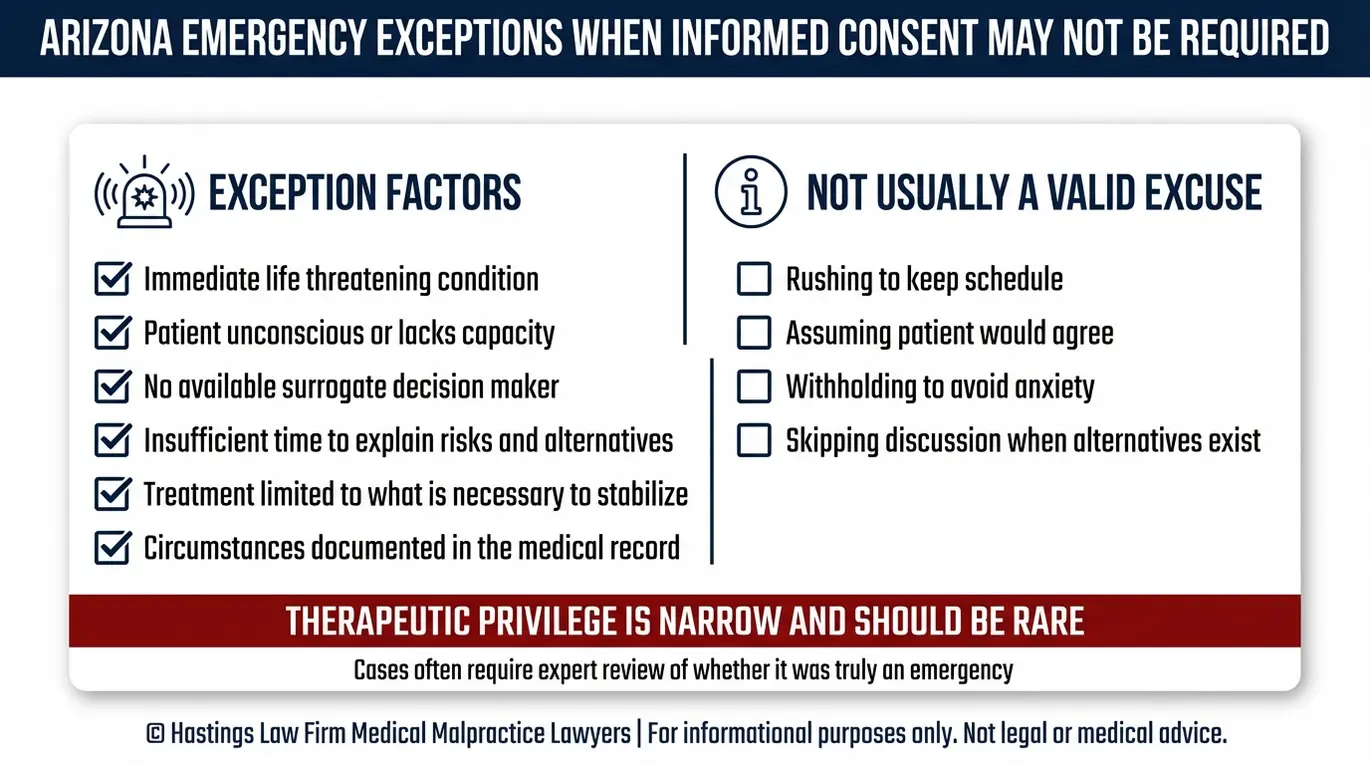
Physicians are generally exempt from obtaining informed consent during life-threatening emergencies where the patient is unconscious or incapacitated and no surrogate decision-maker is immediately available. These exceptions are narrow, and they do not give doctors a blanket right to skip the consent process.
The emergency exception doctrine applies when delaying treatment to obtain consent would put the patient’s life or health at serious risk. In these situations, the law presumes that a reasonable person would want life-saving care. Understanding emergency medical consent laws is important when analyzing these cases.
The law aims to prevent doctors from hesitating when seconds count. However, this defense is frequently overused. If a doctor claims an emergency existed but the medical records show there was time to consult with a family member, the emergency exception may not apply. Scrutinizing the timeline of events is a key part of the investigation.
An analysis published in the Arizona Law Review examining *Duncan v. Scottsdale Medical Imaging, Ltd.* discusses how Arizona courts distinguish between battery and informed consent claims in the context of patient autonomy. Beyond emergencies, there are limited situations involving public health risks where treatment may proceed without individual consent.
The recognized exceptions generally include:
- Life-threatening emergencies where the patient cannot communicate and no authorized surrogate is available.
- Public health situations where statutory authority permits treatment to prevent the spread of serious disease.
- Implied consent in narrow circumstances where a patient’s conduct reasonably indicates agreement to routine care.
Therapeutic privilege is the idea that a doctor may withhold information if disclosing it would cause the patient severe emotional harm. Arizona courts view this exception skeptically, and a patient’s potential emotional distress is rarely considered a valid reason for withholding material information. An Arizona medical malpractice lawyer can evaluate whether a physician’s claim of emergency or therapeutic privilege was genuinely justified.
Compensation for Injuries Caused by Unauthorized Procedures
Patients who suffer harm because of informed consent malpractice can recover damages for medical expenses, lost wages, and non-economic damages like pain and suffering, specifically tied to the complications of the unauthorized treatment. The goal of financial compensation is to address the full scope of harm the patient would not have experienced if proper consent had been obtained. Securing damages for lack of informed consent requires a detailed accounting of every way the injury has altered your life.
Economic Damages
Economic Damages cover the measurable financial losses that result from the undisclosed complication. These typically include medical bills for corrective surgeries, additional treatments, and ongoing care. They also cover lost wages and reduced earning capacity if the injury prevents the patient from working.
Beyond immediate bills, this includes the cost of future surgeries to correct the unauthorized work, long-term physical therapy, and even modifications to your home if the injury resulted in disability.
Non-Economic Damages
Non-economic damages address the personal toll of the experience. When a medical procedure is performed without true informed consent, the injury is not just physical. There is often significant emotional anguish tied to the violation of bodily autonomy, the feeling that a decision was made about your body without your agreement.
Pain and suffering, loss of enjoyment of life, and psychological distress are all recoverable in these cases. The emotional weight of an informed consent violation is heavy. Patients often struggle with anxiety, loss of trust in the medical system, and depression.
Punitive Damages
Punitive damages may be available in limited circumstances. Under The Arizona Constitution, the right to seek damages in civil cases is protected. When the conduct goes beyond negligence and rises to the level of gross disregard for patient rights, such as in battery cases, punitive damages can serve as both accountability and deterrence.
While rare, these are pursued when a physician acts with malice or willful disregard. For instance, if a doctor lied about a risk to secure a profitable surgery, punitive damages might be awarded to punish that conduct.
Every informed consent case is different, and the amount of compensation depends on the severity of the injury and the degree of the physician’s failure. An Arizona failure to obtain informed consent lawyer can evaluate the full scope of your damages during a settlement or trial and work to ensure that nothing is overlooked.
Contact the Arizona Healthcare Malpractice Attorneys at Hastings Law Firm Today for Help
If a medical procedure was performed without your full understanding or permission, you deserve to know what happened and what your options are. That feeling that something was not right, that your consent was not truly informed, is worth exploring.
Hastings Law Firm focuses exclusively on medical negligence as a nationally recognized plaintiff trial firm. Our Phoenix office is staffed with attorneys, nurse consultants, and patient advocates who understand how informed consent failures happen and how to build a case around them. Former defense attorneys on our team know the strategies hospitals use, and we prepare every case as if it is going to trial.
There is no cost to speak with us, and you pay no fees unless we win. If you are looking for an Arizona failure to obtain informed consent lawyer, contact us today for a free, confidential case evaluation. Let us help you find the answers you deserve.
Frequently Asked Questions About Failure to Obtain Informed Consent in Arizona


This content was researched and written by the Hastings Law Firm editorial team, which includes attorneys, medical professionals, and experienced researchers. Our writing is informed by internal knowledge and practical experience, and we cross-check critical details against authoritative sources cited throughout. Every piece undergoes human-led fact-checking and legal review. Because legal and medical information can change, if you spot an error, please contact us. Learn more about our content standards and review process on our editorial policy page.

Tommy Hastings, founder of Hastings Law Firm, is a board-certified personal injury trial lawyer dedicated exclusively to healthcare injury cases. Since 2001, he has represented injured patients and families in litigation against major hospital systems, pharmaceutical companies, and negligent healthcare providers nationwide. He has handled numerous high-profile cases that have drawn national media attention and resulted in multi-million dollar recoveries. He draws on that experience in his writing, helping readers understand how these cases work and what options may be available to them.
