


How Do You File a Medical Malpractice Lawsuit in Arizona?
A medical injury can leave a patient and family facing additional recovery time, unexpected costs, and unanswered questions about the care they received. For many families, the idea of a lawsuit adds its own uncertainty, because the process looks formal and unfamiliar from the outside. That uncertainty can make it hard to decide whether to look further into what happened or to set those questions aside. A clear picture of how a medical malpractice case moves forward in Arizona gives patients and their loved ones steadier footing for that decision.

Last Updated: November 4, 2026
What You Should Know About the Arizona Medical Malpractice Lawsuit Process:
- Before an Arizona medical malpractice lawsuit is filed, the patient’s records are gathered and a qualified medical expert, generally in the same specialty as the provider, reviews whether the care fell below the standard and caused the injury.
- An Arizona medical malpractice complaint is filed in superior court with a written certification of whether expert testimony is needed, and under A.R.S. § 12-566 it states no dollar amount.
- Each defendant in an Arizona medical malpractice lawsuit generally must be served within 90 days after the complaint is filed, and a defendant served in Arizona generally has 20 days to answer.
- In an Arizona medical malpractice case, the preliminary expert opinion affidavit is served with the initial disclosures, which are generally due 30 days after the first answer or other response is filed.
- Arizona medical malpractice cases generally belong in Tier 3, which gives each side 240 days from the Early Meeting to finish discovery unless the court allows changes.
- In an Arizona medical malpractice case, the court’s schedule generally includes a settlement conference or private mediation no more than 15 months after the case begins, and taking part never means having to accept an offer.
- An Arizona superior court civil jury ordinarily has eight jurors, six of whom must agree on the verdict, and no written demand is needed to keep the right to a jury.
- Arizona’s Constitution bars any law that limits the damages recoverable for injury or death, so no statutory cap reduces a medical malpractice jury’s award.
- Arizona generally allows two years to file a medical malpractice lawsuit under A.R.S. § 12-542, usually counted from when the patient knew, or reasonably should have known, enough to investigate whether negligence caused the injury.
What Are the Steps in an Arizona Medical Malpractice Lawsuit?
An Arizona medical malpractice lawsuit generally moves through an expert review of the records, filing in superior court, serving each defendant, any required expert affidavit, the exchange of evidence called discovery, a settlement conference or mediation, trial, and any appeal. For a claim against a health care professional, Section 12-2603 of the Arizona Revised Statutes requires a written certification, filed with the complaint, of whether expert testimony is needed.
Several of those steps are particular to the medical malpractice lawsuit process in Arizona. The case needs the expert certification, plus an early expert affidavit when expert testimony is needed. The complaint states no dollar amount, and the court’s rules generally place the case in Tier 3, a category with its own limits on discovery. For a family learning how to file a medical malpractice lawsuit in Arizona, those requirements come well before trial, and the filing itself has a deadline.
Arizona’s statute of limitations, A.R.S. § 12-542, generally allows two years to file the lawsuit. The two years usually start when the claim accrues, meaning when the patient knew, or reasonably should have known, enough to investigate whether negligence caused the injury. That moment is not necessarily the date of the treatment.
Once the case is filed, how long it takes depends on the schedule the court sets for it, because no rule fixes the length of an Arizona case. Discovery alone generally has up to 240 days in a Tier 3 case, and the deadline for a settlement conference or mediation can fall as late as 15 months after the case begins. The work before filing has no court schedule, so it moves at the pace of the records and the expert review.
What Happens Before a Medical Negligence Lawsuit is Filed in Arizona?
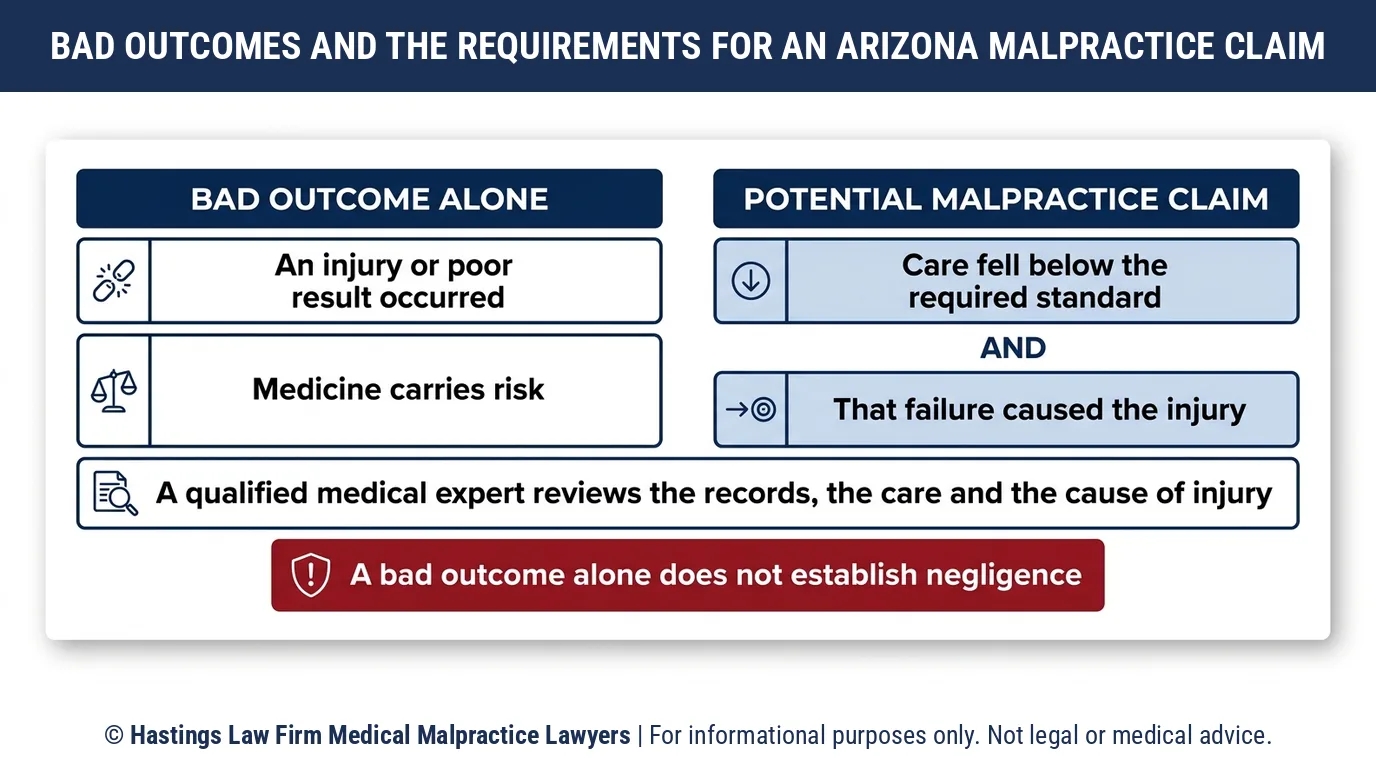
Before a medical negligence lawsuit is filed in Arizona, the patient’s medical records are gathered and a qualified medical expert reviews whether the care fell below the accepted standard and caused the injury. Under A.R.S. § 12-2604, an expert who testifies about the standard of care must generally practice or teach in the same specialty as the provider whose care is in question.
Arizona sets firm limits on who can serve as that expert. The expert must be licensed, must share the provider’s board certification if the provider has one, and must have spent most of the year before the care practicing or teaching in that specialty. Nor can the expert be paid on a contingent fee, meaning a fee that depends on the outcome of the case.
Arizona law does not require the review to be finished before filing, but the complaint must be accompanied by a written certification of whether expert testimony is needed. When it is needed, the expert’s sworn opinion, called the preliminary expert opinion affidavit, follows early in the case. The same review can show that a bad outcome was not negligence, because medicine carries risk.
The review starts with the records. A patient, or the patient’s health care decision maker, can request medical records in writing under A.R.S. § 12-2293. For a request made for a legal claim, the provider has 30 calendar days to respond, and reasonable copy charges may apply.
The evidence also goes beyond the chart, to the bills and to what the patient and family remember. A written timeline of the symptoms, the visits, and the providers seen ties those memories to dates, and the expert reads the records against it.
That evidence is measured against the two things A.R.S. § 12-563 requires a patient to prove. The first is that the provider failed to use the care, skill, and learning expected of a reasonable, prudent provider in the same profession in Arizona, under the same or similar circumstances. The second is that this failure caused the injury.
How is a Medical Malpractice Complaint Filed and Served in Arizona?
A medical malpractice complaint in Arizona is filed in the superior court of a county Arizona law allows, along with the written certification of whether expert testimony is needed. Under A.R.S. § 12-566 and Rule 4 of the Arizona Rules of Civil Procedure, the complaint states no dollar amount of damages, and each defendant generally must be served with it within 90 days.
The right county depends on where the defendants live, and when they live in different counties, the case can be filed in any one of them. A corporation, such as a company that runs a hospital, can also be sued where the claim arose or where it does business, so the case does not always belong in the patient’s home county.
Those defendants are the providers and facilities whose care is at issue, and the complaint names each one. An Arizona hospital is itself a licensed health care provider, and it can be held responsible for the negligence of staff it employs when they act within the scope of their jobs. It can sometimes be liable for a physician it does not employ, when the hospital’s own conduct led the patient to reasonably believe that physician was its employee or agent. Both rules often matter in a claim against an Arizona hospital.
Each defendant is then served with the complaint and a summons, the court’s formal notice of the lawsuit. If a defendant is not served within 90 days, the court can dismiss the case against that defendant or set a new deadline, and it must allow more time when there is good cause for the delay.
Once served in Arizona, a defendant generally has 20 days to file a written answer or other response. Waiving service, certain service outside Arizona, or a motion under Rule 12 can change that deadline.
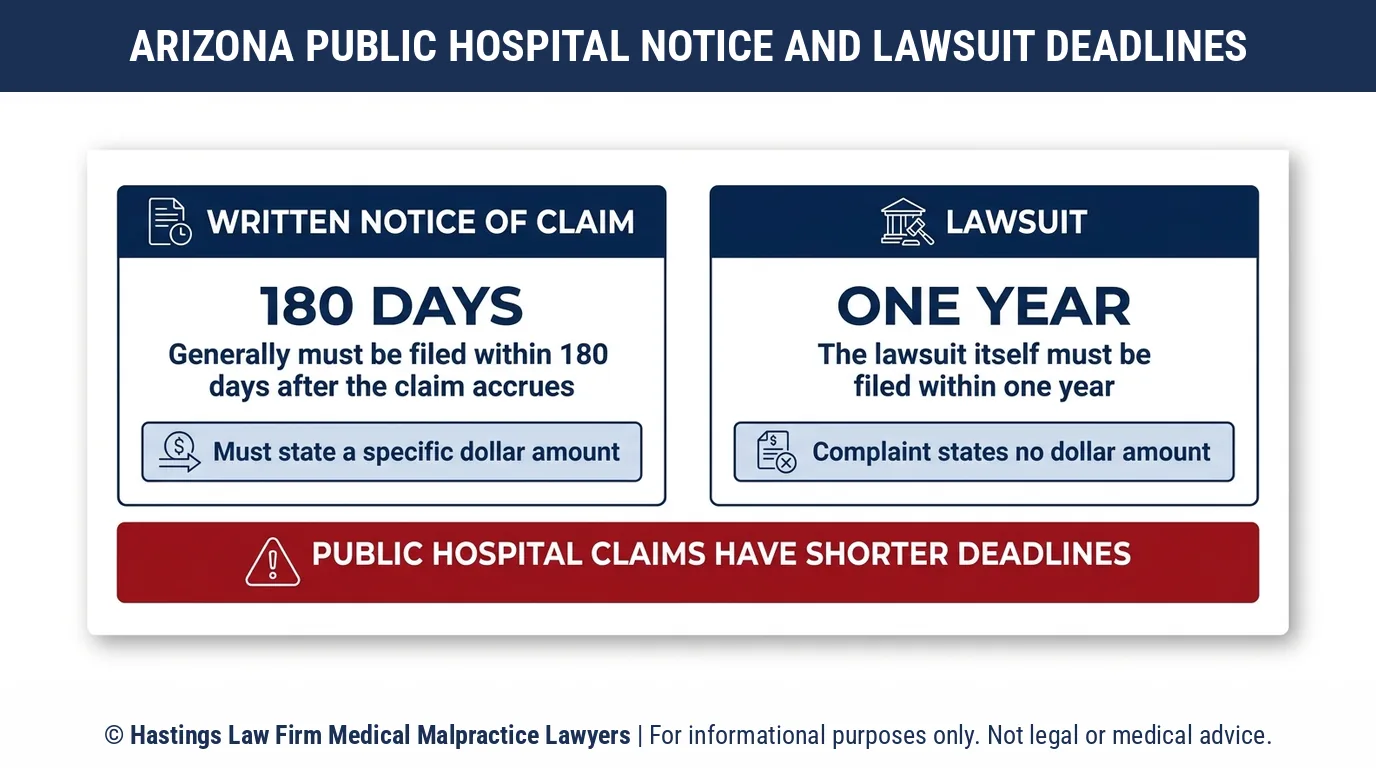
A claim against a public hospital has shorter deadlines. A written notice of claim generally must be filed within 180 days after the claim accrues, and unlike the complaint, that notice must state a specific dollar amount. The lawsuit itself must be filed within one year.
When the patient has died, the two-year deadline generally runs from the date of death. The surviving spouse, a child, a parent, a guardian, or the personal representative of the estate can bring that medical malpractice wrongful death claim.
How Do the Expert Affidavit and Discovery Work in an Arizona Medical Negligence Lawsuit?
After an Arizona medical negligence lawsuit is filed, the patient’s side serves the preliminary expert opinion affidavit with its initial disclosures, and both sides exchange evidence in discovery within the limits of Rule 26.2 of the Arizona Rules of Civil Procedure. The initial disclosures, the opening exchange of case information, are generally due 30 days after the first answer or other response is filed.
The affidavit states the expert’s qualifications, the facts, what fell below the standard of care, and how that failure caused the harm. Without it, the claim can be dismissed without prejudice, which means the court has not decided whether the care was negligent. When an affidavit is challenged as insufficient, the court generally allows a reasonable time to fix it. Later in discovery, retained experts generally give detailed, signed reports that go well beyond the affidavit.
In Tier 3, where medical malpractice cases generally belong, each side as a whole gets 30 hours of fact-witness depositions, 20 interrogatories, 10 requests for production of documents, and 20 requests for admission. Discovery must be finished within 240 days of the Early Meeting, a meeting the parties are required to hold, and the court can allow changes to any of these limits.
A deposition is questioning under oath, and the parties, the disclosed experts, and the treating physicians can all be deposed. Interrogatories are written questions sent to another party and generally answered in writing under oath. For the patient and family, discovery often includes giving depositions of their own.
How Do Settlement Talks and Mediation Work in an Arizona Medical Injury Case?
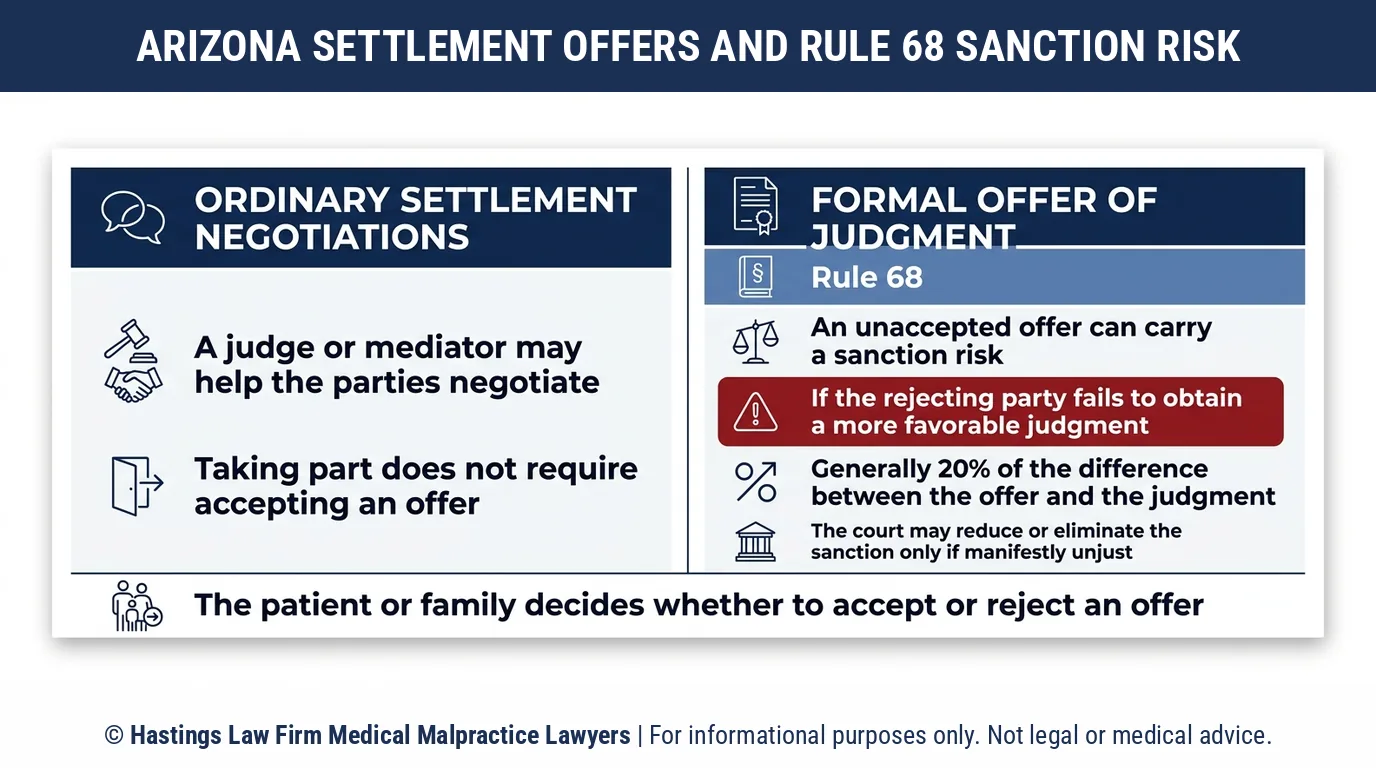
In an Arizona medical malpractice case, the court’s schedule generally includes a settlement conference or private mediation, where a judge or mediator helps both sides negotiate. Under Rule 16 of the Arizona Rules of Civil Procedure, the deadline for that session falls no more than 15 months after the case begins and no later than 60 days after discovery closes, unless the court orders otherwise for good cause.
A trial date generally is not set until that session has happened or is scheduled. When the court orders a settlement conference under Rule 16.1, the parties, their lawyers, and a representative with actual authority to settle must attend unless the court excuses them. Taking part never means having to accept an offer.
A formal offer of judgment under Rule 68 carries more weight than an ordinary offer. A party that lets one go unaccepted and then fails to get a more favorable judgment generally pays a penalty, called a sanction, of 20% of the difference between the offer and the judgment. The court can reduce or eliminate that sanction only if it would be manifestly unjust, meaning clearly unfair.
A case can settle before the lawsuit is filed or while it is still pending. Whether a case settles often depends on how strong the expert evidence is on each side.
Weighing any offer means comparing it with what the evidence supports, the cost of future care, and, for a formal one, the Rule 68 risk. The decision to accept or reject it belongs to the patient or the family.
What Happens at Trial and After the Verdict in an Arizona Medical Negligence Lawsuit?
A medical malpractice case in Arizona that does not settle is generally tried to a jury of eight in superior court, and under A.R.S. § 21-102, six of the eight must agree on the verdict unless the parties consent otherwise. Arizona’s civil rules preserve the right to a jury trial without any written demand.
Those jurors hear from medical experts for each side on the standard of care and on whether the care caused the injury. The treating providers often testify as well, and the patient and family describe the harm and what it has cost them.
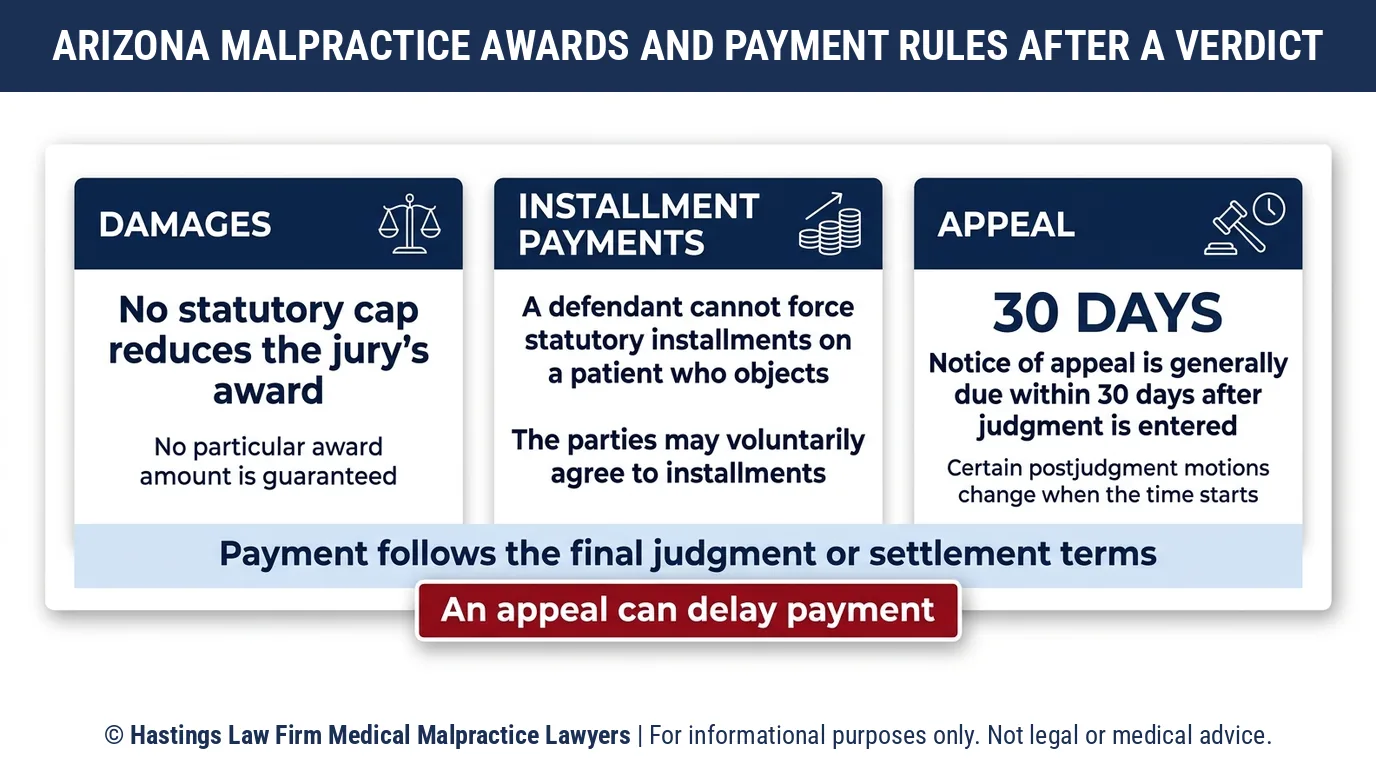
After the jury reaches its verdict, the court enters judgment, and no statutory cap cuts the amount the jury awards. Arizona’s Constitution bars any law that limits the damages recoverable for injury or death, although it does not guarantee any particular amount.
The same constitutional provision shapes how the award is paid. Arizona still publishes statutes on paying future damages in installments, but in Smith v. Myers the Arizona Supreme Court held that statutory scheme unconstitutional, so a defendant cannot use it to force installments on a patient who objects. The parties can still agree to installments voluntarily in a structured settlement.
Either side that disagrees with the outcome can appeal the final judgment to the Arizona Court of Appeals. Under Rule 9 of the Arizona Rules of Civil Appellate Procedure, the notice of appeal is generally due within 30 days after the judgment is entered, and certain motions filed after judgment change when that time starts. Payment follows the final judgment or the terms of a settlement agreement, and an appeal can delay it.
The Hastings Law Firm Difference
Results matter, but what truly sets us apart is how we achieve them. Every verdict, every settlement, and every courtroom victory comes from one guiding promise: To treat each client’s fight for justice as if it were our own.
This balance of skill, experience, and empathy reflects our core philosophy that justice should not only compensate the injured, but also make health care safer nationwide.

What Should You Do First if You Want to Sue for Medical Malpractice in Arizona?
The first steps to file a medical malpractice lawsuit in Arizona are to write down what happened while it is fresh, ask for copies of the medical records, keep getting the care you need, and talk with a lawyer who handles medical negligence cases well before the filing deadline. The notes should include what each provider told you, along with the dates, the names, and the symptoms.
Continuing your care matters for your health first, and it also builds a record of the harm. Keep a copy or a note of the bills, the time missed from work, and any added care at home, because they belong in that record too.
Talking with a lawyer early matters because so much happens before anything is filed. A records request made for a legal claim can take up to 30 calendar days, the expert certification has to go in with the complaint, and a claim against a public hospital generally needs its written notice within 180 days after the claim accrues. Each of those steps uses time the filing deadline does not give back.
Arizona allows a patient to file without a lawyer and represent themselves in their own lawsuit. The court then holds that patient to the same standards as a lawyer, so the expert certification, any required affidavit from an expert qualified under Arizona law, the usual 90-day service deadline, and the case’s Tier 3 discovery limits all still apply.
Every case carries costs. The superior court filing fee alone runs in the hundreds of dollars under A.R.S. § 12-284, and because that fee can change, the clerk in the county where the case is filed has the current total. Expert review, depositions, and expert reports add more as the case is built.
Talk to an Arizona Medical Malpractice Attorney About Your Case
Working with Hastings Law Firm begins with a conversation. A member of our intake team listens to what you experienced and asks about the care, when it happened, and who provided it. We request the medical records at no cost to you, our attorneys and medical professionals study them, and once that work is complete, we give you an honest answer about whether you have a claim.
Our Arizona medical malpractice lawyers are experienced in handling medical negligence lawsuits throughout the state. We understand what that process asks of a family, from gathering the records and waiting on the medical experts to the months of discovery before a case resolves.
We advance the cost of the experts and everything else the case requires, and we work on a contingency fee, so there is no fee unless we win. Hastings Law Firm has been dedicated exclusively to medical malpractice since 2005. If you believe something went wrong in your care or a loved one’s, contact us for a free, confidential case review. Our team is here for you.
Sources
- A.R.S. § 12-2603 on the expert certification and preliminary expert opinion affidavit | Arizona State Legislature
- A.R.S. § 12-542 setting the two-year deadline for medical malpractice actions | Arizona State Legislature
- A.R.S. § 12-2604 on the qualifications of a standard-of-care expert witness | Arizona State Legislature
- A.R.S. § 12-2293 on patient requests for medical records and response times | Arizona State Legislature
- A.R.S. § 12-2295 on charges for copies of medical records | Arizona State Legislature
- A.R.S. § 12-563 listing what a medical malpractice claim must prove | Arizona State Legislature
- A.R.S. § 12-566 barring a dollar amount in a medical malpractice complaint | Arizona State Legislature
- A.R.S. § 12-401 on which county a lawsuit may be filed in | Arizona State Legislature
- Arizona Rule of Civil Procedure 4 on the 90-day limit for serving the summons | Arizona Court Rules on Westlaw
- Arizona Rule of Civil Procedure 12 on the defendant’s 20 days to answer | Arizona Court Rules on Westlaw
- Arizona Rule of Civil Procedure 26.1 on initial disclosures and expert reports | Arizona Court Rules on Westlaw
- Arizona Rule of Civil Procedure 26.2 placing malpractice cases in Tier 3 | Arizona Court Rules on Westlaw
- Arizona Rule of Civil Procedure 30 on who may be deposed, including treating physicians | Arizona Court Rules on Westlaw
- Arizona Rule of Civil Procedure 33 on written interrogatories answered under oath | Arizona Court Rules on Westlaw
- Arizona Rule of Civil Procedure 16 on scheduling and the mediation deadline | Arizona Court Rules on Westlaw
- Arizona Rule of Civil Procedure 16.1 on attendance at court settlement conferences | Arizona Court Rules on Westlaw
- Arizona Rule of Civil Procedure 68 on the offer of judgment and its sanction | Arizona Court Rules on Westlaw
- A.R.S. § 21-102 setting an eight-person civil jury with six agreeing | Arizona State Legislature
- Arizona Rule of Civil Procedure 38 preserving the jury right without a written demand | Arizona Court Rules on Westlaw
- A.R.S. § 12-582 on the election of periodic payments of future damages | Arizona State Legislature
- Smith v. Myers, the Arizona Supreme Court ruling against the periodic-payment scheme | Justia
- Arizona Constitution article 2, section 31 barring limits on injury damages | Arizona State Legislature
- Arizona Rule of Civil Appellate Procedure 9 on the 30-day notice of appeal | Arizona Court Rules on Westlaw
- A.R.S. § 12-2101 allowing appeals from final superior court judgments | Arizona State Legislature
- Arizona Judicial Branch Self-Service Center for people representing themselves in court | Arizona Judicial Branch
- A.R.S. § 12-284 listing superior court filing fees and permitted increases | Arizona State Legislature

This content was researched and written by the Hastings Law Firm editorial team, which includes attorneys, medical professionals, and experienced researchers. Our writing is informed by internal knowledge and practical experience, and we cross-check critical details against authoritative sources cited throughout. Every piece undergoes human-led fact-checking and legal review. Because legal and medical information can change, if you spot an error, please contact us. Learn more about our content standards and review process on our editorial policy page.

Tommy Hastings, founder of Hastings Law Firm, is a board-certified personal injury trial lawyer (by the Texas Board of Legal Specialization) dedicated exclusively to healthcare injury cases. Since 2001, he has represented injured patients and families in litigation against major hospital systems, pharmaceutical companies, and negligent healthcare providers nationwide. He has handled numerous high-profile cases that have drawn national media attention and resulted in multi-million dollar recoveries.
