


Phoenix Doctor Malpractice Lawyer
Physician negligence can leave patients and families facing pain, financial strain, and a loss of trust in medical care. Doctor malpractice claims often turn on whether the care fell below an accepted standard and whether that lapse caused real harm. Common concerns involve diagnostic mistakes, surgical errors, medication problems, and failures in informed consent, and responsibility may extend beyond an individual doctor to a hospital or medical group. If you or a loved one were harmed or worse due to doctor malpractice in Phoenix, Arizona, contact Hastings Law Firm for a free, confidential case review.

Last Updated: July 27, 2026
Trusted Legal Representation for Victims of Physician Negligence in Phoenix
When a doctor’s error causes serious harm, the experience can feel isolating. You may be dealing with unexpected medical costs, ongoing pain, and the unsettling realization that someone you trusted with your health made a preventable mistake. These feelings are valid, and you have every right to ask questions about what happened.
A Phoenix doctor malpractice lawyer at Hastings Law Firm, founded by board-certified trial attorney Tommy Hastings, can help you get those answers. Our firm focuses exclusively on medical malpractice, and our team includes experienced trial attorneys, former defense lawyers, and in-house medical professionals who know how to evaluate physician negligence claims from every angle.
If you believe a doctor’s mistake caused you or a loved one harm, we invite you to contact us for a free, confidential case evaluation. We can review what happened and explain your legal options with no obligation and no fee unless we recover compensation for you.

Defining Doctor Malpractice Under Arizona Law
Doctor malpractice occurs when a licensed health care provider fails to meet the accepted medical standard of care, resulting in injury or death to a patient. Not every bad medical outcome qualifies. The distinction under Arizona law centers on whether a preventable error, rather than an inherent risk of treatment, caused the harm.
Arizona defines the standard for these claims in A.R.S. § 12-563, which requires proof that:
The health care provider failed to exercise that degree of care, skill and learning expected of a reasonable, prudent health care provider in the profession or class to which he belongs within the state acting in the same or similar circumstances, and that such failure was a proximate cause of the injury.
In practical terms, this means that Phoenix doctor malpractice lawyers must show the doctor did something, or failed to do something, that a competent physician in the same specialty would not have done under similar circumstances. A complication that arises despite proper care is not medical negligence. But a missed test, an ignored symptom, or a surgical error that a careful doctor would have avoided can be.
Many people hesitate to question a physician’s judgment. This reaction, the “White Coat Effect,” is the natural tendency to defer to a doctor’s authority simply because of their credentials. While understandable, it should not stop you from seeking answers when something clearly went wrong. You also have a right to informed consent, the requirement that your doctor explain the risks, alternatives, and expected outcomes of a procedure before you agreed to it.
If those steps were skipped, or if the care you received fell below an acceptable standard, the law provides a path to hold the responsible provider accountable.
Common Errors Committed by Physicians in Phoenix
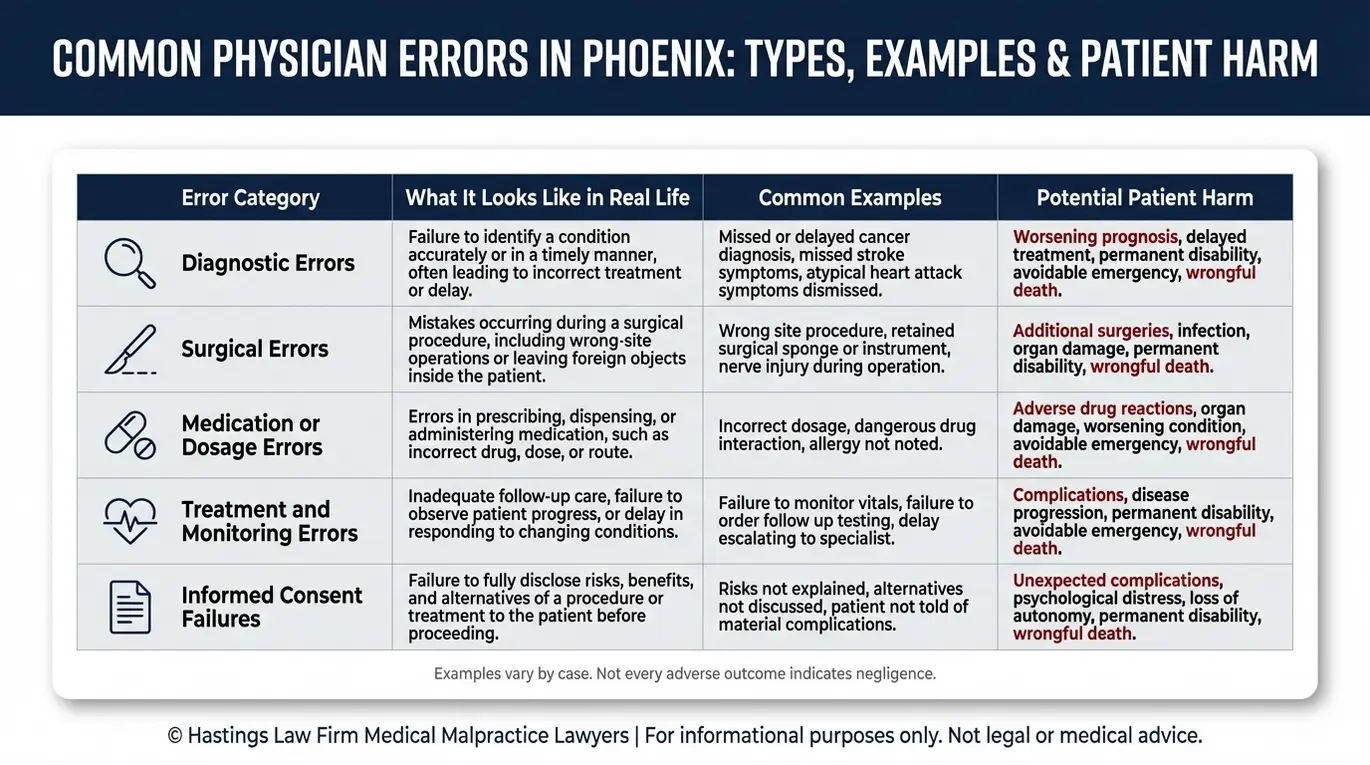
Common physician errors include surgical mistakes, misdiagnosis of critical conditions, medication errors, and failure to obtain informed consent. While every case is different, certain types of mistakes appear repeatedly in malpractice claims across the Phoenix area. Understanding these patterns can help you recognize whether what happened to you or your loved one may warrant a closer look from a doctor malpractice lawyer in Phoenix.
The National Center for Biotechnology Information (NCBI) identifies medical errors as a leading concern in patient safety, with diagnostic and treatment failures among the most frequently documented categories.
In Arizona medical malpractice litigation, Diagnostic errors are among the most common and most dangerous. A misdiagnosis occurs when a doctor identifies the wrong condition, while a failure to diagnose means they miss the condition entirely. A delayed diagnosis, where the correct diagnosis comes too late for effective treatment, can be equally devastating. These errors are particularly harmful in time-sensitive conditions like cancer, stroke, and heart attack.
In many Phoenix surgical malpractice claims, Surgical errors include wrong-site surgery, a procedure performed on the incorrect body part, and retained surgical items (RSIs), instruments, sponges, or other materials accidentally left inside a patient after an operation. Anesthesia errors, such as incorrect dosing or failure to review a patient’s medication history, also fall into this category.
In Phoenix, Treatment and medication errors range from prescribing the wrong drug or dosage to failing to monitor a patient’s response to a medication. Birth injuries caused by delayed interventions or improper use of delivery instruments represent another serious area of concern.
| Type of Error | Example Scenario |
|---|---|
| Misdiagnosis / Failure to Diagnose | A patient presenting with stroke symptoms is diagnosed with a migraine and sent home |
| Surgical Error (Wrong-Site) | A surgeon operates on the left knee instead of the right |
| Retained Surgical Item | A sponge is left in the abdominal cavity after surgery |
| Anesthesia Error | An anesthesiologist fails to account for a known drug allergy |
| Medication / Prescription Error | A physician prescribes a dangerously high dosage of a blood thinner |
| Birth Injury | Delayed C-section leads to oxygen deprivation and neurological harm |
| Failure to Obtain Informed Consent | A surgeon does not disclose known risks before a high-risk procedure |
The Hastings Law Firm Difference
Results matter, but what truly sets us apart is how we achieve them. Every verdict, every settlement, and every Phoenix courtroom victory comes from one guiding promise: To treat each client’s fight for justice as if it were our own.
This balance of skill, experience, and empathy reflects our core philosophy that justice should not only compensate the injured, but also make health care safer nationwide.

Proving Physician Negligence: The Four Legal Elements
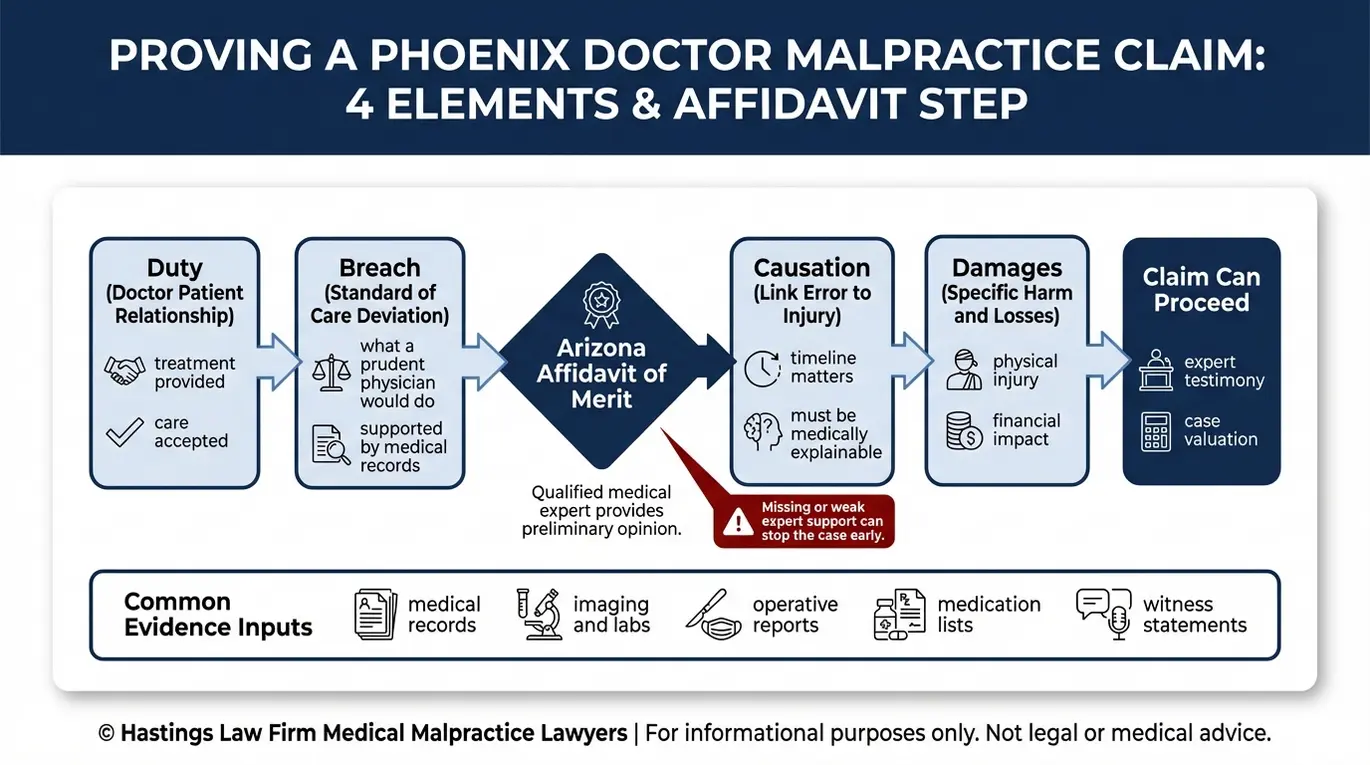
To succeed in a malpractice claim, a patient must prove four elements: a doctor-patient relationship existed, the doctor breached the duty of care, the breach caused the injury, and specific damages resulted. Each element builds on the one before it, and failing to establish any one of them can prevent recovery. Working with experienced doctor malpractice lawyers helps ensure these elements are properly documented.
According to the State Bar of Arizona’s Medical Negligence guidelines, these four elements form the foundation of every medical malpractice case in Arizona.
- Duty of Care (Doctor-Patient Relationship): The first step is showing that a formal doctor-patient relationship existed. This is typically established when a physician agrees to evaluate, diagnose, or treat a patient. Once that relationship exists, the doctor owes a legal duty to provide care that meets the accepted standard.
- Breach of Duty: The next step is demonstrating that the physician deviated from what a reasonably competent doctor in the same specialty would have done. This might involve misdiagnosis, the incorrect identification of a condition, or delayed diagnosis, the failure to identify a condition in a timely manner. This requires a detailed review of medical records and, in most cases, testimony from a qualified expert witness.
- Causation: This is often a difficult element to prove. It is not enough to show the doctor made an error. A Phoenix doctor malpractice attorney must establish a direct link between the physician’s mistake and the patient’s injury. If the injury would have occurred regardless of the error, the causation element may not be met.
- Damages: Finally, there must be proof of actual harm. This includes physical injury, financial losses, emotional distress, or a combination. Documentation such as medical bills, employment records, and expert assessments help quantify these losses.
When a claim involves a public hospital or government-employed physician, additional procedural steps may apply under A.R.S. § 12-821.01, including specific notice requirements that must be met before filing suit.
Arizona’s Preliminary Expert Opinion Affidavit Requirement
Arizona law imposes an additional procedural step in medical malpractice cases. Under A.R.S. § 12-2602, when expert testimony is required, the patient must serve a preliminary expert opinion affidavit from a qualified medical professional with their initial disclosures after the lawsuit is filed. This affidavit certifies that the claim has a legitimate basis.
This requirement exists as a screening tool for the Arizona court system. At Hastings Law Firm, our in-house medical staff, including nurse practitioners, allow us to evaluate the medical facts quickly and secure the necessary expert witness support. This preparation begins on day one of every case we accept.
Liability Beyond the Doctor: Hospitals and Practice Groups
Liability often extends beyond the individual physician to include hospitals, medical groups, or urgent care centers under theories of vicarious liability or negligent credentialing. Identifying every responsible party is a critical part of building a strong claim, and a malpractice lawyer for doctors can help determine where the accountability lies.
In Arizona medical malpractice litigation, the distinction often depends on the physician’s employment status. A doctor who is a direct employee of a hospital typically creates liability for the hospital itself. If the doctor is an independent contractor, the hospital may argue it is not responsible for that physician’s errors. However, this defense does not always hold up. If the hospital presented the doctor as part of its own staff, or if the patient had no reason to know the doctor was an independent contractor, vicarious liability may still apply.
Hospitals and medical groups can also face claims for their own institutional failures, including:
- Negligent credentialing and privileging, the hospital’s failure to verify a physician’s qualifications, training, and disciplinary history before granting them the authority to treat patients
- Inadequate staffing, leading to nurses or support staff being stretched beyond safe limits
- Failure to enforce safety protocols, such as surgical checklists or medication verification procedures
- Anesthesia errors, mistakes regarding sedation dosage or monitoring made by hospital-employed anesthesiologists, including improper dosing or failure to monitor a patient during and after surgery
Determining if your claim involves a single physician, a hospital system, or both can significantly affect the scope of recoverable compensation. Our team reviews admission paperwork, staffing records, and contractual relationships to identify every party that may bear responsibility.
Recoverable Damages in Doctor Negligence Claims
Patients harmed by medical negligence can recover economic damages for medical bills and lost wages, as well as non-economic damages for pain, suffering, and loss of quality of life. The specific value of a claim depends on the severity of the injury, the cost of ongoing care, and the degree to which the error has changed the patient’s daily life.
Phoenix doctor malpractice attorneys at Hastings Law Firm pursue every category of compensation the law allows.
In Phoenix medical malpractice cases, Economic damages cover the measurable financial losses caused by the physician’s negligence:
| Category | Examples |
|---|---|
| Past Medical Expenses | Hospital bills, surgeries, medications, rehabilitation |
| Future Medical Care | Projected treatments, assistive devices, long-term therapy |
| Lost Wages | Income lost during recovery |
| Lost Earning Capacity | Reduced ability to earn income in the future |
| Out-of-Pocket Costs | Travel for medical care, home modifications |
Non-economic damages address the personal toll of the injury. These losses are harder to quantify but no less real. They include physical pain and suffering, emotional distress, loss of enjoyment of activities, and the damage to your sense of trust and safety. For many of our clients, the feeling of betrayal by someone they trusted with their health is one of the most difficult parts of the experience.
Wrongful death damages are available to families who lost a loved one due to medical negligence. These claims may include compensation for funeral and burial costs, loss of the deceased’s expected income, and the profound loss of companionship and guidance.
Arizona Statute of Limitations for Doctor Malpractice
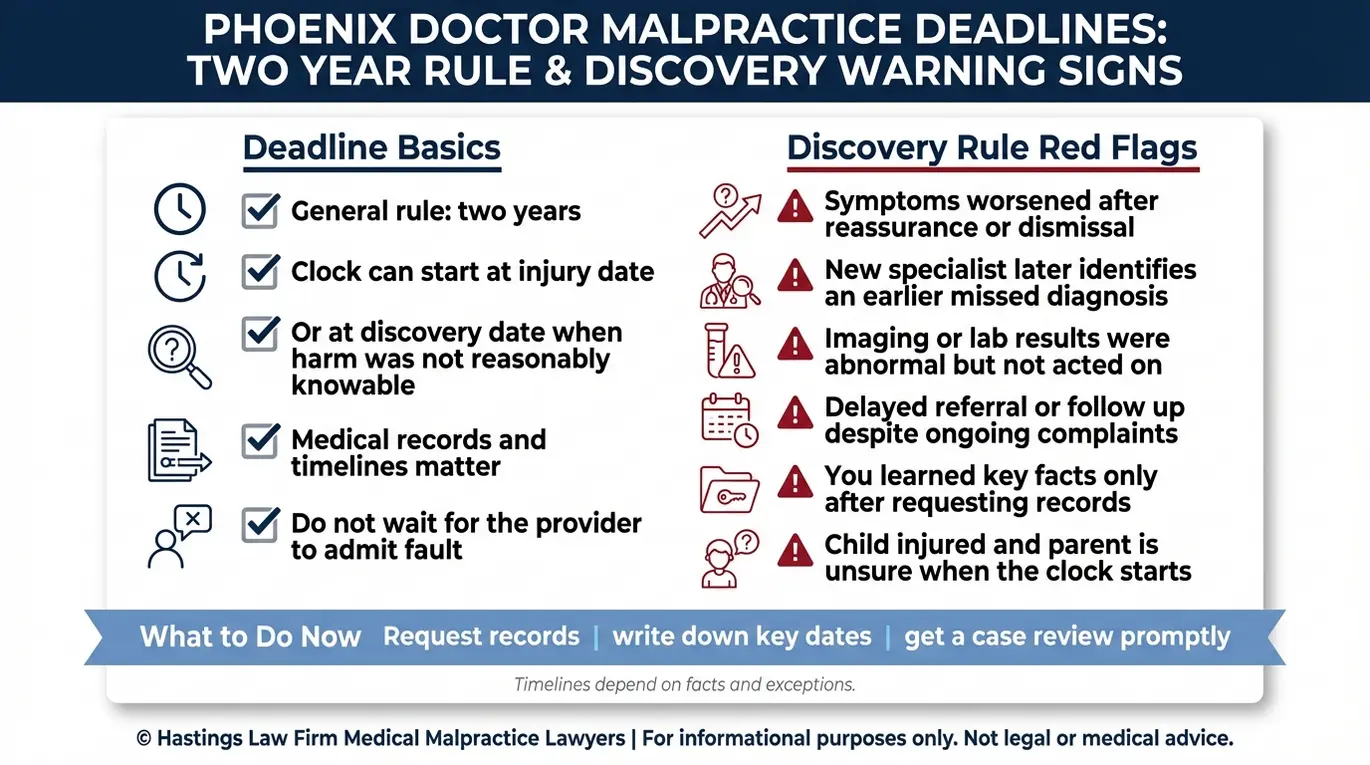
In Arizona, the standard statute of limitations for medical malpractice is two years from the date the injury occurred or was discovered. Missing this deadline typically means losing the right to file a claim entirely, regardless of how strong the evidence may be. Consulting with a Phoenix doctor malpractice legal team early gives you the best chance of preserving your rights.
The two-year filing deadline is established under A.R.S. § 12-542.
The Discovery Rule: In some situations, a patient may not immediately realize they were harmed by medical negligence. For example, a misdiagnosis may not become apparent until the condition has progressed significantly. Arizona’s discovery rule allows the statute of limitations to begin running from the date the patient knew, or reasonably should have known, that the injury was caused by negligent care rather than from the date of the original treatment.
There are also exceptions for minors. Children injured by pediatric malpractice may have additional time to file, as the statute of limitations can be tolled, or paused, until the child reaches a certain age.
Because these deadlines are strict and the exceptions are narrow, early legal consultation is important. The sooner you reach out, the sooner we can begin preserving medical records and securing expert opinions before critical evidence becomes harder to obtain.
How Comparative Negligence Affects Your Claim Against a Doctor
Arizona follows a pure comparative negligence rule, meaning a patient’s compensation is reduced by their percentage of fault, but they are rarely barred from recovery completely. This legal standard applies because the defense in a malpractice case may try to shift some of the blame onto the patient.
For example, a defense attorney might argue that a patient failed to follow post-operative instructions, missed follow-up appointments, or did not disclose relevant medical history. If the jury agrees that the patient bears some responsibility, the award is reduced proportionally.
Here is how the math works: if a jury awards $100,000 in damages but determines the patient was 20% at fault, the final recovery would be $80,000.
Arizona’s pure comparative negligence system means even a patient found to be 90% responsible could still recover 10% of the awarded damages. Unlike some states that bar recovery if the patient is more than 50% at fault, Arizona law allows for partial recovery regardless of the fault split. As your Phoenix doctor malpractice counsel, we build the strongest possible case for causation and breach to minimize any fault allocation to you.
Contact the Phoenix Doctor Malpractice Attorneys at Hastings Law Firm Today for Help
Medical errors are preventable, and when they happen, patients and families deserve honest answers about what went wrong. If you believe a doctor’s negligence caused serious harm to you or someone you love, you do not have to face the hospital’s legal team alone.
Hastings Law Firm focuses exclusively on medical malpractice. Our team includes former defense attorneys who understand how the other side builds its case, in-house medical professionals who can analyze your records, and a national network of expert witnesses ready to support your claim. Every case we accept is prepared from day one as though it will go to trial.
Your consultation is free, confidential, and carries no obligation. As your Phoenix doctor malpractice lawyer, we charge no contingency fee or costs unless we secure compensation for you. Contact us today to take the first step toward restoring trust and protecting your future.
Frequently Asked Questions About Doctor Malpractice in Phoenix


This content was researched and written by the Hastings Law Firm editorial team, which includes attorneys, medical professionals, and experienced researchers. Our writing is informed by internal knowledge and practical experience, and we cross-check critical details against authoritative sources cited throughout. Every piece undergoes human-led fact-checking and legal review. Because legal and medical information can change, if you spot an error, please contact us. Learn more about our content standards and review process on our editorial policy page.

Tommy Hastings, founder of Hastings Law Firm, is a board-certified personal injury trial lawyer dedicated exclusively to healthcare injury cases. Since 2001, he has represented injured patients and families in litigation against major hospital systems, pharmaceutical companies, and negligent healthcare providers nationwide. He has handled numerous high-profile cases that have drawn national media attention and resulted in multi-million dollar recoveries. He draws on that experience in his writing, helping readers understand how these cases work and what options may be available to them.
