


Phoenix Failure To Diagnose Lawyer
A missed, wrong, or delayed diagnosis can leave a serious condition untreated while symptoms worsen and options narrow. People often face more invasive care, longer recovery, lasting disability, or fatal outcomes when warning signs are overlooked or test results are misread. These cases often turn on whether the standard of care was followed and whether the delay changed the likely outcome. Understanding how diagnostic errors happen and who may be responsible can help families make informed decisions after preventable harm. If you or a loved one were harmed or worse due to failure to diagnose in Phoenix, Arizona, contact Hastings Law Firm for a free, confidential case review.

Last Updated: July 27, 2026
Trusted Legal Representation for Diagnosis Failures in Phoenix
When a doctor misses a diagnosis, the consequences can change the course of your life or the life of someone you love. You may be dealing with a condition that has progressed beyond what it should have, facing treatments that might not have been necessary, or searching for answers about what went wrong. These situations carry real weight, and you deserve to know whether a medical professional’s failure caused you harm.
A Phoenix failure to diagnose lawyer at Hastings Law Firm can help you understand what happened and whether you have a legal claim. Our team of attorneys, nurse consultants, and medical experts focuses exclusively on medical malpractice. The firm was founded by Tommy Hastings, a board-certified trial lawyer who has spent over twenty years advocating for families in complex negligence cases. We invite you to contact us for a free, confidential case evaluation to review your situation and explain your options.

Failure to Diagnose vs. Misdiagnosis: Understanding the Difference
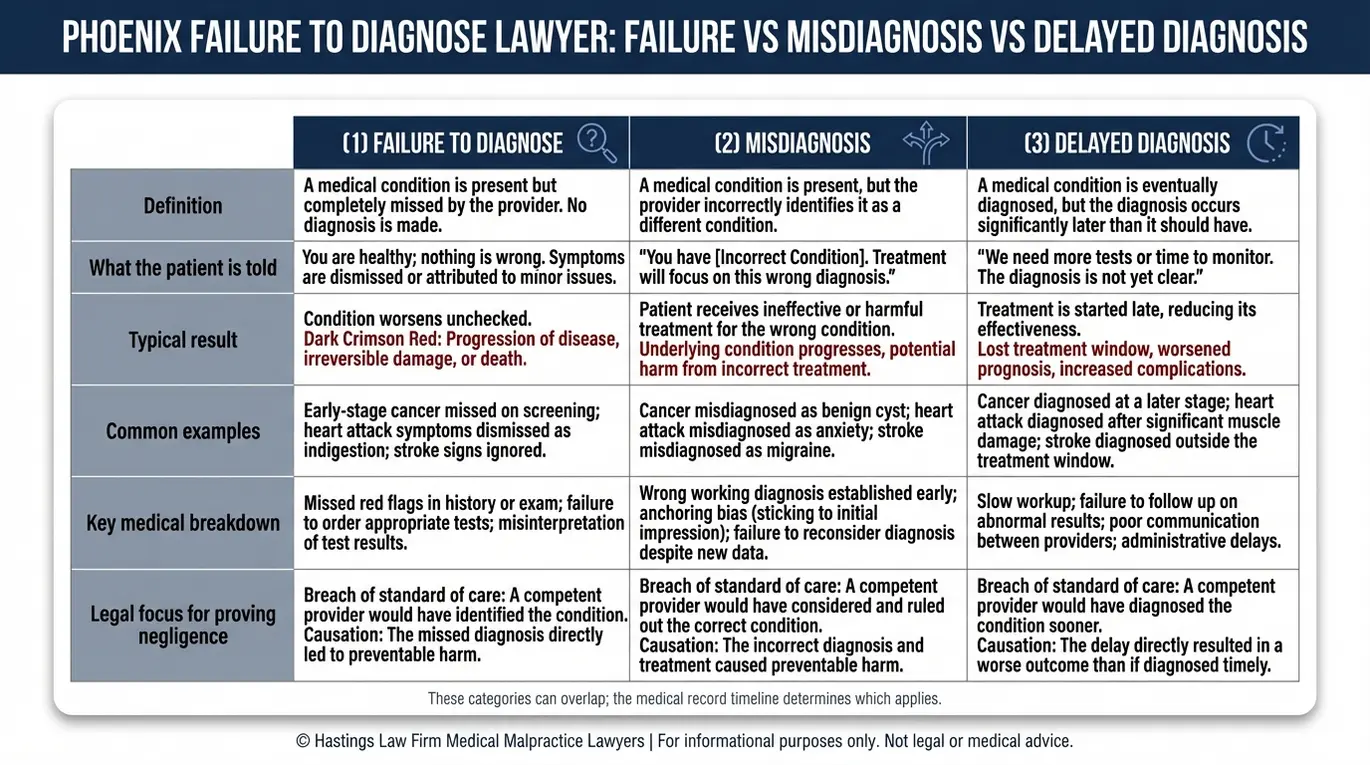
Failure to diagnose occurs when a doctor misses a condition entirely, often declaring the patient healthy, while misdiagnosis involves identifying the wrong condition and administering incorrect treatment. Diagnostic errors happen when a medical provider fails to identify an illness correctly, preventing the patient from receiving necessary care. A failure to diagnose lawyer in Phoenix will frame your claim based on the specific type of diagnostic error that occurred.
Failure to diagnose, a medical error where a physician evaluates a patient and concludes that nothing is wrong, means the condition went completely undetected. The patient left the appointment believing they were healthy, while the disease or injury continued unchecked, often losing critical time for effective intervention. This complete lack of identification distinguishes it from other errors where a condition is acknowledged but misunderstood.
Misdiagnosis is different. Here, the doctor did identify a problem but got it wrong. Examples include a cardiac event labeled as acid reflux or a malignant tumor described as a benign cyst. The patient receives treatment, but for the wrong condition, while the actual illness advances.
Delayed diagnosis, a closely related category where a physician eventually reaches the correct diagnosis but only after a significant and harmful period has passed, implies that the correct answer was reachable sooner. In these cases, the standard of care, the accepted level of treatment a reasonably competent professional would provide under similar circumstances, was not followed, resulting in a gap between symptom onset and treatment.
Under Arizona Revised Statutes § 12-563, a medical malpractice claim requires proof that the provider failed to meet the standard of care and that this failure caused injury. A Phoenix failure to diagnose attorney will determine which category your experience falls into to build the strongest possible claim. The table below clarifies the distinctions between these legal concepts.
| Failure to Diagnose | Misdiagnosis | Delayed Diagnosis | |
|---|---|---|---|
| What happened | Condition missed entirely | Wrong condition identified | Correct diagnosis made too late |
| Doctor’s conclusion | “Nothing is wrong” | “You have condition X” (incorrect) | Eventually correct, but after harmful delay |
| Patient impact | No treatment at all | Treatment for the wrong condition | Necessary treatment is postponed |
| Legal focus | Why the condition was not detected | Why the wrong conclusion was reached | Why the correct diagnosis took so long |
Commonly Misdiagnosed Conditions in Phoenix Hospitals
The most commonly misdiagnosed conditions include various forms of cancer, heart attacks often mistaken for indigestion, and strokes dismissed as migraines or fatigue. Preventable medical errors represent a major safety issue where a healthcare provider fails to identify an illness correctly. Research published by the National Academies of Sciences, Engineering, and Medicine in Improving Diagnosis in Health Care found that diagnostic errors affect an estimated 12 million Americans each year in outpatient settings alone.
The conditions most frequently missed or misidentified include:
- Cancer (breast, lung, and colon): Symptoms such as persistent lumps or unexplained weight loss may be attributed to less serious conditions. Oncology malpractice claims involve the failure to order cancer tests even when risk factors are present. When early detection is delayed, treatment options narrow significantly and survival rates drop. Patients may report symptoms repeatedly only to be dismissed by their providers.
- Heart attacks: Emergency room errors involving cardiac events are particularly dangerous. Women and younger patients are disproportionately affected, as their symptoms may be dismissed as anxiety or muscle pain rather than triggering a full cardiac workup. A missed heart attack can lead to permanent cardiac damage or death if the patient is sent home without intervention.
- Stroke: Failure to recognize neurological warning signs, including sudden numbness, confusion, or difficulty speaking, can result in devastating brain injury. The FAST protocol (Face drooping, Arm weakness, Speech difficulty, Time to call 911) exists because every minute of delay increases the risk of permanent disability. When emergency staff overlook these signs, the consequences can be irreversible.
- Infections (sepsis, meningitis): These conditions can escalate from manageable to life-threatening within hours. A false negative on a lab test can allow sepsis to reach critical stages before necessary treatments begin. Early symptoms are sometimes attributed to common viruses, causing a dangerous delay in care.
These diagnostic failures are preventable. Arizona law, outlined in Arizona Revised Statutes Title 12, provides a legal framework for patients harmed by these errors to pursue accountability.
The Hastings Law Firm Difference
Results matter, but what truly sets us apart is how we achieve them. Every verdict, every settlement, and every Phoenix courtroom victory comes from one guiding promise: To treat each client’s fight for justice as if it were our own.
This balance of skill, experience, and empathy reflects our core philosophy that justice should not only compensate the injured, but also make health care safer nationwide.

Proving Liability: How Doctors Fail the Differential Diagnosis
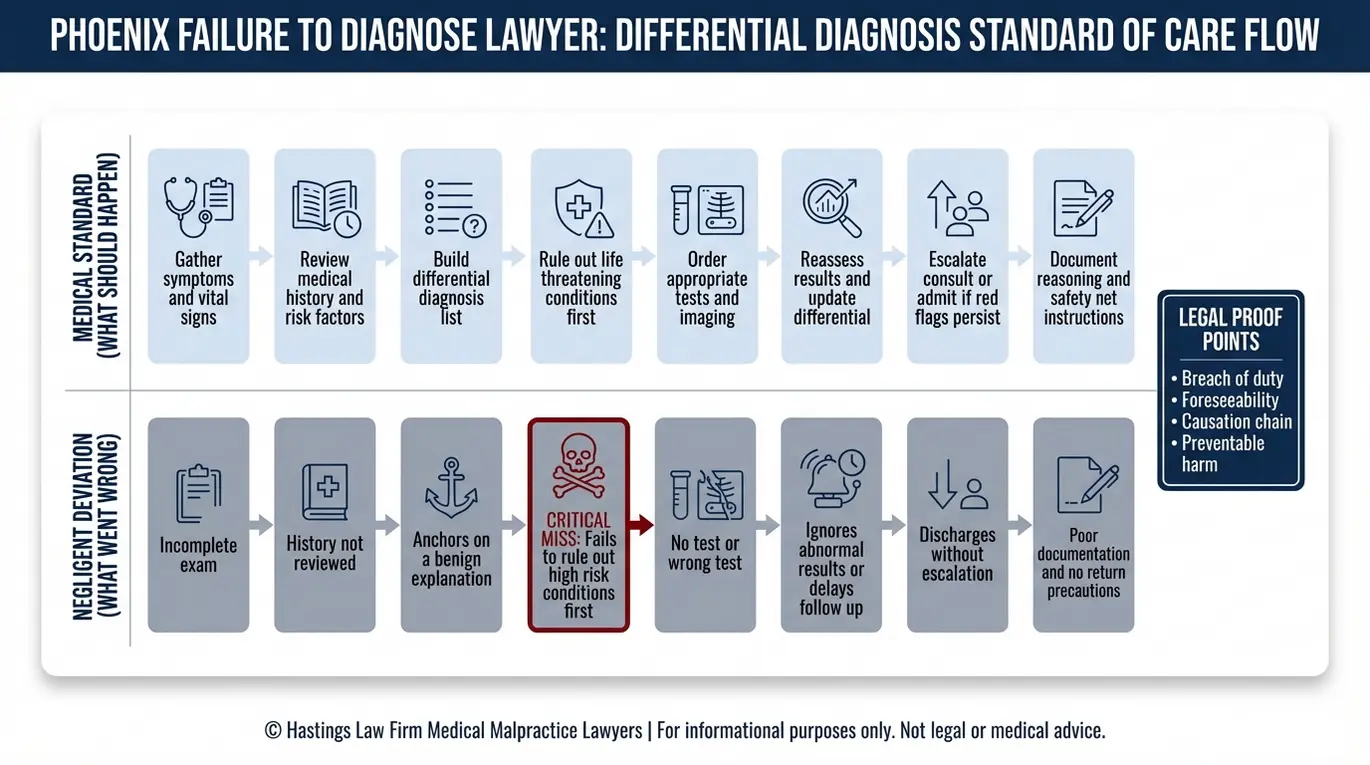
To prove liability, an attorney must demonstrate that the physician deviated from the differential diagnosis protocol, a systematic method used to rule out the most dangerous conditions first. Differential diagnosis is the step-by-step process a doctor uses to identify a patient’s condition and is the standard approach physicians are trained to follow. Phoenix failure to diagnose attorneys build cases by mapping what the doctor actually did against what this protocol required.
Differential diagnosis, the process of narrowing down potential illnesses, works like this:
- Gather information: The physician takes a complete medical history, listens to symptoms, and performs a physical examination. This foundation is essential for identifying potential risks.
- Create a list of possible conditions: Based on the information gathered, the doctor generates a ranked list of potential diagnoses, with the most serious and life-threatening conditions at the top. This list must be comprehensive enough to cover reasonable possibilities.
- Rule out life-threatening conditions first: This is the critical step of the rule-out process, a safety method ensuring the most dangerous potential causes are eliminated before minor ones are considered. The standard of care generally requires that physicians eliminate the most harmful possibilities before settling on a less serious explanation. Blood work, imaging, biopsies, and specialist referrals are common tools at this stage.
- Narrow the list based on results: As test results come back, conditions are eliminated or confirmed. The list shrinks until a working diagnosis is reached. Ignoring this reduction process is a primary cause of negligence claims.
- Diagnose and treat: The physician arrives at a diagnosis supported by the evidence and initiates the appropriate treatment plan.
The Core Elements of Hospital Diagnostic Excellence published by the CDC outlines the institutional safeguards hospitals should maintain to support accurate diagnosis. When a physician skips steps or settles on a benign explanation without first ruling out serious conditions, that gap can constitute a breach of duty. A lawyer for failure to diagnose will work with qualified medical experts to identify exactly where the process broke down.
Who is Liable? From Radiologists to HMOs
Liability can extend well beyond the primary physician. Liability refers to the legal responsibility of a provider or organization for a patient’s injury. Radiologists who misread scans, laboratories that mishandle biopsies, and HMOs that deny necessary diagnostic testing may all bear responsibility for a diagnostic failure.
Radiologists and pathologists are among the most commonly liable specialists in these cases. A radiology error, such as failing to identify a mass on an MRI or CT scan, can directly lead to a missed diagnosis. Radiologists are widely considered the safety net of diagnostics, but fatigue or speed can lead to oversight.
Similarly, when a pathology report, the detailed laboratory analysis of tissue samples, contains errors or misinterpretations of biopsy results, the treating physician may never receive the information needed to make the correct call. These specialists have an independent duty to interpret results accurately, and they can be held accountable when they fall short.
HMO liability and insurance organizations present a distinct form of liability. When an HMO’s administrative decision to deny a recommended test results in a delayed or missed diagnosis, the organization itself may be liable. This responsibility is separate from the physician’s duty. If a doctor requested a scan and the insurer refused it, the insurer’s role and the doctor’s response both become relevant.
Arizona immunity exceptions are also worth understanding. Certain state-funded healthcare providers and emergency scenarios carry specific immunity protections under Arizona law. These exceptions can limit or modify liability in cases involving government-employed physicians or treatment during declared emergencies. Our legal team evaluates whether any immunity provisions apply and how to address them within your claim.
The Role of Evidence: Using the National Practitioner Data Bank
Attorneys use reports from the National Practitioner Data Bank to identify patterns of negligence, previous sanctions, or a history of diagnostic errors by a specific physician. The National Practitioner Data Bank is a federal repository used to track professional conduct and malpractice history across the country. Our legal team includes former defense attorneys and experienced hospital nurses who understand the internal protocols healthcare systems use to handle diagnostic errors.
The foundation of any diagnostic failure case is a complete set of medical records. These records document what tests were ordered, what results were received, and what the physician communicated to the patient. Gaps or inconsistencies within these records often point to where the standard of care was not met, potentially hiding a false negative, a test result that incorrectly indicates a disease is absent.
Beyond the medical chart, the National Practitioner Data Bank (NPDB) collects reports on malpractice payments, adverse licensure actions, and professional sanctions against healthcare practitioners. Under limited circumstances defined by federal law, a plaintiff’s attorney may request NPDB information on a specific practitioner when a malpractice action has been filed against a hospital. This data can help establish that a provider had a known track record of substandard care.
Expert medical testimony ties this evidence together. Qualified specialists review the records and the clinical timeline to offer opinions on whether the standard of care was met and whether the diagnostic failure caused measurable harm. Our in-house medical staff, including nurse practitioners and patient advocates, assists in this review process from the earliest stages.
Damages: Compensation for Worsened Prognosis
Patients harmed by a diagnostic failure can recover damages for the difference between their probable outcome with early detection and their actual worsened prognosis, the medical term for the expected course and outcome of a disease. Damages represent the financial and personal compensation awarded to a patient for their losses and preventable harm caused by negligence.
Damages in failure to diagnose cases generally fall into three categories:
Economic damages cover the measurable financial losses directly tied to the diagnostic error:
- Additional medical bills for treatments or hospitalizations that became necessary because of the delay.
- Lost wages and lost earning capacity during extended treatment or permanent disability.
- Ongoing care costs, including rehabilitation, medication, and long-term medical support.
Non-economic damages address the human toll of the error, including doctrines like loss of chance:
- Physical pain and suffering caused by a disease that progressed beyond its early stages.
- Emotional distress and mental anguish from living with a worsened condition.
- Loss of enjoyment of life and shortened life expectancy tied to the delayed prognosis.
- Loss of consortium for spouses and family members.
Punitive damages may be available in cases involving egregious recklessness. These are not awarded in every case, but when a provider’s conduct goes beyond ordinary negligence, Arizona courts can impose additional damages meant to deter similar behavior. A failure to diagnose lawyer in Phoenix AZ will work with medical and economic experts to calculate the full scope of what the error cost you.
Arizona Statute of Limitations for Diagnostic Errors
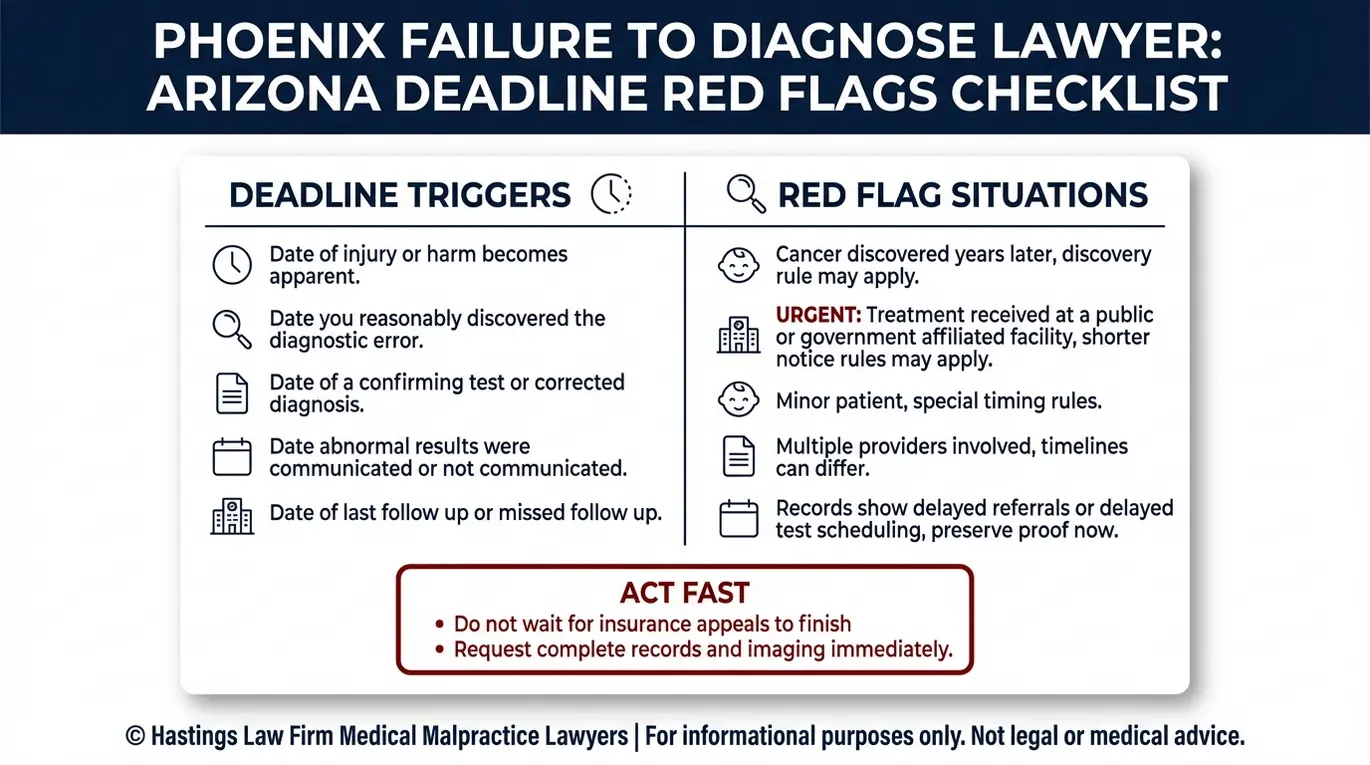
In Arizona, the statute of limitations is generally two years from the date the injury occurred or when it was reasonably discovered, but specific exceptions apply to minors and certain undiscovered errors. A statute of limitations is the strictly enforced legal time limit for filing a lawsuit in Arizona.
The discovery rule is particularly important in failure to diagnose cases. A patient whose cancer was missed in 2021 may not learn about the error until 2024, when the disease is finally detected at a later stage. In these situations, the two-year clock typically begins when the patient knew or should have known that the diagnostic failure occurred.
⚠ Critical Deadlines to Know:
- If your claim involves a government-funded hospital or a state-employed physician, the notice requirements are much shorter.
- Missing a strictly enforced legal deadline can permanently bar your claim, regardless of how strong the evidence may be.
- These shorter windows often require action within 180 days rather than the standard two years.
- A Phoenix failure to diagnose law firm can evaluate your timeline and confirm exactly how much time you have to act.
Contact the Phoenix Diagnosis Failure Attorneys at Hastings Law Firm Today for Help
If you suspect a doctor’s failure to diagnose caused you or a loved one serious harm, Hastings Law Firm is here to help you find answers. Our team reviews every case with the depth and focus that only a firm dedicated to medical malpractice can provide. We invite you to contact us for a free case evaluation to discuss your rights and review your potential claim.
We operate on a contingency fee basis, which means you pay no attorney fees or costs unless we secure a recovery for you. Our goal extends beyond financial compensation. We believe that holding negligent providers accountable is one of the most direct ways to prevent the same error from harming another patient.
Take the first step toward understanding what happened. Contact our Phoenix failure to diagnose lawyers to review your options and help you decide how to move forward.
Frequently Asked Questions About Failure To Diagnose in Phoenix


This content was researched and written by the Hastings Law Firm editorial team, which includes attorneys, medical professionals, and experienced researchers. Our writing is informed by internal knowledge and practical experience, and we cross-check critical details against authoritative sources cited throughout. Every piece undergoes human-led fact-checking and legal review. Because legal and medical information can change, if you spot an error, please contact us. Learn more about our content standards and review process on our editorial policy page.

Tommy Hastings, founder of Hastings Law Firm, is a board-certified personal injury trial lawyer dedicated exclusively to healthcare injury cases. Since 2001, he has represented injured patients and families in litigation against major hospital systems, pharmaceutical companies, and negligent healthcare providers nationwide. He has handled numerous high-profile cases that have drawn national media attention and resulted in multi-million dollar recoveries. He draws on that experience in his writing, helping readers understand how these cases work and what options may be available to them.
