


Phoenix C Section Malpractice Lawyer
Negligent C section care can turn a planned delivery into a traumatic experience for a mother, a baby, or both. The topic often involves whether the medical team recognized warning signs, acted quickly during an emergency, and performed surgery with appropriate skill and monitoring before and after delivery. When preventable errors occur, families may face lasting injuries, intensive treatment needs, and in the most severe situations fatal outcomes. If you or a loved one were harmed or worse due to C section malpractice in Phoenix, Arizona, contact Hastings Law Firm for a free, confidential case review.

Last Updated: July 27, 2026
Phoenix Medical Attorneys for Negligent C-Section Complications
When a C-section causes unexpected harm to you or your baby, the confusion and fear that follow can feel overwhelming. You trusted your medical team to protect you during one of the most vulnerable moments of your life. If that trust was broken by preventable errors, you deserve answers and a clear path forward.
As a Phoenix C Section Injury Lawyer team that focuses exclusively on medical malpractice, Hastings Law Firm understands both the medical and emotional weight of these cases. We are here to help you understand what happened, whether negligence played a role, and what your legal options may be. If you have questions about a C-section injury, contact us for a free, confidential case evaluation. There is no fee unless we recover compensation for you.

Why Choose Our Phoenix C Section Injury Lawyers
Hastings Law Firm offers a distinct advantage by employing former defense attorneys and in-house medical staff to scrutinize hospital records, ensuring that patients of C-section negligence receive the sophisticated legal representation required to win against large healthcare systems. Founded by Board-certified trial attorney Tommy Hastings in 2005, our firm has dedicated decades to representing those harmed by medical errors. Our team reviews records with the same eye that hospitals use to protect themselves. This insider perspective comes from our attorneys who previously defended hospitals and insurance carriers, allowing us to anticipate defense strategies and identify gaps in the medical evidence.
Unlike general personal injury firms, we handle only medical malpractice cases. Every attorney, nurse consultant, and patient advocate on our team is dedicated to one thing: holding healthcare providers accountable when the duty of care and the standard of care are not met. Our in-house staff includes nurse practitioners and Board Certified Patient Advocates who interpret clinical data to build a strong foundation for your case. We operate on a contingency basis so you never pay unless we win.
The Hastings Difference:
- Exclusive focus on medical malpractice. We do not spread our resources across unrelated practice areas.
- Insider insight from former defense counsel. Our attorneys have defended hospitals, so we anticipate their strategies before they deploy them.
- In-house medical professionals. Nurse practitioners and board-certified patient advocates review your records and help build the clinical foundation of your case.
- No fee unless we recover for you. You pay nothing upfront and owe no attorney fees unless we win.
Defining Medical Malpractice in Cesarean Sections
C-section malpractice occurs when a healthcare provider deviates from the accepted standard of care during the prenatal, surgical, or postoperative stages, directly causing injury to the mother or infant. The standard of care is the level of treatment a reasonably competent medical professional would provide under similar circumstances. A poor outcome alone does not prove C-section negligence; the key question is whether the provider’s actions fell below that accepted standard.
Under Arizona law, A.R.S. § 12-563 requires a patient to prove that the healthcare provider failed to exercise the degree of care and skill expected of a competent provider in the same field. This applies to every stage of an emergency Cesarean section, an unplanned surgical delivery performed when serious risks to the mother or baby arise during labor.
Because C-section medical malpractice cases involve both legal and clinical analysis, hiring a C-section injury lawyer for an immediate investigation is essential to determine whether a breach of duty occurred.
The Hastings Law Firm Difference
Results matter, but what truly sets us apart is how we achieve them. Every verdict, every settlement, and every Phoenix courtroom victory comes from one guiding promise: To treat each client’s fight for justice as if it were our own.
This balance of skill, experience, and empathy reflects our core philosophy that justice should not only compensate the injured, but also make health care safer nationwide.

Common Causes of Cesarean Section Malpractice Claims
Claims often arise from failures to respond promptly to fetal distress, surgical errors during the procedure, or performing unnecessary C-sections that expose patients to avoidable risks without medical justification. A Phoenix C-section injury lawyer evaluates these situations by reconstructing the clinical timeline and identifying where care broke down. We investigate cases where an emergency C-section was not performed in time or where surgical precision was lacking.
Here are some of the most common categories we investigate:
- Delayed C-section: We frequently investigate delayed C-section, a failure to act quickly enough after warning signs appear. Intrapartum fetal heart rate monitoring, also called cardiotocography or CTG, a primary tool for detecting fetal distress during labor, presents challenges in reading. Research published by PubMed Central on fetal heart rate monitoring interpretation highlights the difficulty of consistent interpretation, but when clear distress patterns are missed or ignored, the delay can cause lasting harm.
- Surgical errors: Lacerations to the mother’s bladder, bowel, or uterus can occur during delivery. In some cases, the infant sustains cuts or fractures from C-section surgical errors.
- Anesthesia complications: Improper dosing, delayed administration, or failure to monitor for reactions can affect both mother and baby. Anesthesia errors may lead to breathing difficulties, nerve damage, or cardiovascular events.
- Unnecessary C-section: Performing surgery when vaginal delivery was medically appropriate.
Under the Arizona Constitution, Article 2, Section 31, no law may be enacted in Arizona limiting the amount of damages to be recovered for causing the death or injury of any person, which protects families pursuing claims for these types of preventable harm.
When Unnecessary Surgery Becomes Malpractice
A C-section is major abdominal surgery that carries real risks, including infection, blood loss, organ damage, and complications in future pregnancies. An unnecessary C-section, a procedure performed when clinical evidence supports a safe vaginal delivery, subjects a mother to those risks without genuine medical necessity. If that surgery then causes a maternal injury or complication, the provider may be liable for the harm that would not have occurred without the intervention. We evaluate the risk factors present at the time of decision to determine if negligence occurred.
Identifying Injuries to Mother and Infant
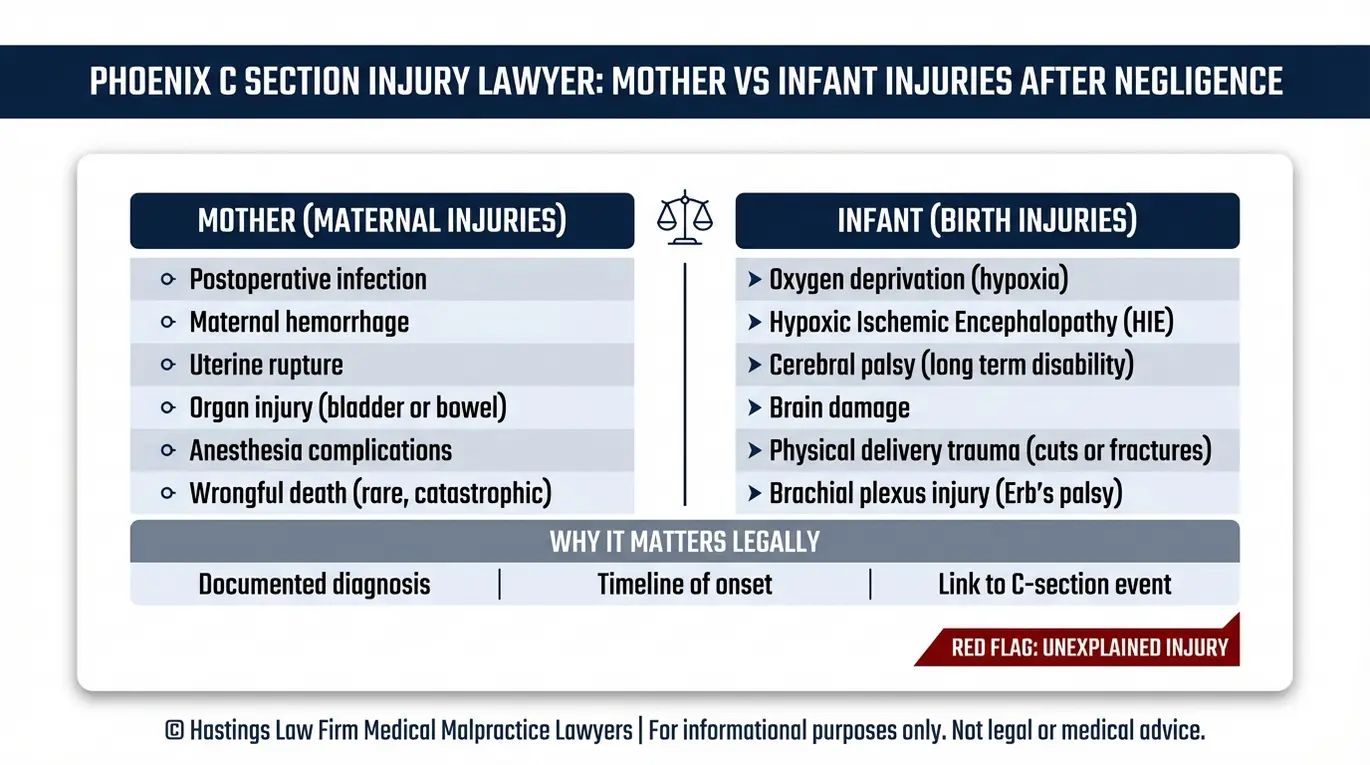
Negligent C-sections can result in outcomes ranging from cerebral palsy and HIE in infants to uterine rupture, hemorrhage, or fatal infections in mothers. Birth injuries include any harm a baby suffers during the labor and delivery process, often involving physical trauma or oxygen loss. A C-section injury attorney evaluates both the immediate and long-term consequences, including the full scope of the birth injury, to build the strongest possible case.
Some injuries are apparent at delivery. Others develop in the hours, days, or weeks that follow. Subtle early signs, such as low muscle tone in a newborn or persistent fever in the mother, can point to serious underlying conditions that a thorough medical-legal review may uncover.
| Infant Injuries | Maternal Injuries |
|---|---|
| Hypoxic ischemic encephalopathy (HIE), a type of brain damage caused by oxygen deprivation before or during birth | Postpartum hemorrhage (maternal hemorrhage), severe bleeding during or after delivery |
| Cerebral palsy from prolonged oxygen loss | Uterine rupture or organ lacerations |
| Brachial plexus injury or Erb’s palsy from traumatic delivery | Surgical site or postoperative infection |
| Skull fractures or lacerations during extraction | Blood clots or anesthesia-related complications |
| Brain damage requiring lifelong support | Wrongful death from uncontrolled complications |
Research from PubMed Central on MRI predictors of long-term outcomes in neonatal HIE confirms that early imaging can help identify the extent of brain injury, which is critical for both treatment planning and establishing the scope of damages in a legal claim.
Risk Factors That Demand Immediate Surgical Intervention
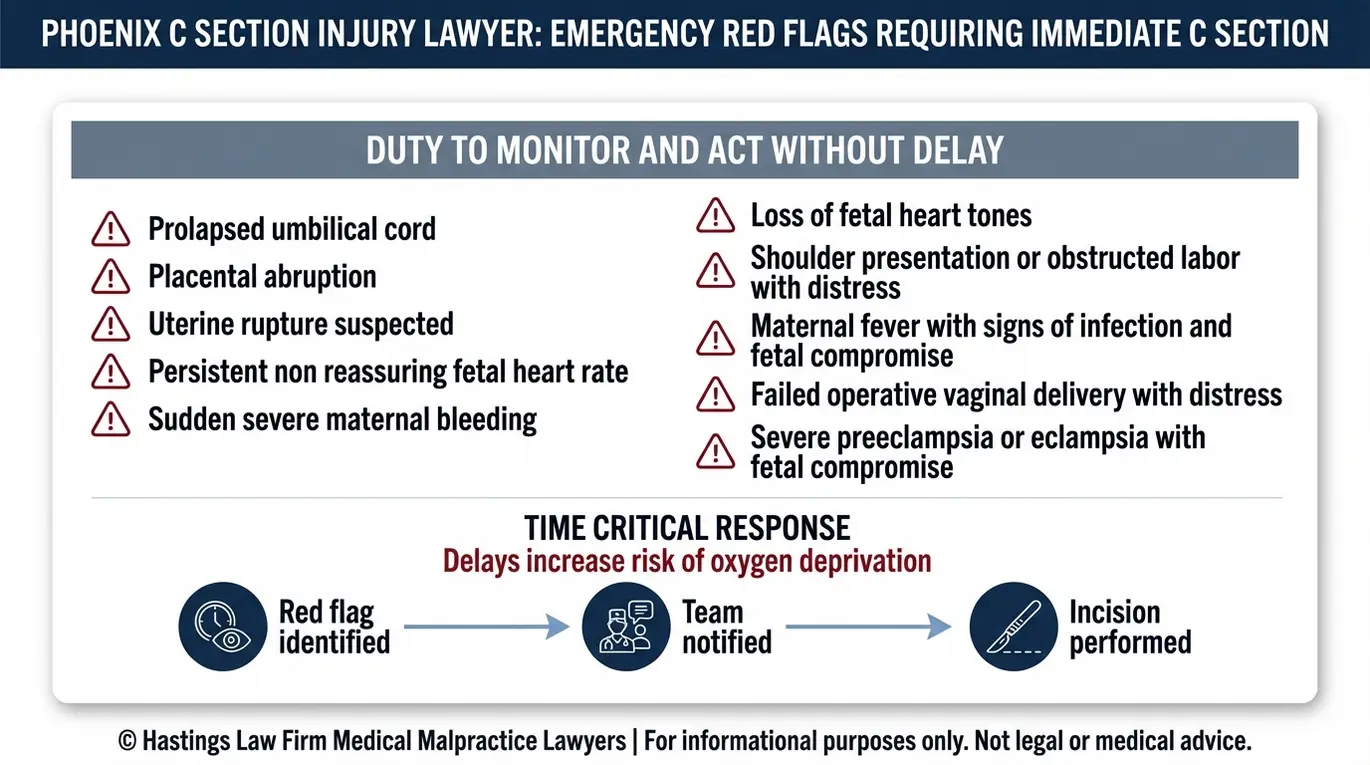
Medical teams must immediately identify and respond to critical indicators such as placental abruption, prolapsed umbilical cords, or unmanageable fetal distress to prevent permanent injury or death. As a Phoenix C Section Injury Lawyer team, we examine whether providers recognized these emergencies and acted within the expected timeframe.
The duty to monitor maternal and fetal vital signs throughout labor is a foundational part of obstetric care. When monitoring reveals any of the following red flags, rapid intervention is typically required:
- Placental abruption, a condition where the placenta separates from the uterine wall before delivery, cutting off the baby’s blood and oxygen supply
- Prolapsed umbilical cord, which occurs when the cord drops through the cervix ahead of the baby, compressing it and restricting blood flow
- Persistent fetal heart rate decelerations that do not respond to standard interventions
- Uterine rupture, particularly in patients with prior C-section scars
- Uncontrolled maternal hemorrhage threatening the mother’s life
The “decision-to-incision” time, the interval between the decision to perform an emergency C-section and the first surgical cut, is a well-recognized benchmark. When that timeline is not met, we investigate why.
The Lifetime Impact of Delayed Delivery
A delay of even a few minutes in performing an emergency C-section can deprive the infant’s brain of oxygen, leading to permanent disabilities like cerebral palsy that may require lifelong care. Decision-to-incision time, which represents the minutes between the call for emergency surgery and the start of the operation, is one of the most important factors our C-section injury attorneys examine.
Oxygen deprivation, known as hypoxia or birth asphyxia, can damage brain tissue rapidly. The consequences often include developmental delays, seizure disorders, impaired motor function, and the need for around-the-clock assistance. For families, this means years of therapy, adaptive equipment, home modifications, and specialized schooling.
In the most devastating cases, a delayed C-section can be fatal. When a delay results in the death of a mother or child, families may pursue a wrongful death claim to recover compensation and hold the responsible parties accountable.
Calculating Damages for Birth Injuries in Arizona
Arizona law allows patients and families to recover economic damages for medical bills and lost wages, as well as non-economic damages for pain, suffering, and the profound loss of independence caused by severe birth injuries. As a Phoenix C Section Injury Lawyer team, we work with medical and financial experts to project the true lifelong expenses of these injuries.
Recoverable damages in a C-section injury case may include:
- Past and future medical expenses: Surgeries, hospitalizations, therapy, medications, and assistive devices
- Lost earning capacity: Income the injured child or mother will never be able to earn
- Home care and modifications: In-home nursing, wheelchair accessibility, and adaptive equipment
- Pain and suffering: Physical pain and emotional distress resulting from the injury
- Loss of enjoyment of life: The inability to participate in activities and milestones
- Parents’ emotional distress claims: Compensation for the anguish of witnessing your child’s preventable injury
Every case is different, and we evaluate the full scope of both current and future needs to pursue the compensation your family deserves.
How to File a C-Section Injury Lawsuit in Phoenix
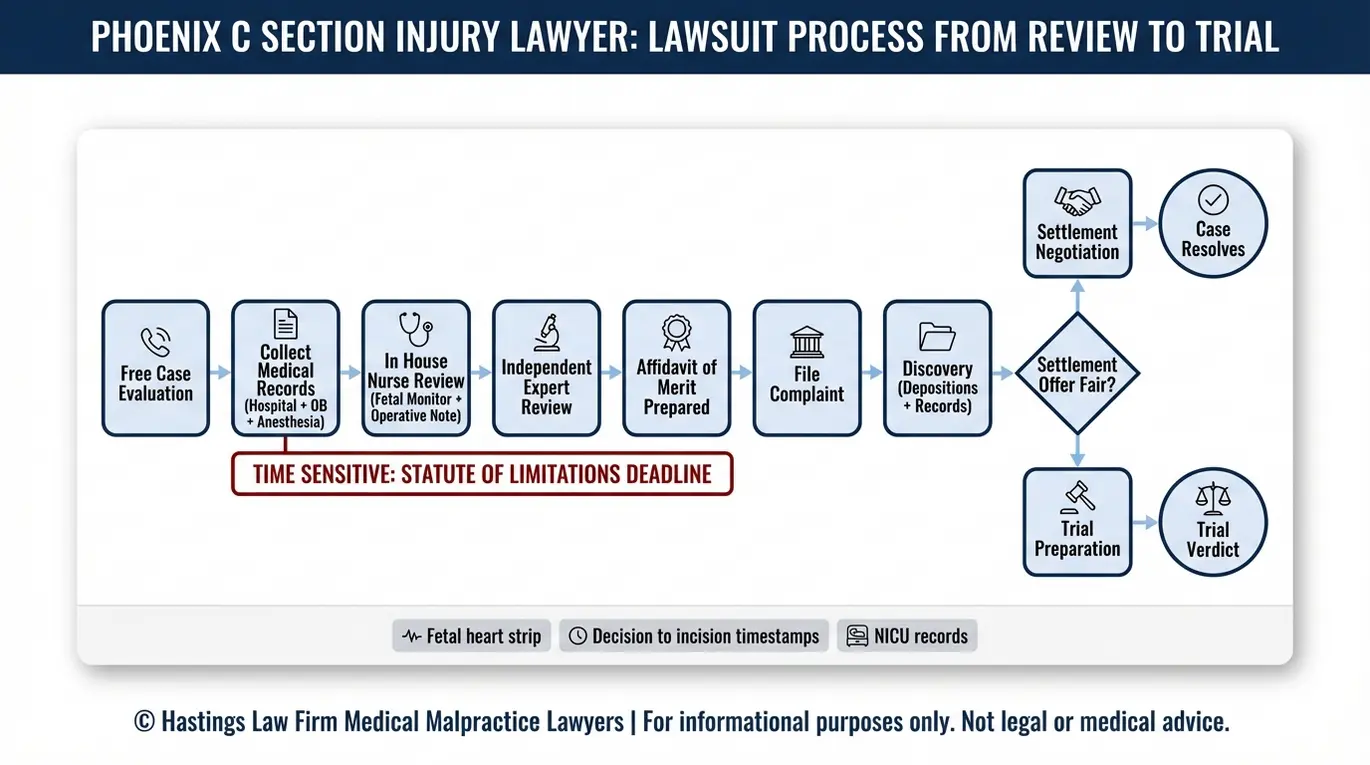
Filing a lawsuit requires a preliminary expert review to obtain an Affidavit of Merit, followed by filing a complaint within the strict Arizona statute of limitations. A medical malpractice lawsuit is a legal process used to seek compensation when healthcare providers fail to meet the required standard of care. This process is best handled by a Phoenix C Section Injury Lawyer with specific experience in medical malpractice litigation.
Here is how the process typically works:
- Free case evaluation. You speak with a patient advocate at Hastings Law Firm who listens to what happened and determines whether a deeper investigation is warranted. There is no cost and no obligation.
- Medical record retrieval and expert review. We obtain your complete medical records, which you are entitled to access under HIPAA’s individual right of access rules. Our in-house medical team and outside experts then analyze the records to identify potential breaches in the standard of care.
- Filing the complaint and discovery. Once our experts confirm the case has merit, we file the medical malpractice lawsuit and serve a formal Affidavit of Merit as required by Arizona law, then begin the discovery process.
- Settlement negotiation or trial. Because we prepare every case as if it will go before a jury, we negotiate from a position of strength. If a fair settlement cannot be reached, we are ready to take your case to trial.
Contact the Phoenix Birth Injury Attorneys at Hastings Law Firm Today for Help
Arizona law sets firm deadlines for filing a medical malpractice lawsuit, and the sooner your medical records are preserved and reviewed, the stronger your case can be. Waiting too long can mean losing the right to pursue a claim entirely.
At Hastings Law Firm, we have the resources, the medical knowledge, and the trial experience to take on hospitals and healthcare systems on behalf of your family. Our team of former defense attorneys, nurse consultants, and nationally recognized medical experts work together to build cases that demand accountability.
If your child or you suffered a preventable injury during a C-section, we want to hear from you. Contact us today for a free, confidential case evaluation. You pay nothing unless we recover compensation for your family. Let us help you find the answers you deserve.
Frequently Asked Questions About C-Section Malpractice in Phoenix


This content was researched and written by the Hastings Law Firm editorial team, which includes attorneys, medical professionals, and experienced researchers. Our writing is informed by internal knowledge and practical experience, and we cross-check critical details against authoritative sources cited throughout. Every piece undergoes human-led fact-checking and legal review. Because legal and medical information can change, if you spot an error, please contact us. Learn more about our content standards and review process on our editorial policy page.

Tommy Hastings, founder of Hastings Law Firm, is a board-certified personal injury trial lawyer dedicated exclusively to healthcare injury cases. Since 2001, he has represented injured patients and families in litigation against major hospital systems, pharmaceutical companies, and negligent healthcare providers nationwide. He has handled numerous high-profile cases that have drawn national media attention and resulted in multi-million dollar recoveries. He draws on that experience in his writing, helping readers understand how these cases work and what options may be available to them.
