


Phoenix Anesthesia Error Lawyer
Anesthesia errors can cause sudden, life changing harm during surgery, especially when monitoring, dosing, airway management, or informed consent falls short of accepted standards. Patients and families often face physical injury, psychological trauma, and in the most severe situations fatal outcomes or permanent disability. Understanding how anesthesiologists and CRNAs are expected to plan care, track vital signs, and respond to distress can clarify whether an injury was preventable. If you or a loved one were harmed or worse due to an anesthesia error in Phoenix, Arizona, contact Hastings Law Firm for a free, confidential case review.

Last Updated: July 27, 2026
Trial-Ready Phoenix Malpractice Attorneys for Anesthesia-Related Injuries
When anesthesia goes wrong, the consequences can change the course of your life in an instant. If you or a loved one suffered harm from an anesthesia error during a surgical procedure, you likely have questions about what happened, why it happened, and what you can do about it. Those questions deserve honest answers from a legal team that understands both the medicine and the law.
At Hastings Law Firm, founded by board-certified trial attorney Tommy Hastings, we focus exclusively on medical malpractice. Our team includes in-house medical professionals and former defense attorneys who know how hospitals and insurers respond to these claims. As a Phoenix anesthesia error lawyer team with deep experience in these cases, we are here to help you understand your options.
If something feels wrong about the care you received, contact us for a free, confidential case evaluation. We can review what happened and explain the path forward.

Understanding the Standard of Care for Anesthesiologists
The standard of care requires an anesthesiologist, a physician specially trained to administer anesthesia and manage pain during surgery, to monitor a patient’s vitals continuously, administer the correct dosage based on medical history, and respond immediately to signs of distress. Failure to meet these obligations can constitute negligence. This standard of care is the baseline for safety in the operating room.
This standard applies to every provider involved in delivering anesthesia, including a Certified Registered Nurse Anesthetist (CRNA), an advanced practice nurse licensed to administer anesthesia, often working under physician supervision. Whether the provider is a physician anesthesiologist or a CRNA, the duty of care remains the same: protect the patient before, during, and after the procedure.
A core part of this duty involves informed consent. Before any procedure requiring anesthesia, the provider must explain the type of anesthesia being used, the risks specific to the patient’s health profile, and any alternatives available. Research published through the Duquesne Scholarship Collection highlights the importance of structured informed consent checklists, particularly in high-risk settings like labor and delivery. When a provider skips this step or fails to disclose known risks, it may form the basis of a malpractice claim, which must be filed within the time limits set by Arizona Revised Statutes § 12-542.
The American Society of Anesthesiologists publishes detailed standards and practice parameters that define the minimum monitoring and safety requirements for every type of anesthesia. These guidelines are central to how an anesthesia error lawyer evaluates whether a provider met or fell below the expected level of care.
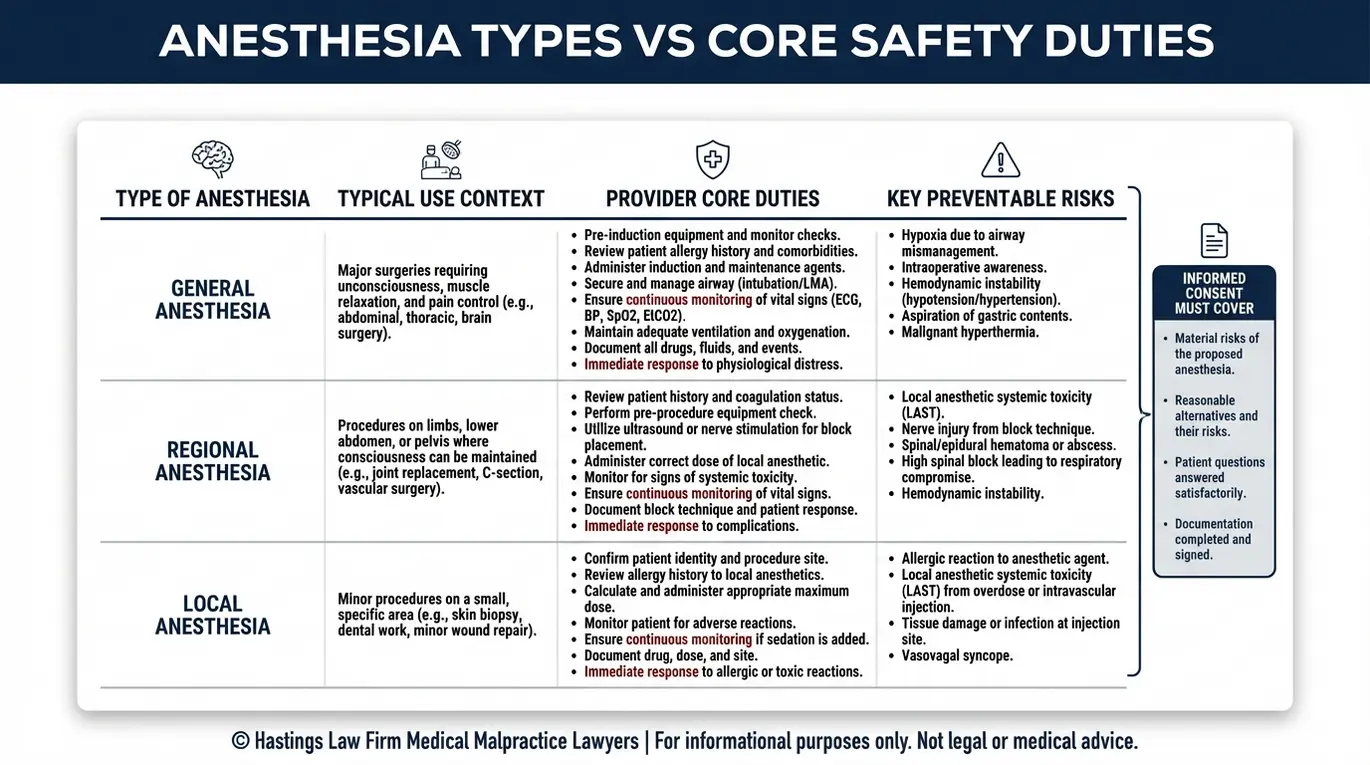
The specific duties and risks vary depending on the type of anesthesia used:
| Type of Anesthesia | How It Works | Key Provider Duties | Associated Risks |
|---|---|---|---|
| General Anesthesia | Renders the patient fully unconscious using IV drugs and inhaled agents | Continuous monitoring of heart rate, blood pressure, oxygen saturation, and CO₂ levels; airway management | Brain damage from oxygen deprivation, adverse drug reactions, anesthesia awareness |
| Regional Anesthesia (e.g., epidural, spinal block) | Numbs a large area of the body while the patient remains conscious | Correct needle placement, dose calculation, monitoring for signs of systemic toxicity | Nerve damage, infection, spinal cord injury, cardiovascular collapse |
| Local Anesthesia | Numbs a small, targeted area for minor procedures | Proper dosing relative to body weight, screening for allergic reaction history | Allergic reaction, toxicity from overdose, inadequate pain control |
Each type of anesthesia carries distinct risks, and the standard of care requires providers to account for those risks based on the patient’s individual medical history. When a Phoenix anesthesia malpractice attorney reviews a case, we examine whether the anesthesia plan was appropriate for the patient and whether monitoring met published clinical standards.
How Preventable Anesthesia Errors Occur in Phoenix Hospitals
Most anesthesia errors and surgical errors stem from communication failures, medication administration errors like dosage miscalculations, defective equipment, or failure to monitor patient vitals during the procedure. These are not mysterious complications; they are preventable mistakes made by health care providers who did not follow established protocols.
Here are some of the most common types of preventable anesthesia errors:
- Dosage errors: Administering too much anesthetic can lead to drug toxicity, cardiovascular collapse, or respiratory failure. Too little can result in the patient experiencing awareness during surgery.
- Intubation errors: Endotracheal intubation, the process of placing a breathing tube into the airway, requires precision. Improper placement can cause airway damage, aspiration, or oxygen deprivation.
- Failure to monitor: Ignoring alarms or failing to track vitals through capnography, a monitoring technique that measures end-tidal CO₂ levels to confirm the patient is breathing properly, can allow dangerous conditions like hypoxia to develop undetected.
- Failure to review patient history: When a provider does not check for known allergies or prior adverse reactions to anesthetic drugs, the patient may suffer a severe allergic reaction that could have been avoided entirely.
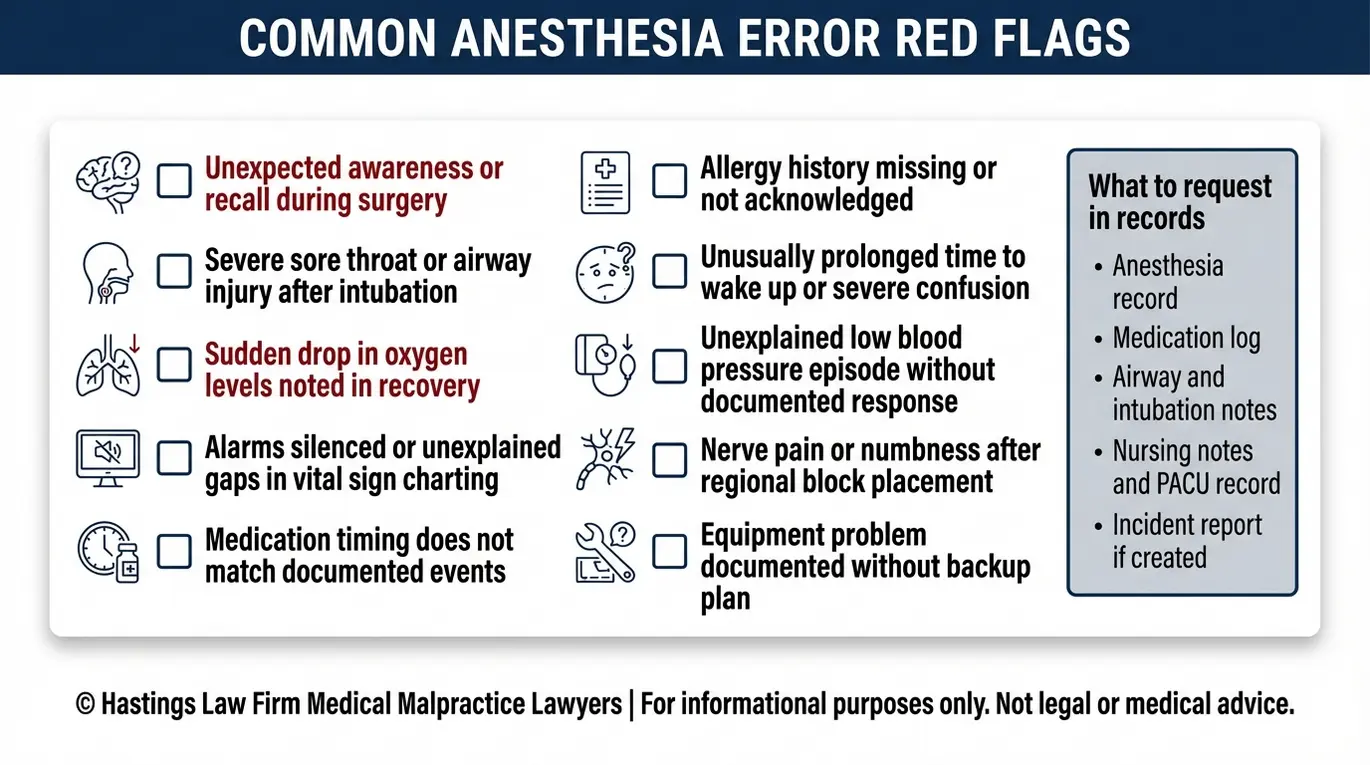
A lawyer for anesthesia errors will look closely at the sequence of events documented in the medical chart. Gaps in monitoring records, missing time entries, or late responses to equipment alarms can all suggest a failure in the standard of care. These details often reveal where things went wrong and who was responsible.
As an anesthesia negligence attorney team, we also examine systemic issues, such as whether the surgical team communicated effectively during handoffs or whether the facility had adequate staffing in the operating room.
The Psychological Trauma of Anesthesia Awareness
Anesthesia awareness, also known as intraoperative awareness, is a rare but deeply traumatic event in which a patient regains consciousness during surgery while still under the effects of neuromuscular blocking agents (paralytics), medications that prevent voluntary muscle movement. The patient may be fully aware of the procedure, unable to move or speak, and in some cases, able to feel pain.
A prospective cohort study published through PubMed Central examined the incidence and behavioral consequences of intraoperative awareness, finding significant associations with PTSD and lasting psychological trauma. Patients who experience this can suffer from nightmares, panic attacks, and long-term emotional distress that affects every part of their daily life.
When awareness occurs because a provider failed to administer adequate anesthesia or failed to use proper monitoring, it may represent a clear breach of the standard of care.
The Hastings Law Firm Difference
Results matter, but what truly sets us apart is how we achieve them. Every verdict, every settlement, and every Phoenix courtroom victory comes from one guiding promise: To treat each client’s fight for justice as if it were our own.
This balance of skill, experience, and empathy reflects our core philosophy that justice should not only compensate the injured, but also make health care safer nationwide.

Severe Injuries Resulting from Anesthetic Mistakes
Negligent anesthesia administration can cause catastrophic injuries ranging from temporary nerve damage to permanent brain injury or death due to lack of oxygen. In anesthesia care, precise balance is required to keep the patient safe while preventing pain.
The most devastating outcomes often involve hypoxia, a condition where the brain or body is deprived of adequate oxygen. Even a few minutes of oxygen deprivation during surgery can result in hypoxic brain injury, which the National Center for Biotechnology Information (NCBI) describes as damage to brain tissue caused by an interruption in oxygen supply. Depending on the duration and severity, this can lead to permanent cognitive impairment, loss of motor function, or a persistent vegetative state.
Improper management of anesthetic drugs can also trigger serious cardiovascular events. If blood pressure or heart rhythm is not carefully controlled, the patient may suffer a stroke or heart attack on the table, either of which can cause lasting disability or death.
Nerve damage is another common consequence, particularly in cases involving regional anesthesia. Incorrect needle placement during a spinal block or epidural can injure the spinal cord or peripheral nerves, leading to chronic pain, numbness, or paralysis. In the most severe cases, families are left pursuing a wrongful death claim after losing a loved one to an error that should never have occurred.
A Phoenix anesthesia injury lawyer can help determine whether the injury you or your loved one suffered was the result of a preventable mistake. If you need legal help for anesthesia errors, our team includes medical professionals who understand exactly what to look for in the clinical record.
Proving Liability in Medical Malpractice Claims
Proving liability requires demonstrating that the provider breached their duty of care and that this breach directly caused specific damages, often necessitating expert medical testimony. This is the foundation of every medical malpractice case, and it demands a methodical, evidence-driven approach.
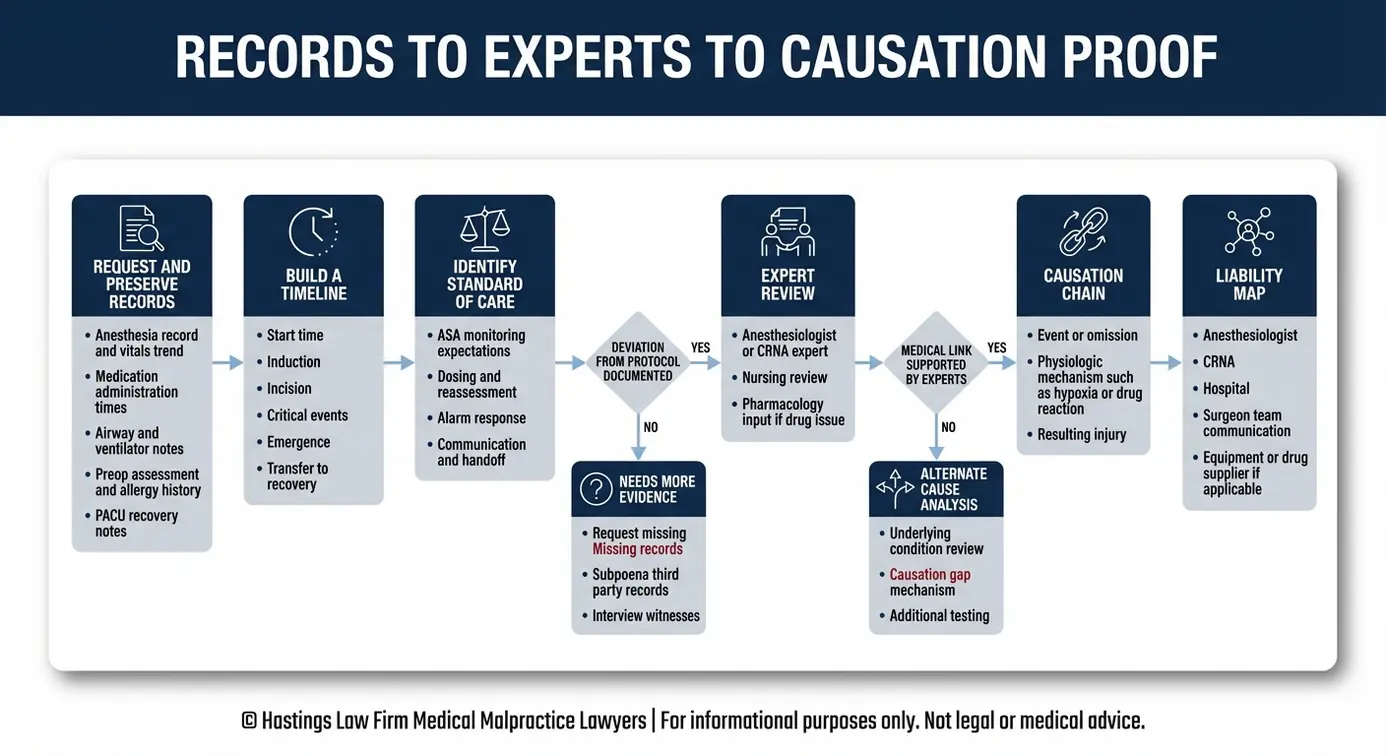
At Hastings Law Firm, our process for building an anesthesia malpractice case follows a clear sequence:
- Step 1: Gather medical records and anesthesia charts. The anesthesia record, a detailed document that logs every drug administered, every vital sign reading, and every intervention made during the procedure, is the single most important piece of evidence. Under federal law, patients have the right to access their own health information, as outlined by the U.S. Department of Health and Human Services under 45 CFR § 164.524. We obtain and review these records immediately.
- Step 2: Consult with medical experts. Our in-house nurse consultants and national network of medical experts examine the records to identify exactly where the provider deviated from accepted protocol. Their analysis pinpoints the specific breach of duty.
- Step 3: Establish causation. It is not enough to show that a mistake was made. We must prove that the error directly caused the injury. This means linking the timing of the breach to the onset of harm, often through a minute-by-minute reconstruction of the procedure.
- Step 4: Identify all liable parties. Liability may extend beyond the anesthesiologist. A CRNA, the supervising physician, the hospital, or even a medical equipment manufacturer could share responsibility depending on the facts.
As a Phoenix anesthesia malpractice law firm, we prepare every case from day one as if it will go to a jury trial. This level of preparation, built on the work of former defense attorneys who understand how hospitals fight these claims, puts us in the strongest possible position during settlement negotiations. When the defense knows you have an anesthesia error attorney team that is ready for trial, the dynamics of the case shift in your favor.
Damages and Compensation Under Arizona Law
Arizona law allows patients to recover economic damages for medical bills and lost wages, as well as non-economic damages for pain and suffering, with no statutory cap on the amount awarded.
Economic damages cover the measurable financial losses caused by the error. This includes past and future medical care, rehabilitation costs, home health services, and lost earning capacity if the injury prevents you from returning to work. Non-economic damages address the less tangible but equally real harm: chronic pain, emotional suffering, loss of enjoyment of life, and the toll the injury takes on your relationships.
What makes Arizona particularly favorable for injured patients is that the Arizona Constitution prohibits caps on damages in personal injury and medical malpractice cases. This means that in a jury trial, a jury can award the full amount it believes is fair based on the evidence, without an artificial ceiling imposed by the legislature.
Our Phoenix anesthesia error lawyer team works on a contingency fee basis, which means you pay no attorney fees unless we recover compensation for you. This structure removes the financial barrier that prevents many families from pursuing the accountability they deserve.
Arizona Statute of Limitations for Medical Malpractice
In Arizona, medical malpractice claims must typically be filed within two years from the date the injury occurred or was discovered. This deadline is set by Arizona Revised Statutes § 12-542, and missing it can permanently bar your right to seek compensation.
Arizona does recognize a discovery rule exception. If the injury was not immediately apparent, the two-year clock may begin on the date you knew, or reasonably should have known, that the injury was caused by medical negligence. Separate rules may also apply for minor victims who were harmed by anesthesia errors, potentially extending the filing deadline.
Because these deadlines are strict, speaking with a Phoenix anesthesia error attorney as early as possible protects your ability to pursue a claim.
Contact the Phoenix Healthcare Malpractice Attorneys at Hastings Law Firm Today for Help
Anesthesia error cases sit at the intersection of complex medicine and high-stakes litigation. They require a legal team that understands both, not a general practice firm learning on the fly.
At Hastings Law Firm, every attorney, nurse consultant, and patient advocate on our team is dedicated exclusively to medical malpractice litigation. Our in-house medical staff reviews your records. Our former defense attorneys know how hospitals and insurers will respond. And we prepare every case for trial from the very beginning.
If you suspect that an anesthesia error caused harm to you or someone you love, you do not have to accept the hospital’s version of events. You deserve the truth, and you deserve a team that knows how to find it.
Contact our Phoenix anesthesia error lawyer team today for a free, confidential case evaluation. There is no fee unless we win your case.
Frequently Asked Questions About Anesthesia Error in Phoenix


This content was researched and written by the Hastings Law Firm editorial team, which includes attorneys, medical professionals, and experienced researchers. Our writing is informed by internal knowledge and practical experience, and we cross-check critical details against authoritative sources cited throughout. Every piece undergoes human-led fact-checking and legal review. Because legal and medical information can change, if you spot an error, please contact us. Learn more about our content standards and review process on our editorial policy page.

Tommy Hastings, founder of Hastings Law Firm, is a board-certified personal injury trial lawyer dedicated exclusively to healthcare injury cases. Since 2001, he has represented injured patients and families in litigation against major hospital systems, pharmaceutical companies, and negligent healthcare providers nationwide. He has handled numerous high-profile cases that have drawn national media attention and resulted in multi-million dollar recoveries. He draws on that experience in his writing, helping readers understand how these cases work and what options may be available to them.
