


Phoenix Nurse Malpractice Lawyer
Nursing negligence can leave patients facing serious injuries, lasting disability, and in the most severe cases fatal outcomes, especially when warning signs are missed or basic safety steps are not followed. Errors such as medication mistakes, monitoring failures, and incomplete documentation can be hard to spot because hospitals control much of the information about what happened. Understanding how the nursing standard of care applies and how liability may extend to a hospital can shape what comes next. If you or a loved one were harmed or worse due to nursing negligence in Phoenix, Arizona, contact Hastings Law Firm for a free, confidential case review.
Last Updated: July 27, 2026
Trusted Medical Attorneys for Nursing Negligence Claims in Phoenix
When a nurse’s error causes harm to you or someone you love, the experience can feel deeply unsettling. You trusted a healthcare professional with your safety, and that trust was broken. Knowing something went wrong is one thing. Proving it requires a legal team with real medical knowledge.
Tommy Hastings, a board-certified trial lawyer, founded Hastings Law Firm to focus exclusively on medical malpractice. Our team includes in-house nurse consultants and former defense attorneys who understand how hospitals operate from the inside. As a Phoenix nurse malpractice lawyer team built around medical cases, we know how to identify nursing errors, preserve the evidence, and hold the responsible parties accountable.
If you believe a nurse’s negligence caused a serious injury, we can review what happened and explain your options during a free, confidential consultation.

Defining Nursing Negligence and Medical Malpractice in Arizona
Nursing negligence occurs when a nurse fails to adhere to the accepted standard of care established by the nursing profession, resulting in preventable harm to a patient. Not every bad outcome qualifies as malpractice, but when a nurse’s conduct falls below what a competent professional would have done under similar conditions, and that failure causes injury, there may be a valid legal claim.
Under Arizona Revised Statutes § 12-563, a medical malpractice claim requires proof of four elements: a duty of care owed to the patient, a breach of that duty, causation, and measurable damages. The injured patient bears the burden of proof.
The specific duties a nurse owes depend on their credentials and role. A Registered Nurse (RN), who holds a nursing degree and state license to perform a broad scope of clinical tasks, carries different responsibilities than a Licensed Practical Nurse (LPN), who provides basic patient care under the supervision of an RN or physician.
The error might involve a failure to escalate symptoms, an incorrect medication dose, or a lapse in monitoring. Regardless of the mistake, the key question is whether the nurse’s actions fell below the standard of care expected of someone in their position. Research from the National Center for Biotechnology Information (NCBI) confirms that many medical errors are preventable and often stem from systemic failures.
Common Types of Preventable Nursing Errors We Litigate
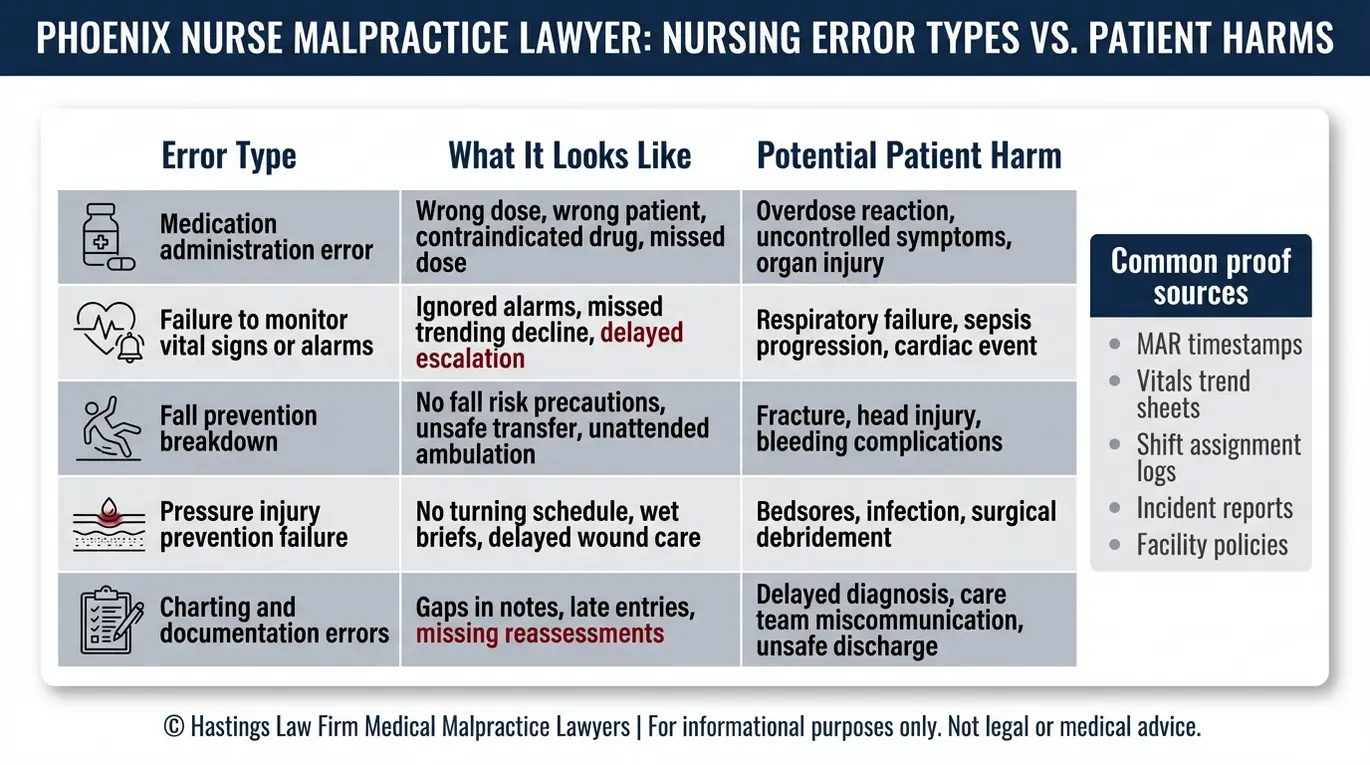
Common nursing errors include medication administration mistakes, failure to monitor vital signs, improper use of medical equipment, and failure to prevent patient falls or bedsores. As nurse malpractice lawyers in Phoenix, we see patterns of negligence repeatedly.
Medication errors are frequent and dangerous. These occur when a nurse violates the Five Rights of Medication Administration, a safety framework requiring the right patient, right drug, right dose, right route, and right time. A single deviation can cause organ damage or death.
Monitoring failures happen when a nurse ignores changing vital signs, silences critical alarms, or fails to notify the attending physician of a patient’s declining condition. In fast-paced environments like the ICU, even a short delay can lead to cardiac arrest or brain injury.
Patient safety lapses include failure to manage fall risk during transfers and the development of pressure ulcers, commonly known as bedsores. Bedsores often result from a failure to follow repositioning protocols, such as the Q2H turning schedule. This schedule requires turning immobile patients at least every two hours to relieve sustained pressure on the skin.
Documentation failures can also form the basis of a claim. Failure to chart symptoms, treatments, or changes in condition accurately creates gaps in the medical record that obscure actual care.
| Error Type | Potential Consequence |
|---|---|
| Wrong medication or dosage | Organ damage, toxic reaction, death |
| Failure to monitor vital signs | Undetected cardiac or respiratory decline |
| Failure to prevent falls | Fractures, traumatic brain injury |
| Inadequate repositioning | Severe pressure ulcers, infection, sepsis |
| Charting or documentation errors | Delayed treatment, loss of critical evidence |
| Surgical or anesthesia-related errors | Nerve damage, brain injury, wrong-site procedures |
The Hastings Law Firm Difference
Results matter, but what truly sets us apart is how we achieve them. Every verdict, every settlement, and every Phoenix courtroom victory comes from one guiding promise: To treat each client’s fight for justice as if it were our own.
This balance of skill, experience, and empathy reflects our core philosophy that justice should not only compensate the injured, but also make health care safer nationwide.

Determining Liability Between the Hospital and Individual Nurse
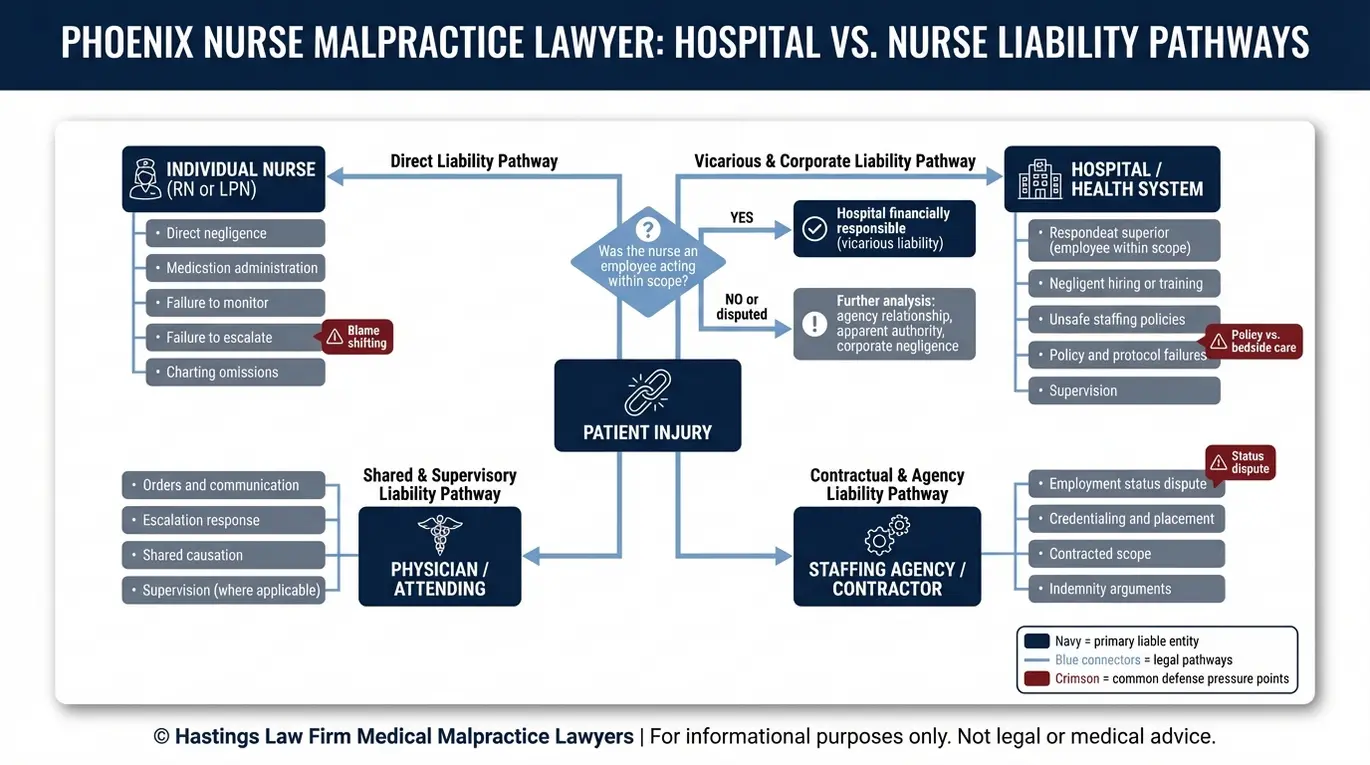
While individual nurses are liable for their actions, the hospital is often held financially responsible under the doctrine of *respondeat superior* (vicarious liability) if the nurse was an employee acting within the scope of their duties. Under vicarious liability, a hospital is generally responsible for the negligence of its staff.
This distinction matters because a Phoenix nurse malpractice attorney will evaluate not just what the nurse did wrong, but evaluate hospital malpractice and who bears legal and financial responsibility for the harm. The Arizona Standard Civil Jury Instructions guide how juries evaluate employer liability in these cases, and Arizona statutes establish procedural standards applicable to medical liability claims.
Several factors affect how liability is assigned:
- Employment status: If the nurse was a hospital employee, the hospital generally shares liability. If the nurse was an independent contractor or agency nurse, the analysis may differ.
- Scope of duties: The hospital’s liability depends on whether the nurse was acting within the scope of their assigned responsibilities or following orders from an attending physician.
- Hiring and training practices: Hospitals can face direct corporate liability for failing to properly screen, train, supervise, or retain competent nursing staff.
- Systemic failures: If hospital administration created conditions that made errors more likely, such as unsafe protocols or inadequate oversight, the institution itself may be independently negligent.
We investigate each of these factors to identify every responsible party and build the strongest possible claim.
Understanding the Reasonable Nurse Standard of Care
The “Reasonable Nurse” standard asks whether a similarly trained and experienced nurse would have acted differently under the same circumstances to prevent patient harm. This standard is not about perfection. It is about whether the nurse demonstrated the level of competence and attentiveness that the profession requires.
The expected standard shifts depending on the clinical setting. A nurse working in a high-acuity ICU is held to a different level of vigilance than one providing routine care on a general medical floor. Specific responsibilities include conducting a Fall Risk Assessment to evaluate a patient’s likelihood of falling. Nurses may also activate an Escalation of Care to seek help for a deteriorating patient through a Rapid Response Team (RRT). These actions define whether the standard was met or breached.
As a Phoenix nursing negligence lawyer team, we work with qualified expert witnesses who review medical records and clinical protocols to explain to a jury exactly what should have happened and where care fell short.
The Role of Charting and Documentation Errors
In nursing malpractice cases, a common principle applies: if it wasn’t charted, it wasn’t done. Gaps in documentation can be some of the strongest evidence of negligence.
We examine the Medication Administration Record (MAR), the official log tracking every drug given to a patient, along with shift logs and nursing notes, the written or electronic records nurses use to document patient observations, assessments, and actions taken during their shift. When these records contain charting errors, missing entries, or late amendments, it can indicate that required care was never actually provided. Our in-house nursing staff is trained to identify exactly these types of discrepancies in electronic health records.
How Staffing Shortages Contribute to Preventable Injuries
Inadequate staffing leads to nurse fatigue and dangerously high patient ratios, increasing the likelihood of medication errors, missed alarms, and neglected hygiene care. When a facility consistently operates with too few nurses, the risk of preventable harm rises significantly.
The nurse-to-patient ratio, the number of patients assigned to a single nurse during a shift, directly affects the quality and safety of care. When that ratio climbs too high, nurses are forced to prioritize, and tasks like repositioning immobile patients, responding to monitor alarms, or conducting thorough assessments may be delayed or skipped entirely.
Nurse fatigue, a state of physical and mental exhaustion, compounds this problem. Research from the Agency for Healthcare Research and Quality (AHRQ) Patient Safety Network documents how fatigue and systemic failures contribute to adverse events and near misses in clinical environments. Extended shifts and insufficient rest periods impair judgment and reaction time in ways that mirror cognitive impairment.
A hospital’s decision to understaff can create dangerous conditions for patients but does not shield the facility from liability. This can create a separate basis for a claim of corporate negligence. As a medical malpractice lawyer for nursing errors, we investigate whether the facility’s staffing practices fell below safe operational standards.
Leveraging In-House Medical Experts to Prove Your Claim
Proving a claim requires a comprehensive analysis of medical records, shift logs, and internal hospital policies to demonstrate a clear breach of duty that directly caused the injury. This is not something a general practice attorney can handle effectively. It demands medical knowledge.
At Hastings Law Firm, our case evaluation and investigation process is built on collaboration between attorneys and clinical professionals who know how hospital systems work from the inside.
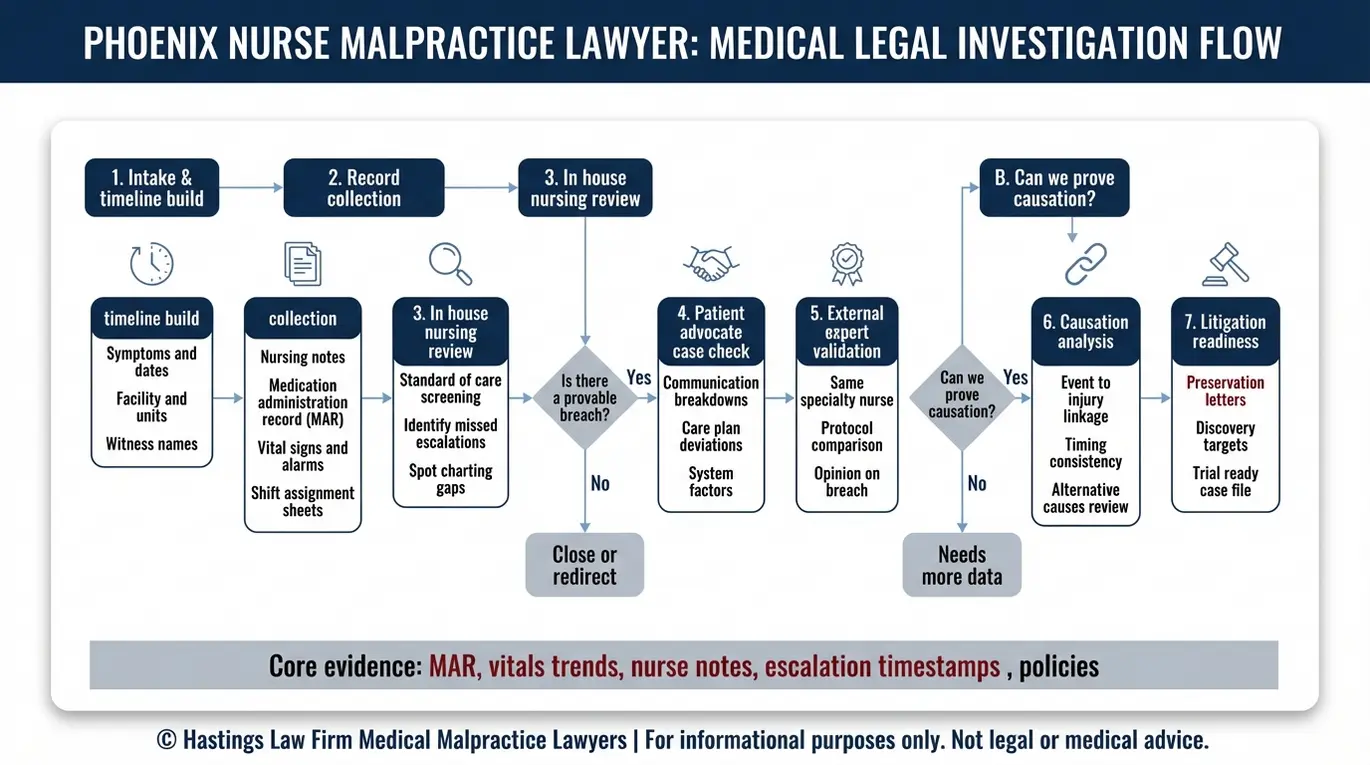
Our investigation follows a structured process:
- Step 1: Gathering records. We secure nursing notes, medication administration records, electronic health records, physician orders, and internal hospital policies to ensure evidence preservation before the formal discovery process begins.
- Step 2: Internal medical review. Our Board Certified Patient Advocates and in-house medical consultant analyze the clinical timeline, identify deviations from protocol, and flag charting inconsistencies that may indicate negligence.
- Step 3: External expert validation. We consult with nationally recognized medical experts in the relevant nursing specialty to confirm the breach, establish causation, and prepare testimony that clearly explains the failure to a jury.
This medical-legal approach allows us to build cases grounded in clinical evidence, not speculation. Because we include former defense attorneys on our team, we anticipate how the hospital’s lawyers will try to shift blame and prepare our case accordingly from day one.
Securing Compensation for Damages Caused by Nursing Negligence
Patients harmed by nursing negligence may recover economic damages for medical bills and lost wages, as well as non-economic damages for pain, suffering, and loss of quality of life. The type and severity of the injury determine what compensation may be available.
Nurse malpractice attorneys evaluate every category of loss to build a complete picture of the harm. Recoverable damages in these cases can include:
- Current and future medical care, including surgeries, rehabilitation, long-term care, and life care plans for catastrophic injuries such as permanent brain damage or birth injuries
- Lost wages and diminished earning capacity, both past income and the ability to earn in the future
- Pain and suffering, including physical discomfort, emotional distress, and mental anguish
- Loss of quality of life, covering the ways the injury has changed the patient’s daily existence and independence
- Wrongful death damages for families who have lost a loved one, including funeral costs, loss of companionship, and loss of financial support
Arizona does not cap damages in medical malpractice cases, which means a jury can award the full amount it determines is fair based on the evidence presented. This ensures that patients receiving economic damages and non-economic damages are fully supported for the duration of their recovery or disability.
Contact the Phoenix Nurse Malpractice Attorneys at Hastings Law Firm Today for Help
Nursing errors are often difficult to detect without a trained eye. Hospitals control the records, and the details of what happened during your care may not be obvious from the outside. That is exactly why these cases require a legal team with real clinical expertise.
Arizona law limits the time you have to file a malpractice claim, so acting early helps preserve critical evidence and protect your rights. When you contact Hastings Law Firm, your case is reviewed by a team that includes nurse consultants and Board Certified Patient Advocates who can identify what went wrong and why.
We take cases on a contingency fee basis, meaning you pay no attorney fees or costs unless we recover compensation for you. And if a fair resolution cannot be reached through negotiation, we are prepared to present your case to a jury.
Call us today for a free, confidential case evaluation. Let us help you get the answers you deserve.
Frequently Asked Questions About Nurse Malpractice in Phoenix


This content was researched and written by the Hastings Law Firm editorial team, which includes attorneys, medical professionals, and experienced researchers. Our writing is informed by internal knowledge and practical experience, and we cross-check critical details against authoritative sources cited throughout. Every piece undergoes human-led fact-checking and legal review. Because legal and medical information can change, if you spot an error, please contact us. Learn more about our content standards and review process on our editorial policy page.

Tommy Hastings, founder of Hastings Law Firm, is a board-certified personal injury trial lawyer dedicated exclusively to healthcare injury cases. Since 2001, he has represented injured patients and families in litigation against major hospital systems, pharmaceutical companies, and negligent healthcare providers nationwide. He has handled numerous high-profile cases that have drawn national media attention and resulted in multi-million dollar recoveries. He draws on that experience in his writing, helping readers understand how these cases work and what options may be available to them.
