


Phoenix Home Health Care Provider Malpractice Lawyer
Home health care is meant to support recovery and protect dignity, but negligent in home care can leave patients with worsening conditions, avoidable complications, and even fatal outcomes. Harm can happen when caregivers fail to follow a plan of care, miss warning signs, mishandle medications, or do not escalate changes to a supervising clinician. These situations are often hard to untangle because a patient may already be medically fragile and oversight can be limited in a home setting. If you or a loved one were harmed or worse due to home health care provider malpractice in Phoenix, Arizona, contact Hastings Law Firm for a free, confidential case review.

Last Updated: July 27, 2026
Trusted Phoenix Medical Attorneys for Patients Injured by Home Healthcare
When someone you love is receiving care at home, you expect that care to be safe. If a home health provider’s negligence has caused harm, the confusion and frustration you may be feeling right now are completely understandable. You trusted a system designed to help, and that trust may have been broken.
Hastings Law Firm represents patients and families across Phoenix who have been injured by substandard home health care. As a firm that focuses exclusively on medical malpractice, we understand both the medical details and the legal framework that these cases demand. Our team includes in-house nurses and former defense attorneys who know how to identify where care went wrong and who should be held accountable.
If you believe a home health care provider caused injury to you or a loved one, a Phoenix home health care provider malpractice lawyer at our firm can review what happened and explain your options during a free, confidential case evaluation.

Understanding Home Health Care Malpractice in Arizona
Home health care malpractice occurs when a visiting nurse, aide, or therapist fails to meet the accepted medical standard of care, directly causing injury or worsening the patient’s condition. As experienced Phoenix home health care malpractice attorneys know, this area of medical negligence is growing as more patients in Phoenix receive treatment outside of hospitals, in their own homes, where oversight can be limited and warning signs easier to miss.
Every health care provider owes a duty of care to the patient. For home health professionals, that duty is defined by the patient’s plan of care (POC), which is the individualized treatment document created by a physician outlining the specific services, medications, and monitoring the patient needs. When a provider delivers skilled nursing, such as wound care or IV administration, or custodial assistance like bathing and dressing, they must follow that plan and respond appropriately when conditions change. When they do not, a home health negligence lawyer should be consulted.
A home health care malpractice attorney can help determine if a provider breached that standard, although not every bad outcome qualifies as medical malpractice. A patient’s condition may worsen despite proper care, especially with chronic or progressive illnesses. The legal question is whether the caregiver’s actions, or failure to act, fell below what a competent provider would have done under similar circumstances. Experienced Phoenix caregiver negligence attorneys understand this distinction.
Arizona law reinforces protections for vulnerable patients receiving in-home care. Under Arizona Revised Statutes § 13-3623, abuse or neglect of a vulnerable adult, including patients dependent on home health services, can carry both criminal and civil consequences. A medical negligence lawyer in Phoenix can evaluate whether the care provided crossed the line from an unfortunate outcome into a breached standard of care. A home health provider malpractice attorney can help clarify this line.
What a Phoenix Home Health Care Provider Malpractice Lawyer Looks for Regarding a Proper Standard of Care:
- Medications administered at the correct dose and time vs. skipped doses or wrong medications given without documentation
- Wound dressings changed on schedule with proper technique vs. wounds left unattended, leading to infection or worsening pressure injuries
- Vital signs monitored per the POC with changes reported to the physician vs. no monitoring performed or abnormal readings ignored
- Patient repositioned regularly to prevent pressure injuries vs. patient left in the same position for extended periods
- Deteriorating symptoms escalated to a supervising physician vs. no contact made despite visible decline
If something about your loved one’s care does not seem right, a caregiver malpractice claim may be worth investigating with a qualified Phoenix home care malpractice lawyer.

Common Examples of Negligence by Phoenix Home Health Providers
Common forms of home health aide negligence and in-home caregiver abuse include medication administration errors, failure to monitor vital signs, improper wound care leading to infection or sepsis, and injuries caused by dropping patients during transfers. These are not rare occurrences. A study published in BMC Health Services Research on adverse events in home healthcare found that preventable harm in home settings is a measurable and documented problem, with medication management and wound care among the most frequent categories.
Medication Errors
A medication administration error, meaning the wrong drug, wrong dose, wrong time, or wrong route of delivery, can have serious consequences for patients who depend on precise dosing. In home settings, a single aide may be responsible for managing a complex medication schedule with little direct supervision. Overdosing on blood thinners, skipping critical heart medications, or administering a drug the patient is allergic to can lead to hospitalization or death. A Phoenix home care injury lawyer can review medication administration records to determine whether protocols were followed.
Wound Care Failures
Patients who are bedridden or have limited mobility are at high risk for developing pressure injuries, commonly known as bedsores or pressure ulcers. These wounds form when sustained pressure restricts blood flow to the skin and underlying tissue. When a home health provider fails to reposition a patient, change dressings, or report worsening wounds, a treatable Stage 1 pressure sore can deteriorate into a Stage 4 wound exposing muscle or bone. Left untreated, these injuries can lead to sepsis and death. A home health care malpractice lawyer recognizes this as a failure to diagnose complications early.
Equipment Misuse
Home health aides may use devices such as patient lifts, oxygen concentrators, or IV lines. Improper use of a Hoyer lift, a mechanical device used to transfer patients who cannot bear weight, can result in falls and fractures. Errors with home oxygen therapy equipment, including oxygen concentrators and nasal cannulas, can cause respiratory distress. A Phoenix home health negligence attorney can investigate these equipment failures.
Failure to Escalate
One of the most dangerous forms of patient neglect occurs when a caregiver notices a change in the patient’s condition and does nothing. If a patient develops a fever, confusion, rapid heart rate, or increased pain, the standard of care requires the aide or nurse to contact the supervising physician. Failing to escalate can delay treatment for life-threatening conditions, and this lack of communication can lead to serious health declines. A Phoenix home health abuse lawyer can determine if this negligence contributed to the outcome.
You can review quality data for specific agencies through resources like Medicare’s Care Compare tool for Arizona home health providers, which tracks patient outcomes and quality measures. Identifying negligence is an important step in improving patient safety standards. If any of these situations sound familiar, speaking with a caregiver negligence attorney in Phoenix is a reasonable next step.
The Hastings Law Firm Difference
Results matter, but what truly sets us apart is how we achieve them. Every verdict, every settlement, and every Phoenix courtroom victory comes from one guiding promise: To treat each client’s fight for justice as if it were our own.
This balance of skill, experience, and empathy reflects our core philosophy that justice should not only compensate the injured, but also make health care safer nationwide.

Identifying Liable Parties in Phoenix Home Health Care Cases
Liability can extend well beyond the individual aide or nurse who provided direct care. Depending on employment status, supervision protocols, and the equipment involved, responsibility may fall on the home health agency, a supervising physician, or even a medical equipment manufacturer. While distinct from nursing home negligence or assisted living neglect, establishing liability for home health malpractice follows similar legal principles.
Our legal team includes nurse practitioners and Board Certified Patient Advocates who help interpret clinical data and hospital protocols for our clients. This specialized medical knowledge allows us to identify where systemic failures occurred within a home health agency.
The Home Health Agency
In many cases, the agency that employs or dispatches the caregiver bears significant liability. Under the legal doctrine of vicarious liability, an employer can be held responsible for the negligent acts of its employees performed within the scope of their duties. Agencies may also face direct claims for negligent hiring or inadequate training.
A Phoenix malpractice attorney will examine hiring records and supervision structure to determine if institutional failures contributed to the harm. Pursuing a claim against a home health agency often involves proving these systemic issues.
The Supervising Physician
A physician who creates or oversees the plan of care has an ongoing obligation to monitor the patient’s progress and adjust treatment as needed. If a doctor fails to review caregiver reports, ignores documented changes in the patient’s condition, or provides inadequate instructions, that physician may share liability for home health malpractice. A Phoenix home health liability lawyer can determine if the doctor is at fault.
The Equipment Manufacturer
When a defective medical device causes injury, such as a malfunctioning Hoyer lift (patient lift device) or faulty home oxygen therapy equipment (oxygen concentrator, nasal cannula), the manufacturer may be liable under product liability law. This is a separate theory from caregiver negligence and may involve different evidence and experts. An attorney for home health negligence can coordinate these claims.
Independent Contractor vs. Agency Employee: Why It Matters
| Factor | Agency Employee | Independent Contractor |
|---|---|---|
| Who directs the work | Agency controls schedule, methods, and protocols | Caregiver sets own schedule and methods |
| Agency liability | Agency is generally liable under vicarious liability | Agency may argue it is not responsible |
| Who provides equipment/supplies | Agency typically provides | Contractor often provides their own |
| How we investigate | Agency records, training logs, supervision policies | Contract terms, hiring agreements, oversight gaps |
Agencies sometimes classify workers as independent contractors, which may impact how liability is established in a medical negligence claim. Our team examines the actual working relationship, not just the label on the contract, to manage these classifications. A Phoenix home care malpractice lawyer can help work through these details and ensure the correct parties are held accountable.
How Our Phoenix Attorneys Prove Home Health Malpractice Claims
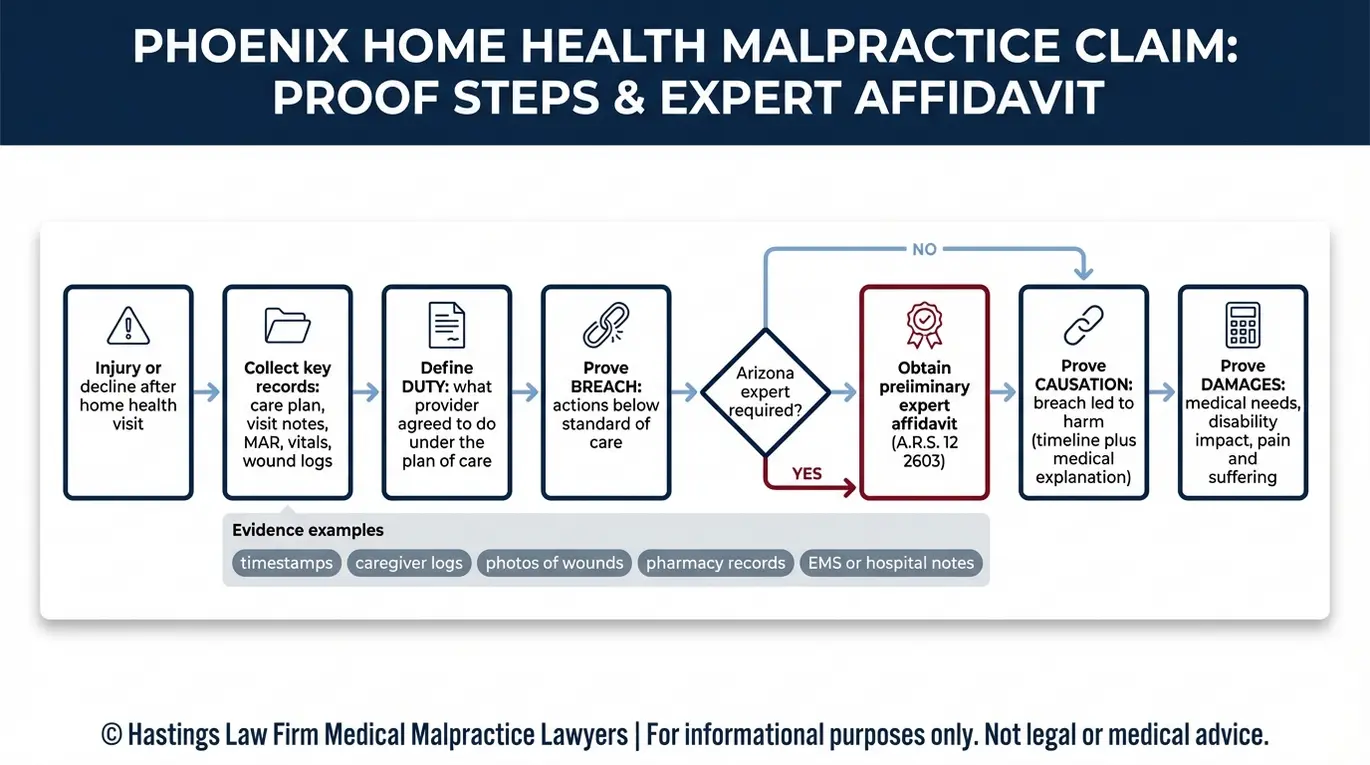
Proving a home health malpractice claim requires establishing four legal elements: a duty of care existed, that duty was breached, the breach directly caused the injury (causation), and the patient suffered quantifiable damages as a result. Each element must be supported by evidence, and our Phoenix personal injury attorneys build that evidence from the very first day while proving home health malpractice. Proving medical malpractice is complex and requires a strategic approach.
- Step 1: Establishing Duty of Care We begin by documenting the legal relationship between the patient and the provider. This includes the plan of care, the agency’s service agreement, and any physician orders that define what care was supposed to be delivered. A Phoenix medical malpractice lawyer handles this detailed collection.
- Step 2: Proving the Breach Medical records are the foundation of our investigation. We collect and analyze caregiver visit notes, daily logs of patient interaction, medication administration records (MARs), which log every drug given along with dosage and timing, and nursing assessments. Our in-house medical staff looks for charting inconsistencies, gaps in documentation, and deviations from the prescribed plan. These records often reveal what actually happened compared to what should have happened.
- Step 3: Establishing Causation Establishing causation is a critical phase where legal claims are often decided. It is not enough to show that care was substandard; we must demonstrate that the substandard care, and not the patient’s underlying condition, caused the specific injury. Our team works with qualified expert witnesses who can connect the breach to the outcome through medical analysis. An attorney for home health claims ensures this link is clear.
- Step 4: Quantifying Damages We document every category of harm: past and future medical costs, lost income, pain, and diminished quality of life. Detailed records and expert projections support the full scope of the claim. Our lawyer for home health injuries documents every category of harm to maximize recovery.
Arizona’s Mandatory Expert Affidavit
Arizona law adds an additional requirement before a medical malpractice lawsuit can move forward. Under Arizona Revised Statutes § 12-2603, the plaintiff must serve a preliminary expert opinion affidavit, often called an affidavit of merit, certifying that a qualified medical professional has reviewed the case and believes the standard of care was breached.
This is not optional. Without it, the case can be dismissed. An Arizona malpractice lawyer at our firm secures these expert opinions early because Tommy Hastings is a board-certified trial lawyer who ensures every case we accept is prepared from day one as if it will go to trial.
Working Through Arizona’s Comparative Negligence Laws
Comparative negligence is a legal rule used to assign a percentage of fault to each party involved in an injury. Arizona follows a pure comparative negligence system. This means that even if the patient is found partially at fault, for example, by not following prescribed medication instructions, the patient’s compensation is reduced by their percentage of fault but is not eliminated entirely.
If a jury determines the patient was 20% responsible for the outcome, the total damages award is reduced by 20%. Unlike some states that bar recovery once fault reaches a certain threshold, Arizona allows injured patients to pursue compensation regardless of their share of fault. This is an important protection, especially in home health cases where agencies may argue patient non-compliance to reduce their own exposure. A home health negligence lawyer will anticipate these arguments and build the evidence to counter them. Establishing home health negligence despite patient fault is possible. A Phoenix home health malpractice attorney can explain how this applies to you.
Recovering Compensation for Injuries Caused by Home Health Aides
Patients harmed by home health negligence may recover both economic and non-economic damages. The specific amount depends on the severity of the injury, the cost of ongoing care, and the impact on the patient’s daily life. Securing full compensation for home health negligence is our priority as we calculate measurable financial losses.
Economic Damages
Economic damages cover measurable financial losses, such as:
- Past and future medical bills, including hospitalizations, surgeries, and rehabilitation
- Prescription medications and medical supplies
- Physical therapy and in-home care needed because of the injury
- Lost income or diminished earning capacity if the injury affects the patient’s ability to work
Damages in malpractice cases must be calculated precisely to cover lifetime needs.
Non-Economic Damages
Non-economic damages address harm that does not carry a receipt:
- Physical pain and suffering caused by the injury
- Emotional distress and mental anguish
- Loss of enjoyment of life and independence
- Loss of consortium, which compensates a spouse or family member for the loss of companionship and support
A Phoenix home health compensation lawyer ensures these are not overlooked.
Wrongful Death
If a loved one died because of home health care negligence, surviving family members may file a wrongful death claim. A wrongful death lawyer in Phoenix can help families recover funeral expenses, lost financial support, and damages for the grief and loss of relationship. A Phoenix injury attorney for home health cases handles these sensitive claims.
How Medicare and Medicaid Liens Affect Your Settlement
One issue that catches many families off guard is subrogation. If Medicare or Medicaid paid for treatment related to the injury, those programs have a legal right to be reimbursed from any settlement or verdict.
The Centers for Medicare and Medicaid Services (CMS) requires that settlement information be reported and outstanding medical liens resolved before the patient receives their portion. Our team accounts for these liens during negotiations to protect as much of your recovery as possible. Maximizing your settlement for home health negligence requires this step. To learn more about recovering damages for home health injury, contact us.
Statute of Limitations for Home Health Malpractice in Arizona
In Arizona, the statute of limitations for medical malpractice is generally two years from the date of the injury or the date the injury was discovered. Missing this filing deadline almost always means losing the right to file a claim, regardless of how strong the evidence may be.
The Standard Two-Year Rule
Under Arizona Revised Statutes, most medical malpractice claims must be filed within a two-year statute of limitations. For home health cases, identifying that date can be complicated, particularly when harm develops gradually, such as a worsening pressure sore or the cumulative effects of medication errors. Determining the deadline for home health malpractice claims requires legal analysis.
The Discovery Rule
Arizona recognizes the discovery rule as an exception for injuries that were not immediately apparent. Under this rule, the two-year clock may begin when the patient knew or reasonably should have known that the injury was caused by negligent care. This exception can apply in cases where symptoms were masked, misattributed to the underlying condition, or concealed by inadequate documentation.
Exceptions for Minors and Incapacitated Adults
The filing deadline may be extended for patients who are minors or who lack the legal capacity to act on their own behalf. Courts evaluate these situations individually, and the rules vary depending on when capacity is established or a guardian is appointed. Understanding the legal deadline is critical.
Do not wait to have your case evaluated. Arizona’s filing deadlines are strict, and evidence from home health visits, including caregiver logs and agency records, can be lost or destroyed over time. Contact a Phoenix malpractice law firm as soon as possible to preserve your rights.

Contact the Phoenix Healthcare Malpractice Attorneys at Hastings Law Firm Today for Help
If you suspect that a home health provider’s negligence caused harm to you or someone you love, you deserve answers. Hastings Law Firm was founded on the principle that accountability in health care protects everyone, and we believe every patient’s voice matters.
Tommy Hastings, a board-certified trial lawyer and founder of the firm, has spent over two decades representing families in Phoenix and across the country. Our Phoenix medical malpractice team of attorneys, in-house nurses, and patient advocates is ready to review your case at no cost and with no obligation. We work on a contingency fee basis, which means you pay nothing unless we recover compensation on your behalf.
You do not have to face the insurance companies or the agency alone. Contact our Phoenix home health care provider malpractice lawyers today to schedule a free, confidential case evaluation. Let us help you understand what happened and what options are available to protect your family’s future.
Frequently Asked Questions About Home Health Care Provider Malpractice in Phoenix


This content was researched and written by the Hastings Law Firm editorial team, which includes attorneys, medical professionals, and experienced researchers. Our writing is informed by internal knowledge and practical experience, and we cross-check critical details against authoritative sources cited throughout. Every piece undergoes human-led fact-checking and legal review. Because legal and medical information can change, if you spot an error, please contact us. Learn more about our content standards and review process on our editorial policy page.

Tommy Hastings, founder of Hastings Law Firm, is a board-certified personal injury trial lawyer dedicated exclusively to healthcare injury cases. Since 2001, he has represented injured patients and families in litigation against major hospital systems, pharmaceutical companies, and negligent healthcare providers nationwide. He has handled numerous high-profile cases that have drawn national media attention and resulted in multi-million dollar recoveries. He draws on that experience in his writing, helping readers understand how these cases work and what options may be available to them.
