


Arizona Home Health Care Provider Malpractice Lawyer
Home health care should protect vulnerable patients, but negligent care at home can leave families facing serious injuries, lasting disability, or worse. Arizona home health malpractice claims often turn on whether a licensed provider followed the accepted standard of care and whether a specific clinical failure caused the harm. Common concerns involve medication mistakes, pressure injuries, equipment misuse, and missed warning signs that required escalation. Options and recovery can also be shaped by rules on damages and filing deadlines. If you or a loved one were harmed or worse due to home health care provider malpractice in Arizona, contact Hastings Law Firm for a free, confidential case review.
Last Updated: July 27, 2026
Trial-Ready Arizona Attorneys for Home Health Negligence
When someone you trust to care for a loved one at home causes harm instead of healing, the sense of betrayal can be overwhelming. You may be watching a parent, spouse, or family member suffer from injuries that should never have happened, and you’re not sure where to turn. If you or a loved one is going through this, you are not alone, and your instinct that something went wrong deserves to be taken seriously.
At Hastings Law Firm, our team focuses exclusively on medical malpractice, and we are ready to review your situation in a free, confidential consultation. An experienced Arizona home health care provider malpractice lawyer can help you understand what happened, determine whether the care your loved one received fell below acceptable medical standards, and explain the legal options available to your family.

Understanding Home Health Care Malpractice Laws in Arizona
Home health care malpractice occurs when a licensed provider deviates from the accepted standard of care, causing injury or death to a patient receiving treatment in their own home. This area of law applies to a range of professionals, from visiting nurses and therapists to home health aides, or HHAs. These aides provide hands-on assistance such as bathing and dressing under clinical supervision.
The standard of care is the level of treatment a reasonably competent home health professional would deliver under similar circumstances. In a home setting, the patient-provider relationship is established when the agency assigns a caregiver and a plan of care (the written set of medical instructions and goals, often called a POC) is created. From that point forward, every provider involved owes the patient a legal duty of care.
An Arizona home health malpractice attorney can help clarify whether what happened to your loved one was more than just a bad outcome. Medical negligence requires proof that a provider’s breach of duty directly caused harm, and simple dissatisfaction with care does not meet this legal threshold. A home health care negligence lawyer evaluates the clinical evidence to determine if the care crossed the line from unfortunate to actionable. Understanding this distinction early is one of the most important steps your family can take.
Common Examples of Home Health Provider Negligence
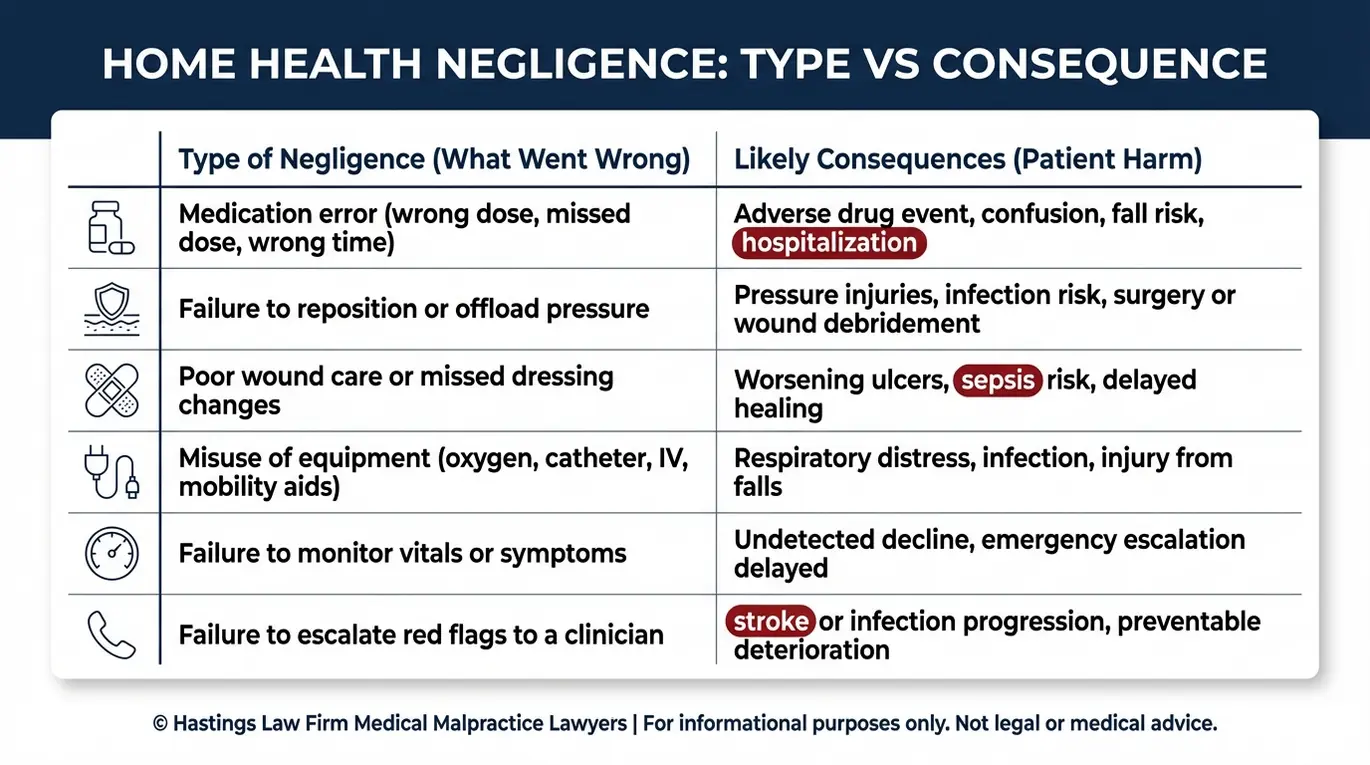
Common forms of home health care provider malpractice include medication errors, failure to prevent bedsores, improper use of medical equipment, and failure to escalate critical changes in a patient’s condition. Each of these failures can lead to serious, sometimes fatal, consequences for vulnerable patients.
Medication errors are among the most frequent preventable medical errors in home health settings. These can involve administering the wrong drug, giving an incorrect dose, or failing to perform medication reconciliation, which is the process of verifying that all of a patient’s medications are accurate and free of harmful interactions. Without proper oversight, these mistakes go unnoticed until significant damage has been done.
Skin integrity failures represent another common area of caregiver neglect or negligence. Stage 3 and Stage 4 pressure injuries, also known as decubitus ulcers, occur when patients are not regularly repositioned. According to the National Registry of Rehabilitation Technology Suppliers (NRRTS), these advanced-stage wounds involve full-thickness tissue loss and can expose muscle or bone. Their presence in a cared-for patient often points to a sustained failure in basic nursing protocols.
Equipment misuse and failure to treat round out the most common categories. When a caregiver improperly manages a ventilator, IV line, or catheter, the risk of infection or injury rises sharply. Similarly, ignoring early signs of infection, stroke, or other acute changes in condition is a form of medical misdiagnosis that can turn a treatable problem into a life-threatening emergency. The Arizona Supreme Court has addressed the standards for expert testimony in medical malpractice cases, reinforcing the importance of qualified opinions in proving these failures.
| Type of Negligence | Potential Consequence |
|---|---|
| Medication error (wrong drug or dose) | Overdose, organ damage, adverse drug reaction |
| Failure to reposition patient | Stage 3/4 pressure injuries, sepsis |
| Misuse of ventilator, IV, or catheter | Infection, respiratory failure, tissue damage |
| Ignoring signs of infection or stroke | Permanent disability, wrongful death |
| Failure to follow plan of care | Worsening of underlying condition |
The Hastings Law Firm Difference
Results matter, but what truly sets us apart is how we achieve them. Every verdict, every settlement, and every Arizona courtroom victory comes from one guiding promise: To treat each client’s fight for justice as if it were our own.
This balance of skill, experience, and empathy reflects our core philosophy that justice should not only compensate the injured, but also make health care safer nationwide.

Distinguishing Between General Neglect and Medical Malpractice
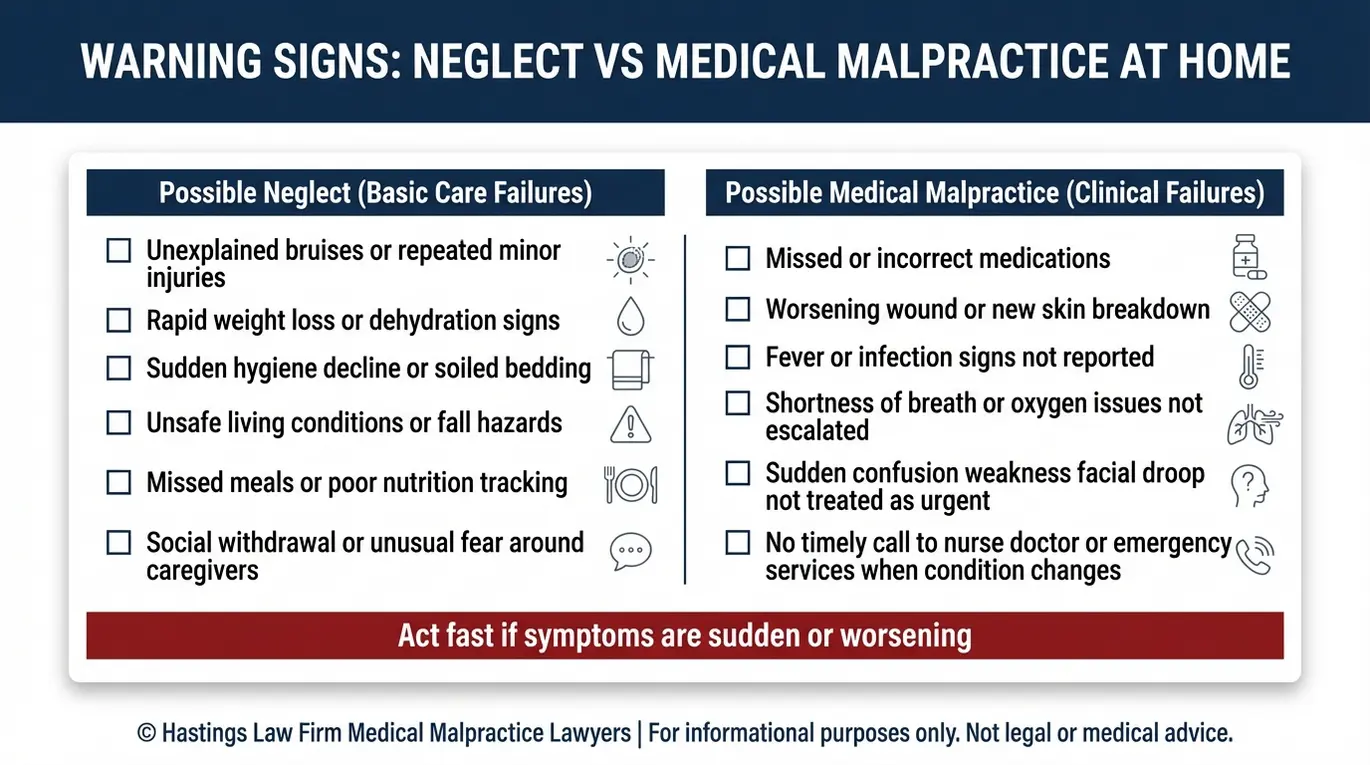
While neglect often involves a failure to provide basic needs like food, hygiene, or supervision, medical malpractice involves a licensed professional failing to perform clinical duties such as wound care, drug administration, or patient monitoring. This distinction clarifies the difference between custodial neglect and medical malpractice.
Elder abuse cases often involve failure in custodial care, the non-medical assistance with daily needs like hygiene. An Arizona home health care malpractice lawyer handles claims rooted in clinical negligence, where skilled nursing care, the medical treatment provided by a licensed professional, fell short of accepted standards. Home health care malpractice requires proof of causation linking a specific clinical failure to the patient’s injury.
Families should be alert to warning signs that may indicate either neglect or malpractice:
- Unexplained bruises, cuts, or skin breakdown
- Rapid, unexplained weight loss or signs of malnutrition
- A sudden decline in personal hygiene
- New or worsening bedsores between caregiver visits
- Confusion or behavioral changes that could signal medication errors
- Reluctance by the caregiver to allow family to observe care
Documenting these signs and seeking a home health negligence claim evaluation can preserve evidence. The Arizona Center on Aging provides clinician reporting guidelines that outline how healthcare professionals in Arizona are expected to respond to suspected abuse and neglect.
Proving Liability Against Arizona Home Health Agencies
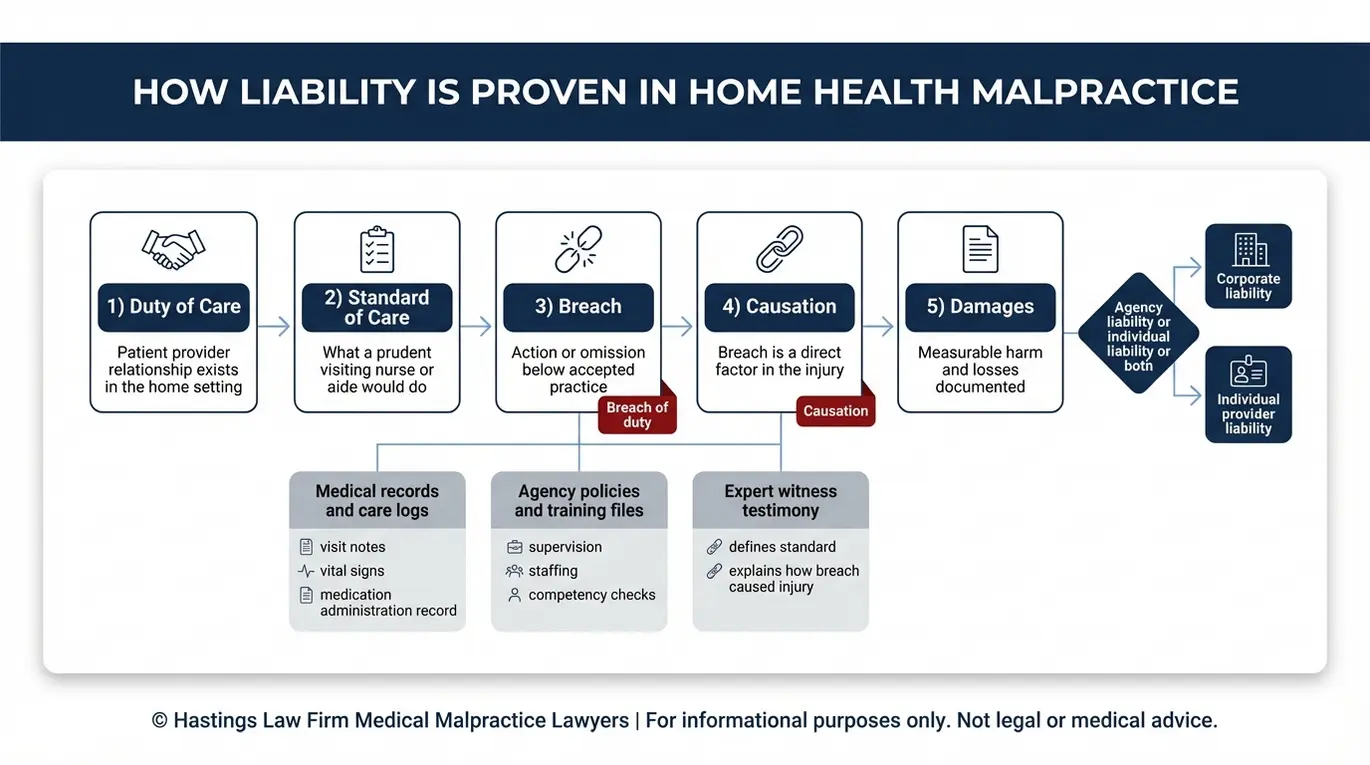
Proving liability requires demonstrating that the agency or its employee owed a duty of care to the patient, breached that duty, and directly caused the patient’s injury through clear evidence and expert witness testimony. This investigation process identifies whether an agency followed its own safety protocols and state regulations.
One of the first questions a home health care malpractice attorney will examine is whether to pursue corporate liability against the agency, individual liability against the caregiver, or both. Agencies can be held responsible for the actions of their employees and, in many situations, for their own failures in hiring, training, or supervision. If an agency assigned an unqualified provider or failed to monitor the quality of care being delivered, the agency itself may bear direct legal responsibility.
Expert witness testimony is central to any medical malpractice claim involving home health care. A qualified expert reviews the facts and offers an opinion on what a prudent provider would have done under the same circumstances. This testimony connects the dots between the provider’s actions and the patient’s harm, establishing the causation element that Arizona law requires.
At Hastings Law Firm, our in-house medical staff, including nurse practitioners and board-certified patient advocates, review medical records to identify gaps and inconsistencies. We gather daily care logs, the medication administration record (MAR, the document tracking every drug given to the patient), home health visit notes (the clinical charting from each encounter), employment files, and agency policies. Our investigation process focuses on securing the clinical records that tell the real story when suing a home health agency.
Compensation for Victims of Home Health Negligence
Patients and families affected by home health care negligence may recover economic damages for medical bills, lost care costs, and related expenses, as well as non-economic damages for pain, suffering, and loss of enjoyment of life. Economic damages are measurable financial losses you face due to the injury.
Economic damages in these cases typically include:
- Past and future medical bills related to the injury
- Cost of replacement or corrective home health care
- Lost wages for family members who had to leave work to provide care
- Rehabilitation and long-term care expenses
Non-economic damages cover physical and emotional suffering that doesn’t come with a receipt. These include pain and suffering, mental anguish, loss of companionship or consortium, and the diminished quality of life the patient experiences as a result of the injury. Economic damages provide for measurable financial losses while non-economic awards address personal suffering.
Arizona offers an important protection for injured patients and their families. Under Article 2, Section 31 of the Arizona Constitution, there is a constitutional prohibition on caps for damages in personal injury and wrongful death cases. Unlike many states that impose arbitrary limits, an Arizona home health malpractice lawyer can pursue the full value of your family’s losses without a legislatively imposed ceiling. This provision reflects Arizona’s strong commitment to ensuring that juries, not lawmakers, determine fair compensation.
Arizona Statute of Limitations for Home Health Claims
In Arizona, a medical malpractice lawsuit typically must be filed within two years from the date the injury occurred or was discovered, though exceptions exist for minors. This legal deadline is a strict cutoff for initiating a claim in the court system. Missing this deadline can permanently bar your family from pursuing compensation, regardless of how strong the evidence may be.
The statute of limitations is established under Arizona Revised Statutes § 12-542. In most cases, the clock starts on the date the negligent act occurred. But home health care injuries are not always immediately obvious. Internal infections, medication-related organ damage, and slowly progressing pressure injuries may not become apparent for weeks or months.
Arizona’s discovery rule addresses this by starting the limitations period when the patient knew, or reasonably should have known, about the injury and its potential connection to negligent care. Waiting can also put your case at risk for practical reasons. Staff turnover at home health agencies is high, and daily care logs or electronic records may be altered, lost, or purged over time.
An Arizona medical malpractice attorney can take steps to preserve this evidence early. When filing a home health malpractice suit, consulting with a lawyer sooner rather than later helps protect your legal rights and the evidence your case depends on.
Contact the Arizona Healthcare Malpractice Attorneys at Hastings Law Firm Today for Help
No family should have to face the aftermath of medical negligence alone. If you believe a home health care provider caused harm to someone you love, contact our home health attorneys at Hastings Law Firm to help you find answers and understand your options.
Our firm handles nothing but medical malpractice cases. Founded by Tommy Hastings, a board-certified trial lawyer, our legal team includes former defense attorneys and in-house nursing professionals who evaluate medical records from a clinical perspective. This combination of medical and legal knowledge sets our approach apart when representing families harmed by home health care provider malpractice in Arizona.
There is no cost to get started. We work on a contingency fee basis, which means you pay no attorney fees or costs unless we recover compensation for your family. Contact an Arizona home health care provider malpractice lawyer at Hastings Law Firm today for a free, confidential case evaluation. Let us help you take the first step toward accountability and answers.
Frequently Asked Questions About Home Health Care Provider Malpractice in Arizona


This content was researched and written by the Hastings Law Firm editorial team, which includes attorneys, medical professionals, and experienced researchers. Our writing is informed by internal knowledge and practical experience, and we cross-check critical details against authoritative sources cited throughout. Every piece undergoes human-led fact-checking and legal review. Because legal and medical information can change, if you spot an error, please contact us. Learn more about our content standards and review process on our editorial policy page.

Tommy Hastings, founder of Hastings Law Firm, is a board-certified personal injury trial lawyer dedicated exclusively to healthcare injury cases. Since 2001, he has represented injured patients and families in litigation against major hospital systems, pharmaceutical companies, and negligent healthcare providers nationwide. He has handled numerous high-profile cases that have drawn national media attention and resulted in multi-million dollar recoveries. He draws on that experience in his writing, helping readers understand how these cases work and what options may be available to them.
