


Phoenix Fetal Monitoring Injury Lawyer
Fetal monitoring during labor is meant to detect early signs that a baby is not getting enough oxygen so the care team can act quickly. When clinicians miss nonreassuring patterns or delay urgent intervention, the result can be severe and irreversible harm such as permanent brain injury or other lasting complications. Families are often left with unanswered questions and a long road of medical care and support needs. If your child suffered harm due to fetal monitoring errors in Phoenix, Arizona, contact Hastings Law Firm for a free, confidential case review.
Last Updated: July 27, 2026
Trusted Medical Attorneys for Birth Negligence Claims in Phoenix
When your child has been harmed during labor and delivery, the weight of that experience can feel impossible to carry. You may sense that something went wrong, that warning signs were missed, but you may not know how to confirm what happened or what your legal options are. You are not alone in feeling that way, and your instincts deserve to be taken seriously.
As a Phoenix fetal monitoring injury lawyer team, Hastings Law Firm focuses exclusively on medical malpractice. The firm was founded by board-certified trial lawyer Tommy Hastings, who has over 20 years of experience in medical litigation. Our legal and medical professionals, including in-house nurse consultants and former defense attorneys who previously worked for hospital systems, work together to examine monitoring records and build cases for trial.
If your family is dealing with the aftermath of a birth injury, we are here to help you find answers. Contact us for a free, confidential case evaluation to learn what may have happened and what options are available to you.

The Critical Role of Fetal Monitoring During Labor and Delivery
Fetal monitoring is the standard of care used to track a baby’s heart rate and oxygen levels during labor, providing early warnings of distress that require immediate medical intervention. If the medical team employs intermittent auscultation, which involves listening to the baby’s heart at set intervals, or continuous electronic fetal heart rate monitoring, the goal remains the same: to obtain real-time information about how the baby is tolerating the physical stress of labor.
During uterine contractions, the muscle tightens and temporarily reduces blood flow through the placenta to the fetus. A healthy baby can usually handle these brief interruptions without issue. But when contractions are too strong, too frequent, or when the placenta or umbilical cord is already compromised, oxygen delivery to the baby can drop to dangerous levels.
This is what the monitor is designed to detect. Patterns on the tracing can reveal what clinicians call a nonreassuring fetal status, a term used when the baby’s heart rate suggests it may not be getting enough oxygen. If providers fail to recognize or respond to those patterns, the result can be birth asphyxia, distinct oxygen deprivation that leads to brain damage or other permanent injury.
Monitoring data is only valuable if someone is watching, interpreting, and acting on it. When that chain breaks down, the consequences for the baby can be severe and irreversible.
Understanding Electronic Fetal Heart Rate Monitoring Systems
Electronic fetal monitoring, commonly called EFM, uses external sensors or internal scalp electrodes to simultaneously record the baby’s heart rate and the mother’s contractions, creating a visual graph for doctors to analyze. This tracing becomes one of the most important pieces of medical evidence in a birth injury case.
There are two primary methods:
- External monitoring uses ultrasound transducers strapped to the mother’s abdomen. One sensor tracks the fetal heart rate while the other measures uterine contractions. This method allows for mobility but may require repositioning if the signal is lost during intense contractions.
- Internal monitoring involves placing a fetal scalp electrode, or FSE, a small wire attached directly to the baby’s scalp, to measure heart rate more accurately. While more invasive, this provides the most reliable data when the clinical situation becomes uncertain or high-risk. A separate intrauterine pressure catheter may also be inserted to measure the exact strength and frequency of contractions.
Both methods produce a continuous strip that records the baby’s baseline heart rate, the degree of variability (the normal fluctuations in the heart rate), and how the heart rate responds to contractions. According to the American Academy of Family Physicians’ guide on interpreting electronic fetal heart rate tracings, these elements are central to fetal heart rate monitoring and help clinicians assess whether the baby is tolerating labor.
Abnormal contraction patterns also matter. Tachysystole, sometimes referred to as uterine hyperstimulation, occurs when contractions come too frequently, reducing the baby’s recovery time between them. When that happens, intervention is needed quickly.
The Hastings Law Firm Difference
Results matter, but what truly sets us apart is how we achieve them. Every verdict, every settlement, and every Phoenix courtroom victory comes from one guiding promise: To treat each client’s fight for justice as if it were our own.
This balance of skill, experience, and empathy reflects our core philosophy that justice should not only compensate the injured, but also make health care safer nationwide.

Interpreting Fetal Heart Rate Patterns and Categories
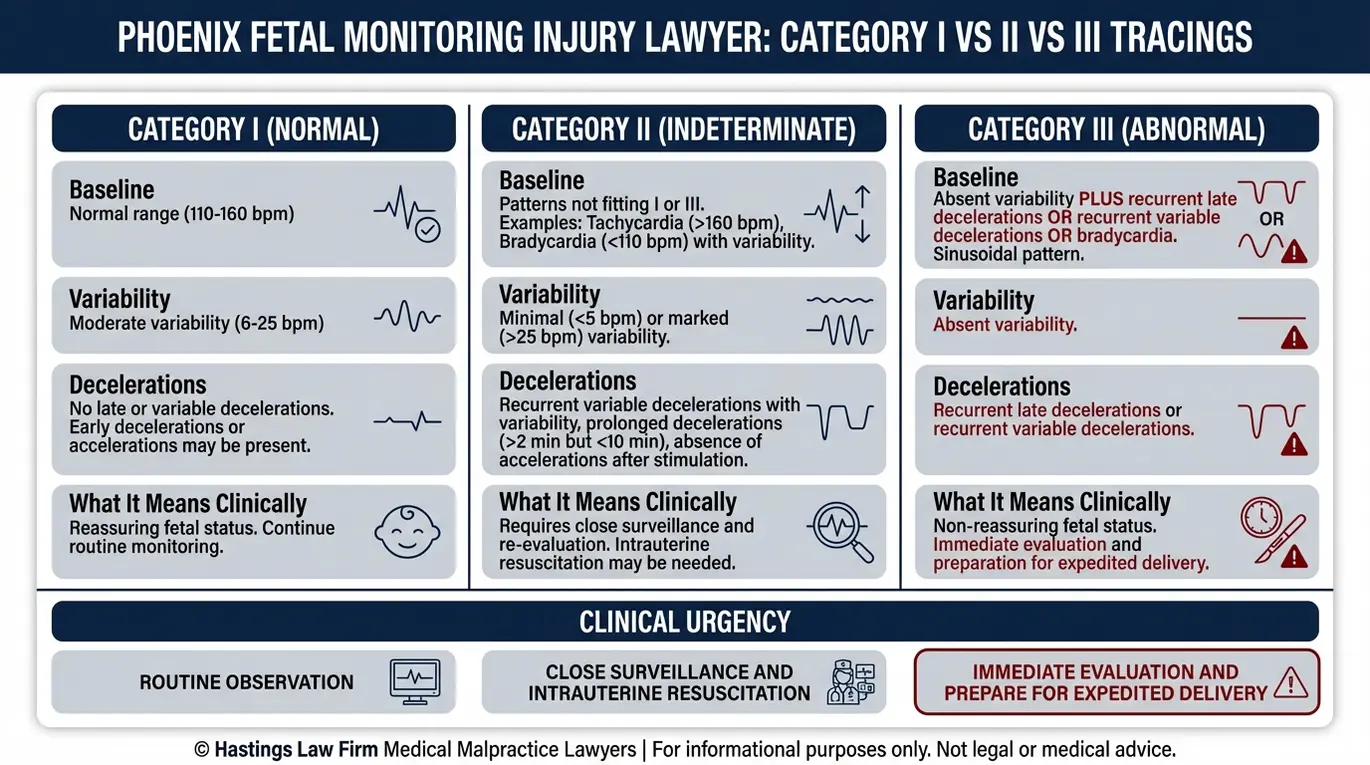
Doctors classify fetal heart rate patterns into three categories: Category I (Normal), Category II (Indeterminate/Warning), and Category III (Abnormal/Ominous), with the latter requiring immediate delivery to prevent injury. Understanding this classification system is essential for any fetal monitoring injury attorney in Phoenix evaluating whether the medical team responded appropriately.
A normal baseline fetal heart rate falls between 110 and 160 beats per minute. Rates exceeding 160 bpm indicate fetal tachycardia, while those below 110 bpm are termed fetal bradycardia.
Fetal heart rate variability, the slight beat-to-beat fluctuations in the rate, is one of the most reliable indicators of a baby’s neurological health. Moderate variability suggests the baby’s brain and nervous system are functioning well. Minimal or absent variability can signal that the baby is in distress.
The Category I fetal heart rate is considered normal, while Category II fetal heart rate and Category III fetal heart rate patterns require scrutiny. Decelerations, or temporary drops in heart rate, are categorized by their timing relative to contractions.
Early decelerations typically mirror contractions and are generally benign. Late decelerations occur after the peak of a contraction and suggest the placenta may not be delivering enough oxygen. Variable decelerations are abrupt drops that often indicate umbilical cord compression.
The ACOG Clinical Practice Guideline on intrapartum fetal heart rate monitoring outlines the three-tier category system used to guide clinical decision-making:
| Category | Key Features | Required Response |
|---|---|---|
| Category I | Normal baseline (110–160 bpm), moderate variability, no late or variable decelerations | Routine monitoring; no intervention needed |
| Category II | Indeterminate patterns, such as minimal variability, recurrent variable decelerations, or prolonged decelerations | Requires close observation, evaluation, and possible intervention |
| Category III | Absent variability with recurrent late or variable decelerations or bradycardia; or sinusoidal pattern | Immediate intervention required, typically emergency delivery |
Detailed Breakdown of Fetal Heart Rate Characteristics
Certain fetal monitor strip indicators function as urgent red flags. Late decelerations, which are gradual heart rate drops that begin after the peak of a contraction and return to baseline after the contraction ends, suggest the baby is not receiving adequate oxygen through the placenta. When these become recurrent, the clinical picture becomes increasingly concerning.
A sinusoidal pattern, a smooth, wave-like undulation in the fetal heart rate with absent variability, is one of the most ominous findings on a fetal monitor strip. This pattern can indicate severe fetal anemia, hypoxia, or other life-threatening conditions and almost always requires immediate delivery.
When these red flags appear and go unaddressed, the risk of hypoxic-ischemic encephalopathy, or HIE, a form of brain injury caused by oxygen deprivation, rises significantly with every passing minute. A nonreassuring fetal status that persists without intervention is precisely the type of clinical failure that forms the basis of many birth injury claims.
Negligent Fetal Monitoring Errors Committed by Phoenix Medical Providers
Medical malpractice occurs when providers fail to recognize nonreassuring patterns, delay notifying an obstetrician, or fail to order an emergency C-section despite clear evidence of fetal distress. As a Phoenix birth injury legal team, we investigate these failures by reconstructing the clinical timeline minute by minute.
Common errors we examine include:
- Failure to recognize Category III tracings or persistent, worsening Category II patterns. Identifying these patterns early is necessary to prevent the progression to permanent injury.
- Misinterpreting indeterminate strips as reassuring, which can lead to a false sense of security and continued delay. Small changes in heart rate variability can be the first indicator that the baby is struggling.
- Nursing staff failure to escalate to the attending physician when the clinical picture deteriorated. A breakdown in communication can delay critical interventions, such as an emergency delivery, when seconds matter.
- Misuse of Pitocin or other labor-augmenting drugs, which can cause uterine tachysystole. This excessive frequency of contractions deprives the baby of recovery time. Research published by PubMed Central on acute tocolysis for uterine tachysystole documents these risks.
- Gaps in continuous monitoring, where the strip is interrupted or not reviewed for extended periods. Unmonitored intervals leave a gap in the baby’s medical history, making it difficult to detect sudden changes in heart rate.
Variable decelerations, which are sudden, sharp drops in fetal heart rate often linked to cord compression, can become dangerous when they are deep, prolonged, or repetitive. A delay in ordering C-section when the strip indicates urgent compromise can be catastrophic.
In some cases, the team fails to order an emergency C-section, or Cesarean delivery, despite clear indicators. Each of these errors creates a window of time during which the baby may have been deprived of oxygen, and that window is exactly what our medical and legal team works to identify.
Injuries Caused by Unaddressed Fetal Distress
Prolonged oxygen deprivation due to monitoring errors can result in permanent catastrophic injuries, including hypoxic-ischemic encephalopathy (HIE), cerebral palsy, and even stillbirth. The severity of the injury often depends on how long the baby went without adequate oxygen and how quickly the medical team intervened.
When oxygen flow to the brain is interrupted, brain cells begin to die within minutes. HIE is the clinical term for the resulting brain damage, and it can range from mild to severe. In serious cases, it leads to cerebral palsy, seizures, cognitive disabilities, and impairments that require lifelong care.
In some instances, fetal distress triggers meconium aspiration, where the baby inhales waste products into the lungs, causing severe respiratory complications. The financial impact of these injuries is staggering.
A study on the prevalence and cost of care for children with cerebral palsy enrolled in Medicaid managed care illustrates the enormous long-term costs families face. These include therapy, adaptive equipment, home modifications, and around-the-clock nursing care.
In the most tragic cases, oxygen deprivation results in stillbirth or neonatal death. As Phoenix medical malpractice lawyers, we also represent families pursuing wrongful death claims when a child’s life is lost due to preventable monitoring failures.
Proving Negligence in Arizona Fetal Monitoring Cases
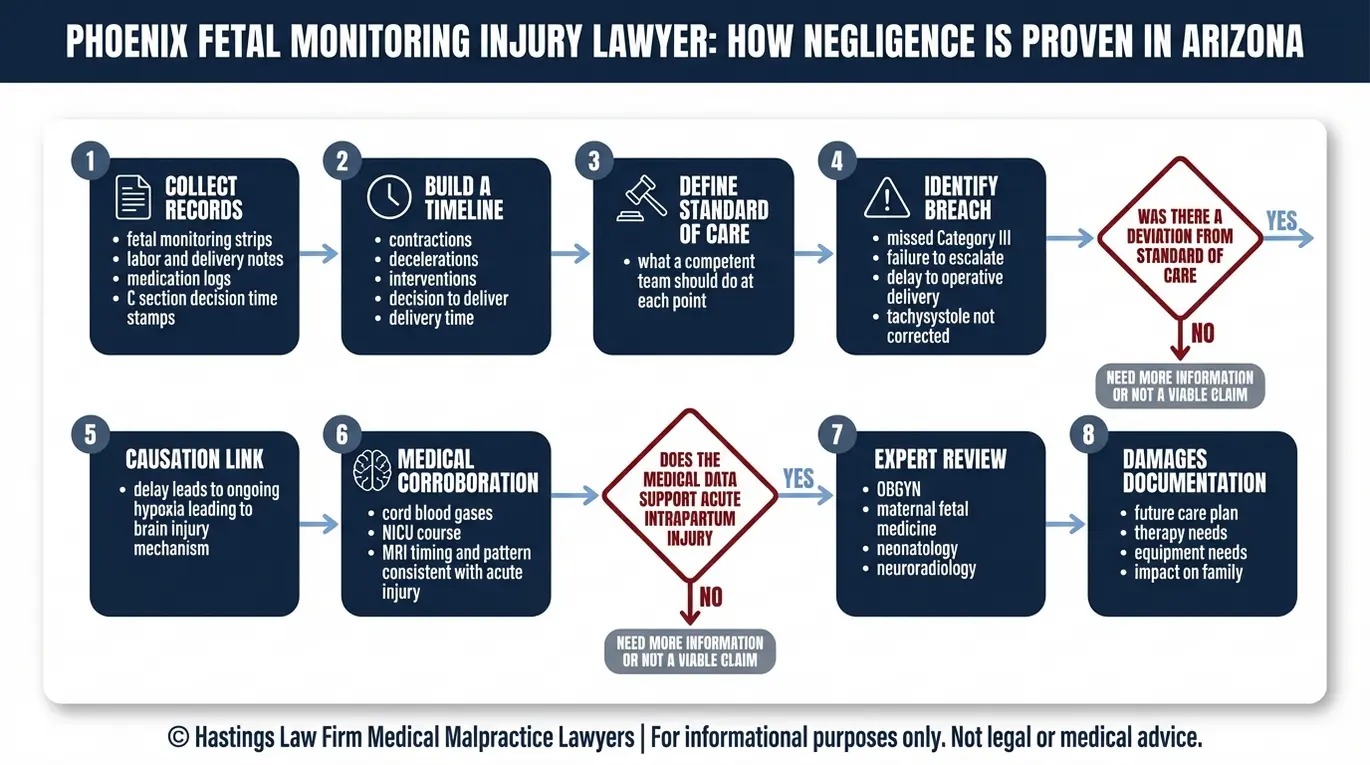
Successful litigation requires proving that a competent provider would have intervened sooner based on the monitoring strips and that this delay directly caused the child’s injury. Building that proof is a structured process that draws on medical expertise and careful evidence analysis.
Every fetal monitoring malpractice lawyer handling these cases must establish four legal elements: duty, breach, causation, and damages. Here is how our team approaches the investigation:
- Secure and preserve the evidence. We obtain the complete medical records and original electronic fetal monitoring strips. Access to medical records from Arizona facilities is an important early step in preventing the loss of electronic data.
- Identify the breach. Our staff and experts review the strips to determine if the care team deviated from the accepted standard of care. This often involves securing expert testimony to confirm where the medical team failed to act.
- Establish causation. We work with specialists to analyze brain MRI findings and cord blood gas results. This analysis helps clarify whether the injury was preventable or occurred before the monitoring errors began.
- Document the damages. We calculate the full scope of harm, including past and future medical costs and lost earning capacity. This provides a clear picture of the financial support required to sustain the child’s quality of life.
Our team includes former defense attorneys who know how hospitals and their insurers build their cases. That perspective allows us to anticipate challenges and prepare evidence that holds up under scrutiny in a birth injury lawsuit.
Arizona Statute of Limitations for Birth Injury Claims
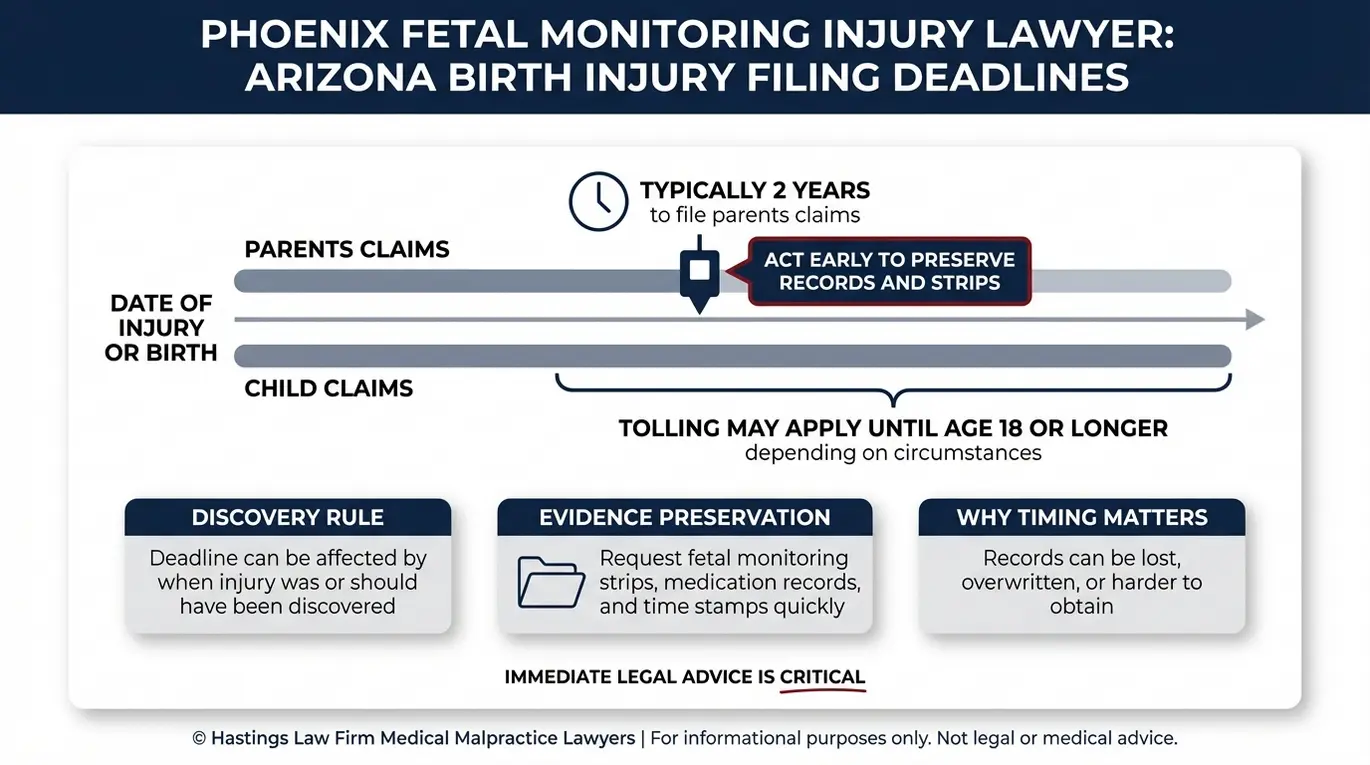
Arizona law provides distinct filing deadlines for birth injuries, typically allowing parents two years to file for their own damages, while the child may have until age 18 or older to file, though immediate legal advice is critical to preserve evidence. Even so, strict deadlines apply.
Under Arizona Revised Statutes § 12-542, the general statute of limitations for personal injury claims, including medical malpractice, is two years. For parents, this clock usually starts running from the date of the injury or from when the injury was discovered, a principle known as the “discovery rule” under Arizona medical malpractice laws.
The child’s claim operates differently. Because minors cannot file lawsuits on their own behalf, Arizona law allows for the tolling of statute limitations until the child reaches 18, giving them additional time.
But waiting carries serious risks. Medical records can be altered or lost. Staff memories fade. Monitoring strips stored electronically may be overwritten. Contacting an attorney early ensures the preservation of evidence that can make or break a birth injury claim.
Contact the Phoenix Birth Injury Attorneys at Hastings Law Firm Today for Help
The cost of seeking justice should never add to the burden your family is already carrying. At Hastings Law Firm, we handle every case on a contingency fee basis, meaning you pay no attorney fees or costs unless we recover compensation for you.
Your first step is a free, confidential evaluation with a Board Certified Patient Advocate on our team. During this conversation, we review what happened during your child’s birth, explain what the medical records may reveal, and help you understand whether you have a viable claim.
As a Phoenix fetal monitoring injury lawyer team that focuses exclusively on medical malpractice, we bring the medical knowledge, legal experience, and trial preparation that these cases demand. Our attorneys, nurse consultants, and national network of medical experts work together from day one to build your case as if it is going to trial.
If you believe your child was harmed by a failure in fetal monitoring, call us or reach out online. We are here to help you uncover the truth and protect your family’s future.
Frequently Asked Questions About Fetal Monitoring Error in Phoenix


This content was researched and written by the Hastings Law Firm editorial team, which includes attorneys, medical professionals, and experienced researchers. Our writing is informed by internal knowledge and practical experience, and we cross-check critical details against authoritative sources cited throughout. Every piece undergoes human-led fact-checking and legal review. Because legal and medical information can change, if you spot an error, please contact us. Learn more about our content standards and review process on our editorial policy page.

Tommy Hastings, founder of Hastings Law Firm, is a board-certified personal injury trial lawyer dedicated exclusively to healthcare injury cases. Since 2001, he has represented injured patients and families in litigation against major hospital systems, pharmaceutical companies, and negligent healthcare providers nationwide. He has handled numerous high-profile cases that have drawn national media attention and resulted in multi-million dollar recoveries. He draws on that experience in his writing, helping readers understand how these cases work and what options may be available to them.
