


Arizona Fetal Monitoring Malpractice Lawyer
Fetal monitoring failures during labor can leave families facing preventable birth injuries and a lasting sense of betrayal. When electronic fetal monitoring data shows fetal distress, the care team is expected to recognize concerning patterns and respond without delay. Misreading fetal heart rate tracings, failing to escalate care, or waiting too long to deliver can turn a recoverable situation into permanent harm or worse. Clear records like EFM strips often become central to understanding what happened and when. If you or a loved one were harmed or worse due to fetal monitoring failures in Arizona, contact Hastings Law Firm for a free, confidential case review.
Last Updated: September 24, 2026
Trial-Ready Fetal Monitoring Injury Attorneys in Arizona
When your child suffers a birth injury that could have been prevented, the weight of what happened can feel unbearable. You trusted the medical team to protect your baby during labor, and that trust may have been broken. We understand how isolating and overwhelming this moment can be.
Hastings Law Firm focuses exclusively on medical malpractice, including cases involving fetal monitoring failures during labor and delivery. Our founder, Tommy Hastings, is Board Certified in Personal Injury Trial Law by the Texas Board of Legal Specialization, a distinction held by fewer than 2% of Texas attorneys. Our team includes nurses and former defense attorneys who understand how hospitals operate from the inside.
If you need an Arizona fetal monitoring malpractice lawyer who can help you understand what happened and explain your legal options, we are here. Contact us for a free, confidential case evaluation.

How Fetal Monitoring Failures Lead to Medical Malpractice Claims
Fetal monitoring malpractice occurs when medical staff fail to correctly interpret or respond to electronic fetal monitoring (EFM) data showing signs of fetal distress, leading to preventable birth injuries. The key word is “preventable.” Not every difficult birth or tragic outcome involves negligence, but when medical professionals miss clear warning signs or delay critical interventions, families have the right to seek accountability.
Arizona obstetricians, nurses, and other labor and delivery staff have a legal duty of care to accurately read fetal heart rate tracings throughout labor. Fetal distress, a condition where the baby shows signs of inadequate oxygen supply, can develop gradually or suddenly. The medical team’s responsibility is to recognize these patterns and act appropriately.
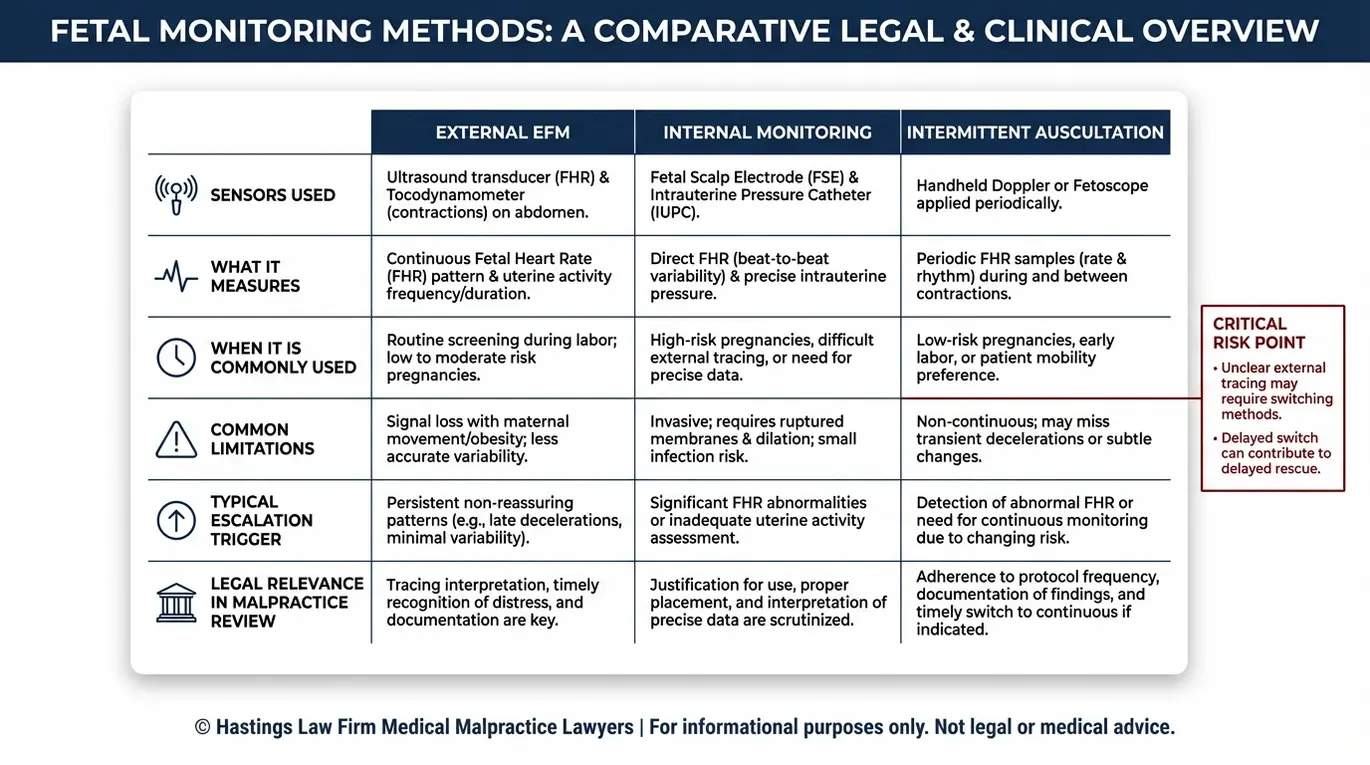
The negligence in many of these cases is not the distress itself. Complications can arise even with excellent care. The failure often lies in what happens next: a delayed response to concerning patterns on the monitor. When the standard of care requires an emergency cesarean section, which is a surgical delivery performed when vaginal birth poses risks to mother or baby, waiting too long to order one can result in permanent harm.
A breach of duty occurs when the medical provider fails to act as a reasonably prudent professional would under similar circumstances. In the context of fetal monitoring, this often involves the misinterpretation of heart rate data or a failure to escalate care when the baby is struggling. A delayed delivery, specifically waiting too long to move to the operating room, can allow a recoverable situation to turn into a permanent injury.
A fetal monitoring malpractice lawyer in Arizona evaluates whether the medical team’s response fell below the accepted standard. We examine the timeline between when warning signs appeared and when the team intervened. Minutes matter during fetal distress, and the difference between a difficult delivery and a preventable tragedy often comes down to how quickly the care team acted. Our role as an Arizona fetal monitoring lawyer is to investigate the full sequence of events, identify where the breakdown occurred, and determine whether timely action could have changed the outcome for your child.
Types of Fetal Monitoring Systems Used in Arizona Delivery Rooms
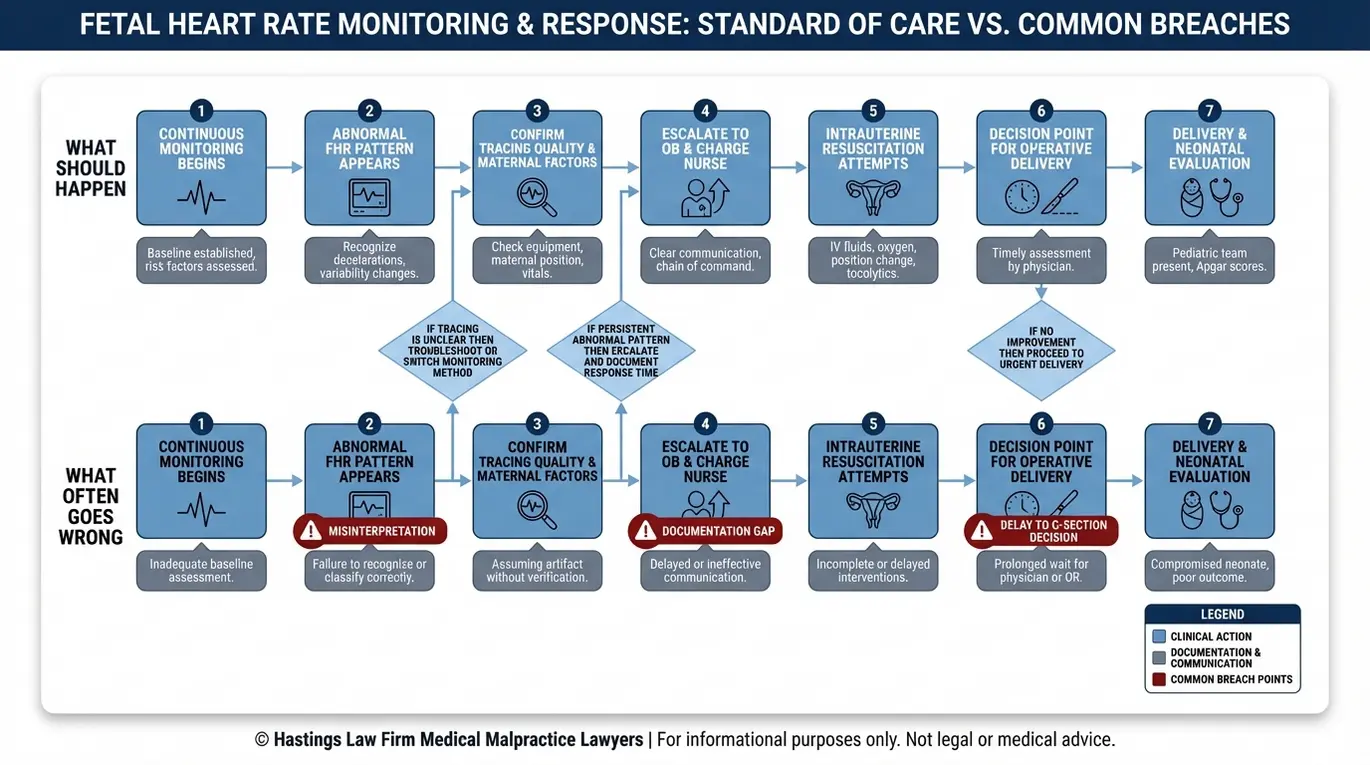
Hospitals primarily use external electronic fetal monitoring (EFM) using ultrasound and TOCO sensors, though internal monitoring via scalp electrodes may be used for higher precision during complicated labors. Understanding these systems helps clarify where errors can occur and how we evaluate potential negligence.
Hospitals primarily use electronic fetal monitoring, often called EFM, as a method of continuously tracking the baby’s heart rate and the mother’s contractions during labor. According to the Cleveland Clinic on electronic fetal monitoring, this technology is the primary tool used to assess fetal well-being during labor. Most Arizona hospitals use this technology as the standard approach for monitoring labor progression.
External monitoring involves two sensors placed on the mother’s abdomen. An ultrasound transducer tracks the fetal heart rate, while a tocodynamometer measures the timing and frequency of contractions. This method is non-invasive and works well in many situations, though it has limitations. Maternal movement, body habitus, and fetal position can affect signal quality. While external EFM is non-invasive, it can suffer from signal loss if the mother has a high Body Max Index (BMI) or if the baby is active.
Internal monitoring provides more precise data. A fetal scalp electrode, a small wire attached directly to the baby’s scalp, delivers a more accurate heart rate reading. An intrauterine pressure catheter can measure the actual intensity of contractions, not just their timing.
Internal monitoring bypasses the issues of external sensors by collecting data directly from the fetus. This provides a continuous, reliable signal that is critical when decisions must be made in seconds. These methods require the membranes to be ruptured and are typically reserved for higher-risk labors.
Some providers still use intermittent auscultation with a handheld Doppler device, listening to the heart rate at set intervals rather than continuously. This approach is less common in high-risk pregnancies but remains appropriate in certain low-risk situations.
| Monitoring Type | Method | Precision | Best Used For |
|---|---|---|---|
| External EFM | Ultrasound + TOCO sensors on abdomen | Moderate | Routine labor monitoring |
| Internal EFM | Scalp electrode + pressure catheter | High | High-risk or complicated labor |
| Intermittent Auscultation | Handheld Doppler | Variable | Low-risk pregnancies |
Arizona fetal monitoring malpractice attorneys examine which monitoring method was used and whether it was appropriate for the clinical situation.
The Limitations of TOCO Sensors
A tocodynamometer, commonly called a TOCO, is an external sensor used in electronic fetal monitoring to measure when contractions occur and how long they last, but it cannot measure the intensity of contractions. This limitation matters because the strength of contractions affects how the baby tolerates labor.
If the TOCO shows regular contractions but the care team cannot assess their force, they may misjudge how much stress the baby is experiencing. In cases where internal monitoring would provide clearer information, the failure to switch methods when external readings are inadequate can represent a departure from appropriate care.
The Hastings Law Firm Difference
Results matter, but what truly sets us apart is how we achieve them. Every verdict, every settlement, and every Arizona courtroom victory comes from one guiding promise: To treat each client’s fight for justice as if it were our own.
This balance of skill, experience, and empathy reflects our core philosophy that justice should not only compensate the injured, but also make health care safer nationwide.

Recognizing the Warning Signs on Fetal Heart Rate Tracings
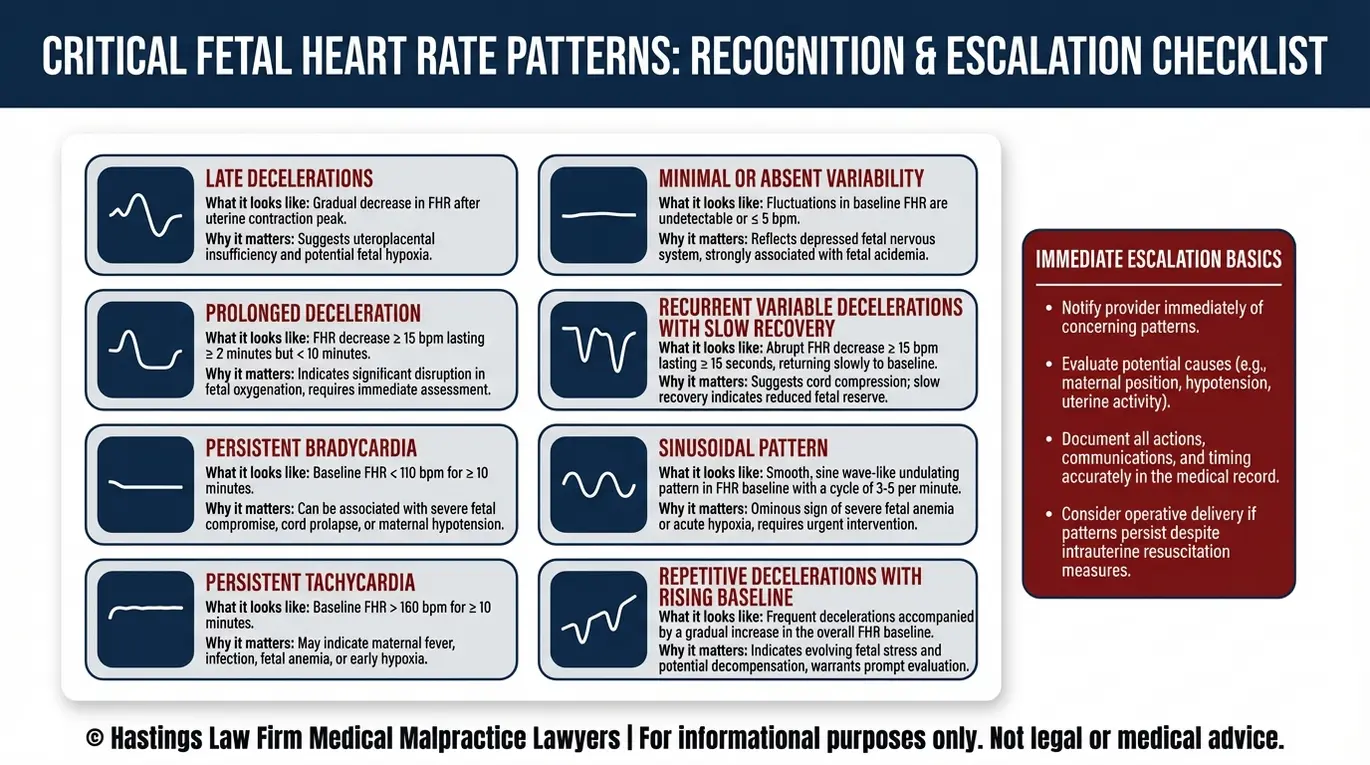
Critical warning signs on EFM strips include late decelerations, fetal bradycardia, tachycardia, and sinusoidal patterns, all of which indicate the baby is deprived of oxygen and requires immediate medical intervention. Each of these patterns signals that the intrauterine environment has become hostile.
A normal fetal heart rate baseline ranges between 110 and 160 beats per minute, with moderate variability showing the baby’s nervous system is functioning well. When patterns deviate from this baseline in specific ways, experienced clinicians recognize the need for intervention.
Late decelerations are drops in heart rate that occur after a contraction peaks rather than during it. This pattern suggests the placenta is not delivering adequate oxygen to the baby, a condition called uteroplacental insufficiency. A malpractice lawyer for fetal monitoring errors will examine whether the medical team recognized this pattern and responded appropriately.
Fetal heart rate variability, the normal fluctuation in heart rate from beat to beat, reflects the baby’s neurological health. When this variability disappears and the tracing becomes flat, it can indicate the baby’s nervous system is already compromised from oxygen deprivation, sometimes called hypoxia, or a reduction in oxygen supply.
A sinusoidal pattern is also particularly alarming as it represents a smooth, sine-wave-like undulation of the heart rate baseline. This rare but ominous sign is strongly associated with severe fetal anemia or massive feto-maternal hemorrhage. Immediate delivery is almost always required when this pattern appears to prevent severe hypoxic injury or death.
Red Flag Patterns Requiring Immediate Evaluation:
- Late decelerations occurring with multiple contractions
- Prolonged bradycardia (sustained heart rate below 110 bpm for more than 10 minutes)
- Tachycardia (sustained heart rate above 160 bpm, which may indicate infection or distress)
- Minimal or absent variability lasting more than 30-60 minutes
- Sinusoidal pattern (a smooth, wave-like pattern that can indicate severe fetal anemia)
- Variable decelerations that become progressively deeper or longer
The presence of one or more of these patterns does not automatically mean negligence occurred. What matters is how the care team responded and whether their actions met the standard of care given the information available to them.
Birth Injuries Resulting from Unheeded Fetal Distress
When medical staff ignore EFM warnings, infants can suffer catastrophic injuries including Hypoxic-Ischemic Encephalopathy (HIE), Cerebral Palsy, and permanent brain damage due to prolonged oxygen deprivation. The severity of injury often correlates with how long the baby was deprived of adequate oxygen before delivery.
Hypoxic-ischemic encephalopathy, or HIE, is a type of brain injury caused by reduced blood flow and oxygen to the brain around the time of birth. According to data from the Centers for Disease Control and Prevention’s National Vital Statistics Reports, birth-related complications remain a significant concern for infant health outcomes. HIE can range from mild, with full recovery expected, to severe, resulting in lifelong disabilities or death.
Cerebral palsy is a group of disorders affecting movement and muscle coordination. While not all cerebral palsy cases are caused by birth trauma, a significant percentage are linked to intrapartum asphyxia, which is oxygen deprivation occurring during the labor and delivery process. When EFM strips show prolonged distress that was not addressed, the connection between the monitoring failure and the injury becomes a central question.
In the most tragic instances, the failure to act on distress signals results in wrongful death. For families who have lost a child to preventable negligence, a legal claim provides a path to accountability, acknowledging the life that was cut short.
Injuries That May Result from Delayed Response to Fetal Distress:
- Hypoxic-ischemic encephalopathy (HIE)
- Cerebral palsy
- Developmental delays and intellectual disabilities
- Seizure disorders
- Vision and hearing impairments
- Stillbirth or neonatal death
An Arizona birth injury lawyer investigates whether timely intervention, such as an emergency C-section, could have prevented or reduced the severity of these injuries. The medical records, EFM strips, and nursing notes all contribute to understanding what happened and when.
Proving Negligence Using EFM Strips as Evidence
EFM strips serve as a permanent “paper trail” that provides a second-by-second timeline of the baby’s condition, allowing legal experts to prove exactly when the medical team should have intervened. Unlike verbal conversations or recollections that may differ between parties, fetal heart rate tracings, or EFM strips, are objective data recorded in real time.
A fetal monitoring negligence attorney uses these strips to reconstruct the timeline of labor. We can see exactly when concerning patterns first appeared, how long they persisted, and what actions (if any) the medical team took in response. This documentation is invaluable because it removes much of the uncertainty that can complicate other types of cases. During the discovery phase of litigation, we demand production of the original digital tracing files to ensure no data has been overlooked or altered.
Hospitals sometimes argue that the injury happened before the mother arrived, a strategy known as the “futility defense.” They may claim that even with perfect care, the outcome would have been the same. Our team counters this by having independent medical experts review the admission strips to determine the baby’s condition upon arrival. Establishing causation requires connecting the specific period of unaddressed distress to the injury diagnosed after birth.
Research published in PubMed Central on the reliability of intrapartum fetal heart rate monitoring interpretation shows that while EFM interpretation can vary between clinicians, certain patterns are universally recognized as requiring action. An Arizona fetal monitoring malpractice lawyer works with qualified OB/GYN experts who can testify about what a reasonably competent physician should have recognized and how they should have responded.
Expert testimony is essential in these cases. A qualified specialist reviews the EFM strips against the accepted standard of care and provides an opinion on whether the medical team’s conduct fell below that standard and whether the failure caused or contributed to the injury.
Recovering Damages for Birth Injuries in Arizona
Arizona law allows families to recover economic damages for past and future medical care, as well as non-economic damages for pain, suffering, and loss of quality of life, with no statutory cap on the amount awarded for wrongful death or personal injury.
This last point is significant. Unlike many states that limit how much families can recover for non-economic losses, the Arizona Constitution prohibits caps on damages for personal injury and wrongful death claims. This means juries in Arizona can award compensation that truly reflects the scope of harm caused by medical negligence. The jury is free to assess the true value of the non-economic damages based on the evidence presented, ensuring the award matches the severity of the loss.
Economic damages cover the tangible financial losses a family faces. For a child with a permanent brain injury, these costs can be enormous and span a lifetime. A life care plan, developed by medical and financial experts, projects the cost of ongoing therapy, specialized equipment, home modifications, educational support, and 24-hour care if needed. These plans ensure that compensation accounts for decades of future needs, adjusting for inflation and medical cost increases over the child’s life expectancy.
Non-economic damages address the losses that cannot be easily quantified: physical pain, emotional suffering, loss of enjoyment of life, and the impact on family relationships. For parents watching their child struggle with disabilities that should have been prevented, these damages recognize the profound human cost of medical negligence.
An Arizona fetal monitoring malpractice lawyer helps families understand the full scope of compensation available under Arizona Revised Statutes § 12-542, which governs the timeline for filing personal injury claims. Building a thorough damages case requires gathering medical records, expert opinions, and life care planning early in the process.
Contact the Arizona Birth Injury Attorneys at Hastings Law Firm Today for Help
A birth injury caused by monitoring failures changes everything for a family. The plans you had, the future you imagined, all of it shifts in ways you never expected. Your child deserves every resource available to support their development and quality of life.
Hastings Law Firm handles medical malpractice cases exclusively. We do not spread our attention across unrelated practice areas. This focus means our attorneys, nurses, and support staff dedicate their full expertise to cases like yours. Our team includes former hospital nurses and former defense attorneys who understand how medical institutions operate and how they defend themselves.
If you believe your child’s injury resulted from a failure to monitor or respond to fetal distress, we want to hear what happened. Contact us for a free, confidential case evaluation. There is no fee unless we recover compensation for your family.
Frequently Asked Questions About Fetal Monitoring Error in Arizona


This content was researched and written by the Hastings Law Firm editorial team, which includes attorneys, medical professionals, and experienced researchers. Our writing is informed by internal knowledge and practical experience, and we cross-check critical details against authoritative sources cited throughout. Every piece undergoes human-led fact-checking and legal review. Because legal and medical information can change, if you spot an error, please contact us. Learn more about our content standards and review process on our editorial policy page.

Tommy Hastings, founder of Hastings Law Firm, is a board-certified personal injury trial lawyer (by the Texas Board of Legal Specialization) dedicated exclusively to healthcare injury cases. Since 2001, he has represented injured patients and families in litigation against major hospital systems, pharmaceutical companies, and negligent healthcare providers nationwide. He has handled numerous high-profile cases that have drawn national media attention and resulted in multi-million dollar recoveries.
