


Phoenix Medical Misdiagnosis Lawyer
A wrong or delayed diagnosis can derail treatment and leave lasting physical and emotional harm. When a provider misses key warning signs or stops evaluating too soon, a condition can progress until options are limited and outcomes become life threatening. Not every diagnostic mistake is malpractice, but preventable errors that fall below the accepted standard of care can create accountability when they cause injury. If you or a loved one were harmed or worse due to medical misdiagnosis in Phoenix, Arizona, contact Hastings Law Firm for a free, confidential case review.

Last Updated: July 27, 2026
Trusted Medical Attorneys for Wrong Diagnosis Claims in Phoenix
When a doctor gets the diagnosis wrong, the consequences can change everything. A condition that could have been treated early may progress to a stage where options are limited. Recovery may become uncertain, and the emotional toll can be overwhelming.
If you or a loved one received a wrong or delayed diagnosis from a Phoenix healthcare provider, you likely have questions about what went wrong. You may wonder if anyone can be held accountable for the harm you suffered.
As a Phoenix Medical Misdiagnosis Lawyer team, Hastings Law Firm focuses exclusively on medical malpractice. Our legal and medical professionals, including in-house nurse consultants and former defense attorneys, investigate diagnostic failures with the same rigor we bring to every case we accept. We prepare from day one as though the case will go to a jury, because that preparation is what drives fair outcomes.
If something about your care does not sit right, we are here to listen. Contact us for a free, confidential case evaluation to learn whether you have a claim.

Understanding Medical Misdiagnosis and Diagnostic Errors in Arizona
Medical misdiagnosis occurs when a healthcare provider fails to accurately identify a patient’s condition, leading to incorrect treatment, delayed care, or no treatment at all, and that failure results in harm. Not every wrong answer amounts to malpractice, but when a doctor’s diagnostic error falls below the accepted standard of care, the law provides a path to accountability.
Diagnostic errors generally fall into three categories. A failure to diagnose is an error where the condition is missed entirely. This results in the patient being told nothing is wrong and sent home without the correct identification of their illness.
A misdiagnosis, the assignment of the wrong condition, can lead a patient down a treatment path that does nothing to address the actual problem. This can cause additional harm from unnecessary procedures. A delayed diagnosis means the doctor eventually identifies the correct condition, but only after critical time has passed.
Each of these scenarios can allow a disease to advance unchecked. Cancer may spread or an infection may become systemic. The emotional weight of learning that your condition could have been caught earlier is something we take seriously. It is a form of betrayal by the system you trusted to protect your health.
What separates a bad outcome from medical negligence is whether the provider’s conduct fell below what a reasonably competent physician in the same specialty would have done. This legal benchmark ensures that doctors are not penalized for honest mistakes that fall within accepted practices. We focus on preventable errors that cause actual injury. A Phoenix misdiagnosis attorney helps establish this through medical records, expert analysis, and a careful reconstruction of the clinical timeline.
Commonly Misdiagnosed Conditions in Phoenix Hospitals
The most commonly misdiagnosed conditions include cancer, heart attacks, and strokes, often mistaken for less severe issues like indigestion, anxiety, or benign infections. Research published by Johns Hopkins University on the burden of serious harms from diagnostic error found that a small number of high-harm conditions account for many diagnostic failures.
These conditions fall into three major categories. Cancer, including lung, breast, and colorectal cancer, is frequently missed because early symptoms can mimic common complaints. Vascular events like stroke and heart attack are sometimes attributed to stress or migraines, particularly in women and younger patients. Serious infections such as sepsis and meningitis can be initially treated as the flu, with devastating results when the true cause goes unrecognized.
A central issue in many of these cases is the failure to conduct a proper differential diagnosis. This is the systematic process doctors should use to evaluate all plausible conditions and rule out the most dangerous ones first. As explained by MedlinePlus, this method requires ordering screening tests, reviewing lab results, and making timely specialist referrals. When a provider skips steps or locks onto a single explanation too early, life-threatening conditions go undetected.
A false-negative test result, where a test incorrectly indicates a condition is absent, can compound the problem. Even then, the standard of care may require the physician to follow up or order additional testing if the clinical symptoms do not match the result.
| Condition | Commonly Mistaken For | Consequences of delay |
|---|---|---|
| Lung, Breast, or Colon Cancer | Respiratory infection, fibrocystic changes, IBS | Progression to advanced stage; reduced survival rate |
| Heart Attack | Acid reflux, anxiety, musculoskeletal pain | Permanent heart damage or death |
| Stroke | Migraine, vertigo, fatigue | Irreversible brain injury, paralysis, death |
| Sepsis | Flu, urinary tract infection, general malaise | Organ failure, amputation, death |
| Meningitis | Viral illness, tension headache | Brain damage, hearing loss, death |
Under Article 2, Section 31 of the Arizona Constitution, individuals who suffer personal injury or death retain the right to recover damages. The legislature cannot place an arbitrary cap on those recoveries. For anyone harmed by a wrong diagnosis in Phoenix, that constitutional protection is significant. A wrong diagnosis lawyer in Phoenix can help determine whether the medical records support a claim.

The Hastings Law Firm Difference
Results matter, but what truly sets us apart is how we achieve them. Every verdict, every settlement, and every Phoenix courtroom victory comes from one guiding promise: To treat each client’s fight for justice as if it were our own.
This balance of skill, experience, and empathy reflects our core philosophy that justice should not only compensate the injured, but also make health care safer nationwide.

Patient Red Flags Suggesting a Missed Diagnosis
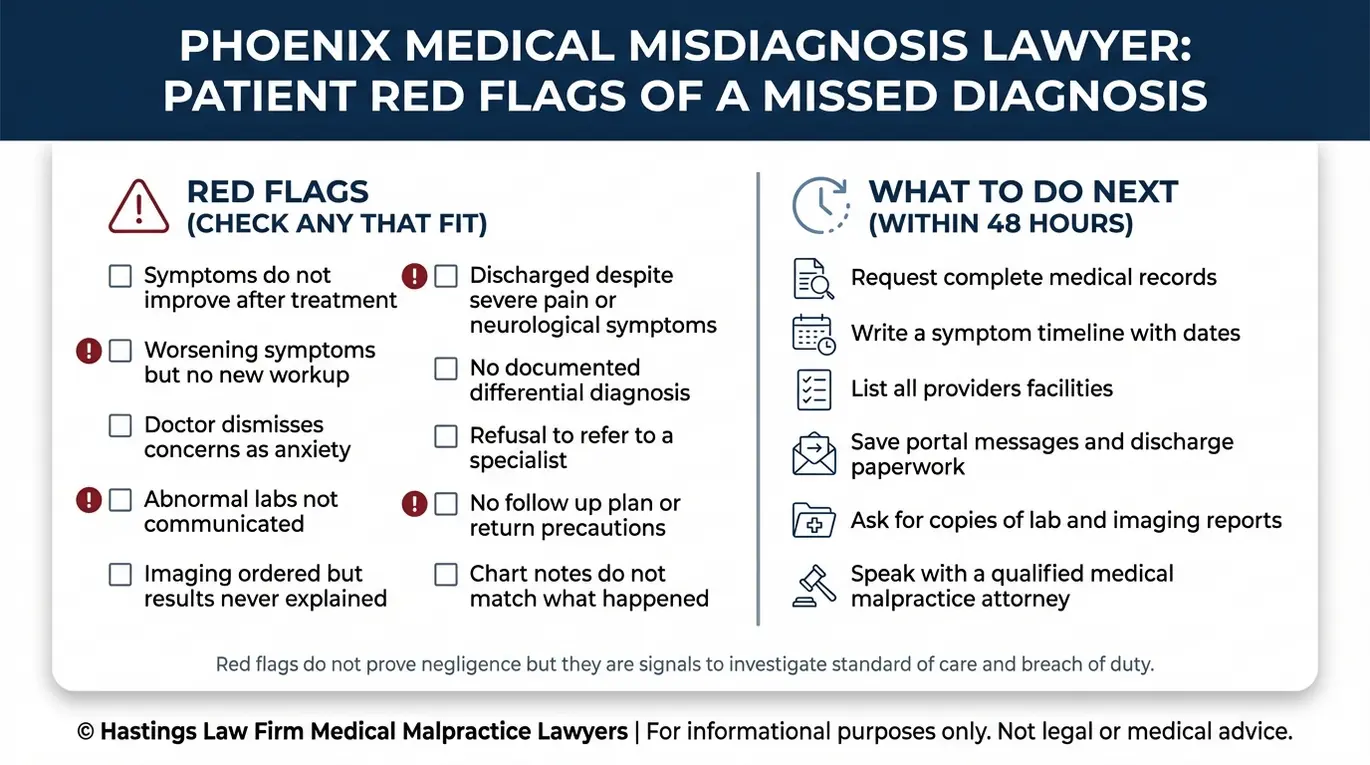
Red flags of a missed diagnosis include symptoms that do not improve with treatment, test results that are never communicated to the patient, or a doctor who refuses to order further testing despite worsening conditions. A delayed diagnosis, where a correct identification comes only after the disease has progressed, often leaves patients asking why no one acted sooner.
If you are looking back at your care and something feels wrong, consider whether any of these patterns apply:
- Your doctor dismissed persistent symptoms as anxiety, stress, or aging without further investigation
- Abnormal lab results or a critical test result were never discussed with you or acted upon
- You were discharged from an emergency room despite severe or worsening pain
- Your provider refused to refer you to a specialist even after initial treatment failed
- You were given a diagnosis, but the prescribed treatment had no effect on your symptoms
- Your medical records, which you have the right to obtain through resources like Maricopa County’s Medical Records guide, contain notes that do not match what you were told
These warning signs do not automatically prove negligence. They can indicate a breach of duty, showing that a provider failed to meet the expected degree of care that a competent physician would provide. A medical malpractice lawyer for misdiagnosis can review your records and help determine whether those gaps led to preventable harm.
Proving Negligence: The Standard of Care and Causation
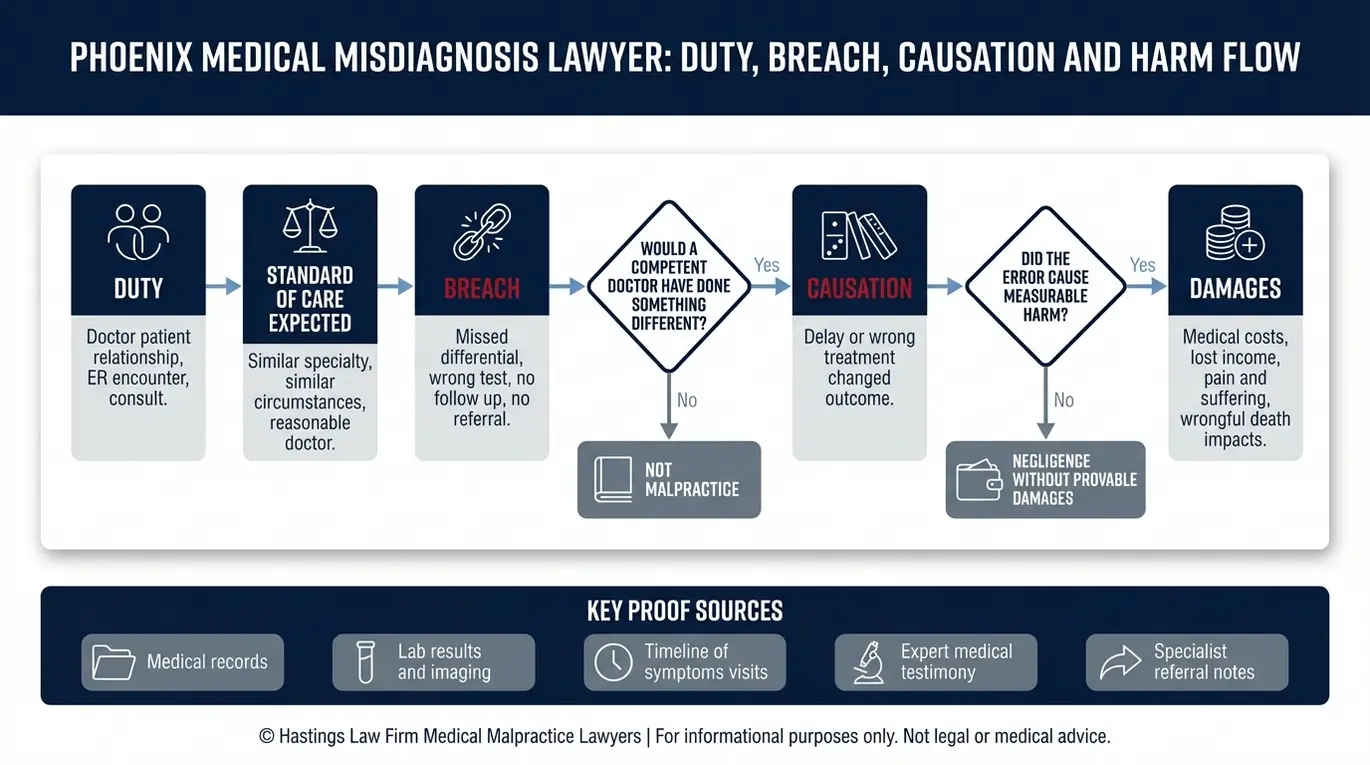
To prove misdiagnosis malpractice, you must demonstrate that a competent doctor in the same specialty would have correctly diagnosed the condition under similar circumstances, and that the diagnostic error directly caused specific harm. This is the legal framework that establishes liability, separating a clinical disagreement from actionable medical negligence.
Our founder Tommy Hastings is board-certified in Personal Injury Trial Law, a distinction held by fewer than 2% of attorneys in Texas, and he uses this expertise to build strong claims. A Phoenix failure to diagnose attorney builds this case in three steps:
- Step 1: Establishing Duty. The first element is proving a doctor-patient relationship existed. Once a provider agrees to evaluate or treat you, they owe you a legal duty of care.
- Step 2: Proving Breach. The core question is whether the doctor deviated from the standard of care. This is the level of treatment a reasonably competent provider in the same specialty would deliver. For example, if a patient has sudden, severe headaches and a physician fails to order imaging to rule out a stroke, a medical expert may testify that the omission fell below the accepted standard.
- Step 3: Proving Causation. You must also show that the diagnostic error caused or worsened the harm. This is often challenging when the underlying condition was already serious. Expert medical testimony is used to establish that an earlier diagnosis would have led to a different treatment path and a better outcome.
Under A.R.S. § 12-563, a medical malpractice claim in Arizona requires proof that the provider’s negligence was the cause of the injury. Each of these elements must be supported by qualified expert testimony. Our team works with specialists across the country to build that foundation and determine if a specialist referral should have been made.
Damages Recoverable for Diagnostic Errors
Patients harmed by diagnostic errors can recover compensatory damages, including economic damages for medical bills and lost wages, as well as non-economic damages for pain, suffering, and loss of life enjoyment. The specific value of a medical misdiagnosis settlement or verdict depends on the severity of harm and how the delay affected the patient’s treatment and prognosis.
- Economic damages cover the financial losses directly tied to the error. These include medical costs, which often increase when a delayed diagnosis forces more aggressive treatment, such as late-stage chemotherapy instead of surgery.
- Non-economic damages address the harm that does not carry a receipt. Pain and suffering, mental anguish, and the loss of the ability to enjoy life are all compensable. For spouses, a claim for loss of consortium may be available when the error damages the marital relationship.
In cases where the patient passes away as a result of the diagnostic failure, surviving family members may pursue a wrongful death claim. In rare cases involving extreme or reckless conduct, punitive damages may also be available to deter similar behavior.
Arizona law provides an important protection because the Arizona Constitution generally prohibits caps on damages for personal injury. This means juries are free to award what the evidence supports without an artificial ceiling reducing what a family can recover.
Arizona Statute of Limitations and The Discovery Rule
In Arizona, medical malpractice claims must generally be filed within two years of the date the injury occurred. This deadline is set by the Arizona Revised Statutes, specifically A.R.S. § 12-542, and missing it can permanently bar your claim.
The discovery rule recognizes that some diagnostic errors are not immediately apparent. In a cancer misdiagnosis case, a patient may not learn the original diagnosis was wrong until months or even years later. Under this rule, the time limit for filing a claim may begin when the patient knew, or reasonably should have known, the injury was connected to the provider’s error.
Courts interpret this exception narrowly. Relying on it without legal guidance is risky. If you suspect a diagnostic error contributed to your condition, the safest step is to speak with an attorney as soon as possible so that critical deadlines are not missed.
Contact the Phoenix Misdiagnosis Attorneys at Hastings Law Firm Today for Help
A wrong diagnosis is more than a medical mistake. It is a violation of the trust you placed in someone responsible for your care. Established by Tommy Hastings in 2005, our firm has a long history of helping patients hold healthcare systems accountable.
As a Phoenix Medical Misdiagnosis Lawyer team, we prepare every case for trial from day one. Our contingency fee structure means you pay no attorney fees or costs unless we recover compensation on your behalf. There is no financial risk in reaching out.
Contact Hastings Law Firm today for a free, confidential case evaluation. Let us review what happened and explain your options.
Frequently Asked Questions About Medical Misdiagnosis in Phoenix


This content was researched and written by the Hastings Law Firm editorial team, which includes attorneys, medical professionals, and experienced researchers. Our writing is informed by internal knowledge and practical experience, and we cross-check critical details against authoritative sources cited throughout. Every piece undergoes human-led fact-checking and legal review. Because legal and medical information can change, if you spot an error, please contact us. Learn more about our content standards and review process on our editorial policy page.

Tommy Hastings, founder of Hastings Law Firm, is a board-certified personal injury trial lawyer dedicated exclusively to healthcare injury cases. Since 2001, he has represented injured patients and families in litigation against major hospital systems, pharmaceutical companies, and negligent healthcare providers nationwide. He has handled numerous high-profile cases that have drawn national media attention and resulted in multi-million dollar recoveries. He draws on that experience in his writing, helping readers understand how these cases work and what options may be available to them.
