


Phoenix Hospital Malpractice Lawyer
Hospital negligence can leave patients and families facing serious injuries, mounting costs, and lasting uncertainty about what went wrong. In Arizona, a poor outcome alone is not enough, and claims often turn on whether hospital staff or systems fell below the accepted standard of care and whether that lapse caused measurable harm. Common issues range from treatment and medication mistakes to emergency room failures and broader institutional problems like understaffing. If you or a loved one were harmed or worse due to hospital malpractice in Phoenix, Arizona, contact Hastings Law Firm for a free, confidential case review.

Last Updated: October 4, 2026
Trusted Phoenix Malpractice Attorneys for Hospital Injury Claims
When you or someone you love is harmed during what should have been safe medical care, the experience can feel isolating. Hospitals are large, well-funded institutions with legal teams, risk management departments, and layers of administration designed to protect their interests. You may feel like the system that was supposed to help you has let you down, and you may not know where to turn for honest answers about what went wrong.
Hastings Law Firm represents patients and families harmed by hospital negligence across Phoenix and throughout Arizona. As a firm that focuses exclusively on medical malpractice since 2005, our team includes former defense attorneys, in-house nurse consultants, and board-certified trial leadership. We understand how hospitals operate, from credentialing and privileging, the internal process hospitals use to verify and authorize a provider’s qualifications before granting them the ability to treat patients, to the clinical protocols that govern daily care.
If you believe a hospital error caused serious harm, a Phoenix Hospital Malpractice Lawyer at our firm can review what happened and explain your options in a free, confidential case evaluation.

Understanding Hospital Malpractice Laws in Arizona
Hospital malpractice occurs when a facility or its staff deviates from the accepted standard of care, causing injury to a patient. The standard of care refers to the level of treatment a reasonably competent healthcare provider would deliver under similar circumstances. In a hospital setting, this applies not only to physicians and surgeons but also to nurses, technicians, pharmacists, and the institution itself. It is the benchmark against which all medical actions are measured during a legal review.
An unfavorable medical outcome does not automatically mean malpractice occurred. Medical procedures carry inherent risks, and sometimes treatment fails despite best efforts. To pursue a valid claim, the patient or their family must prove that medical negligence, not just bad luck or a known complication, caused the harm. This is known as the burden of proof, and it rests entirely on the person bringing the claim against the facility.
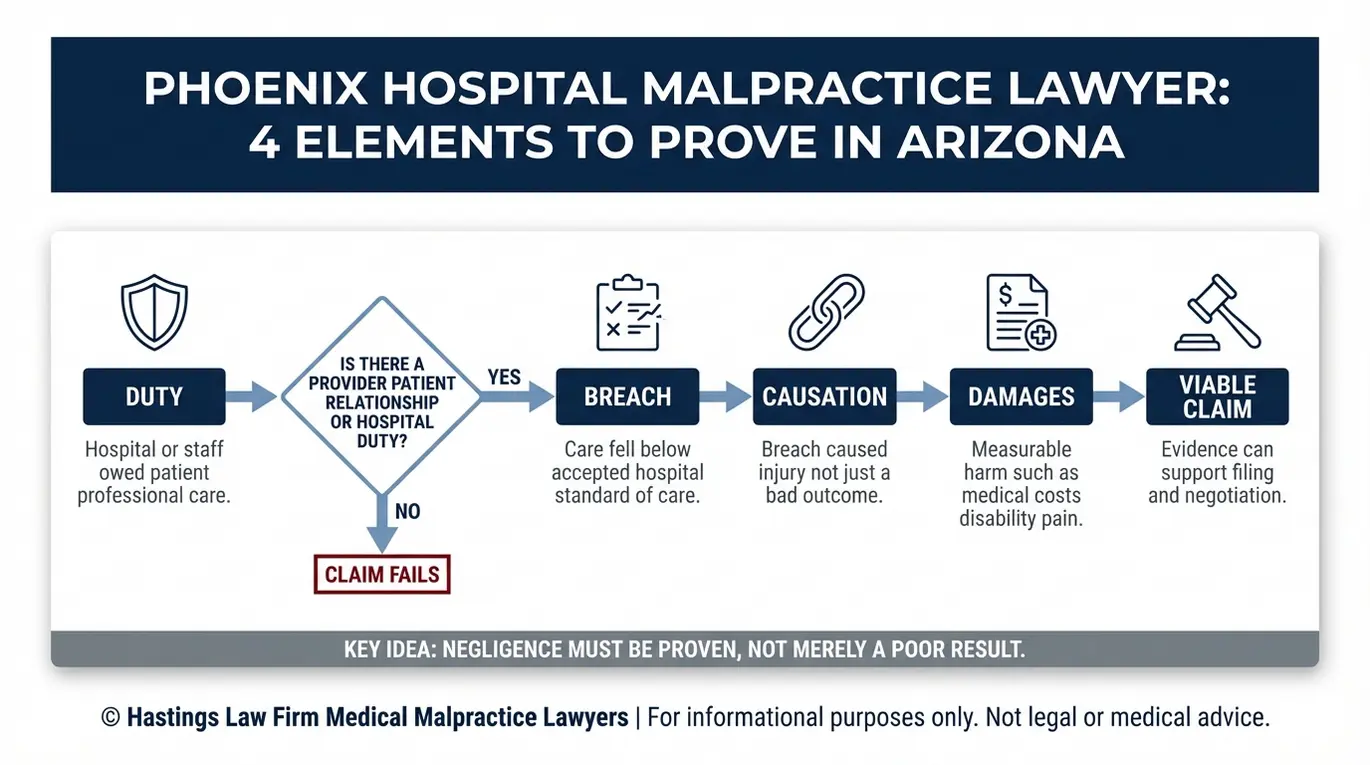
Arizona hospital malpractice cases require proof of four legal elements:
- Duty: The hospital or healthcare provider owed the patient a duty of care. This duty is established the moment a provider-patient relationship exists, such as when a patient is admitted, treated in the emergency department, or undergoes a procedure.
- Breach: The provider or facility failed to meet the accepted standard of care. A breach of duty can include errors in treatment, delayed response to critical changes in a patient’s condition, or patient dumping, the illegal practice of transferring or discharging a patient from an emergency department without providing a proper medical screening or stabilizing treatment.
- Causation: The breach directly caused or materially contributed to the patient’s injury. This is often the most contested element, because the defense will argue the injury was caused by the patient’s underlying condition rather than any error.
- Damages: The patient suffered actual, measurable harm, whether physical, financial, or emotional.
Understanding emergency department triage, the system hospitals use to assign treatment priority based on the Emergency Severity Index (ESI), can also be relevant. If triage protocols were not followed and a serious condition was deprioritized, that may constitute a breach.
A Phoenix hospital malpractice lawyer or attorney for hospital negligence can help determine whether these four elements are present in your situation and whether negligence can be established through the medical evidence.
Common Types of Errors in Phoenix Hospitals
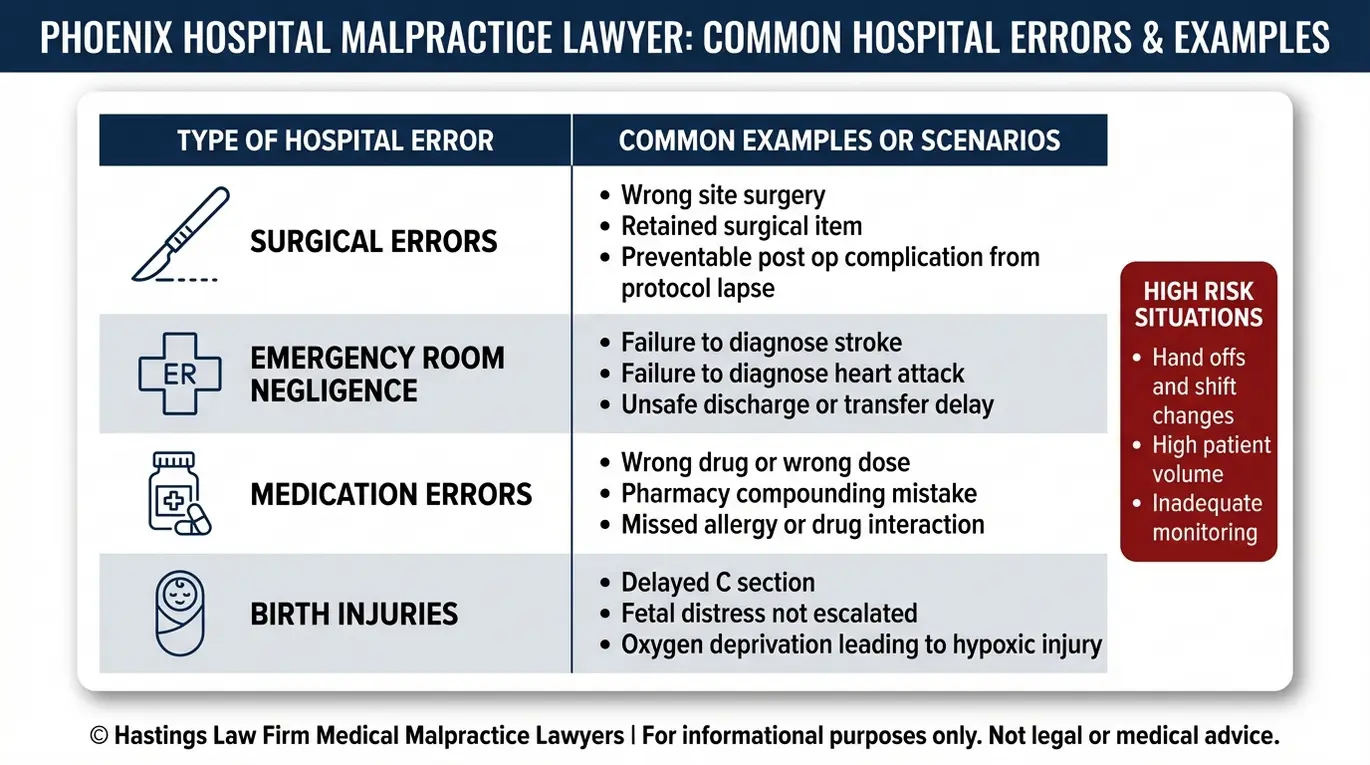
Common hospital errors include surgical mistakes, medication errors, emergency room negligence, and birth injuries caused by preventable oversight. While each case involves unique medical facts, certain patterns of hospital malpractice appear repeatedly in claims across Phoenix and Maricopa County. Identifying these specific errors is a necessary step in determining if a facility followed proper patient safety protocols.
| Type of Error | Common Examples |
|---|---|
| Surgical Errors | Wrong-site surgery (operating on the wrong body part or wrong patient), retained surgical items (RSIs) such as sponges or instruments left inside the body, nerve damage from improper technique |
| Emergency Room Errors | Failure to diagnose a stroke or heart attack, premature discharge, inadequate monitoring, triage failures that delay treatment of critical patients |
| Medication Errors | Administering the wrong drug or dosage, pharmacy compounding mistakes, dangerous drug interactions missed by hospital staff |
| Anesthesia Errors | Incorrect dosage, failure to review patient history for allergies or contraindications, inadequate monitoring during sedation |
| Birth Injuries | Failure to perform a timely C-section, improper use of forceps or vacuum extraction leading to hypoxia (oxygen deprivation) or cerebral palsy |
| Failure to Diagnose | Missed or delayed diagnosis of cancer, infection, pulmonary embolism, or other time-sensitive conditions |
A wrong-site surgery, sometimes called a “never event” because it should never happen under proper safety protocols, often points to breakdowns in pre-operative verification. A retained surgical item (RSI) is any foreign object, such as a sponge, needle, or clamp, unintentionally left in a patient’s body after a procedure. Our Phoenix hospital malpractice attorneys frequently handle cases involving these devastating preventable errors.
Hospital error data reported through the Arizona Health Care Cost Containment System (AHCCCS) can provide insight into facility-level safety trends across the state. When our hospital malpractice lawyers in Phoenix investigate a claim, this type of public data can help identify whether a hospital has a pattern of similar incidents. This data helps establish if a facility has a history of disregarding patient safety protocols.
Each of these errors may involve multiple responsible parties. A Phoenix hospital malpractice attorney examines not just the individual provider’s actions but the hospital systems that allowed the error to occur. Our malpractice lawyers review operative reports, nursing notes, lab results, and monitoring records to build a clear picture of what happened and where care broke down.
The Hastings Law Firm Difference
Results matter, but what truly sets us apart is how we achieve them. Every verdict, every settlement, and every Phoenix courtroom victory comes from one guiding promise: To treat each client’s fight for justice as if it were our own.
This balance of skill, experience, and empathy reflects our core philosophy that justice should not only compensate the injured, but also make health care safer nationwide.

Phoenix Hospitals Where Negligence Claims Arise
The Phoenix area’s hospitals belong to nonprofit systems such as Banner Health, HonorHealth, Dignity Health, and Phoenix Children’s, the for-profit Abrazo Health, and Maricopa County’s public teaching hospital, with trauma centers from Goodyear to Mesa and Chandler. Arizona law expects the same standard of care from each of them.
Claims in the Phoenix area frequently involve the hospitals below, and each has a dedicated page describing the negligence patterns we see at that facility.
- Phoenix Children’s Hospital is a Level I pediatric trauma center and teaching hospital with a Level IV NICU, where missed emergency diagnoses, pediatric surgery and anesthesia errors, and NICU and pediatric intensive care errors arise.
- Banner – University Medical Center Phoenix is Banner Health’s academic Level I trauma center with transplant and heart programs, where emergency and trauma errors, surgical, transplant, and heart procedure errors, and high-risk obstetric injuries arise.
- Banner Desert Medical Center is a Level I trauma and tertiary referral hospital in Mesa, home to Banner Children’s at Desert, where labor, delivery, and NICU injuries, children’s emergency errors, and delayed stroke and heart care arise.
- St. Joseph’s Hospital and Medical Center is a Level I trauma center and teaching hospital with Barrow Neurological Institute on its campus, where brain and spine surgery errors, emergency and trauma diagnosis errors, and birth and NICU injuries arise.
- Dignity Health Chandler Regional Medical Center is a Level I trauma center serving the East Valley, where delayed stroke and emergency diagnoses, robotic, orthopedic, and general surgery errors, and pregnancy, delivery, and NICU injuries arise.
- Valleywise Health Medical Center is Maricopa County’s public teaching hospital, with a Level I trauma center and a burn center, where trauma and burn care failures, harm to mothers and newborns, and pediatric emergency and ICU errors arise. Because a public district operates it, a notice of claim must be filed within 180 days.
- HonorHealth Scottsdale Osborn Medical Center is a Level I trauma center with DNV Comprehensive Stroke Center certification, where missed injuries after serious trauma, late stroke care, and neurosurgery and general surgery errors arise.
- HonorHealth John C. Lincoln Medical Center is a Level I trauma center in north-central Phoenix that hosts a general surgery residency, where overlooked trauma injuries, complications after general, orthopedic, and robotic surgery, and delayed stroke treatment arise.
- HonorHealth Deer Valley Medical Center is a Level I trauma center on the north Phoenix I-17 corridor, where missed internal injuries and fractures, late care for chest pain, cardiac arrest, and stroke, and missed surgical complications arise.
- Abrazo West Campus is a Tenet-owned Level I trauma center in Goodyear with a comprehensive stroke center and a maternity unit, where trauma and emergency delays, late stroke treatment, and preventable harm to mothers and newborns arise.
Systemic Failures and Corporate Negligence
Beyond individual doctor errors, hospitals can be liable for systemic failures and corporate negligence such as understaffing, inadequate training, or unsafe protocols. These institutional breakdowns often set the stage for the bedside errors that directly harm patients.
Hospital understaffing, a condition where nurse-to-patient ratios exceed safe limits, is one of the most common systemic problems we investigate. When nurses are responsible for too many patients at once, critical warning signs can be missed, medications can be delayed, and response times suffer. Research published through the National Academies of Sciences, Engineering, and Medicine has documented how clinician burnout, driven by unsustainable workloads, directly threatens patient safety.
A related concept is failure to rescue, which occurs when hospital staff fail to recognize and respond to a patient whose condition is deteriorating. Failure to rescue is often a symptom of deeper institutional problems: too few nurses per shift, inadequate monitoring equipment, or poor communication between departments.
One defense hospitals frequently raise is that the physician involved was an “independent contractor,” not a hospital employee. This argument is designed to shift hospital liability away from the institution. A Phoenix hospital malpractice lawyer experienced in these cases knows how to challenge this defense by examining how much control the hospital exercised over the negligent healthcare provider’s work, scheduling, and protocols. In many situations, the hospital still bears responsibility for the systems and conditions that contributed to the harm. A lawyer for hospital errors can identify these hidden liability structures.
How Medical Experts and In-House Nurses Build Your Case
Building a strong case requires expert testimony to validate the breach of duty and connect it to the patient’s injury. In Arizona, as in most states, a qualified medical expert witness must explain to the court what the standard of care required and how the hospital or provider fell short.
Our approach as a Phoenix hospital malpractice lawyer differs from general practice firms because we integrate clinical insights early in the process. Our legal team includes in-house medical staff, such as nurse practitioners and Board Certified Patient Advocates who work alongside our attorneys from the earliest stages of investigation. These professionals know how hospitals document care, and they know where to look for inconsistencies that may reveal what actually happened versus what was recorded.
For example, every medication a hospital administers should be documented in the medication administration record (MAR), a detailed log of what drugs were given, at what dosage, and at what time. Our nurses cross-reference these records against physician orders and the patient’s clinical presentation. They also review electronic health record (EHR) audit trails, the digital logs that track every entry, edit, and deletion made in a patient’s chart, to determine whether records were altered after an adverse event.
Under federal law, patients have the right to access their own health information. The U.S. Department of Health and Human Services’ HIPAA Access Guidance confirms that individuals can request complete copies of their medical records, which is a critical first step in any investigation.
Here is an overview of our case evaluation and investigation process as a Phoenix medical malpractice attorney:
- Obtain and organize all hospital records, imaging, lab results, and billing data
- Conduct an in-house clinical review by our nurse practitioners to identify potential breaches
- Analyze the MAR, nursing flow sheets, and EHR audit trails for inconsistencies or gaps
- Consult with nationally recognized medical experts in the relevant specialty
- Reconstruct a detailed timeline of the patient’s care, minute by minute when necessary
- Identify all potentially responsible parties, from individual providers to the hospital entity
This medical-legal collaboration is what allows us to evaluate whether negligence occurred and, if so, to build the evidence needed to prove it.
Recovering Compensation for Medical Injuries
Patients harmed by hospital negligence may recover economic damages for medical bills and lost wages, as well as non-economic damages for pain, suffering, and loss of quality of life. The type and amount of compensation depends on the severity of the injury, the impact on the patient’s daily life, and the strength of the evidence.
Damages in hospital malpractice cases generally fall into two categories:
- Economic Damages: These cover measurable financial losses, including past and future medical expenses, rehabilitation costs, lost wages, and diminished earning capacity. In cases involving permanent injury, an economist or life care planner may project the total cost of future care.
- Non-Economic Damages: These address losses that cannot be easily quantified, such as physical pain, emotional distress, mental anguish, loss of enjoyment of life, and loss of companionship (in wrongful death claims brought by surviving family members).
One issue that often surprises families after a settlement or verdict is subrogation. Subrogation is the legal right of a health insurer or government program (like Medicare or AHCCCS) to recover money it paid for treatment related to the malpractice injury. In other words, your health insurance company may claim a portion of your recovery.
Our Phoenix hospital malpractice lawyers handle subrogation negotiations as part of the case, working to reduce these liens so that more of the compensation for hospital negligence reaches the client. This is an often-overlooked part of the process, but it can significantly affect the final amount a family receives.
Arizona’s Statute of Limitations for Hospital Malpractice Claims
In Arizona, medical malpractice claims must generally be filed within two years from the date the injury occurred or was discovered. This deadline is established under Arizona Revised Statutes (ARS) § 12-542, and missing it typically means losing the right to pursue a claim entirely. Understanding the statute of limitations is critical to preserving your right to seek legal relief after a medical error.
⚠️ Arizona’s Filing Deadline: What You Need to Know
The two-year clock does not always start on the date of the procedure or hospital visit. Arizona recognizes the “discovery rule,” which means the statute of limitations may begin when the patient knew, or reasonably should have known, that an injury occurred and that it may have been caused by negligence. This is particularly relevant in cases involving missed diagnoses or conditions that take time to manifest.
There are also exceptions for minors. Children injured by medical negligence may have additional time to file, depending on their age at the time of the injury.
Because these deadlines are strict and the exceptions are fact-specific, consulting with a Phoenix hospital malpractice lawyer early protects your ability to pursue a claim. Evidence can degrade, witnesses’ memories fade, and medical records retention policies can limit what is available over time.
Contact the Phoenix Hospital Malpractice Attorneys at Hastings Law Firm Today for Help
Hospital malpractice cases are not just about compensation. They are about finding out what actually happened, holding the responsible parties accountable, and helping prevent the same harm from happening to another patient or family.
At Hastings Law Firm, our team was built for exactly these cases. Founded by Tommy Hastings, a board-certified trial attorney and 2025 inductee into the American Board of Trial Advocates (ABOTA), the firm brings together former defense attorneys who understand hospital litigation strategy and in-house medical professionals who know how to read clinical records. Every case we accept is prepared from day one as if it will go to a jury, because that preparation is what drives fair outcomes, whether a case resolves through settlement or at trial.
If you or a loved one was seriously injured by a hospital error in Phoenix or anywhere in Arizona, we are here to listen. Our consultations are free, confidential, and come with no obligation. You pay no attorney fees or costs unless we recover compensation on your behalf.
Contact a Phoenix Hospital Malpractice Lawyer at Hastings Law Firm to schedule your case evaluation and take the first step toward answers.
Frequently Asked Questions About Hospital Malpractice in Phoenix


This content was researched and written by the Hastings Law Firm editorial team, which includes attorneys, medical professionals, and experienced researchers. Our writing is informed by internal knowledge and practical experience, and we cross-check critical details against authoritative sources cited throughout. Every piece undergoes human-led fact-checking and legal review. Because legal and medical information can change, if you spot an error, please contact us. Learn more about our content standards and review process on our editorial policy page.

Tommy Hastings, founder of Hastings Law Firm, is a board-certified personal injury trial lawyer (by the Texas Board of Legal Specialization) dedicated exclusively to healthcare injury cases. Since 2001, he has represented injured patients and families in litigation against major hospital systems, pharmaceutical companies, and negligent healthcare providers nationwide. He has handled numerous high-profile cases that have drawn national media attention and resulted in multi-million dollar recoveries.
