


Phoenix Dangerous Drug Injury Lawyer
A dangerous drug injury can leave a patient facing sudden medical complications, uncertainty about what went wrong, and lasting harm that affects daily life. These cases often involve more than one possible source of error, such as a defective medication, a prescribing mistake, or a pharmacy dispensing problem. Understanding how responsibility is evaluated can help families make sense of a confusing situation and recognize why careful documentation and expert review matter. If you or a loved one were harmed or worse due to dangerous drug injuries in Phoenix, Arizona, contact Hastings Law Firm for a free, confidential case review.

Last Updated: July 27, 2026
Trial-Ready Phoenix Dangerous Drug Injury Lawyers Defending Patient Safety
When a medication you trusted to help you causes serious harm, the experience can feel deeply disorienting. You followed your doctor’s instructions, filled the prescription, and took it as directed. Now you’re dealing with an injury that never should have happened, and you may not be sure who is responsible or what to do next.
At Hastings Law Firm, we focus exclusively on medical malpractice, including pharmaceutical injuries caused by defective drugs, prescribing errors, and dispensing mistakes. Our Phoenix dangerous drug lawyer team includes in-house medical professionals and former defense attorneys who understand how these cases are built from both sides. If a medication has harmed you or someone in your family, we can review what happened and explain your legal options at no cost and no obligation.
—

Understanding Liability in Pharmaceutical Injury Cases
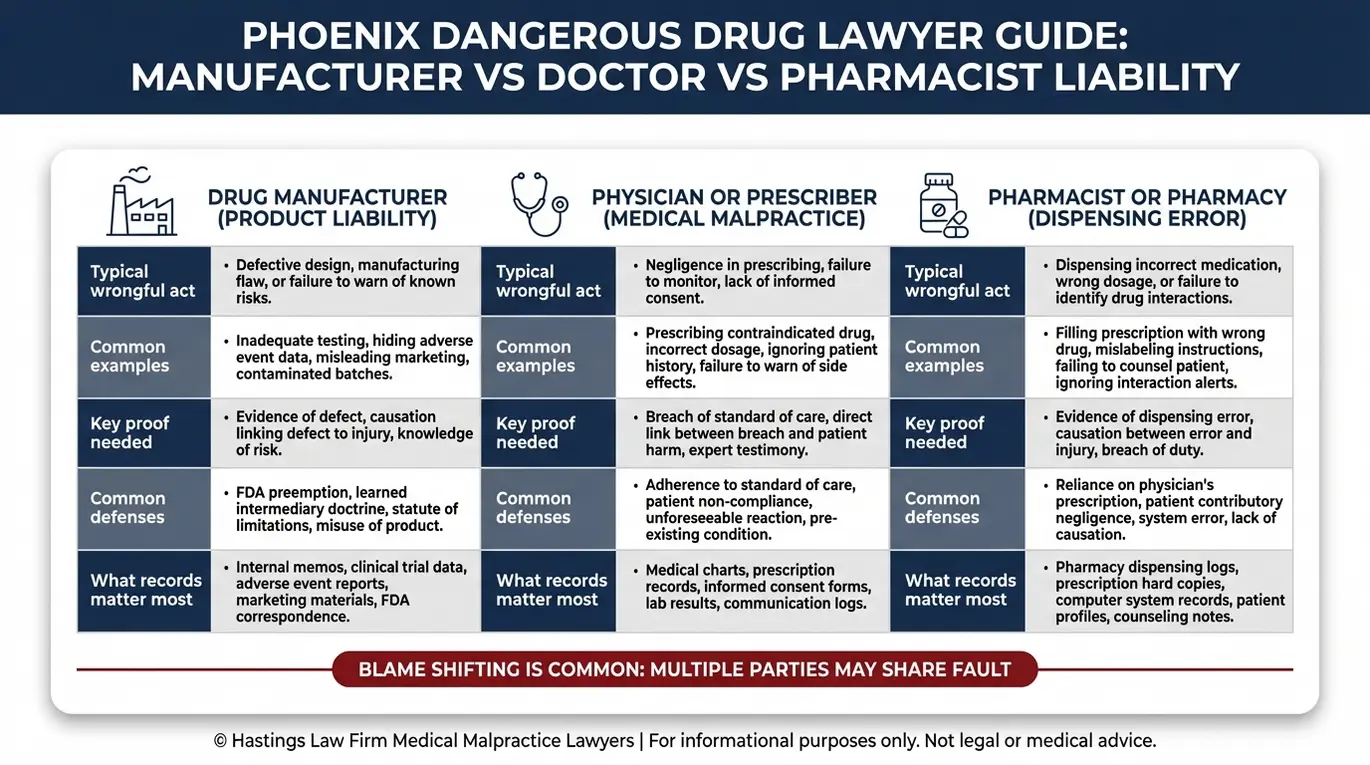
Liability in drug injury cases typically falls on one or more parties: the manufacturer for producing or marketing a defective product, the physician for a prescribing error, or the pharmacist for a dispensing mistake. Identifying the right party is one of the first and most important steps in any prescription drug injury claim, and experienced prescription drug injury attorneys can help clarify these complex liability structures.
Each of these parties owes a distinct duty to the patient, and the legal theories used to hold them accountable differ in meaningful ways.
Pharmaceutical Companies can be held liable under product liability law. This includes cases involving defective manufacturing, flawed drug design, or a failure to warn consumers and physicians about known risks. Under Arizona law, courts may apply a risk-utility analysis, which weighs whether the drug’s benefits outweighed its dangers given what the manufacturer knew or should have known. The Arizona Law Review’s analysis of risk-utility testing in products liability explains how this standard has shaped drug defect claims in the state. A manufacturer can be held liable even if the drug received FDA approval, especially when internal data showing harm was withheld or minimized.
Healthcare Providers face liability under medical malpractice law when they breach the standard of care. This can include prescribing the wrong drug, ordering an incorrect dosage, ignoring documented drug interactions, or failing to monitor a patient’s response to a medication. Arizona requires that expert witnesses in medical malpractice actions meet specific qualifications. Under A.R.S. § 12-2604, experts must share the same specialty as the defendant and have devoted a majority of their professional time to clinical practice or instruction, which ensures that someone with relevant clinical knowledge evaluates the standard of care.
Pharmacists may be liable for pharmacy dispensing errors, which occur when the wrong medication, wrong dosage, or wrong patient label is applied to a filled prescription. A dosage calculation error, where the pharmacist incorrectly converts or measures the prescribed amount, can turn a safe medication into a toxic one.
Because multiple parties can share fault, a Phoenix dangerous drug lawyer must carefully trace the chain from manufacturer to prescriber to pharmacy to determine where the breakdown occurred. At Hastings Law Firm, our medication error attorneys use in-house nursing staff and pharmacy records analysis to map that chain with precision.
| Liable Party | Legal Theory | Common Failures |
|---|---|---|
| Drug Manufacturer | Product Liability (Strict Liability / Failure to Warn) | Defective design, hidden side effects, contaminated batches |
| Physician / Prescriber | Medical Malpractice (Negligence / Breach of Duty) | Wrong drug, wrong dose, ignored drug interactions |
| Pharmacist / Pharmacy | Negligence / Dispensing Error | Wrong pill dispensed, incorrect label, dosage miscalculation |
—
Common Types of Prescription Drug Injuries and Errors
Actionable errors in pharmaceutical injury cases include prescribing contraindicated medications, dosage calculation mistakes, pharmacy dispensing errors, and the continued distribution of recalled or defective drugs. Each of these failures can cause severe, sometimes irreversible harm.
Prescribing errors remain one of the most common sources of drug-related injury. A contraindication is a specific condition or factor that makes a particular medication unsafe for a patient. For example, prescribing a blood thinner to a patient with a known bleeding disorder can lead to organ failure. Giving a medication that triggers a dangerous drug-drug interaction can also cause a stroke or cardiac arrest. Off-label prescribing, the practice of using an FDA-approved drug for a purpose it was not specifically approved to treat, can expose patients to serious risks. A prescription error attorney can evaluate if such off-label use was negligence.
“Pill mill” operations are a harmful form of prescribing negligence. These clinics systematically over-prescribe opioids and painkillers without legitimate medical justification. The CDC’s Opioid Dispensing Rate Maps show that certain regions, including parts of Arizona, continue to experience disproportionately high prescribing rates. Hastings Law Firm founder Tommy Hastings secured a landmark $10 million verdict against operators of a pill mill, one of the first of its kind in the country.
Compounding errors occur when a compounding pharmacy introduces contamination or mixes incorrect concentrations. Compounded medications carry higher risks when quality controls fail because they are not mass-produced under the same regulatory oversight.
Common adverse reactions from these types of errors include:
- Heart attack or stroke from hidden cardiovascular risks
- Liver or kidney failure from toxic dosages or drug interactions
- Birth defects linked to medications taken during pregnancy
- Fatal overdose from over-prescribed controlled substances
- Severe allergic reactions from mislabeled or contaminated drugs
If you suspect an injury from a recalled drug, the U.S. Food and Drug Administration’s Drug Recalls page maintains a current database you can check. A Phoenix prescription drug injury lawyer can help determine whether the drug involved in your case has known defects or a history of reported harm.
Specific Liability Grounds for Different Parties
Liability in dangerous drug injury cases refers to the legal responsibility assigned to the parties involved in your medical care or drug production. The legal distinction between suing a doctor for malpractice and suing a manufacturer for product liability shapes the entire approach to a case.
In a medical malpractice claim, the question is whether the prescribing physician met the standard of care. This is the level of treatment a reasonably competent doctor in the same specialty would have provided. The focus is on the provider’s decision-making, such as whether they reviewed the patient’s history or accounted for known allergies.
In a product liability claim against a manufacturer, strict liability may apply. Under strict liability, the injured patient does not need to prove the manufacturer was careless. They need to show the drug was unreasonably dangerous due to a design defect, manufacturing flaw, or failure to warn about known side effects. This distinction matters because it affects what evidence is needed, which experts are required, and how damages are calculated.
Our drug injury lawyers in Phoenix work with medical experts and pharmacologists to build the right legal theory for each case, whether it targets the prescriber, the manufacturer, or both.
—
The Hastings Law Firm Difference
Results matter, but what truly sets us apart is how we achieve them. Every verdict, every settlement, and every Phoenix courtroom victory comes from one guiding promise: To treat each client’s fight for justice as if it were our own.
This balance of skill, experience, and empathy reflects our core philosophy that justice should not only compensate the injured, but also make health care safer nationwide.

The FDA Approval Process and Systemic Risks
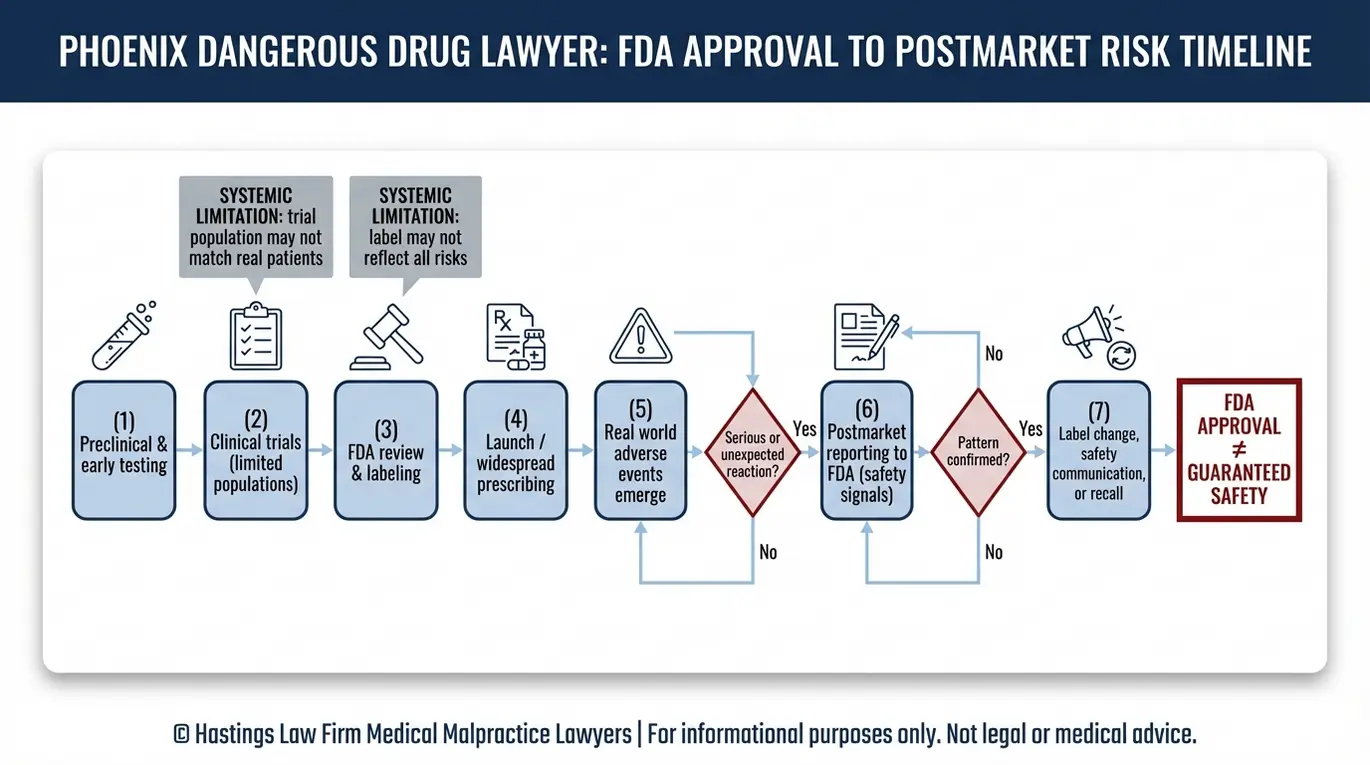
FDA approval does not guarantee a drug is safe. In some cases, manufacturers accelerate testing phases or underreport adverse events during the clinical trial phase, leaving patients and prescribers with an incomplete picture of a medication’s true risk profile. Our drug injury legal team frequently sees cases where important safety data was omitted or minimized.
The path from laboratory to pharmacy shelf is long but imperfect. Before a drug reaches the market, it passes through multiple phases of clinical trials. But these trials often involve relatively small, healthy populations that do not reflect the broader patient demographic. Elderly patients, those with chronic conditions, and pregnant individuals are frequently underrepresented. As a result, serious adverse reactions may not appear until the drug is widely prescribed.
Postmarketing surveillance, also called pharmacovigilance, is the system used to track a drug’s safety after it is approved and in use by the general public. Under 21 CFR § 314.80, manufacturers are required to report adverse drug experiences to the FDA after a product reaches the market. Yet reporting gaps and delayed submissions are well-documented problems. In many high-profile drug recalls, the manufacturer had access to internal safety data long before the public was warned.
A drug recall occurs when a medication is pulled from the market due to newly identified safety risks. But by the time a recall is issued, thousands of patients may have already been harmed. FDA approval does not shield a manufacturer from a lawsuit if evidence shows they concealed known dangers during the approval process.
Our Phoenix pharmaceutical lawyers at Hastings Law Firm work with toxicologists and clinical pharmacologists to examine a drug’s trial data, its postmarket safety reports, and the manufacturer’s internal communications. This level of investigation is essential for building a case rooted in evidence rather than speculation.
—
Navigating Arizona Law and Expert Witness Requirements
Arizona law requires that a medical malpractice claimant certify whether expert opinion testimony is necessary and, if so, serve a preliminary expert opinion affidavit from a qualified expert. Missing this step, or doing it incorrectly, can end a case before it begins.
Under A.R.S. § 12-2603, any patient bringing a claim against a healthcare professional must certify whether expert testimony is needed to prove the standard of care. When expert testimony is required, the claimant must serve a preliminary expert opinion affidavit with initial disclosures. This affidavit must be from a qualified expert who concludes that the provider’s conduct fell below the standard of care. This requires a physician or specialist in the same field as the defendant to issue a written opinion supporting the claim.
Arizona also imposes a statute of limitations, which generally gives injured patients two years from the date the injury occurred or was reasonably discovered to file a claim. The “discovery rule” can extend that window in certain situations, such as when a drug’s harmful effects take time to manifest. Waiting too long, or misunderstanding when the clock started, puts the entire case at risk.
Here is what a Phoenix prescription drug injury lawyer at Hastings Law Firm handles when preparing your claim under Arizona law:
- Retain a qualified medical expert in the relevant specialty to review your records and issue a preliminary opinion
- Confirm that the expert meets Arizona’s statutory requirements for testimony
- Determine when the statute of limitations began based on the date of injury or discovery
- Prepare and file the required affidavit of merit before the court’s deadline
- Gather pharmacy logs, prescribing records, and clinical documentation to support the expert’s findings
These procedural requirements are one reason why generalist attorneys often struggle with pharmaceutical injury cases. At Hastings Law Firm, our Arizona medication law firm team handles these requirements routinely because medical malpractice is all we do.
—

Recoverable Damages in Pharmaceutical Injury Claims
Patients harmed by a dangerous or improperly prescribed drug may recover both economic and non-economic damages, and in fatal cases, surviving family members may pursue a wrongful death claim. Securing a fair Phoenix drug injury settlement ensures these comprehensive costs are covered.
Economic damages cover the tangible financial losses caused by the injury. These include past and future medical bills, rehabilitation costs, prescription expenses, and lost income from missed work or diminished earning capacity.
Non-economic damages address the personal toll. Pain and suffering, emotional distress, loss of enjoyment of life, and loss of consortium (the impact on a family relationship) all fall into this category. When a pharmaceutical injury causes permanent impairment, these damages can be substantial.
Wrongful death damages apply when a medication error or defective drug causes a patient’s death. Surviving family members can seek compensation for funeral expenses, loss of financial support, and the profound personal loss of their loved one.
The types of damages available in your case depend on the severity of the injury, the parties involved, and the evidence supporting each category. Our Phoenix drug injury attorneys work with medical experts and financial consultants to document the full scope of harm so that nothing is overlooked.
—
Contact the Phoenix Dangerous Drug Attorneys at Hastings Law Firm Today for Help
If a medication has caused you or a loved one serious harm, you deserve answers and a clear understanding of your legal options. Hastings Law Firm is a board-certified medical malpractice law firm that focuses exclusively on cases involving healthcare negligence, including pharmaceutical injuries caused by defective drugs, prescribing errors, and dispensing mistakes.
Our team includes in-house medical professionals, former defense attorneys, and a national network of experts. We prepare every case as though it will go to trial, and we charge no fees unless we recover compensation on your behalf.
You can reach our Phoenix prescription drug injury lawyers for a free, confidential case evaluation. Let us review your records, explain what may have gone wrong, and help you understand your path forward.
—
Frequently Asked Questions About Dangerous Drug Injury in Phoenix


This content was researched and written by the Hastings Law Firm editorial team, which includes attorneys, medical professionals, and experienced researchers. Our writing is informed by internal knowledge and practical experience, and we cross-check critical details against authoritative sources cited throughout. Every piece undergoes human-led fact-checking and legal review. Because legal and medical information can change, if you spot an error, please contact us. Learn more about our content standards and review process on our editorial policy page.

Tommy Hastings, founder of Hastings Law Firm, is a board-certified personal injury trial lawyer dedicated exclusively to healthcare injury cases. Since 2001, he has represented injured patients and families in litigation against major hospital systems, pharmaceutical companies, and negligent healthcare providers nationwide. He has handled numerous high-profile cases that have drawn national media attention and resulted in multi-million dollar recoveries. He draws on that experience in his writing, helping readers understand how these cases work and what options may be available to them.
