


Phoenix Nursing Home Supervision Lawyer
Negligent supervision in a nursing home can leave residents exposed to preventable harm when staff fail to monitor known risks and follow individualized care plans. These failures are often tied to systemic problems such as understaffing, inadequate training, and ignored safety alarms, which can allow falls, wandering, aggression, and missed emergencies to occur. Families may notice warning signs like unanswered call lights, unexplained injuries, poor hygiene, or sudden behavioral changes. If your loved one was harmed or worse due to negligent nursing home supervision in Phoenix, Arizona, contact Hastings Law Firm for a free, confidential case review.
Last Updated: July 27, 2026
Protecting Phoenix Seniors from Negligent Oversight
When a family places a loved one in a nursing home, they trust that the facility will provide attentive, consistent care. Learning that your parent or grandparent was harmed because no one was watching is a deeply painful experience, and it raises serious questions about what went wrong and who is responsible.
Supervision failures in long-term care facilities are not simple oversights. They often reflect deeper systemic problems that put residents at risk every day. If your family member suffered an injury due to inadequate monitoring in a Phoenix care facility, you may have legal options worth exploring.
As Phoenix nursing home supervision lawyers, our firm provides legal experience and in-house medical expertise to these cases. Our founder, Tommy Hastings, is board-certified in personal injury trial law by the Texas Board of Legal Specialization. We can review what happened and help you understand your options during a free, confidential consultation.
Defining Negligent Supervision in Arizona Nursing Homes
Negligent supervision occurs when a long-term care facility fails to monitor residents adequately according to their care plan, resulting in preventable harm such as falls, wandering, or resident-on-resident aggression. It is not simply the absence of a caregiver in the room. It is a failure to anticipate and respond to risks that were known or should have been known.
Every resident admitted to a long-term care facility or assisted living facility receives an individualized care plan. This document outlines the resident’s specific medical needs, mobility limitations, cognitive status, and required level of monitoring. That plan also typically includes a fall-risk assessment, which evaluates how likely a resident is to fall and what precautions staff must take to prevent it. These documents create a legal duty of care. When staff fail to follow them, the facility can be held responsible.
The distinction between an unavoidable accident and negligent supervision comes down to foreseeability. If a resident has been identified as a fall risk and is left unassisted in a bathroom, that is not an accident. It is a clear case of inadequate supervision. If a resident with advanced dementia wanders out of the building because an exit alarm was disabled, that is not bad luck. That is unsupervised care.
Resident rights under both federal and Arizona law guarantee specific standards of care that include adequate monitoring. Phoenix nursing home supervision attorneys at Hastings Law Firm evaluate whether the facility met these standards by comparing what the care plan required against what actually happened.
Key concepts that define negligent supervision include:
- Failure to follow the care plan: Staff did not carry out the monitoring protocols documented for the resident.
- Failure to reassess risks: The facility did not update the care plan as the resident’s condition changed.
- Failure to anticipate foreseeable harm: Staff ignored known risk factors, such as a history of falls or aggressive behavior from other residents.
- Failure to maintain adequate staffing: Not enough qualified personnel were present to carry out required monitoring.

Systemic Failures: How Understaffing Leads to Supervision Errors
Chronic understaffing is the primary driver of supervision negligence, as profit-driven facilities often cut labor costs, leaving too few caregivers to monitor high-risk residents effectively. The result is a care environment where known risks go unaddressed and “never events” become commonplace. High staffing levels are required to ensure that every resident receives the monitoring necessary to prevent harm.
The resident-to-staff ratio, or the number of residents assigned to each caregiver on a given shift, directly determines whether meaningful supervision is possible. When one aide is responsible for 15 or 20 residents, routine tasks like answering call bells, assisting with meals, and performing safety rounds become impossible to complete on schedule.
Understaffing also contributes to alarm fatigue, a condition where caregivers become desensitized to alerts because they ring constantly and cannot all be addressed. Call lights go unanswered. Bed alarms are silenced. Safety checks are documented but never actually performed.
Staffing shortages also lead to negligent hiring and inadequate training. Facilities struggling to fill shifts may hire individuals without proper credentials or fail to provide meaningful orientation. A caregiver who does not understand how to assist with a safe transfer or recognize early signs of a medical emergency creates additional risk for every resident on the unit.
If your loved one was injured due to these types of failures, a lawyer for nursing home supervision negligence can investigate whether staffing levels contributed to the harm.
| Root Cause | How It Leads to Supervision Failure |
|---|---|
| Low staffing ratios | Caregivers cannot complete required safety rounds or respond to alerts promptly |
| Negligent hiring | Unqualified staff lack the skills to recognize and manage resident risks |
| Inadequate training | Caregivers are not prepared to follow individualized care plans correctly |
| Alarm fatigue | Repeated, unanswered alerts cause staff to ignore or disable safety systems |
| High turnover | Constant staff changes mean caregivers are unfamiliar with individual residents’ needs |
The Impact of Profit-Driven Ownership Models
Many long-term care facilities in Arizona are owned by corporate chains or investment groups. When ownership structures prioritize budget reductions, staffing budgets are often the area affected. Internal records in these cases can reveal patterns: open positions left unfilled for weeks, overtime hours cut despite census increases, and training programs reduced to bare minimums.
These are not assumptions. They are patterns that emerge during the investigation of supervision negligence claims. When a facility’s own financial records show that staffing was kept below the levels needed to meet residents’ documented care needs, that evidence can be central to building a case.
The Hastings Law Firm Difference
Results matter, but what truly sets us apart is how we achieve them. Every verdict, every settlement, and every Phoenix courtroom victory comes from one guiding promise: To treat each client’s fight for justice as if it were our own.
This balance of skill, experience, and empathy reflects our core philosophy that justice should not only compensate the injured, but also make health care safer nationwide.

Common Injuries Caused by Lack of Proper Monitoring
Failure to supervise high-risk residents frequently results in elopement (wandering off), falls during unassisted transfers, choking incidents, and bedsores from failure to turn immobile patients. A Phoenix nursing home supervision lawyer investigates these injuries by tracing them back to specific supervision breakdowns. The injury itself tells part of the story, but the care plan, staffing records, and facility policies reveal whether it should have been prevented.
According to the Agency for Healthcare Research and Quality’s Surveys on Patient Safety Culture, the safety culture within a nursing home directly affects the frequency and severity of resident injuries. Facilities with weak safety practices consistently report higher rates of preventable harm.
Common nursing home resident injuries linked to inadequate supervision include:
- Wandering and elopements: Elopement occurs when a resident, often one with dementia or cognitive impairment, leaves the facility or a secured area without staff knowledge. This can result in exposure, dehydration, traffic injuries, or death.
- Falls: Residents identified as fall risks who attempt to use the restroom, get out of bed, or transfer to a wheelchair without assistance are at high risk for hip fractures, head trauma, and spinal injuries.
- Resident-on-resident aggression: When staff are not present to monitor common areas or shared rooms, aggressive residents may physically harm others, leading to claims of physical abuse. Facilities have a duty to identify these risks and separate or supervise accordingly.
- Choking incidents: Residents with swallowing difficulties require monitored mealtimes. Without supervision, aspiration and choking can occur.
- Pressure ulcers (bedsores): Immobile residents must be repositioned at regular intervals. When turning schedules are missed due to short staffing, painful and potentially life-threatening bedsores can develop.
- Unrecognized medical emergencies: Signs of stroke, cardiac events, or infection may go unnoticed for hours when staff are unavailable to perform regular wellness checks.
Warning Signs That a Facility Is Neglecting Supervision Duties
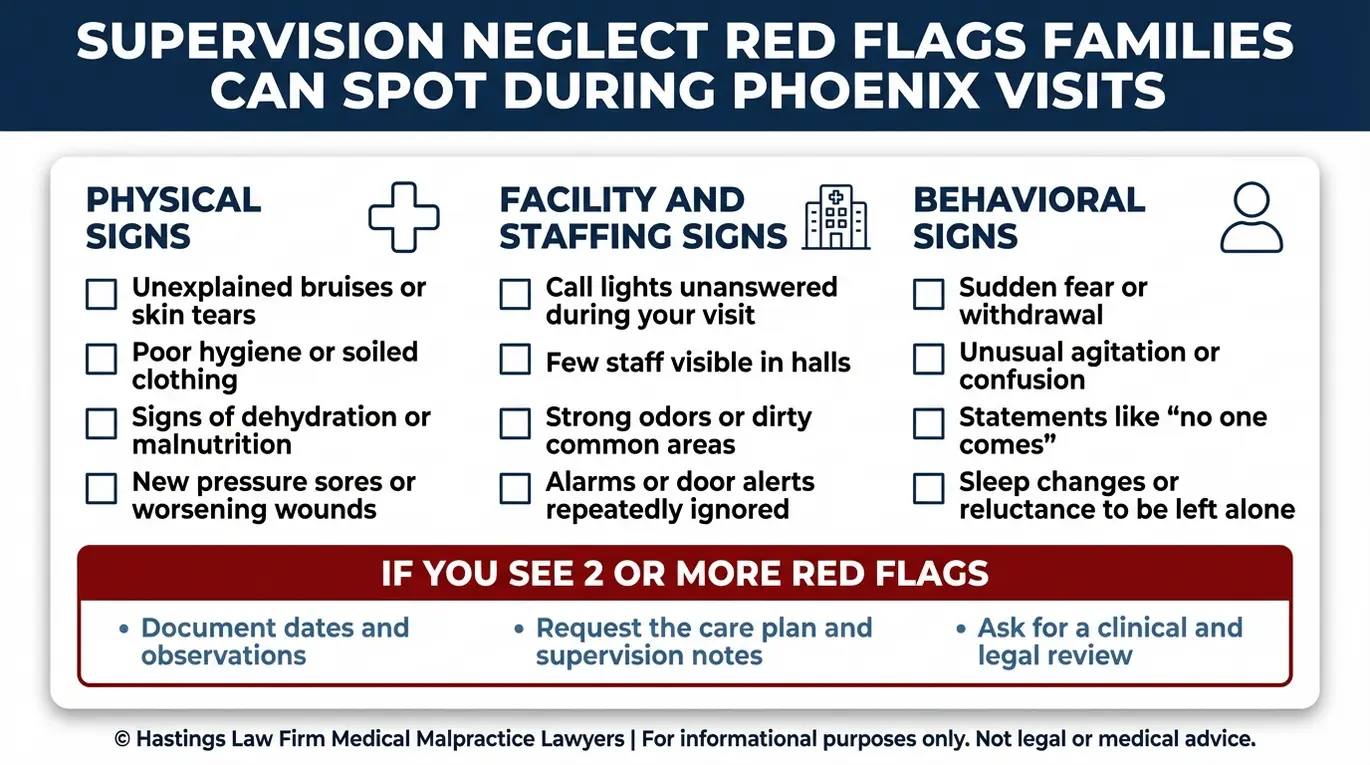
Signs of inadequate supervision include frequent unexplained bruises, unkempt appearance, unanswered call lights during visits, and sudden weight loss that may indicate a lack of feeding assistance. Recognizing these warning signs early can protect your loved one from further harm.
A call light, sometimes called a call bell, is the button a resident presses to summon a caregiver. If you notice these unanswered call lights during your visits, it may reflect a broader pattern of nursing home neglect. The same is true if your loved one is struggling with activities of daily living (ADLs), which are basic self-care tasks like bathing, dressing, and eating. These symptoms can suggest elder abuse.
Use the following checklist during your visits to identify potential supervision failures:
Physical Indicators
- Unexplained injuries, such as bruises, cuts, or fractures
- Rapid or unexplained weight loss (malnutrition)
- Signs of dehydration (dry mouth, cracked lips, confusion)
- Bedsores or skin breakdown, especially in immobile residents
- Poor hygiene, including soiled clothing or unbathed skin
Environmental Indicators
- Strong or persistent odors in the facility
- Few visible staff members during your visit
- Call lights ringing without response for extended periods
- Broken or disabled safety equipment (bed alarms, door alarms)
Behavioral Changes in the Resident
- New anxiety, fearfulness, or withdrawal
- Reluctance to speak openly around staff
- Sudden changes in mood or personality
- Resistance to returning to the facility after outings
If you observe several of these signs, consider contacting a nursing home supervision legal team to discuss whether an investigation is warranted.
Arizona Laws and Federal Regulations Regarding Resident Supervision
Facilities in Arizona must comply with the Federal Nursing Home Reform Act (NHRA) and Arizona Administrative Code, which mandate sufficient staffing levels to meet the specific needs of every resident. This includes maintaining standards of care that ensure residents are protected from avoidable accidents.
The NHRA requires that each nursing home provide care that helps residents “attain or maintain the highest practicable physical, mental, and psychosocial well-being.” This is not a vague aspiration. It is a federally enforceable standard that applies to every Medicare- and Medicaid-certified facility. When a facility fails to provide adequate supervision, it may be in direct violation of this mandate.
Arizona adds its own layer of regulatory oversight. The Arizona Department of Health Services (ADHS) Article 8 regulations establish specific operational requirements for assisted living facilities, including supervision protocols and staffing expectations. The Residential Care Assisted Living Compendium published by HHS ASPE provides additional detail on Arizona’s regulatory framework for these facilities.
Arizona’s Adult Protective Services Act (APSA) also imposes reporting obligations on healthcare workers. Caregivers, nurses, and administrators are mandatory reporters, meaning they are legally required to report suspected abuse or neglect. Failure to report can itself be a violation. Families can also file complaints directly through the Arizona Department of Health Services health complaints process.
A Phoenix nursing home supervision lawyer can review whether a facility’s actions violated these federal and state requirements, including the Arizona Administrative Code nursing home regulations, and use documented regulatory failures as evidence in your case.
Proving Liability: Investigating Supervision Failures
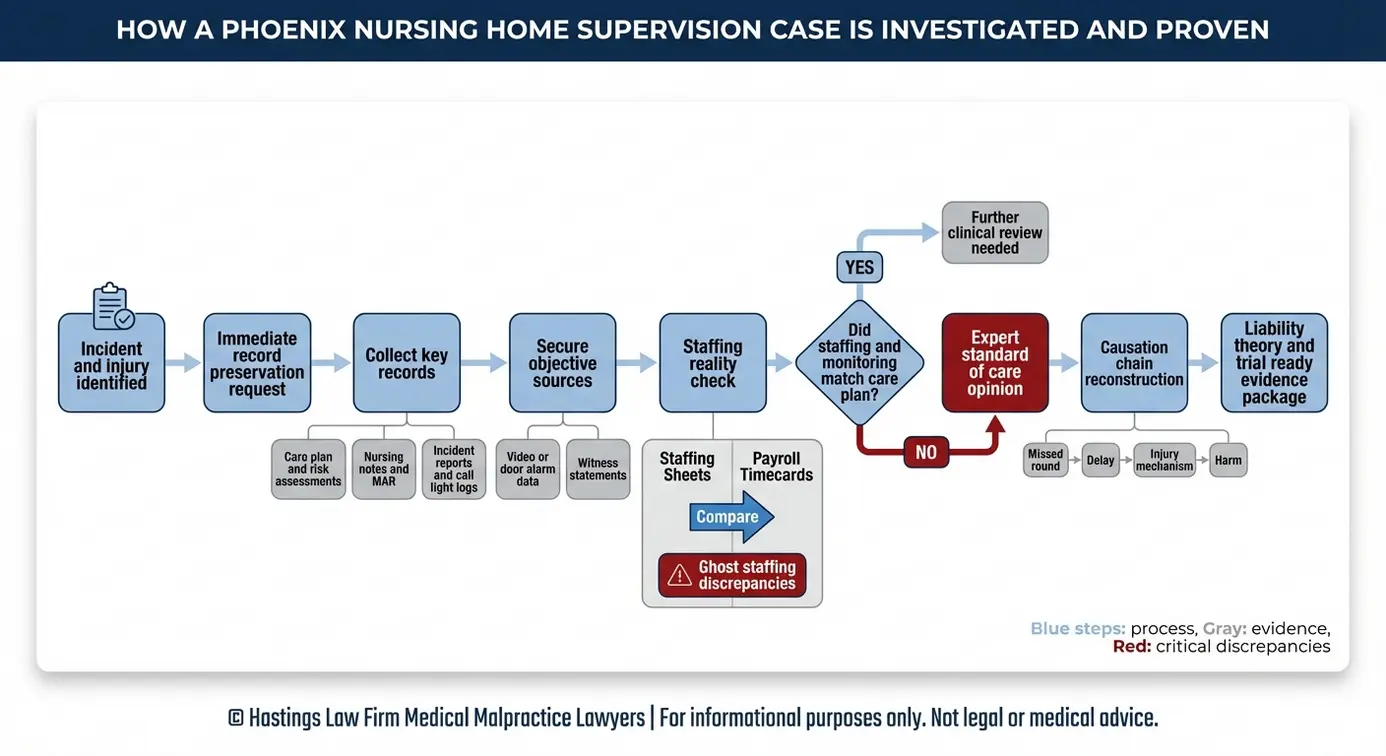
Proving a supervision case requires a forensic review of staffing logs, resident care plans, and video surveillance to demonstrate that the facility failed to provide the agreed-upon level of monitoring. At Hastings Law Firm, our team of attorneys, nurse consultants, and medical experts follows a structured process to build these cases. Our in-house medical staff evaluates the clinical data to determine if a breach in care occurred. Forensic review involves a detailed analysis of all records to identify exactly where monitoring failed.
Here is how the investigation and evidence gathering typically unfolds:
- Securing medical records before they can be altered. We move quickly to obtain healthcare documentation, incident reports, staffing logs, and any available surveillance footage. Early preservation is critical because facilities may revise or lose documentation after an incident is reported.
- Reviewing the care plan against actual care delivered. Our medical staff compares what the resident’s care plan required with what the records show actually happened. Gaps between the two often reveal where supervision broke down.
- Identifying ghost staffing. Ghost staffing occurs when a facility’s staffing sheets list employees who were not actually present or working during a shift. We compare internal scheduling records against payroll data and electronic badge logs to uncover discrepancies. Public inspection data, such as records available through Medicare.gov’s Care Compare tool, can also reveal prior staffing and inspection violations.
- Engaging qualified expert witnesses. Medical and nursing experts review the evidence and provide opinions on whether the facility met the applicable standards of care. Their testimony is often essential to establishing what a reasonably competent facility would have done differently.
- Conducting a regulatory compliance review. We examine whether the facility had prior citations, complaints, or deficiency reports from state or federal regulators that show a pattern of supervision failures.
Attorneys for nursing home negligence at our firm prepare every case as though it will go to trial. This level of preparation strengthens our position whether the case resolves through negotiation or before a jury.
Compensation for Supervision Negligence in Phoenix
Injured patients who suffer from supervision negligence in Phoenix can recover economic damages for medical bills and non-economic damages for pain, suffering, and loss of dignity, as well as punitive damages in cases of gross negligence. These legal remedies aim to restore financial stability and acknowledge the impact of the injury.
Economic damages cover measurable costs, including medical expenses for treating the injury, rehabilitation expenses, and the cost of transferring your loved one to a safer facility.
Non-economic damages address the less tangible but equally real harm: pain and suffering, emotional distress, loss of dignity, and diminished quality of life. In cases involving particularly reckless conduct, punitive damages may also be available. These are designed to hold the facility accountable and discourage similar behavior in the future.
If a loved one died as a result of supervision negligence, family members may pursue a wrongful death claim to recover funeral costs, lost companionship, and other related losses. A Phoenix nursing home supervision lawyer at Hastings Law Firm can evaluate the full scope of damages that may apply to your situation.
Contact the Phoenix Nursing Home Attorneys at Hastings Law Firm Today for Help
No family should have to wonder whether their loved one is safe in a care facility. If you suspect that a nursing home’s failure to supervise contributed to your family member’s injury or death, you deserve answers.
Hastings Law Firm brings a unique combination of legal experience and medical insight to every supervision negligence case. Our team includes former defense attorneys who previously worked for the systems they now challenge, along with in-house nurse consultants who can analyze care records with clinical precision.
We handle these cases on a contingency fee basis, which means you pay no attorney fees or costs unless we recover compensation for you. The consultation is free and confidential.
Contact Hastings Law Firm today. Let us help you find the answers you deserve and understand your family’s options.
Frequently Asked Questions About Nursing Home Supervision in Phoenix

This content was researched and written by the Hastings Law Firm editorial team, which includes attorneys, medical professionals, and experienced researchers. Our writing is informed by internal knowledge and practical experience, and we cross-check critical details against authoritative sources cited throughout. Every piece undergoes human-led fact-checking and legal review. Because legal and medical information can change, if you spot an error, please contact us. Learn more about our content standards and review process on our editorial policy page.

Tommy Hastings, founder of Hastings Law Firm, is a board-certified personal injury trial lawyer dedicated exclusively to healthcare injury cases. Since 2001, he has represented injured patients and families in litigation against major hospital systems, pharmaceutical companies, and negligent healthcare providers nationwide. He has handled numerous high-profile cases that have drawn national media attention and resulted in multi-million dollar recoveries. He draws on that experience in his writing, helping readers understand how these cases work and what options may be available to them.
