


Phoenix Pediatric Malpractice Lawyer
Pediatric medical errors can leave families facing sudden uncertainty, ongoing care needs, and a deep loss of trust in the providers who were supposed to protect a child. Pediatric care has unique risks because children need age specific assessment, careful dosing, and timely recognition of serious symptoms. When a provider falls below accepted standards, the consequences can be life altering, including permanent injury, long term disability, or fatal outcomes. If your child suffered harm due to pediatric malpractice in Phoenix, Arizona, contact Hastings Law Firm for a free, confidential case review.

Last Updated: September 19, 2026
Trusted Phoenix Medical Attorneys for Pediatric Negligence Claims
When your child has been harmed by a medical error, the weight of that experience touches every part of your life. You may be managing follow-up appointments, worrying about your child’s future, and struggling with the feeling that the doctors or hospital you trusted let your family down. That instinct deserves to be taken seriously.
At Hastings Law Firm, we focus exclusively on medical malpractice. Founded in 2005 by board-certified trial attorney Tommy Hastings, our team of attorneys, nurse consultants, and board-certified patient advocates understands both the medicine and the law behind pediatric negligence claims. As a Phoenix pediatric malpractice lawyer team with in-house medical staff and former defense attorneys, we know how to investigate what went wrong and why.
If your child was injured by a medical error in Arizona, we can review what happened and explain your options in a free, confidential consultation.

Defining Pediatric Malpractice and Negligence in Arizona
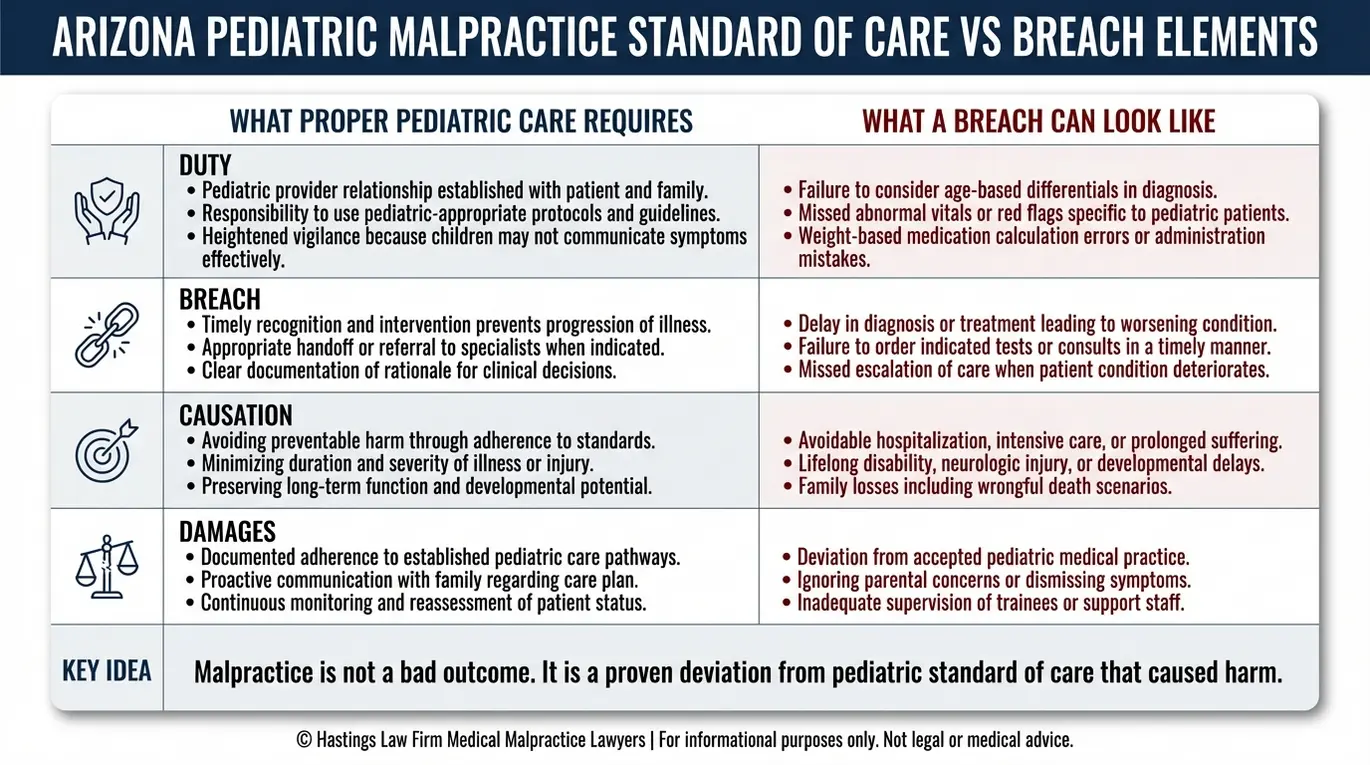
Pediatric malpractice occurs when a medical professional deviates from the accepted standard of care for treating a child, directly causing injury or worsening a condition. Unlike adult medicine, pediatric care requires specialized knowledge because children are not simply small adults. Their bodies metabolize medication differently through pediatric pharmacokinetics, the study of how drugs are absorbed and processed in growing bodies. Their vital signs follow different ranges. And protocols like the Neonatal Resuscitation Program (NRP), a standardized set of steps for responding to newborns in distress, reflect just how distinct neonatal and pediatric treatment must be.
The standard of care in pediatric medicine refers to what a reasonably competent pediatric provider would do under similar circumstances. A doctor treating a child has a duty of care to follow those accepted practices. When that duty is breached, meaning the provider fell below the expected standard, and the breach directly causes harm, the foundation of a medical negligence claim exists.
To establish a valid case for an illness or injury, four legal elements must be present: a duty of care owed to the child, a breach of that duty, a direct causal link between the breach and the injury, and measurable damages resulting from the harm.
Many parents sense something went wrong during their child’s treatment but feel uncertain about questioning a doctor’s judgment. That hesitation is understandable. Years of trusting medical professionals can make it hard to challenge a diagnosis or decision, even when the outcome speaks for itself. A pediatric malpractice lawyer can help you separate what should have happened from what actually did, using objective medical evidence rather than assumptions.
Common Errors and Injuries Affecting Children
Common pediatric errors include medication mistakes based on incorrect weight calculations, failure to diagnose conditions like meningitis or appendicitis, surgical errors, and birth injuries that can result in brain damage or other catastrophic outcomes.
Medical errors in pediatric care often involve specialized issues like dosing or failure to recognize symptoms in children who cannot communicate their pain.
Medication Errors
Children are especially vulnerable to medication errors because nearly every pediatric dose depends on weight-based dosing, a method where the correct amount of a drug is calculated using milligrams per kilogram of body weight (mg/kg). A small miscalculation can mean a child receives two or three times the intended dose. Liquid medication concentration, expressed as milligrams per volume such as mg/5 mL, adds another layer of risk. If a pharmacist or provider confuses concentrations, the consequences can be severe.
Research published by the Agency for Healthcare Research and Quality’s Patient Safety Network (PSNet) highlights how frequently pediatric medication errors occur, including errors during prescribing, dispensing, and administration. A separate study in PubMed Central on medication safety reinforces that including patient weight on all prescriptions is a basic safeguard, yet one that is still inconsistently followed.
Misdiagnosis of Time-Sensitive Conditions
Conditions like bacterial meningitis, appendicitis, and sepsis can deteriorate rapidly in children. A missed diagnosis or delayed diagnosis of these illnesses may lead to permanent organ damage, brain injury, or wrongful death. When a provider fails to order timely testing or dismisses warning signs, the window for effective treatment can close quickly.
Birth Injuries
Oxygen deprivation during labor and delivery, known as hypoxia, can cause irreversible brain damage, including cerebral palsy. Our Phoenix medical negligence lawyers have direct experience handling birth injury claims. We focus on identifying evidence of preventable harm and building a case to secure the child’s long-term care needs.
Under Arizona Revised Statutes § 12-542, personal injury claims generally carry a two-year statute of limitations, though specific rules apply to minors. Prompt legal action helps preserve evidence and protect your child’s rights.
| Error Type | Potential Consequence |
|---|---|
| Weight-based medication dosing error | Overdose, organ damage, or death |
| Missed meningitis diagnosis | Brain damage, hearing loss, death |
| Delayed appendicitis diagnosis | Rupture, sepsis, prolonged hospitalization |
| Surgical error (wrong site, retained object) | Infection, additional surgeries, nerve damage |
| Birth injury (oxygen deprivation) | Cerebral palsy, cognitive disability, seizures |
Unique Diagnostic Challenges in Pediatric Medicine
Young children cannot describe their symptoms the way adults can. An infant cannot say where it hurts or how long the pain has lasted. This communication barrier raises the standard of vigilance expected from pediatricians and emergency physicians. Providers are trained to rely on objective tools like age-adjusted vital signs, which account for the fact that normal heart rate, blood pressure, and respiratory rate differ by age, and pain assessment scales like the FLACC scale (Face, Legs, Activity, Cry, Consolability), a behavioral tool used to evaluate pain in preverbal or nonverbal children.
When a provider fails to account for these diagnostic challenges, overlooking subtle symptoms or dismissing parental concern, the result can be a delayed or missed diagnosis with life-altering consequences.
The Hastings Law Firm Difference
Results matter, but what truly sets us apart is how we achieve them. Every verdict, every settlement, and every Phoenix courtroom victory comes from one guiding promise: To treat each client’s fight for justice as if it were our own.
This balance of skill, experience, and empathy reflects our core philosophy that justice should not only compensate the injured, but also make health care safer nationwide.

Liability and Accountability in Pediatric Cases
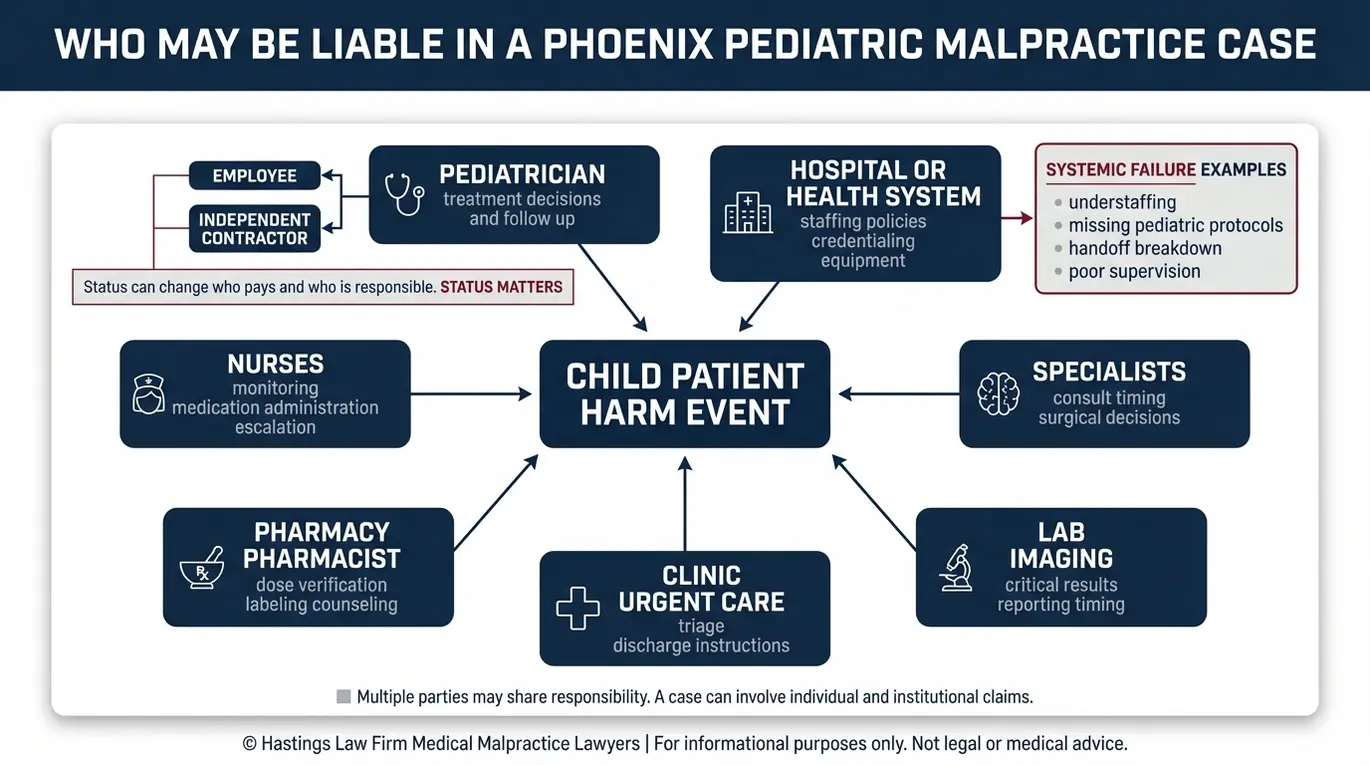
Liability in pediatric malpractice cases can extend beyond the treating pediatrician to include nurses, specialists, pharmacists, and the hospital itself for systemic failures or inadequate staffing.
Liability identifies which healthcare providers or facilities are legally responsible for medical harm.
Determining who is responsible depends on where the error originated and who had control over the care decisions. A private practice pediatrician may be individually liable for a personal injury or negligent treatment decision, while a hospital-employed physician’s error may also trigger institutional liability. Research published by PubMed Central on malpractice lawsuits involving pediatric trainees shows that claims frequently involve multiple parties, including supervising physicians and the facilities where care was provided.
Hospitals can also be held accountable for failures in credentialing and privileging, the process by which a facility verifies a provider’s qualifications and grants permission to practice there. If a hospital allows an under-qualified provider to treat children, or if staffing levels fall below safe thresholds, the institution itself may bear responsibility.
Potential defendants in a pediatric malpractice claim may include:
- The treating pediatrician or specialist
- Nurses or other clinical staff involved in the child’s care
- The hospital or medical facility
- Pharmacists or pharmacy systems responsible for dispensing medication
- Supervising physicians overseeing residents or trainees
As a hospital negligence lawyer team serving Phoenix, Arizona, we include former defense attorneys who previously represented hospitals. This experience helps us understand how institutions build their defenses and allows us to identify all potentially liable parties early in the investigation.
Recovering Compensation for a Child’s Future
Families may recover economic damages for past and future medical care, loss of future earning capacity, and non-economic damages for pain, suffering, and loss of enjoyment of life.
Compensation in legal claims refers to the financial recovery for losses caused by medical negligence. Recovering economic damages helps families manage the high costs associated with a lifelong injury.
When a child suffers a lifelong disability from medical negligence, the financial reality is staggering. A life care plan, a detailed projection of the medical treatment, therapies, assistive devices, and support services a child will need over their lifetime, often spans 70 or more years. These plans are built by pediatric experts who review medical records to form the backbone of any claim for future damages.
Non-economic damages account for the child’s pain and suffering, emotional distress, and loss of normal childhood experiences. Parents may also have claims for loss of consortium, which addresses the impact on the parent-child relationship. In cases involving death, wrongful death damages allow families to seek accountability for the most devastating loss imaginable.
Insurance companies often push back hardest on pediatric claims precisely because the long-term value is so significant. They may challenge the severity of the injury, dispute future care projections, or pressure families toward a quick, undervalued pediatric malpractice settlement that offers insufficient compensation. Our firm prepares every case with detailed expert analysis and a litigation posture that makes clear we are ready to present the full scope of damages to a jury.
How Our Firm Builds a Winning Case
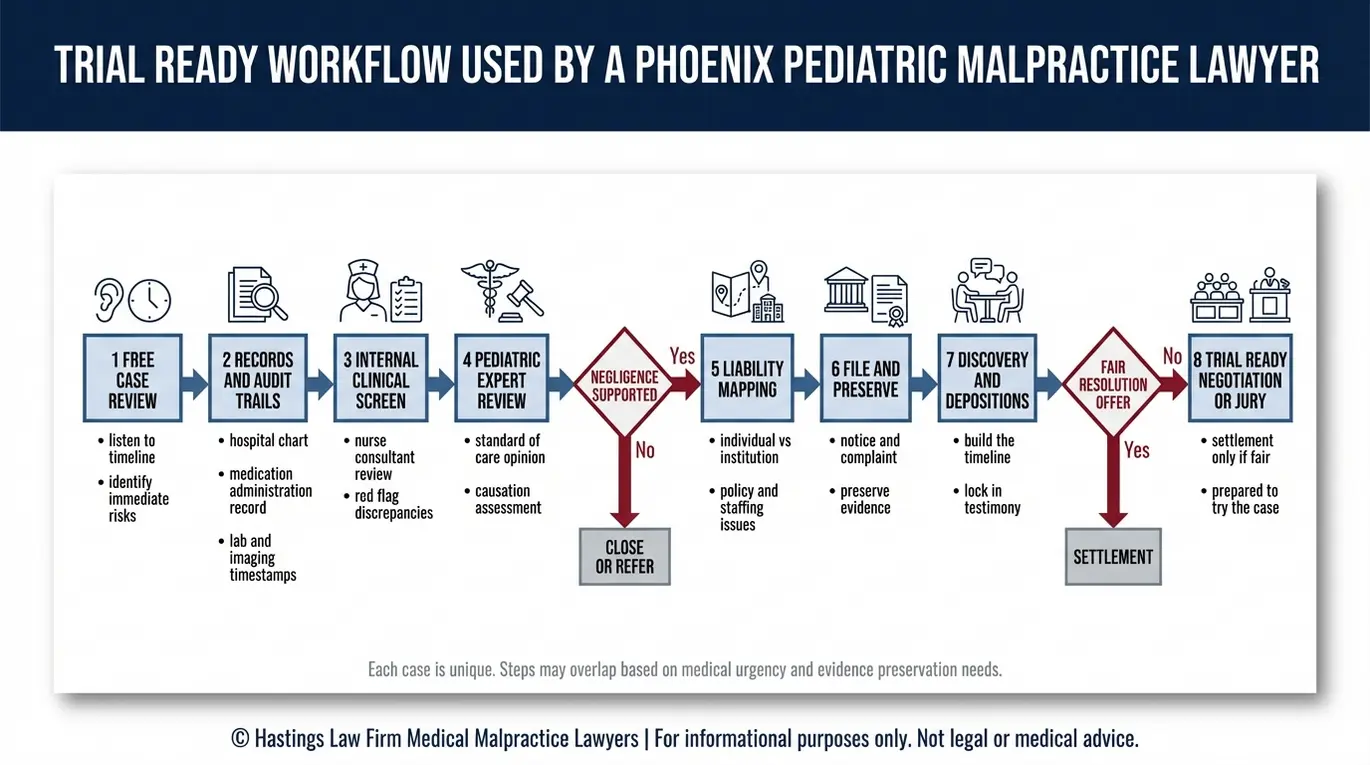
We use a trial-ready approach that involves immediate expert review, rigorous evidence gathering, and the retention of national pediatric specialists to establish negligence and causation from the start.
Building a case involves gathering detailed evidence to prove that a medical error occurred through a trial-ready approach.
As a Phoenix pediatric malpractice lawyer team, we prepare every case as if it will go before a jury. That level of preparation begins on day one and continues through every stage of the process. Here is what that looks like in practice:
- Immediate records collection: We secure all relevant medical records, including the electronic health record (EHR) audit trail, a digital log that tracks every entry, edit, and deletion made in a patient’s chart. We also look for barcode medication administration (BCMA) data, the electronic system that tracks whether medications were scanned and administered correctly.
- In-house medical review: Our nursing staff and board-certified patient advocates analyze clinical data, identify charting inconsistencies, and flag potential breaches in the standard of care.
- National expert consultation: Through our network of pediatric specialists across the country, we retain qualified experts who can provide objective opinions and expert testimony on whether the care met accepted standards.
- Litigation and trial preparation: We file a lawsuit and begin building the trial strategy immediately. Depositions, discovery, and expert disclosures are all handled with a focus on presenting the strongest possible case, whether the matter resolves through settlement negotiations or goes to a jury.
This approach signals to defense attorneys and insurance carriers that we will not accept less than fair value for a child’s injuries.
Contact the Phoenix Doctor Malpractice Attorneys at Hastings Law Firm Today for Help
No parent should have to wonder whether their child’s injury could have been prevented, and then face the medical and legal system alone while searching for answers. At Hastings Law Firm, we exist to restore trust for families who feel betrayed by the providers they relied on. Our entire team is dedicated to one mission: holding negligent medical providers accountable and protecting your child’s future.
Arizona law imposes time limits on filing a claim, and critical evidence can degrade or disappear. The sooner you reach out, the sooner we can begin preserving the records and testimony that matter most.
Your consultation is free, confidential, and carries no financial obligation. As your Phoenix pediatric malpractice lawyer, we do not collect a fee unless we recover compensation for your family. Contact Hastings Law Firm today to get the answers you deserve.
Frequently Asked Questions About Pediatric Malpractice in Phoenix


This content was researched and written by the Hastings Law Firm editorial team, which includes attorneys, medical professionals, and experienced researchers. Our writing is informed by internal knowledge and practical experience, and we cross-check critical details against authoritative sources cited throughout. Every piece undergoes human-led fact-checking and legal review. Because legal and medical information can change, if you spot an error, please contact us. Learn more about our content standards and review process on our editorial policy page.

Tommy Hastings, founder of Hastings Law Firm, is a board-certified personal injury trial lawyer dedicated exclusively to healthcare injury cases. Since 2001, he has represented injured patients and families in litigation against major hospital systems, pharmaceutical companies, and negligent healthcare providers nationwide. He has handled numerous high-profile cases that have drawn national media attention and resulted in multi-million dollar recoveries. He draws on that experience in his writing, helping readers understand how these cases work and what options may be available to them.
