


Arizona Pediatric Malpractice Lawyer
Pediatric medical malpractice can leave families coping with lasting harm and a deep sense of betrayal, especially when trusted providers dismiss parental concerns or apply an adult approach to a child. Arizona pediatric cases often turn on whether care met a pediatric standard of care and whether a preventable error caused measurable damages. Liability may involve individual clinicians and the facility, and compensation can address long term medical needs and other losses. If you or a loved one were harmed or worse due to pediatric medical malpractice in Arizona, contact Hastings Law Firm for a free, confidential case review.
Last Updated: September 19, 2026
Trusted Arizona Attorneys for Pediatric Medical Malpractice Claims
When your child is harmed by the people you trusted to help them, the pain goes beyond the physical injury. Many parents describe a deep sense of betrayal, one made harder by what is often called the White Coat Effect, the ingrained belief that doctors always know best. That conditioning can make you question your own instincts, even when the evidence of a serious medical error is right in front of you.
Your instincts matter. If something feels wrong about the care your child received, you deserve answers from a team that knows how to find them.
As an Arizona pediatric malpractice lawyer, Hastings Law Firm focuses exclusively on medical negligence cases. Our team includes in-house medical professionals, such as experienced nurses, and former defense attorneys who previously worked for the hospital systems they now challenge. This insider perspective helps us identify exactly where a provider may have failed a young patient.
If your child was injured by a medical error, contact us for a free, confidential case evaluation. We can review what happened and explain your options.

Defining Pediatric Malpractice in Arizona Healthcare
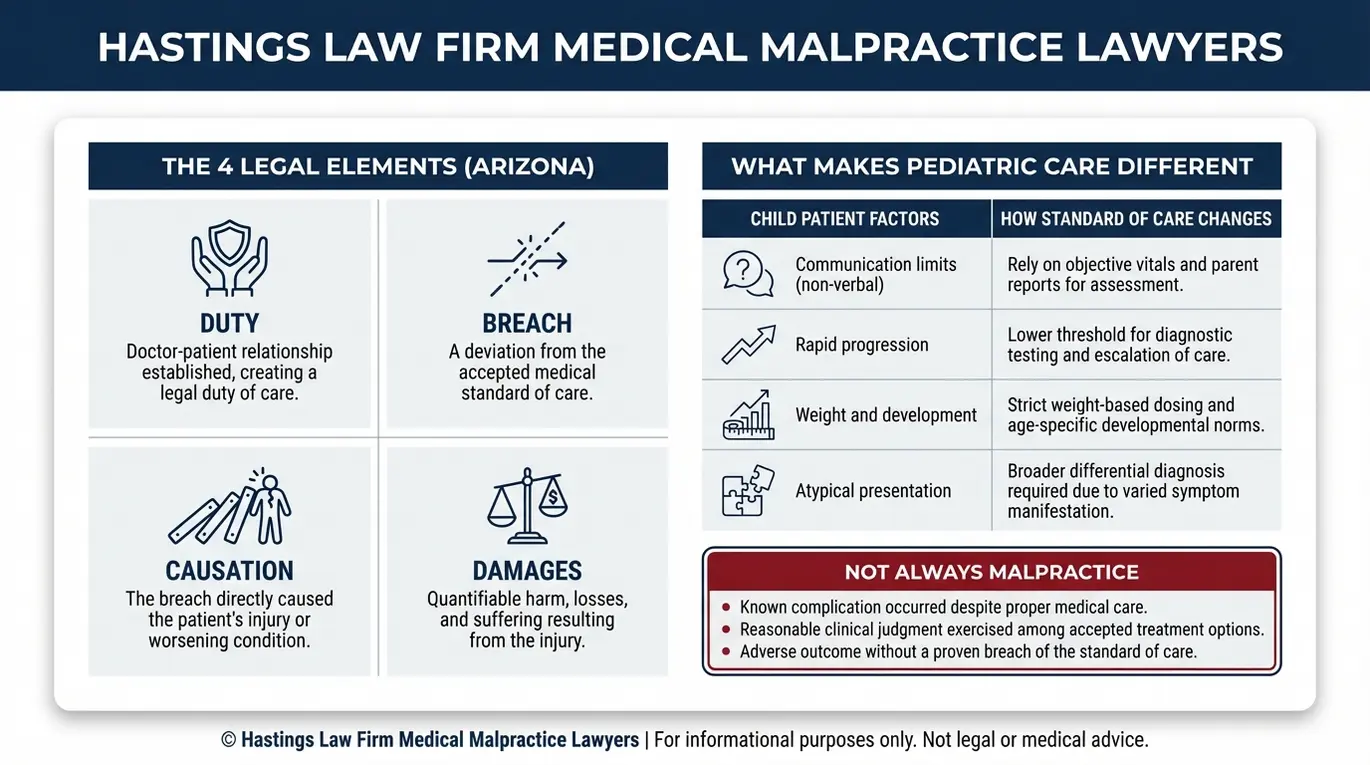
Pediatric malpractice occurs when a medical professional deviates from the accepted standard of care for treating children, directly causing injury or worsening a condition. These criteria help determine if a medical error was a result of negligence rather than an unavoidable outcome. The legal question is whether the provider’s actions fell below what a reasonably competent professional would have done under similar circumstances.
Under Arizona law, a medical malpractice claim requires proof of four elements. First, the provider owed a duty of care to the child through a doctor-patient relationship. Second, the provider breached that duty by failing to meet the standard of care. Third, the breach directly caused the child’s injury (causation). And fourth, the child suffered measurable damages as a result. Arizona Revised Statutes § 12-563 specifically requires proof that the provider failed to exercise the degree of care expected of a reasonable, prudent provider in the same profession and circumstances, and that such failure was a proximate cause of the injury.
What makes pediatric cases distinct is the pediatric standard of care, an age- and size-specific framework for treatment. A developmentally appropriate assessment, an evaluation tailored to a child’s specific growth stage, looks very different from an adult evaluation. Children may not be able to describe symptoms, their vital sign ranges differ by age, and certain conditions present differently in younger patients. A provider who applies an adult framework to a pediatric patient may miss critical warning signs.
An experienced Arizona pediatric malpractice lawyer understands these differences and works with qualified pediatric experts to determine whether the care your child received met the standard. Our team examines medical records, clinical timelines, and provider protocols to identify where the breakdown occurred. If you believe your child was harmed by substandard care, a pediatric malpractice attorney in Arizona can help you understand whether you have a viable claim.
Common Types of Negligence by Pediatricians and Hospitals
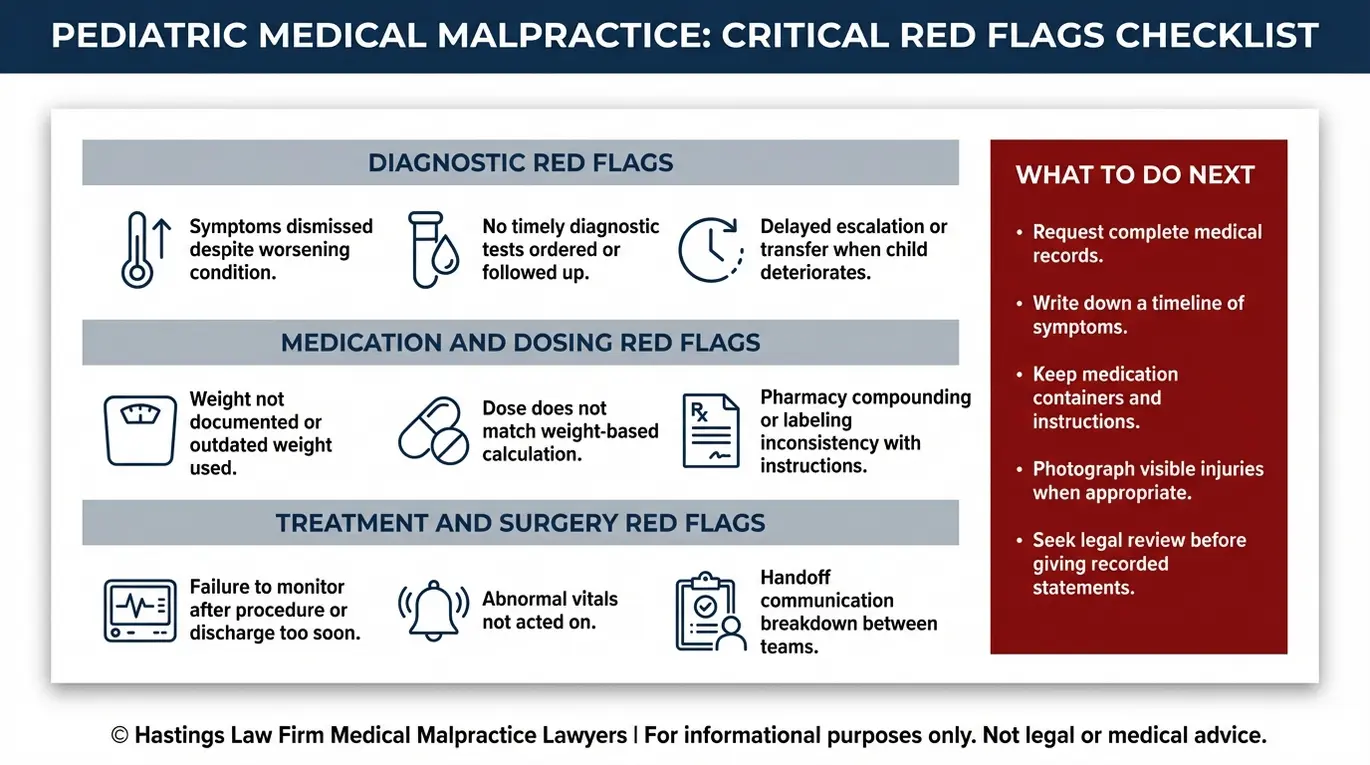
Common forms of pediatric negligence include misdiagnosis of critical conditions like meningitis or appendicitis, medication dosing errors based on weight, and surgical mistakes during delivery or pediatric procedures. These errors represent a failure to provide the safe, competent care that every pediatric patient deserves. They can have life-altering consequences for a child.
Frequent categories of pediatric medical malpractice include:
- Diagnostic errors: Misdiagnosis, delayed diagnosis, or failure to diagnose conditions such as meningitis, pneumonia, appendicitis, or cancer. Young children and infants often cannot articulate symptoms, making accurate diagnostic testing and clinical observation essential.
- Medication errors: Pediatric medications require precise weight-based dosing, a calculation in milligrams per kilogram of the child’s body weight. A medication compounding error, where a pharmacist or provider incorrectly prepares or measures a drug, can lead to toxicity. According to the Agency for Healthcare Research and Quality’s Patient Safety Network (PSNet), children are vulnerable to a prescription dosage error because of the complex calculations involved.
- Surgical and birth injuries: Errors during delivery, such as improper use of forceps, or mistakes during pediatric surgery that result in nerve damage, organ injury, or other preventable harm.
- Treatment errors: Choosing the wrong course of treatment, failing to monitor a child’s response to medication, or discharging a child too early without proper follow-up.
As the Arizona Court of Appeals addressed in Fadely v. Encompass Health, healthcare facilities can be held accountable for the conduct of providers involved in a patient’s care. An Arizona pediatric malpractice lawyer evaluates these errors. If you are looking for a lawyer for pediatric malpractice, our medical-legal team can review your child’s records.
Dismissal of Parental Concerns
Providers may sometimes dismiss parental concerns as an overreaction. When a parent reports that something is wrong and the provider attributes the symptoms to a minor issue without proper evaluation, a delayed diagnosis in children, the late identification of a condition leading to worsened health, can result.
Children, especially infants, may have an atypical presentation, symptoms that do not follow the textbook pattern that providers expect. This makes the parent’s observations even more important. If those concerns are documented in the medical records but were not acted on, that gap can become a failure to diagnose and central to a claim of pediatrician negligence. An Arizona pediatric negligence lawyer reviews these records closely to determine whether a provider’s dismissal fell below the standard of care.
The Hastings Law Firm Difference
Results matter, but what truly sets us apart is how we achieve them. Every verdict, every settlement, and every Arizona courtroom victory comes from one guiding promise: To treat each client’s fight for justice as if it were our own.
This balance of skill, experience, and empathy reflects our core philosophy that justice should not only compensate the injured, but also make health care safer nationwide.

Liability for Pediatric Errors by Doctors and Facilities
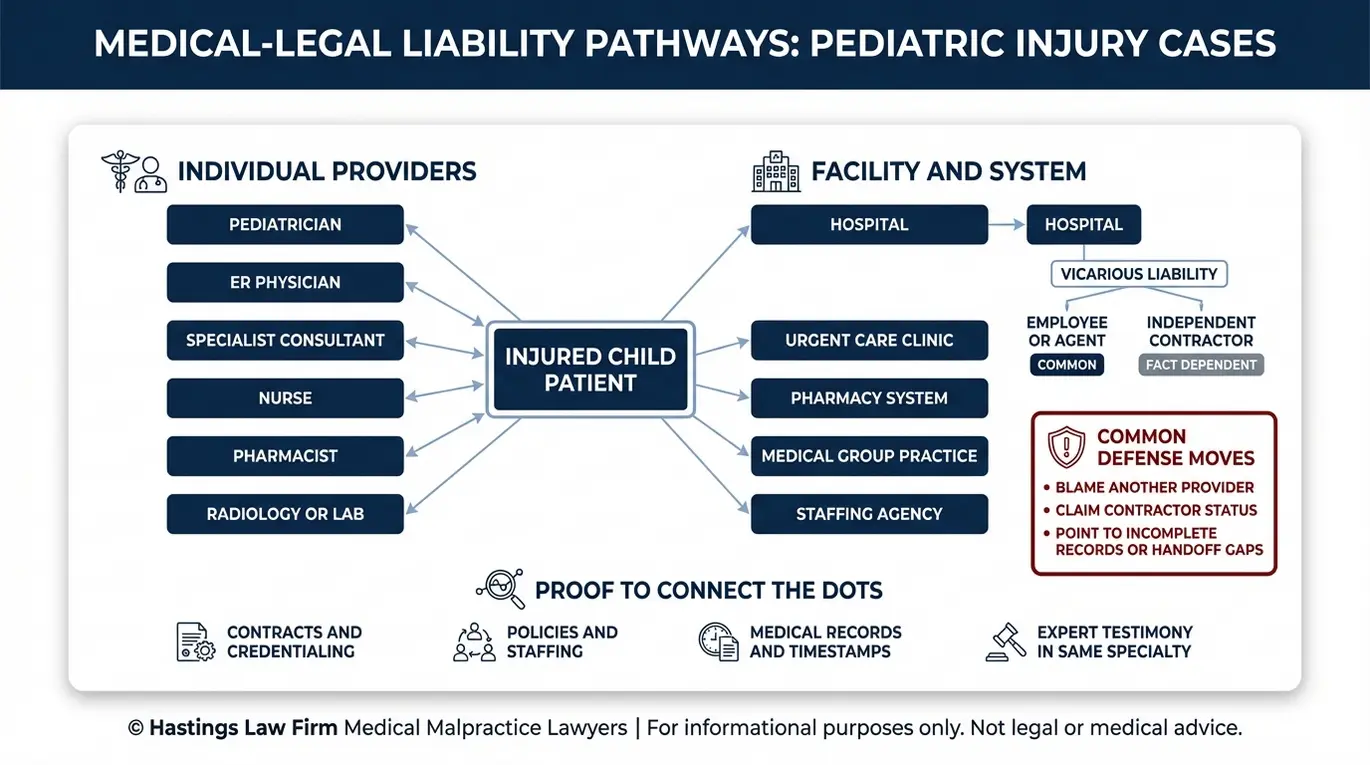
Liability can extend beyond the individual pediatrician to include nurses, specialists, pharmacists, and the hospital system itself under theories of vicarious liability. Identifying who is legally responsible is necessary to ensure all parties that contributed to the harm are held accountable.
Determining who is legally responsible starts with the relationship between the provider and the facility. If the pediatrician is a direct employee of the hospital, the hospital may share liability for that doctor’s actions. If the doctor is an independent contractor with privileges at the facility, liability may rest primarily with the individual provider. This distinction between private practice and hospital-based care shapes how the case is built and who is named in the claim.
Vicarious liability applies when a hospital is held responsible for the negligent acts of its employees, including nurses, technicians, and other staff. If a nurse administered the wrong medication dose or a lab technician failed to flag an abnormal result, the facility that employed them can be accountable for the resulting hospital liability.
Arizona law also requires expert testimony from a qualified specialist to establish that the standard of care, the accepted level of treatment for the profession, was breached. In pediatric cases, this typically means retaining an expert in the same pediatric specialty as the treating provider. This expert reviews the medical records and offers an opinion on whether the care fell below acceptable standards and whether that failure caused the child’s injury.
As an Arizona pediatric malpractice lawyer, Hastings Law Firm works with a national network of pediatric medical experts. Our team, which includes former defense counsel and in-house nursing professionals, examines each layer of potential liability so no responsible party is overlooked. If you need experienced pediatric malpractice counsel, we can evaluate the full scope of your child’s case.
Recovering Damages for Your Child’s Long-Term Care
Compensation in pediatric cases covers medical bills, future life care costs, pain and suffering, and the child’s loss of future earning capacity. In Arizona, damages are the financial compensation intended to cover the physical and emotional losses suffered by the child. Since children have a lifetime ahead, the financial stakes are significant.
Arizona recognizes two main categories of damages:
| Economic Damages | Non-Economic Damages |
|---|---|
| Past and future medical expenses | Pain and suffering |
| Rehabilitation and therapy costs | Emotional distress |
| Specialized equipment and home modifications | Loss of enjoyment of life |
| Loss of future earning capacity | Permanent disability and its daily impact |
Economic damages are calculated based on documented costs and projected future needs. Non-economic damages address suffering, including chronic pain, emotional trauma, and lost experiences.
One challenge in pediatric cases is calculating loss of earning capacity for a child who has never worked. An Arizona pediatric malpractice lawyer works with economic experts to project what the child would have reasonably earned over a lifetime, and what that earning potential looks like after the injury.
Managing Settlement Funds for Minors
When a settlement or jury award is reached on behalf of a minor, Arizona law requires court approval to ensure the resolution is in the child’s best interest. Funds are typically placed in a protected arrangement, such as a blocked account, conservatorship, or structured settlement, designed to preserve the money for the child’s long-term care. These safeguards prevent funds from being spent before the child reaches adulthood or before they are needed.
Contact the Arizona Doctor Malpractice Attorneys at Hastings Law Firm Today for Help
Your child’s recovery is your priority. Accountability is ours.
At Hastings Law Firm, our entire team of attorneys, nurse consultants, and patient advocates is dedicated to medical malpractice cases. Founder Tommy Hastings is a board-certified trial lawyer with over two decades of experience dedicated to medical negligence litigation. We prepare every case as if it will go to a jury, which means we build the evidence early and negotiate from a position of strength.
Our in-house medical staff reviews your child’s records from the start, and our former defense attorneys know exactly how hospitals and insurers respond to these claims. We operate on a contingency fee basis. You pay no attorney fees or costs unless we secure a recovery for your family.
If your child was hurt by a medical error in Arizona, you do not have to carry this alone. Contact Hastings Law Firm today for a free, confidential case evaluation. We will review what happened, explain your legal options, and help you take the next step toward answers and security for your child’s future.
Frequently Asked Questions About Pediatric Malpractice in Arizona


This content was researched and written by the Hastings Law Firm editorial team, which includes attorneys, medical professionals, and experienced researchers. Our writing is informed by internal knowledge and practical experience, and we cross-check critical details against authoritative sources cited throughout. Every piece undergoes human-led fact-checking and legal review. Because legal and medical information can change, if you spot an error, please contact us. Learn more about our content standards and review process on our editorial policy page.

Tommy Hastings, founder of Hastings Law Firm, is a board-certified personal injury trial lawyer dedicated exclusively to healthcare injury cases. Since 2001, he has represented injured patients and families in litigation against major hospital systems, pharmaceutical companies, and negligent healthcare providers nationwide. He has handled numerous high-profile cases that have drawn national media attention and resulted in multi-million dollar recoveries. He draws on that experience in his writing, helping readers understand how these cases work and what options may be available to them.
