


Phoenix Forcep & Vacuum Birth Injury Lawyer
Forceps and vacuum assisted deliveries can be appropriate in some labors, but improper use can cause severe and lasting harm to a newborn. Liability often turns on whether safety criteria were met, whether fetal distress was recognized, and whether an assisted attempt should have been abandoned for a cesarean delivery. Families may also face disputes about whether an injury was preventable or tied to other causes, while long term care needs can be extensive. If your child suffered harm or worse due to forceps or vacuum assisted delivery injuries in Phoenix, Arizona, contact Hastings Law Firm for a free, confidential case review.

Last Updated: July 27, 2026
Trusted Medical Attorneys in Phoenix for Labor and Delivery Instrument Injuries
When a child is injured during a forceps or vacuum-assisted delivery, the emotional weight can feel unbearable. You trusted your medical team to protect your baby, and now you may be left with more questions than answers. That confusion, that sense that something went wrong but not knowing how to prove it, is something we hear from families every day.
Founded by Tommy Hastings, a board-certified trial attorney, Hastings Law Firm focuses exclusively on medical malpractice. Our team includes board-certified trial attorneys, former defense lawyers, and in-house medical professionals who understand both the clinical details and the legal path forward. If your child was harmed during an assisted delivery, we can review what happened and explain your options in a free, confidential consultation.

Understanding Liability in Assisted Vaginal Delivery
Assisted vaginal delivery involves using forceps or a vacuum extractor to guide a baby through the birth canal during the second stage of labor. While these tools can prevent prolonged labor, their use carries significant risks if the physician fails to follow strict safety protocols or ignores signs of fetal distress.
There are recognized medical reasons a doctor may choose an assisted delivery. Valid indications include:
- Prolonged labor where the mother has been pushing for an extended period without progress
- Maternal exhaustion or an inability to push effectively
- Fetal distress shown on monitoring that requires a faster delivery
- Certain maternal medical conditions where prolonged pushing poses a health risk
The standard of care typically requires that specific conditions be met before these tools are used. The cervix must be fully dilated, the membranes must be ruptured, and the baby’s position must be confirmed. When a physician reaches for forceps or a vacuum extraction device without meeting these criteria, or as a substitute for a needed cesarean section, that decision can move from clinical judgment into negligence. Our team evaluates whether those conditions were met and whether the provider’s actions were appropriate given the circumstances.
Injuries Caused by Negligent Forceps Delivery
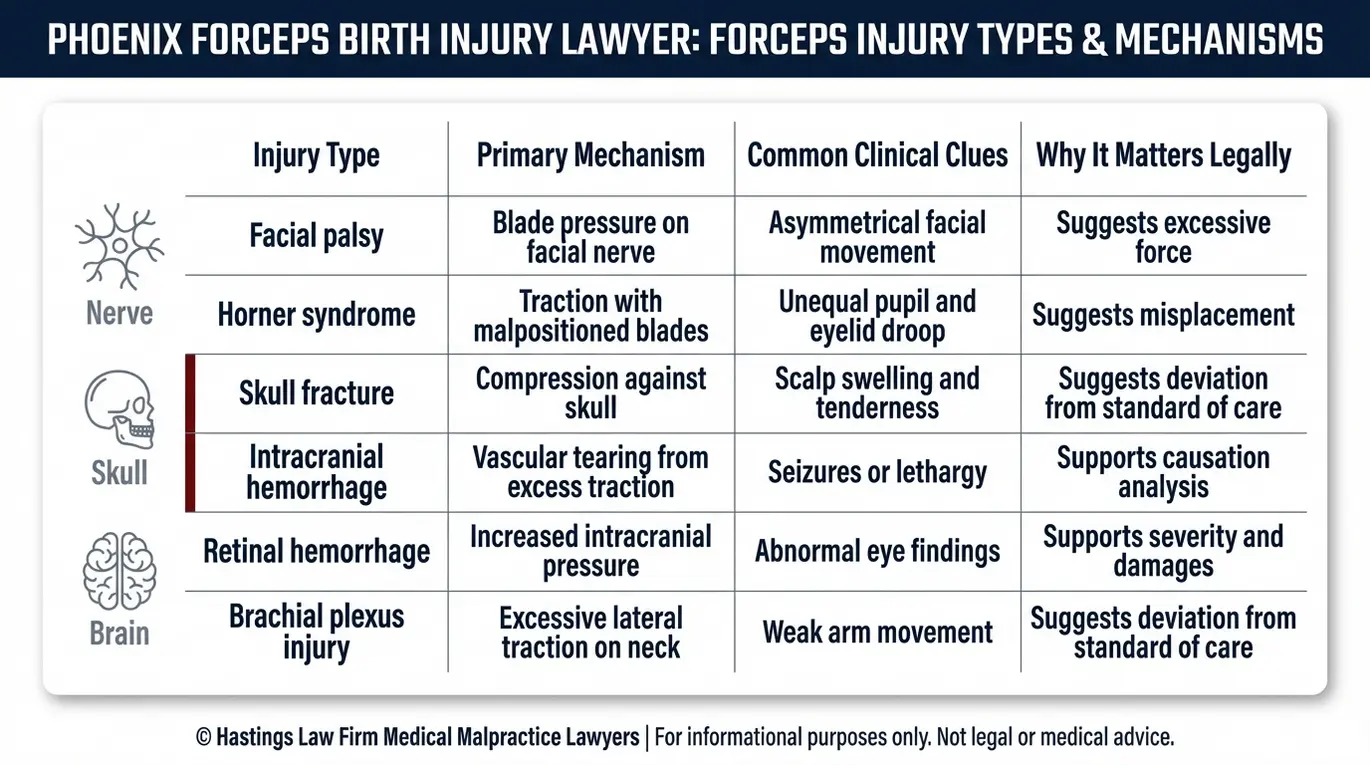
Improper use of forceps, such as applying excessive traction or misplacing the blades, can cause catastrophic physical trauma to the infant’s skull and facial nerves. Common injuries include facial palsy, skull fractures, and intracranial hemorrhages that may lead to permanent cognitive disabilities.
Forceps work by gripping the sides of a baby’s head. When positioned or used incorrectly, the pressure from the blades can compress delicate nerves or fracture thin skull bones. Facial palsy, a type of facial nerve injury that can cause partial or complete paralysis on one side of the face, is one of the more common outcomes. In some cases, nerve damage extends deeper, leading to Horner’s syndrome, a condition affecting the nerves between the brain and the eye that can cause a drooping eyelid and unequal pupil size.
Brachial plexus injuries involve damage to the network of nerves controlling movement and sensation in the arm and can occur when excessive force is used during delivery. These injuries may result in limited arm mobility or, in severe cases, permanent paralysis.
Forceps misuse can also cause ocular injuries. According to the National Center for Biotechnology Information’s review of retinal hemorrhage, bleeding in the retina after delivery can signal deeper trauma, including intracranial hemorrhage, or bleeding inside the skull. This type of injury may not be immediately obvious but can lead to lasting developmental and cognitive problems.
| Injury Type | How It Happens |
|---|---|
| Facial palsy | Nerve compression from misplaced or overtightened blades |
| Skull fracture | Excessive pressure applied to thin cranial bones |
| Intracranial hemorrhage | Forceful traction causing bleeding inside the skull |
| Brachial plexus injury | Excessive pulling force on the head and neck during extraction |
| Horner’s syndrome | Damage to sympathetic nerves from blade pressure near the neck or face |
| Retinal hemorrhage | Increased intracranial pressure from improper forceps application |
As a Phoenix forcep injury attorney, we work with medical experts to trace these injuries back to the specific actions taken during delivery and determine whether the standard of care was met.
The Hastings Law Firm Difference
Results matter, but what truly sets us apart is how we achieve them. Every verdict, every settlement, and every Phoenix courtroom victory comes from one guiding promise: To treat each client’s fight for justice as if it were our own.
This balance of skill, experience, and empathy reflects our core philosophy that justice should not only compensate the injured, but also make health care safer nationwide.

Severe Complications from Vacuum Extraction Errors
Vacuum extraction carries a unique risk of causing subgaleal hemorrhages and scalp injuries if the suction cup is placed incorrectly or if the doctor attempts “pop-offs” beyond the safe limit. Unlike forceps which compress, vacuums can cause shearing injuries that lead to life-threatening blood loss or brain damage.
A subgaleal hemorrhage, a life-threatening bleed that occurs between the skull’s outer covering and the scalp tissue, is one of the most dangerous complications of vacuum extraction negligence. Because the subgaleal space can hold a large volume of blood, a newborn can lose a significant percentage of their blood volume before symptoms become obvious. Research published by PubMed Central on neonatal subgaleal hemorrhage highlights the importance of rapid diagnosis and intervention to prevent shock and brain damage.
Cephalohematoma is another vacuum-related injury. Unlike normal newborn bruising, a cephalohematoma is a collection of blood between the skull bone and its membrane. While many resolve on their own, larger ones may indicate more significant trauma, such as retinal hemorrhage, and should be closely monitored.
Vacuum “pop-offs,” which occur when the suction cup detaches from the baby’s scalp during extraction, are a critical warning sign. Most guidelines limit the acceptable number of pop-offs before the procedure should be abandoned. Continued attempts increase the risk of hypoxic-ischemic encephalopathy (HIE), a form of brain damage caused by oxygen deprivation. Shoulder dystocia, where the baby’s shoulder becomes lodged behind the mother’s pelvic bone, can also worsen when a vacuum is used to pull a baby that is not in a safe position for vaginal delivery.
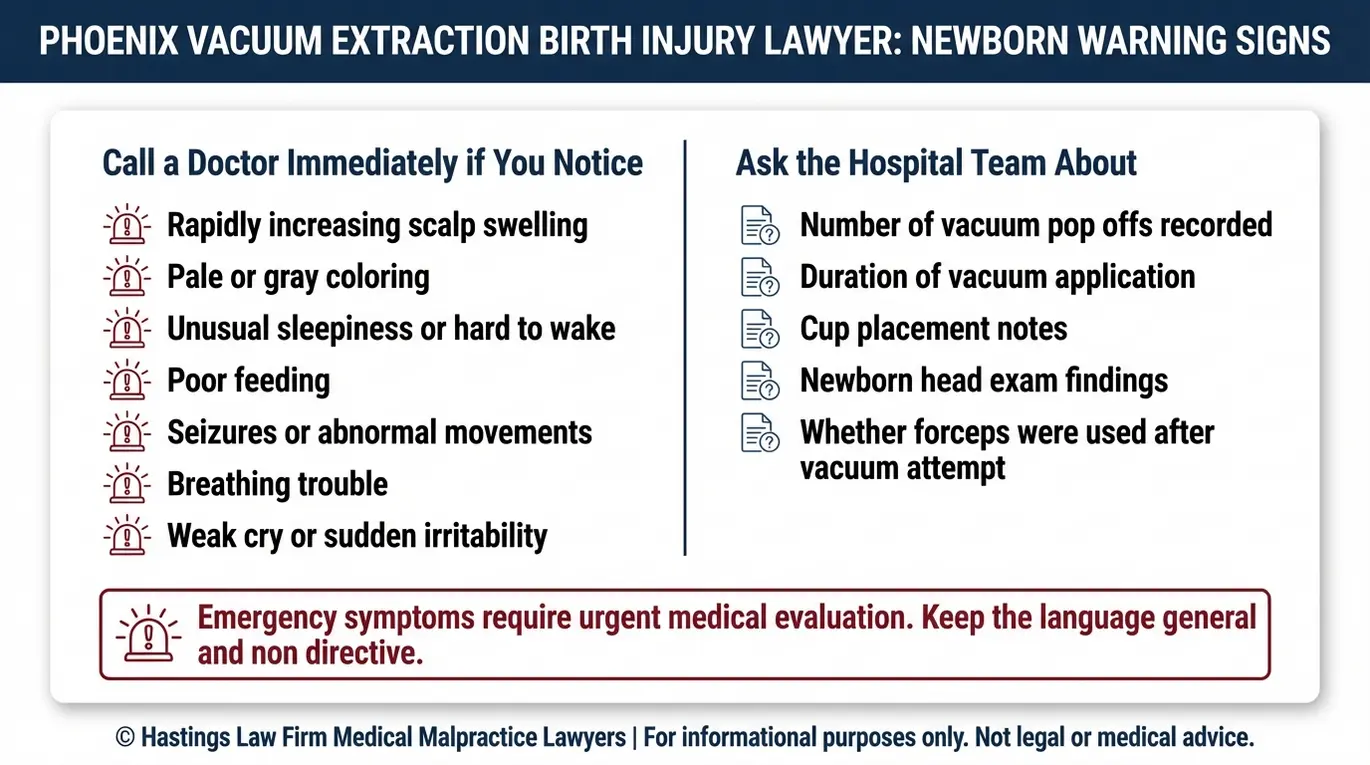
Warning signs that may indicate vacuum extraction caused harm to your child:
- Rapidly swelling or “boggy” scalp shortly after birth
- Sudden drop in the baby’s heart rate or blood pressure after delivery
- Pallor, lethargy, or difficulty feeding in the first hours of life
- Seizures within the first 24 to 72 hours
- A visible or growing lump on the baby’s head that does not resolve quickly
If your child experienced any of these symptoms following a vacuum-assisted delivery, a vacuum birth injury lawyer in Phoenix can help determine whether the provider’s actions fell below the accepted standard of care.
Critical Violations of ACOG Guidelines
The American College of Obstetricians and Gynecologists (ACOG) sets strict limits on assisted delivery, including strongly discouraging the sequential use of vacuum and forceps. If a doctor fails with a vacuum and then attempts forceps (or vice versa), this is a major deviation from the standard of care and strong evidence of malpractice.
ACOG strongly discourages this practice because it significantly increases the risk of intracranial hemorrhage and other serious birth injuries. Intracranial hemorrhage involves bleeding inside the skull and can lead to permanent cognitive disabilities. The NCBI Bookshelf overview of vacuum extraction states that the compounding trauma from sequential instrument use places the infant at a higher risk of catastrophic brain injury.
Other red flags that may indicate a violation of accepted guidelines include:
- Exceeding the recommended number of pulls or pop-offs during vacuum extraction (the “three-pull rule”)
- Applying the vacuum or forceps for longer than the recommended time limits
- Failing to transition to a cesarean section after an unsuccessful assisted attempt
- Not obtaining informed consent, meaning the doctor did not explain the risks compared to alternatives
Arizona law establishes a two-year statute of limitations for medical malpractice claims under A.R.S. § 12-542, which requires beginning an investigation promptly to preserve your rights. As a Phoenix birth injury lawyer, we review delivery records, fetal monitoring strips, and nursing logs to identify whether any of these protocol violations occurred.
Is Your Child’s Injury Considered Medical Malpractice?
Not every birth injury is malpractice, but if your physician failed to act as a reasonably competent doctor would under similar circumstances, you may have a valid claim. This includes situations such as failing to perform a C-section when assisted delivery tools are unsuccessful, using instruments without obtaining informed consent, or ignoring fetal monitoring strips that indicated distress.
To establish a medical negligence claim, four legal elements must be present:
- Duty: The doctor had a professional obligation to provide care that met accepted medical standards.
- Breach of Duty: The doctor deviated from the standard of care, such as misusing forceps or ignoring ACOG protocols.
- Causation: The breach directly caused the child’s injury, rather than a pre-existing condition or unavoidable complication.
- Damages: The child suffered measurable harm, whether physical, cognitive, or financial.
Causation is often the most contested element in medical malpractice cases. Hospitals and their insurers frequently argue that the child’s condition was caused by genetics rather than medical actions. Our medical-legal team’s approach focuses on these records to find the truth. We work with medical experts who analyze electronic fetal monitoring (EFM) records, delivery notes, nursing charts, and imaging studies.
The severity of the injury also factors into the strength of the case. Catastrophic outcomes like cerebral palsy or hypoxic-ischemic encephalopathy (HIE) often correlate with identifiable points of failure in the delivery timeline. Injuries like a bruise or mild swelling may resolve quickly, while permanent neurological damage typically points to a more significant breakdown in the standard of care. A Phoenix medical malpractice lawyer can help distinguish between an unfortunate outcome and a preventable one.
Compensation for Long-Term Care and Rehabilitation
Damages in birth injury cases are designed to cover the lifetime cost of care for the child, which can reach into the millions of dollars depending on the severity of the injury. This includes funding for future medical treatment, physical therapy, specialized education, assistive technology, and compensation for pain and suffering.
| Damage Category | Examples |
|---|---|
| Economic Damages | Past and future medical bills, surgical costs, prescription medications, physical and occupational therapy, speech therapy, specialized schooling, home modifications, assistive devices, and future lost earning capacity |
| Non-Economic Damages | Pain and suffering, emotional distress, loss of enjoyment of life, and loss of normal childhood experiences |
For children diagnosed with conditions like cerebral palsy or HIE, the financial needs extend across an entire lifetime. Experts develop a life care plan, which is a detailed projection of every medical service, therapy session, and adaptive resource the child will require. Research published in PubMed on certification standards for life care plan professionals states these plans are developed by specialists who assess the full scope of future needs following a brain injury.
A Phoenix birth injury lawsuit handled by an experienced legal team ensures that these long-term costs are accounted for. This helps ensure families do not carry the financial burden of a medical mistake alone.
Why Choose Hastings Law Firm for Your Phoenix Case
We are not a high-volume settlement mill; we are a specialized medical malpractice firm that dedicates its full resources to a select number of cases. With a physical office in Phoenix and a team comprising board-certified attorneys and medical professionals, we offer the empathetic, trial-ready representation your family deserves.
Founded by board-certified trial attorney Tommy Hastings, our firm operates with a “trial-ready” approach. Our team includes former defense lawyers and board-certified patient advocates who understand hospital protocols from the inside. This collaboration allows us to identify charting inconsistencies, protocol violations, and gaps in care that a general practice firm might miss. As a Phoenix forcep and vacuum birth injury lawyer, we prepare every case as though it will go before a jury to maintain a strong negotiating position.
We also understand the hesitation many families feel about questioning a doctor’s decisions. Years of conditioning can make it difficult to challenge medical authority, even when evidence suggests something went wrong. Your instincts brought you here, and we believe those instincts deserve to be taken seriously. Our firm frequently receives peer referrals from other attorneys because of our rigorous approach. Our consultations are free, confidential, and come with no obligation.
Contact the Phoenix Birth Injury Attorneys at Hastings Law Firm Today for Help
If your child suffered a preventable injury during a forceps or vacuum-assisted delivery, you deserve a legal team that combines medical knowledge with dedicated trial preparation. Hastings Law Firm’s medical-legal team will review your child’s delivery records, identify where the standard of care may have been violated, and explain your legal options clearly and honestly.
Every case begins with a free, confidential evaluation with our medical staff. There are no upfront fees, and you pay nothing unless we secure a recovery for your family on a contingency fee basis.
Call our Phoenix office or complete our online form to schedule your consultation. We are here to help you find answers, understand what happened, and protect your child’s future.
Frequently Asked Questions About Forcep & Vacuum Birth Injury in Phoenix


This content was researched and written by the Hastings Law Firm editorial team, which includes attorneys, medical professionals, and experienced researchers. Our writing is informed by internal knowledge and practical experience, and we cross-check critical details against authoritative sources cited throughout. Every piece undergoes human-led fact-checking and legal review. Because legal and medical information can change, if you spot an error, please contact us. Learn more about our content standards and review process on our editorial policy page.

Tommy Hastings, founder of Hastings Law Firm, is a board-certified personal injury trial lawyer dedicated exclusively to healthcare injury cases. Since 2001, he has represented injured patients and families in litigation against major hospital systems, pharmaceutical companies, and negligent healthcare providers nationwide. He has handled numerous high-profile cases that have drawn national media attention and resulted in multi-million dollar recoveries. He draws on that experience in his writing, helping readers understand how these cases work and what options may be available to them.
