


Texas Breech Extraction Birth Injury Lawyer
Written by: Hastings Law Firm | Reviewed by: Tommy Hastings | Updated: July 27, 2026
Breech delivery errors can leave families facing lasting harm and uncertainty about whether the outcome was preventable. When a baby is positioned feet first or buttocks first, delivery decisions and technique become especially high stakes, and mistakes can lead to serious trauma or oxygen deprivation. Understanding breech presentation, when a C section is typically recommended, and how care is evaluated can help families make sense of what happened. If you or a loved one were harmed or worse due to breech extraction errors in Texas, contact Hastings Law Firm for a free, confidential case review.

Top Rated Malpractice Attorneys for Breech Birth Injuries
What You Should Know About Improper Breech Delivery Claims in Texas:
- Life changing infant harm can follow a mishandled breech delivery, especially when oxygen deprivation or severe trauma occurs.
- Accountability can turn on whether a timely C section was chosen when breech presentation was identified or should have been identified.
- Options for recovery can be limited by Texas caps on non economic damages in medical malpractice cases.
- The ability to pursue a claim can be lost if Texas timing rules are missed, including a statute of repose that can bar claims.
- Disputes often focus on whether the provider met the standard of care in prenatal imaging and delivery decision making.
- Hospital liability may be at issue when staff failed to monitor or escalate signs of fetal distress.
- Long term financial impact can be substantial when a child needs ongoing medical care and life care planning.
- Medical records and fetal heart rate monitoring strips can be central evidence when evaluating what occurred during labor and delivery.
- Expert medical opinion can be decisive on causation when the defense claims the outcome was an unavoidable complication.

A Healthcare Focused Law Firm
When your child has been hurt during a breech delivery, the weight of that experience can feel overwhelming to face. You may be searching for answers about what went wrong, why it happened, and whether anyone will be held accountable. Those questions deserve honest, informed responses from a legal team that understands both the medicine and the law behind these cases.
At Hastings Law Firm, we focus exclusively on medical malpractice. Our team of board-certified trial attorneys, in-house nurse consultants, and former defense lawyers investigates breech extraction injuries across Texas and nationwide.
As a Texas breech extraction error lawyer team, we prepare every case as if it will go before a jury. This thorough preparation is what drives fair outcomes. If your family is dealing with an injury that may have been preventable, we invite you to contact us for a free, confidential case evaluation. There is no fee unless we recover compensation for you.
Understanding Breech Presentation and Extraction Errors
A breech extraction error occurs when a physician improperly attempts to deliver a baby positioned feet-first or buttocks-first, or fails to perform a timely C-section, resulting in physical trauma or oxygen deprivation to the infant. Breech presentation occurs when a baby is not positioned head-down before birth. These errors during labor and delivery can have lasting consequences, often prompting families to seek a Texas breech extraction error lawyer.
In a typical delivery, a baby enters the birth canal headfirst. Breech presentation, a condition where the baby is positioned with the feet or buttocks entering the birth canal first, occurs in roughly 3 to 4 percent of full-term pregnancies.
This abnormal fetal position changes the mechanics of delivery significantly. It also raises the risk of complications if a vaginal birth is attempted. When a physician proceeds with a vaginal breech extraction rather than performing a Cesarean section, the margin for error is extremely narrow.
Breech extraction is the manual process of guiding or pulling the baby through the birth canal during a breech birth. This process demands precise technique and timing. Mechanical errors can include applying excessive force to the baby’s limbs, using improper hand placement during delivery of the head, or failing to anticipate common complications like head entrapment.
A breech birth attorney evaluates whether these deviations indicate negligence. As a Texas breech extraction error lawyer team, we examine the specific decisions made before and during delivery to determine whether the medical team met the standard of care. We use this data to compare the chosen delivery method against safer alternatives.
The risks of vaginal breech delivery compared to a planned C-section are well-documented. The table below outlines key differences:
| Factor | Vaginal Breech Delivery | Planned C-Section |
|---|---|---|
| Risk of head entrapment | Higher; the head is the last part delivered | Avoided; the head is not subject to canal compression |
| Risk of cord prolapse | Elevated due to breech position | Significantly reduced |
| Need for precise physician technique | Critical; errors can cause immediate trauma | Standardized surgical procedure |
| Risk of oxygen deprivation | Increased if delivery is prolonged or complicated | Lower when performed before labor complications arise |
| General recommendation for breech births | Increasingly discouraged for most breech presentations | Widely considered the safer option for term breech babies |
Understanding the type of breech position involved is essential to evaluating what happened during a delivery and what options the medical team should have considered.
Different Types of Breech Positions and Associated Risks
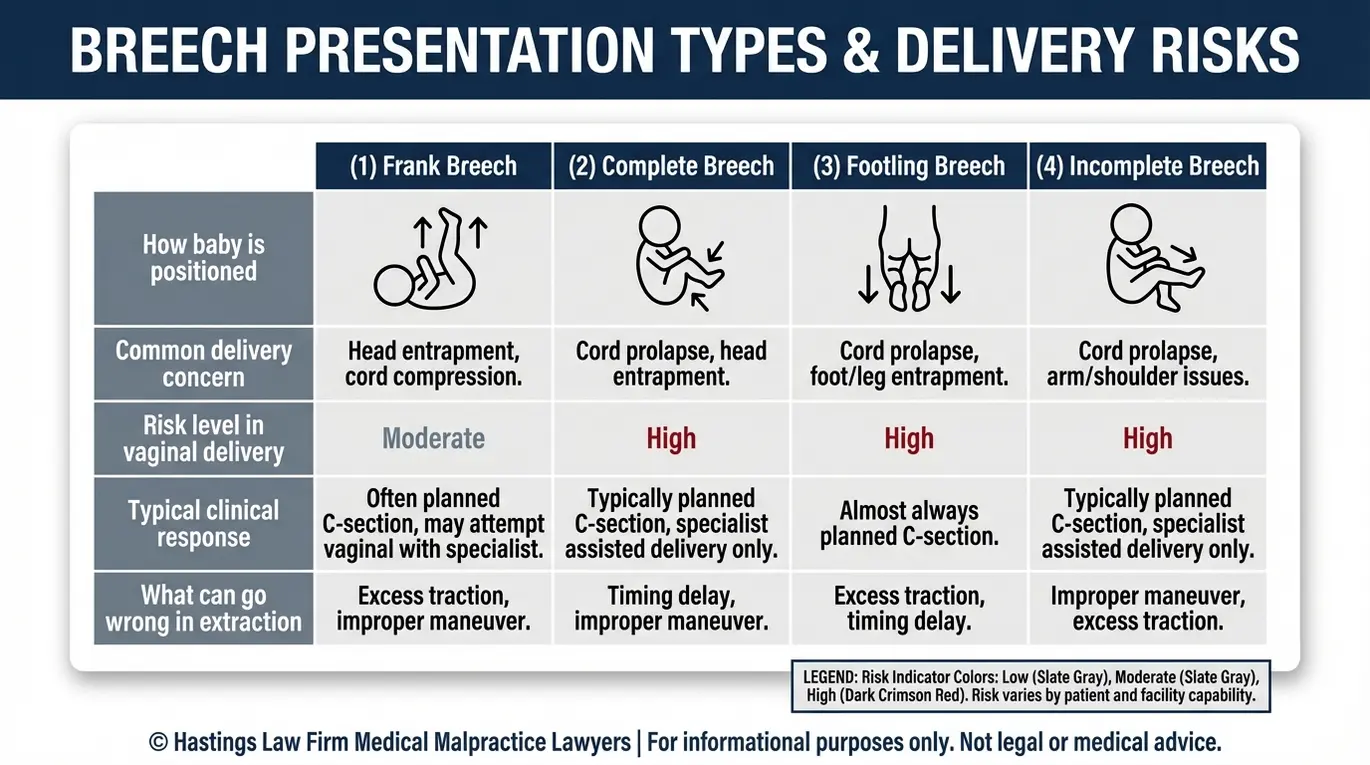
Not all breech presentations carry identical risks. Breech positions describe the specific way a baby is oriented in the womb before delivery. The specific position of the baby affects both the likelihood of a successful vaginal delivery and the types of injuries that can occur if extraction is mishandled.
Frank breech is the most common type where the baby’s buttocks are positioned downward while the legs extend straight up toward the head. It is generally considered the least risky of the breech positions for vaginal delivery, though significant dangers remain. A breech birth attorney reviews these details carefully.
A footling breech, where one or both of the baby’s feet are positioned to enter the birth canal first, carries a higher risk of umbilical cord prolapse and limb injury during extraction. A complete breech occurs when the baby is sitting cross-legged with both hips and knees flexed. An incomplete breech is similar but with one or both legs partially extended.
Both complete and incomplete breech positions increase the complexity of delivery and the potential for entrapment or cord complications. A Texas breech extraction error lawyer can explain how these positions impact safety. Identifying the specific breech position is one of the first steps in understanding whether the medical team made appropriate decisions about how to deliver the baby.
The Standard of Care Regarding C-Sections and Breech Births
The medical standard of care often requires a Cesarean section for breech presentations to avoid the elevated risk of entrapment, cord prolapse, and trauma that comes with vaginal delivery. A C-section is a surgical delivery performed through incisions in the mother’s abdomen. When a physician deviates from this standard without clear clinical justification, the result can be a preventable birth injury. A Texas birth injury attorney investigates these deviations to determine if negligence occurred.
An OB-GYN’s obligation begins well before delivery day. Prenatal testing, including routine ultrasound examinations in the third trimester, is expected to identify the baby’s position. According to ACOG Committee Opinion No. 745 on Mode of Term Singleton Breech Delivery, the evidence supports planned Cesarean delivery for term singleton breech presentations.
ACOG refers to the American College of Obstetricians and Gynecologists, an organization that sets medical standards for pregnancy care. When a physician fails to diagnose a breech position through standard prenatal imaging, the opportunity to plan a safer delivery may be lost. This can lead to a claim based on a failure to perform timely C-section. A lawyer for breech extraction errors often cites this failure as negligence.
Before recommending a C-section, some physicians may offer external cephalic version (ECV). ECV is a technique used to turn a breech baby while still in the womb by applying pressure to the mother’s abdomen. The Cleveland Clinic’s overview of External Cephalic Version (ECV) explains that this procedure is typically attempted around 36 to 37 weeks of pregnancy.
ECV is not appropriate in every case. It may be contraindicated when there are concerns about placenta placement, low amniotic fluid, or other maternal health factors. Consulting a Texas birth injury attorney helps clarify if ECV was mishandled. A lawyer for breech extraction errors will examine whether the physician:
- Identified the breech position through appropriate prenatal imaging
- Discussed the risks and benefits of vaginal breech delivery versus emergency C-section with the patient
- Offered or considered ECV when clinically appropriate
- Checked for conditions like macrosomia (an unusually large baby) or cephalopelvic disproportion (CPD) that make vaginal delivery dangerous
- Responded appropriately when labor stalled or complications arose.
A Texas birth injury attorney reviews these responses and analyzes the timing of each decision. In Texas, medical malpractice claims involving breech deliveries fall under Texas Civil Practice and Remedies Code Chapter 74, which sets specific procedural requirements for filing suit.
Our team, which includes in-house nurses who previously worked in hospital settings, reviews prenatal records and delivery documentation to evaluate the care provided. An experienced lawyer for breech extraction errors ensures no detail is overlooked. This medical-legal collaboration helps us identify inconsistencies in charting that may suggest negligence.
The Hastings Law Firm Difference
Results matter, but what truly sets us apart is how we achieve them. Every verdict, every settlement, and every Texas courtroom victory comes from one guiding promise: To treat each client’s fight for justice as if it were our own.
This balance of skill, experience, and empathy reflects our core philosophy that justice should not only compensate the injured, but also make healthcare safer nationwide.

Consequences of Negligent Breech Deliveries and Trauma
Improper management of a breech birth can cause severe complications ranging from orthopedic fractures to catastrophic brain damage due to oxygen deprivation. Hypoxia refers to a dangerous lack of oxygen reaching the body’s tissues. For many families, the effects of a negligent breech delivery are not temporary and can reshape the course of a child’s entire life. A Texas medical malpractice attorney can help families understand the long-term impact.
The injuries associated with breech extraction errors generally fall into three categories: traumatic physical injuries, hypoxic brain injuries, and maternal injuries. A breech birth malpractice lawyer categorizes these damages for litigation. Traumatic injuries result from the physical forces applied during extraction.
When a physician uses excessive traction or improper technique, the baby’s body can sustain serious damage. A Texas medical malpractice attorney investigates if force was excessive. Common traumatic injuries include:
- Brachial plexus injury (Erb’s palsy): Damage to the network of nerves controlling the shoulder, arm, and hand
- Clavicle and long bone fractures: Broken collarbones or femurs from forceful manipulation
- Spinal cord injury: Damage caused by excessive twisting or pulling on the baby’s torso or neck
- Shoulder dystocia complications: Trauma when the baby’s shoulders become trapped behind the mother’s pelvic bone
Hypoxic injuries occur when the baby’s oxygen supply is interrupted during delivery. In breech births, this can happen when the umbilical cord slips ahead of the baby, a condition known as umbilical cord prolapse. Head entrapment can also deprive the brain of oxygen for critical minutes. A breech birth malpractice lawyer looks for evidence of delay.
Prolonged oxygen deprivation can lead to hypoxia and hypoxic ischemic encephalopathy (HIE), which is brain damage caused by reduced blood flow and oxygen. HIE is a leading cause of cerebral palsy in newborns. A Texas medical malpractice attorney works with experts to prove causation. Research published by Frontiers in Pediatrics on persistent inequities in neonatal encephalopathy underscores the long-term burden these injuries create for families.
Maternal injuries are also a concern. A complicated breech delivery can result in uterine rupture, severe hemorrhaging, or lasting pelvic floor damage. These injuries may require emergency surgical intervention and can affect future pregnancies. A breech birth malpractice lawyer considers the mother’s trauma as well.
As a breech birth malpractice lawyer team, we work with medical experts to connect the specific errors made during delivery to the injuries a child sustained. A Texas medical malpractice attorney must show the injury was caused by how the delivery was managed rather than by an unavoidable complication.
Proving Liability in Texas Medical Malpractice Cases
To succeed in a malpractice claim in Texas, the plaintiff must prove that a doctor-patient relationship existed, the physician breached the standard of care, and that breach directly caused the infant’s injury. Liability is the legal responsibility one party has for the harm caused to another. These foundational elements must be supported by credible evidence, making experienced malpractice counsel essential.
The four elements of medical negligence are:
Duty. The physician or hospital owed a duty of care to the patient. In birth injury cases, this is established by the doctor-patient relationship during pregnancy management. A Texas breech extraction error lawyer verifies this relationship.
Breach. The medical provider failed to meet the accepted standard of care. For a breech delivery, this could mean failing to diagnose the breech position or using improper extraction technique. Malpractice counsel identifies these specific failures.
Causation. The breach of the standard of care directly caused the injury. Expert medical testimony is necessary here to establish a direct link between the provider’s actions and the harm. A Texas breech extraction error lawyer uses this evidence to reconstruct the timeline.
Damages. The patient suffered measurable harm, whether physical, financial, or emotional. Damages can include the cost of ongoing medical care and the impact on the child’s quality of life. Malpractice counsel calculates these accurately.
Texas imposes strict procedural requirements through Chapter 74 of the Civil Practice and Remedies Code. One of the most important is the expert report requirement. Within 120 days after each defendant’s original answer is filed, the plaintiff must serve a written report from a qualified medical expert. This report must identify the standard of care, the breach, and the cause of injury.
A Texas breech extraction error lawyer ensures strict compliance to avoid dismissal. We also evaluate whether liability extends beyond the individual physician. Hospital staff have a responsibility to monitor the mother and baby and escalate concerns.
If nurses failed to communicate signs of fetal distress, the hospital itself may share liability. This can include a claim for hospital negligence, which malpractice counsel will evaluate. Our team examines every layer of the care team’s decision-making to identify all responsible parties. Meeting the burden of proof requires detailed evidence.
How We Investigate and Litigate Birth Injury Claims
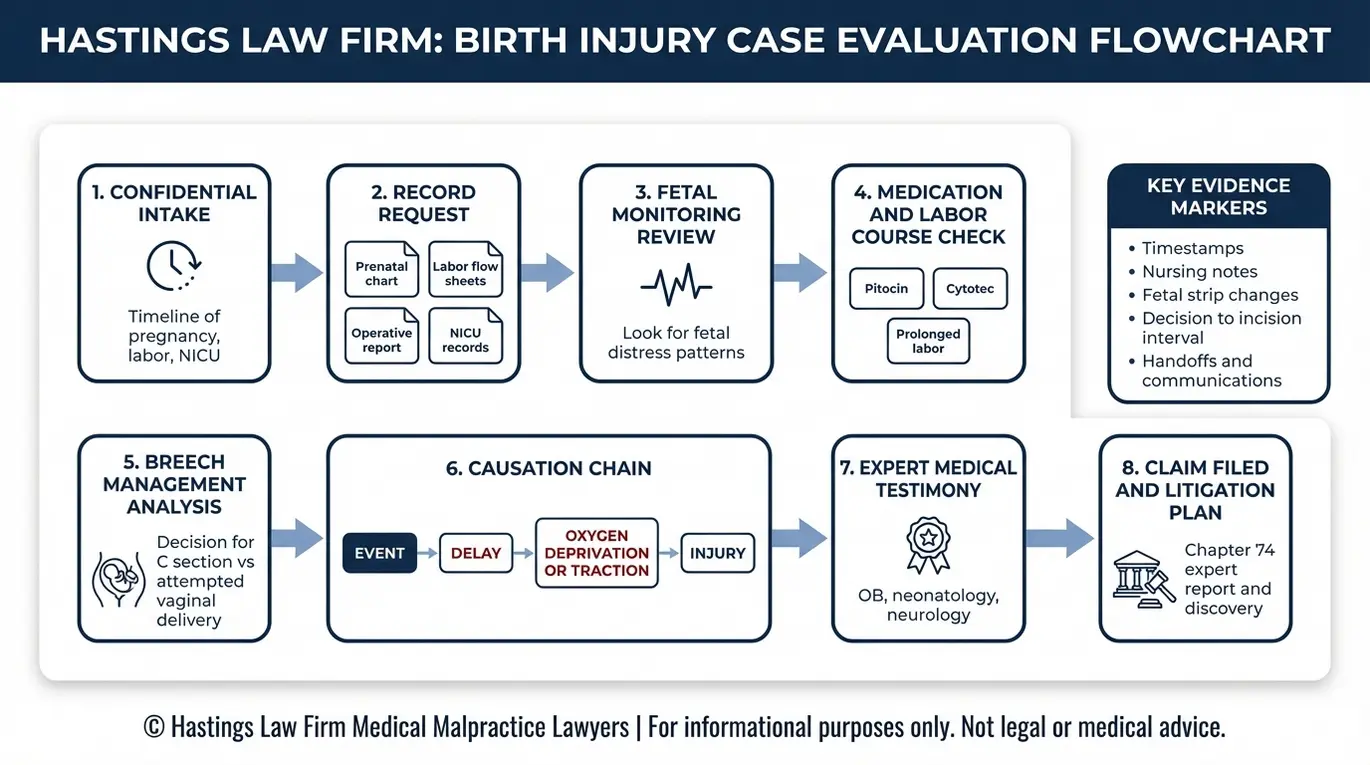
Our investigation starts with a forensic-level review of prenatal records, labor flow sheets, and fetal heart rate strips, conducted by our in-house medical team, to identify the specific moments where the standard of care may have been violated. Medical records are the formal documentation of a patient’s clinical history and care. We build each case from the medical evidence outward. A birth injury law firm must be thorough.
Here is how our process works:
Step 1: Intake and initial review by a Patient Advocate. When a family contacts our birth injury law firm, the first conversation is with a patient advocate who gathers preliminary details. An attorney for extraction errors oversees this intake. This step is free and confidential.
Step 2: Medical record analysis and fetal monitoring review. Once a case is accepted, our in-house nurses and medical consultants conduct a detailed review of the complete medical record. This includes prenatal visit notes, ultrasound reports, and fetal heart rate monitoring strips.
Fetal heart rate monitoring can reveal whether the baby showed signs of distress that the medical team failed to act on. We also look at whether labor-inducing medications like Pitocin or Cytotec were administered and whether monitoring protocols were followed.
Step 3: Expert consultation through our national network. After our internal review, we consult with specialists who practice in the same field as the provider being evaluated. These experts provide independent opinions on whether the standard of care was breached. An attorney for extraction errors relies on these insights for the required expert report and trial testimony.
Step 4: Building the legal case. With the medical investigation complete, our attorneys develop the litigation strategy and handle all filings, depositions, and discovery. As a specialized birth injury law firm, we prepare every case from day one for trial. Our team includes former defense attorneys who understand the arguments hospitals and insurers use.
For families working with an attorney for extraction errors, this process is designed to minimize stress while building a strong case. You are kept informed at every stage, and our contingency fee structure means you pay nothing unless we secure a recovery.
Calculating Damages for Lifelong Disabilities
Compensation in breech injury cases typically covers past and future medical expenses, life care costs, lost earning capacity, and non-economic damages such as pain and suffering. Economic damages are the measurable financial losses resulting from an injury. When a child faces a lifetime of care needs, the financial stakes are significant. Experienced compensation lawyers understand these stakes.
Caring for a child with HIE or cerebral palsy can involve years of therapy, specialized equipment, and home modifications. These costs often reach into the millions of dollars over the child’s lifetime. A Texas breech extraction error lawyer ensures these are calculated correctly.
To accurately project these future needs, our team works with life care planners and forensic economists. A life care plan is a detailed document that outlines every anticipated medical need and its associated cost over the child’s expected lifespan. Our compensation lawyers work to project future medical costs and lost earning capacity.
Damages in birth injury cases generally fall into two categories:
| Economic Damages | Non-Economic Damages |
|---|---|
| Past and future medical bills | Physical pain and suffering |
| Rehabilitation and therapy costs | Emotional distress |
| Adaptive equipment and home modifications | Loss of enjoyment of life |
| Lost future earning capacity | Loss of companionship (for parents) |
| In-home nursing or attendant care | Mental anguish |
Texas imposes caps on non-economic damages in medical malpractice cases. Under Chapter 74, non-economic damages against individual physicians are capped at $250,000 per defendant. Compensation lawyers work within these statutory limits. Economic damages, which cover actual financial losses, are not capped. Punitive damages may be available in rare cases involving especially egregious conduct.
Texas Statute of Limitations for Birth Injury Lawsuits
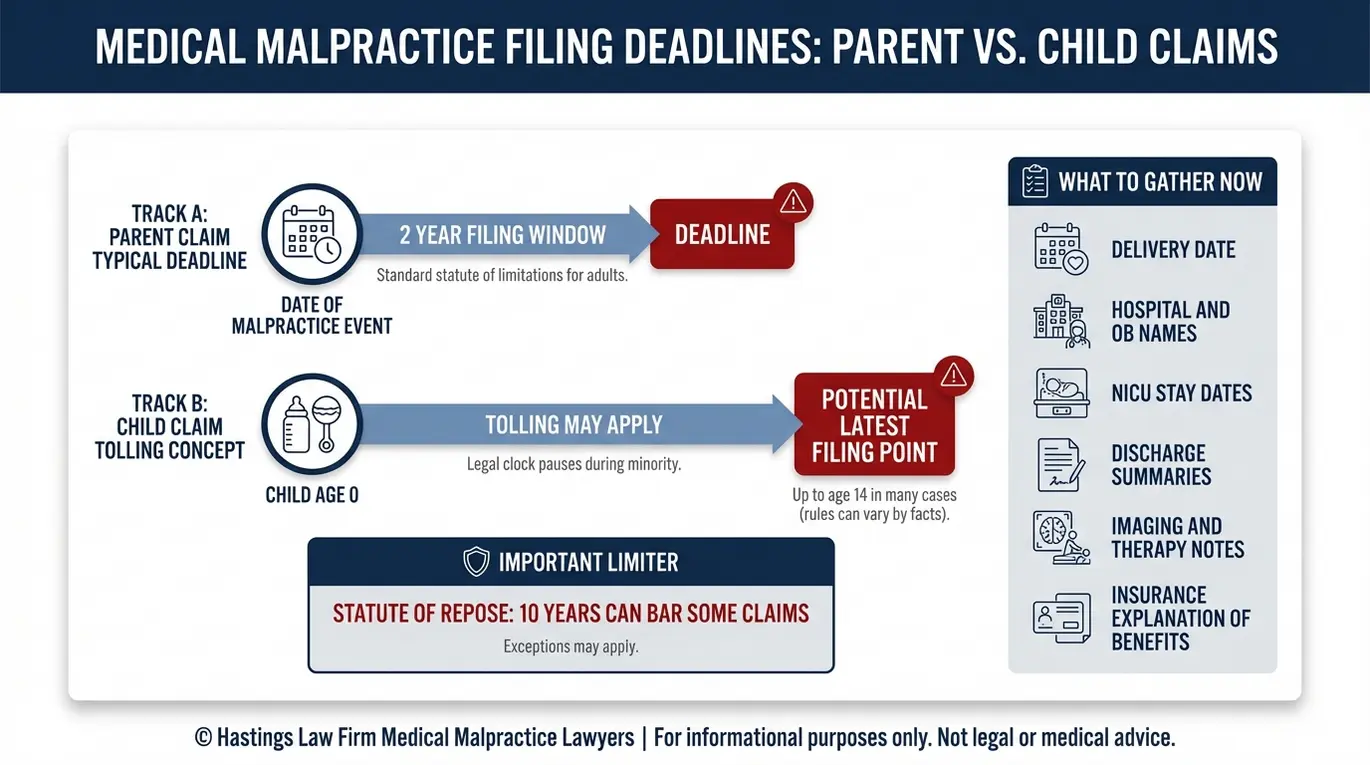
In Texas, parents generally have two years from the date of the injury to file a medical malpractice claim. A statute of limitations is a law that sets the maximum time parties have to initiate legal proceedings. However, the statute of limitations for the injured child is paused until the child turns 12. This means a claim can typically be filed until the child’s 14th birthday.
A filing deadline attorney can verify how these dates apply to your specific situation. The general statute of limitations in Texas dictates strict timing for filing suit. While the standard rule applies to parents, the minor statute of limitations provides time for the child’s claim to be brought.
Because a minor cannot bring a lawsuit on their own, the statute of limitations is legally tolled. However, relying on tolling provisions can be risky without a filing deadline attorney to guide you. Importantly, Texas enforces a statute of repose, a hard 10-year deadline that bars claims regardless of the child’s age. This rule overrides other extensions.
Distinguishing Birth Injuries from Birth Defects
One important legal distinction is birth defect vs birth injury. A birth defect is a health condition present at birth, while a birth injury is harm caused during delivery.
A birth defect is typically a genetic condition found through genetic testing. A preventable injury, by contrast, is physical harm caused by negligence. Our team analyzes records to prove the child’s condition resulted from delivery trauma.
Contact the Texas Birth Injury Attorneys at Hastings Law Firm Today for Help
If your child was injured during a breech delivery, you deserve to know what happened and why. At Hastings Law Firm, our mission is to restore trust for families who feel the healthcare system failed them and to secure the resources your child needs for the future.
Founded by Tommy Hastings, a board-certified trial lawyer recognized for over two decades of experience in medical negligence litigation, our firm has the experience to handle complex breech birth injury cases. Our team includes board-certified trial attorneys, in-house nurse consultants, and former defense lawyers who focus exclusively on medical malpractice.
We offer a free, confidential case evaluation and work on a contingency fee basis. This means you pay no attorney fees or costs unless we recover compensation for your family. Contact us today to speak with a patient advocate who can review what happened and help you understand your options.
Frequently Asked Questions About Breech Extraction Birth Injury in Texas


This content was researched and written by the Hastings Law Firm editorial team, which includes attorneys, medical professionals, and experienced researchers. Our writing is informed by internal knowledge and practical experience, and we cross-check critical details against authoritative sources cited throughout. Every piece undergoes human-led fact-checking and legal review. Because legal and medical information can change, if you spot an error, please contact us. Learn more about our content standards and review process on our editorial policy page.

Tommy Hastings, founder of Hastings Law Firm, is a board-certified personal injury trial lawyer dedicated exclusively to healthcare injury cases. Since 2001, he has represented injured patients and families in litigation against major hospital systems, pharmaceutical companies, and negligent healthcare providers nationwide. He has handled numerous high-profile cases that have drawn national media attention and resulted in multi-million dollar recoveries. He draws on that experience in his writing, helping readers understand how these cases work and what options may be available to them.
