


Texas Labor & Delivery Handoff Failure Lawyer
Written by: Hastings Law Firm | Reviewed by: Tommy Hastings | Updated: July 27, 2026
Obstetric shift changes can create dangerous gaps when critical information is not clearly handed off between nurses and physicians. Miscommunication about monitoring, medications, or escalating concerns can delay intervention during labor and delivery and lead to severe, lasting harm. Hospitals may be accountable when breakdowns in continuity of care fall below accepted standards and contribute to an avoidable injury. Clear records of what was communicated and when can be central to understanding what happened. If you or a loved one were harmed or worse due to labor and delivery handoff failure in Texas, contact Hastings Law Firm for a free, confidential case review.

Holding Hospitals Accountable for Obstetric Shift Change Negligence
What You Should Know About Obstetric Shift-Change Negligence Claims in Texas:
- Life altering birth injuries can result when shift change miscommunication delays emergency intervention during labor and delivery.
- Hospital accountability can hinge on whether critical patient information was not communicated during a handoff and an injury followed.
- Severe outcomes can occur when fetal distress is not recognized or acted on during a transition in care.
- Options can be limited if Texas medical malpractice timing rules are missed, including special rules for minors and an outside cutoff.
- Financial recovery can be constrained by Texas limits on non economic damages even when medical needs are extensive.
- Disputes often focus on whether monitoring gaps occurred during nursing handoffs and whether warning signs went unreviewed.
- Medication related harm can be tied to handoff failures when infusion details are not relayed, such as Pitocin dosing.
- Delays can be amplified when a new physician restarts decision making instead of building on prior assessments.
- Documentation can be pivotal because EHR audit trails and fetal monitoring records can show who reviewed key data and when.
- Communication protocol breakdowns can be reflected in nursing notes and escalation records when concerns were documented but not acted on.

A Healthcare Focused Law Firm
When a baby is harmed during labor and delivery, families often learn that the injury traces back not to one dramatic moment, but to a quiet gap: the minutes when one medical team handed off care to the next. If you suspect that a miscommunication or missed warning sign during a shift change contributed to your child’s injury, you are not alone in feeling that something went wrong.
As a Texas labor & delivery handoff failure lawyer team, Hastings Law Firm focuses exclusively on medical malpractice, including birth injuries caused by breakdowns in hospital communication. We can review what happened during your delivery, examine the medical records, and explain your legal options in a free, confidential consultation.
Defining Negligence When Shift Change Errors Cause Birth Injuries
A shift change error becomes actionable medical malpractice in Texas when a healthcare provider fails to communicate critical patient data to the incoming team, directly resulting in a failure to intervene and subsequent injury to the child. Not every poor outcome at delivery is negligence, but when miscommunication violates the accepted standard of care, the hospital and its staff can be held accountable. A handoff negligence attorney can help families identify these breaches.
At the center of cases handled by a Texas labor & delivery handoff failure lawyer is a concept called continuity of care, the principle that a patient’s treatment must remain consistent and uninterrupted even as individual providers rotate on and off duty. A labor and delivery handoff, or shift-change handoff, which is the structured transfer of patient information from one nurse or physician to the next, is critical. The duty of care does not end when one provider clocks out. It transfers to whoever takes over.
Shift changes, commonly occurring around 7 AM and 7 PM, are widely recognized as some of the most vulnerable moments in a hospital. During these transitions, attention splits. Outgoing staff are wrapping up documentation while incoming staff are absorbing new information about multiple patients at once.
In obstetric malpractice cases, critical details about a mother’s labor progress, fetal status, or medication regimen often fall through the cracks. An obstetric communication failure lawyer identifies these omissions.
Under Texas Civil Practice and Remedies Code, Chapter 74, healthcare providers owe patients a duty of care that meets accepted medical standards. When we investigate these claims as a handoff negligence attorney team, we look at medical records for specific gaps where the “baton was dropped.” The records frequently tell the story the hospital would prefer stayed hidden, as an obstetric communication failure lawyer knows well.
Duty of Care Checklist During a Labor & Delivery Shift Change:
- Outgoing provider communicated the current stage of labor and any complications
- Fetal monitoring status and any concerning patterns were relayed
- All active medications and dosages were documented and transferred
- Maternal vital signs and risk factors were discussed with the incoming team
- Pending orders or physician concerns were clearly handed off
- The incoming provider confirmed receipt and understanding of the patient’s condition
When any of these steps are skipped or rushed, a Texas labor & delivery handoff failure lawyer can evaluate whether the resulting gap caused preventable harm to the baby.
The Black Hole of Information: Failure to Monitor During Nursing Handoffs
Hospitals can be held liable for injuries that occur when incoming staff fail to review fetal monitoring strips or when outgoing staff fail to report signs of fetal distress during the transition period. This gap in surveillance, a lapse in maternal monitoring sometimes lasting 15 to 30 minutes, can be the difference between a healthy delivery and a catastrophic one.
Electronic fetal monitoring (EFM) strips, the continuous tracings that record a baby’s heart rate throughout labor, are one of the most important tools in the delivery room. When a nurse steps away to give report and the incoming nurse has not yet assumed care, these strips may go unreviewed. A labor and delivery malpractice attorney notes that a study published by PubMed Central on acute care nurses’ experiences of patient handoffs during shift change highlights how these transitions create real-time monitoring gaps with measurable patient safety consequences.
During this window, warning signs can escalate quickly. Late decelerations in the fetal heart rate, a pattern that may indicate the baby is not getting enough oxygen, can progress from concerning to dangerous in minutes. Dropping oxygen levels or changes in maternal vital signs may also go unnoticed when no one is actively watching. A Texas shift change birth injury lawyer knows that during this window, rapid response is essential.
As a Texas shift change birth injury lawyer team, we rely on the electronic health record (EHR) audit trail, the digital log that records exactly who accessed a patient’s chart, what they viewed, and when. This audit trail is powerful evidence. It can show whether the incoming nurse reviewed the fetal heart rate strips before assuming care or whether there was a gap of 20, 30, or even 45 minutes where no provider checked the tracings. A failure to handoff lawyer uses this data to prove negligence.
A labor and delivery malpractice attorney experienced in these cases knows how to interpret these records and work with qualified medical experts to establish whether the monitoring failure caused or contributed to the injury. If your family is dealing with the consequences of a missed warning sign, a failure to handoff lawyer can help you understand whether the hospital’s systems failed your child.
The Hastings Law Firm Difference
Results matter, but what truly sets us apart is how we achieve them. Every verdict, every settlement, and every Texas courtroom victory comes from one guiding promise: To treat each client’s fight for justice as if it were our own.
This balance of skill, experience, and empathy reflects our core philosophy that justice should not only compensate the injured, but also make healthcare safer nationwide.

Common Critical Information Lost During Obstetric Staff Changes
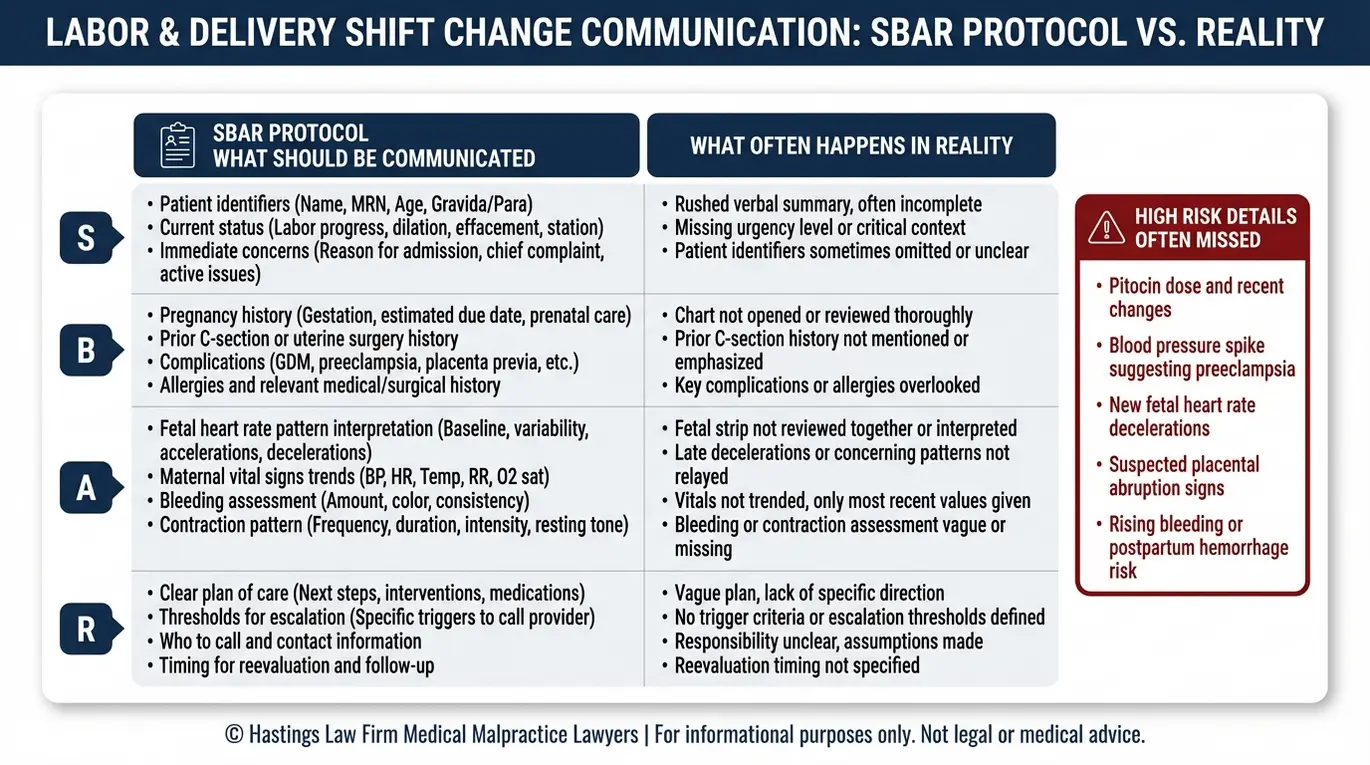
The most frequently missed data points during handoffs include fluctuating fetal heart rates, recent medication administration (like Pitocin) involving potential medication errors, and maternal blood pressure spikes indicating preeclampsia, a dangerous pregnancy complication involving high blood pressure that can lead to seizures or organ damage. A birth injury lawyer in Texas sees these spikes ignored too often.
Hospitals are supposed to follow structured communication protocols for shift changes. The most widely recommended framework is SBAR (SafetyCulture), which stands for Situation, Background, Assessment, and Recommendation. In practice, the gap between what should happen and what actually happens can be significant. An obstetric negligence counsel can compare these protocols to the records.
| SBAR Protocol (What Should Happen) | The Reality (What Often Happens) |
|---|---|
| Situation: Clear summary of the patient’s current labor status and any active concerns | Rushed verbal summary given while walking between rooms |
| Background: Relevant history including prior C-sections, gestational diabetes, or preeclampsia risk | Prior surgical history or risk factors skipped due to time pressure |
| Assessment: Nurse’s clinical judgment on fetal and maternal status, including EFM interpretation | Subjective assessment minimized or omitted entirely |
| Recommendation: Specific next steps, such as “call the attending if heart rate drops below 110” | No clear action items communicated to incoming provider |
One of the most dangerous handoff failures involves Pitocin, a synthetic form of oxytocin used to induce or strengthen contractions. If the incoming nurse does not know the current Pitocin infusion rate or how the mother has been responding, she may continue increasing the dose. This can lead to uterine hyperstimulation and, in severe cases, uterine rupture or postpartum hemorrhage. A Texas handoff failure attorney investigates these infusion errors.
Equally concerning is the failure to relay a mother’s obstetric history. If a new physician is unaware of prior cesarean sections, they may attempt a vaginal delivery that places the mother at serious risk. As a Texas handoff failure attorney team, we see these patterns repeatedly in the records we review. A birth injury lawyer in Texas with experience in obstetric negligence knows exactly where to look for what was lost in translation. Consulting a birth injury lawyer in Texas is crucial.
Why Nurses’ Concerns Are Often Dismissed During Handoffs
A related and deeply troubling pattern involves the chain of command, which is the nursing escalation process that allows a bedside nurse to report concerns to a charge nurse or attending physician. This formal hierarchy is designed to ensure that a higher level of medical authority reviews a patient when their condition is declining. In labor and delivery negligence cases, we sometimes find that an outgoing nurse documented concerns about fetal distress, but the incoming physician or charge nurse did not act on them.
The nursing escalation process requires staff to move up the medical hierarchy when patient safety is at risk. This type of miscommunication can amount to medical malpractice when the dismissal of a nurse’s clinical observations delays a necessary intervention. We examine nursing notes, physician response times, and escalation logs to determine whether the chain of command broke down and whether that breakdown contributed to the injury.
The Consequences of Delayed Action Due to Communication Breakdowns
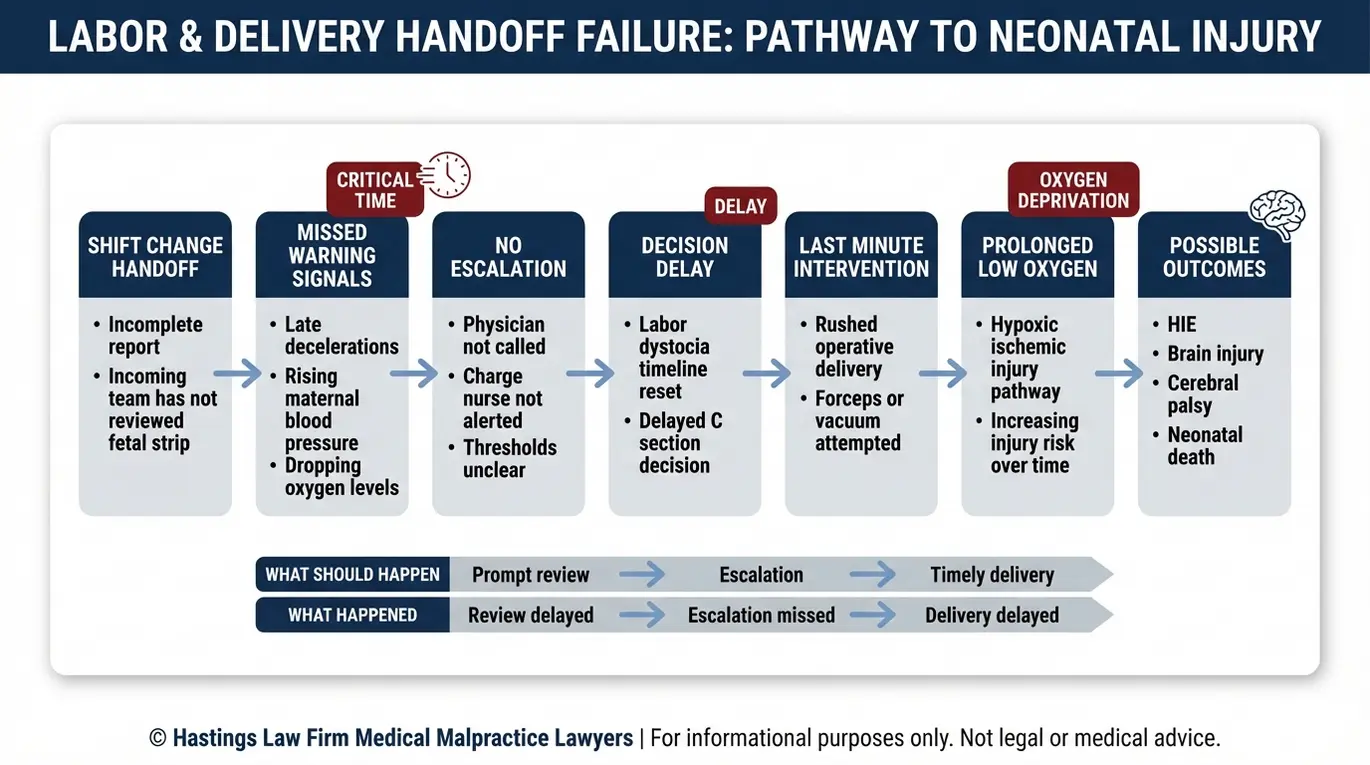
When handoff failures cause delays in necessary emergency interventions, the infant may suffer from prolonged oxygen deprivation, leading to permanent brain damage or death. The relationship between time and brain health during delivery is direct: every minute a baby goes without adequate oxygen increases the risk of lasting neurological harm. A hypoxic injury lawyer understands this urgency.
One of the most critical metrics in obstetric emergencies is decision-to-incision time, which is the interval between recognizing that an emergency cesarean section is needed and actually delivering the baby. According to clinical practice guidelines for neonatal hypoxic ischemic encephalopathy published in PubMed Central, the duration and severity of oxygen deprivation are key factors in determining the extent of brain injury. Hypoxic ischemic encephalopathy (HIE), a form of brain damage caused by insufficient oxygen and blood flow, can result from delays measured in minutes. A delayed C-section attorney tracks these minutes.
A particularly dangerous scenario arises when a “fresh” physician arrives at the start of a shift and effectively restarts the clinical decision-making process. Rather than building on the outgoing team’s observations and assessments, the new doctor may want to form their own impression, losing precious time re-evaluating a patient who has already been laboring for hours with signs of distress. A Texas labor & delivery handoff failure lawyer scrutinizes these delays.
When the delay becomes critical and delivery can no longer wait, the result is often a rushed, last-minute intervention. Injuries associated with these emergency situations reviewed by a delayed C-section attorney include:
- Hypoxic ischemic encephalopathy (HIE): oxygen deprivation causing mild to severe brain damage
- Cerebral palsy: permanent motor and developmental disability linked to brain injury at birth
- Brachial plexus injuries: nerve damage from difficult or forced delivery
- Injuries from improper forceps or vacuum extractor use: skull fractures, brain bleeds, or soft tissue damage from instruments applied under emergency pressure
- Delayed C-section complications: increased risk of maternal hemorrhage and neonatal distress
As a Texas labor & delivery handoff failure lawyer team, we build minute-by-minute timelines to establish whether a delayed C-section or panicked intervention was the direct result of a communication breakdown. A hypoxic injury lawyer experienced in these cases can work with neonatal and obstetric experts to connect the handoff failure to the specific harm your child suffered.
How Our Texas Medical Malpractice Team Proves Systemic Liability
We use a dual approach of forensic medical expert review and corporate discovery to prove that the injury was caused by systemic hospital failures rather than a single isolated mistake. Birth injuries from handoff breakdowns are rarely about one person making one error. They are about a system that allowed critical information to slip through. A medical malpractice law firm exposes these patterns.
Our investigation as a Texas labor & delivery handoff failure lawyer team begins with a complete reconstruction of the labor and delivery timeline. Our in-house medical staff, including nurse practitioners and board-certified patient advocates, review the records alongside our attorneys to identify exactly where communication broke down.
Our Investigation Process:
- Record Acquisition and Reconstruction: We obtain all medical records, EHR audit logs, fetal monitoring strips, nursing notes, and physician orders to build a minute-by-minute timeline of the labor.
- Expert Medical Review: Through our national expert network, we retain qualified obstetricians and neonatologists to evaluate whether the standard of care was met during the handoff. A hospital negligence attorney guides this process.
- Vicarious Liability Analysis: We determine whether the hospital is legally responsible for the actions of its employed nurses and physicians. When a hospital’s own staff caused the injury, the institution itself can be held accountable through vicarious liability.
- Corporate Negligence Investigation: We examine whether the hospital failed to implement or enforce safe hospital protocols for shift changes. If the facility lacked a structured handoff policy, this supports a corporate negligence claim. A Texas labor & delivery handoff failure lawyer checks if these protocols were followed.
- Damages Assessment: We work with life care planners and economic experts to document the full cost of your child’s injury, including lifetime medical needs and therapy.
Founded by Tommy Hastings, a board-certified trial lawyer, we handle every case with the knowledge that it may need to go before a jury. Our hospital negligence attorney team includes former defense counsel who know how hospitals and insurance carriers think, allowing us to anticipate their strategies and counter them with evidence built through thorough investigation.

Contact the Texas Birth Injury Attorneys at Hastings Law Firm Today for Help
Shift change failures during labor and delivery are not simply “accidents” or unavoidable complications. They reflect systemic breakdowns in hospital communication that put mothers and babies at risk. When a hospital fails to enforce safe handoff protocols and your child is harmed as a result, your family has a right to answers and accountability.
Hastings Law Firm is dedicated to helping families affected by preventable birth injuries. As a Texas labor & delivery handoff failure lawyer team, we have the medical knowledge, legal experience, and resources to investigate what happened and hold the responsible parties accountable.
If you believe a communication breakdown during your delivery contributed to your child’s injury, we are here to help. Contact Hastings Law Firm for a free, confidential case evaluation. A legal investigation can determine if hospital protocols were followed during these critical staff transitions. You pay no fees unless we recover compensation for your family.
Frequently Asked Questions About Labor & Delivery Handoff Failure in Texas


This content was researched and written by the Hastings Law Firm editorial team, which includes attorneys, medical professionals, and experienced researchers. Our writing is informed by internal knowledge and practical experience, and we cross-check critical details against authoritative sources cited throughout. Every piece undergoes human-led fact-checking and legal review. Because legal and medical information can change, if you spot an error, please contact us. Learn more about our content standards and review process on our editorial policy page.

Tommy Hastings, founder of Hastings Law Firm, is a board-certified personal injury trial lawyer dedicated exclusively to healthcare injury cases. Since 2001, he has represented injured patients and families in litigation against major hospital systems, pharmaceutical companies, and negligent healthcare providers nationwide. He has handled numerous high-profile cases that have drawn national media attention and resulted in multi-million dollar recoveries. He draws on that experience in his writing, helping readers understand how these cases work and what options may be available to them.
