


Texas Fetal Distress Lawyer
Written by: Hastings Law Firm | Reviewed by: Tommy Hastings | Updated: July 27, 2026
Fetal distress, also called nonreassuring fetal status, signals that a baby may not be getting enough oxygen during labor and delivery and it can require urgent medical action. Warning signs often appear on electronic fetal monitoring strips, and delays in recognizing or responding to abnormal patterns can lead to permanent neurological harm or worse. The discussion also addresses how oxygen deprivation can happen, what timely interventions are expected, and how long term needs can affect a family. If you or a loved one were harmed or worse due to fetal distress in Texas, contact Hastings Law Firm for a free, confidential case review.

Trusted Medical Malpractice Attorneys for Texas Birth Injuries
What You Should Know About Nonreassuring Fetal Status Negligence Claims in Texas:
- Lifelong neurological injury can result when oxygen deprivation during labor is not corrected in time.
- Stillbirth can occur when clear signs of deterioration go undetected or untreated for too long.
- Disputes often focus on whether the medical team recognized abnormal fetal monitoring patterns and responded with appropriate urgency.
- Accountability can turn on whether escalation to emergency cesarean delivery occurred when the tracing remained abnormal.
- Clarity about the cause of oxygen deprivation can shape conclusions about whether the injury was sudden during labor or developed over time.
- Recovery options in Texas can be limited for non economic harms because state law caps non economic damages in medical malpractice cases.
- Financial recovery can be driven by the projected cost of long term medical care and support needs.
- The most important records can include fetal monitor strips and time stamped documentation of team actions.
- Placental pathology findings can be central to timing because they may indicate an acute event versus a chronic process.
- Expert review can be decisive because specialists interpret fetal monitoring and connect the labor timeline to the child injury.

A Healthcare Focused Law Firm
When your child has been harmed during labor or delivery, the weight of that experience is something no family should carry alone. You may have questions about what went wrong, whether the medical team responded appropriately, and what options exist to protect your child’s future. These are the right questions to ask, and you deserve honest answers.
As a Texas fetal distress lawyer, Hastings Law Firm focuses exclusively on medical malpractice. Our team of attorneys, nurse consultants, and medical staff works together to investigate birth injury cases with the precision and care your family’s situation demands. If something happened during your child’s birth that does not feel right, we can review the medical records, explain what we find, and help you understand your legal options. Consultations are free, and there are no fees unless we recover compensation on your behalf.
Understanding Fetal Distress and Nonreassuring Fetal Status
Fetal distress, now more commonly referred to in the medical community as nonreassuring fetal status (NRFS), is a complication during labor indicating the baby is not receiving adequate oxygen. It requires immediate medical intervention to prevent permanent injury.
The shift in terminology from “fetal distress” to nonreassuring fetal status reflects a move toward more precise clinical language. Older phrasing implied a definitive diagnosis, while NRFS describes a pattern of warning signs that something may be wrong with the baby’s oxygen supply. This distinction guides the medical team to look for specific patterns rather than reacting to a vague label.
It emphasizes the need for a differential diagnosis, which is a process used to rule out other conditions to determine if the baby is truly hypoxic. According to the American Pregnancy Association, this condition signals the need for prompt evaluation and urgent intervention.
The underlying mechanism is rooted in compromised blood flow. When the placenta or umbilical cord cannot deliver enough oxygenated blood to the baby, oxygen levels drop. This is known as hypoxia, a reduction in oxygen reaching the body’s tissues. Acidosis, a buildup of acid in the baby’s blood, often follows prolonged hypoxia. This metabolic shift is particularly dangerous to the fetal brain and requires prompt reversal. If hypoxia persists long enough, it can progress to birth asphyxia, a condition where the baby is deprived of oxygen to the point that organs, particularly the brain, begin to sustain damage.
Regardless of which term appears in a medical chart, the clinical urgency remains the same. A baby showing signs of oxygen deprivation during labor needs a timely and appropriate medical response. When that response is delayed or inadequate, the consequences can be life-altering. This is exactly the type of case we investigate: whether the medical team recognized the warning signs and acted within the accepted standard of care.
Recognizing Signs of Distress on Electronic Fetal Monitors
Doctors identify fetal distress primarily through electronic fetal monitoring (EFM) anomalies, such as late decelerations, loss of variability, or persistent tachycardia. This technology continuously tracks the baby’s heart rate alongside the mother’s uterine contractions during labor. Abnormalities on the monitor can signal that the baby is in trouble.
Electronic fetal monitoring works by recording two streams of data simultaneously. One sensor tracks the fetal heart rate, while another measures the timing and intensity of contractions. Together, they produce a tracing, often called a fetal monitor strip, that gives the medical team a real-time picture of how the baby is tolerating labor. A normal baseline fetal heart rate generally falls between 110 and 160 beats per minute with moderate variability, meaning the heart rate fluctuates in a healthy, expected pattern.
When our attorneys review a birth injury case, the EFM strips are among the most important pieces of evidence. These tracings tell a minute-by-minute story that can reveal whether warning signs were present and how quickly the medical team responded.
The table below outlines the general differences between reassuring and nonreassuring patterns on fetal monitoring:
| Feature | Reassuring Pattern | Nonreassuring Pattern |
|---|---|---|
| Heart Rate Baseline | 110–160 bpm | Below 110 (bradycardia) or above 160 (tachycardia) |
| Variability | Moderate (6–25 bpm fluctuations) | Minimal or absent variability |
| Accelerations | Present | Absent after 32 weeks |
| Decelerations | None or early (mirror contractions) | Late or variable decelerations |
| Pattern Shape | Normal, reactive | Sinusoidal (smooth, wave-like) |
Beyond the monitor, physical signs during delivery can also indicate distress. Meconium-stained amniotic fluid, which occurs when the baby passes its first stool before birth due to stress, is one such indicator that the medical team should evaluate alongside the EFM data.
EFM Categories and Escalation Thresholds
To standardize how providers interpret fetal heart rate tracings, the National Institute of Child Health and Human Development (NICHD) established a three-tier classification system for cardiotocography. This system helps define the expected standard of care when responding to different monitoring results.
Category I tracings are normal. They show a stable baseline, moderate variability, and no significant decelerations. These tracings require only routine monitoring.
Category II tracings are indeterminate. They include patterns that are not clearly normal or abnormal, such as minimal variability without decelerations or variable decelerations with slow recovery. Category II requires continued observation, evaluation, and potentially corrective measures.
Category III tracings are abnormal and demand immediate action. These include either absent baseline variability with recurrent late decelerations, recurrent variable decelerations, or bradycardia, or a sinusoidal pattern. Category III tracings are associated with a high risk of fetal injury and typically require emergency intervention, including preparation for an emergency cesarean delivery.
The medical records should reflect not only what the tracings showed, but what actions the team took and when.

The Hastings Law Firm Difference
Results matter, but what truly sets us apart is how we achieve them. Every verdict, every settlement, and every Texas courtroom victory comes from one guiding promise: To treat each client’s fight for justice as if it were our own.
This balance of skill, experience, and empathy reflects our core philosophy that justice should not only compensate the injured, but also make healthcare safer nationwide.

Common Causes of Oxygen Deprivation During Labor
Fetal distress is often caused by complications such as placental abruption, umbilical cord compression, or maternal conditions like preeclampsia that restrict blood flow to the infant. Understanding the source of oxygen deprivation is a key part of what we investigate when evaluating a potential case.
Several categories of complications can lead to reduced oxygen delivery during labor:
- Maternal factors: Conditions like preeclampsia (dangerously high blood pressure during pregnancy), gestational diabetes, or infection can compromise the mother’s ability to supply adequate blood flow to the baby. Diabetes can degrade the placental blood vessels over time, reducing the efficiency of oxygen transfer.
- Placental and cord factors: Placental abruption, the premature separation of the placenta from the uterine wall, can cause sudden and severe oxygen loss. Umbilical cord compression, where the cord becomes pinched or squeezed during labor, restricts the baby’s oxygen supply. Umbilical cord prolapse, a medical emergency where the cord drops through the open cervix into the vagina ahead of the baby, can also cut off oxygen instantly. Placental insufficiency, a condition where the placenta gradually fails to function properly, can also limit oxygen delivery over time. Oligohydramnios, or abnormally low amniotic fluid, increases the risk of cord compression because there is less cushioning around the baby.
- Uterine factors: Hyperstimulation from medications like Pitocin (synthetic oxytocin), used to induce or speed up labor, can cause contractions that are too frequent or too strong. This condition, known as tachysystole, prevents the uterus from resting. Without this rest period, blood flow through the placenta is impeded, causing a cumulative drop in fetal oxygen levels.
Some of these conditions develop suddenly, while others build gradually over hours. In either case, the medical team is responsible for identifying the signs of distress and responding according to accepted protocols. When the cause of oxygen deprivation is identifiable and the response is delayed or absent, that gap becomes the foundation of a medical negligence investigation.
The Standard of Care: Timely Interventions and Emergency C-Sections
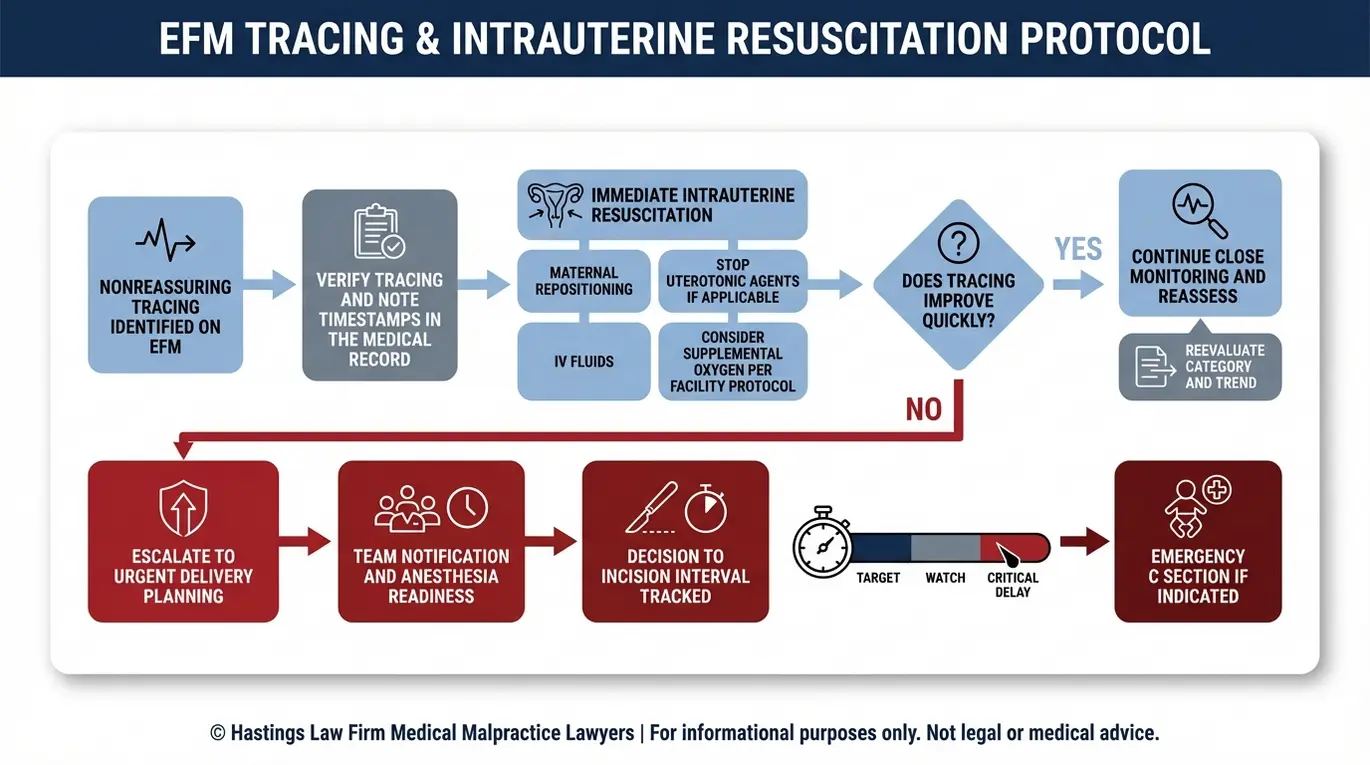
When nonreassuring fetal status is identified, the standard of care requires immediate intrauterine resuscitation, a set of corrective measures aimed at restoring oxygen flow to the baby, followed by an emergency C-section if the baby’s condition does not improve.
We evaluate whether the medical team followed the expected escalation steps. The standard of care refers to the level of treatment a competent provider should offer under similar circumstances. The general protocol proceeds as follows:
- Step 1: Conservative measures. The first response to abnormal fetal heart rate tracings typically includes maternal repositioning (turning the mother onto her left side to relieve pressure on blood vessels), administering supplemental oxygen, increasing IV fluids, and discontinuing Pitocin or other uterine stimulants if they are being used. Stopping uterine stimulants is critical because it halts the strong contractions that may be stressing the baby, allowing the placenta to refill with oxygenated blood.
- Step 2: Amnioinfusion (when applicable). If cord compression is suspected, the provider may perform an amnioinfusion, a procedure that introduces saline into the uterus to cushion the umbilical cord and reduce pressure on it. This is not appropriate in every situation, but when it is indicated, delaying it can worsen the baby’s condition.
- Step 3: Emergency cesarean delivery. If intrauterine resuscitation does not produce improvement, or if the fetal heart rate tracings show Category III patterns, the standard of care calls for an emergency C-section. Hospitals must have the personnel and equipment ready to perform a cesarean section immediately. Any delay in assembling the surgical team or locating an operating room may indicate a breach of the standard of care. Research published in a study on decision-to-delivery intervals for emergency cesarean sections discusses the “30-minute rule.” This rule holds that the time from the decision to perform a C-section to delivery should generally not exceed 30 minutes in urgent situations.
Every minute matters in these cases. When conservative measures fail and the decision to proceed with a C-section is delayed, the baby remains in a state of oxygen deprivation. Our team examines the timeline documented in medical records to determine whether each escalation step occurred within an acceptable window and whether the response matched the severity of the tracings.
Long-Term Injuries Caused by Unmanaged Fetal Distress
Prolonged oxygen deprivation during labor can lead to permanent neurological damage, including hypoxic-ischemic encephalopathy (HIE), cerebral palsy, and cognitive disabilities that affect a child for the rest of their life.
Hypoxic-ischemic encephalopathy (HIE) is a specific type of brain injury that occurs when the brain is deprived of both oxygen and blood flow around the time of birth. The severity of HIE is often classified using the Sarnat staging system, as described in research published in a study on Sarnat scoring in neonatal subjects with perinatal asphyxia. Stage I (mild) may involve irritability and hyperalertness. Stage II (moderate) can cause lethargy, decreased reflexes, and seizures. Stage III (severe) is associated with a depressed level of consciousness, absent reflexes, and a high risk of long-term disability or death. The Sarnat score helps doctors predict the long-term prognosis. Infants with Stage III HIE often face the most significant challenges, including the potential for multi-organ failure and profound neurodevelopmental deficits.
The connection between intrapartum oxygen deprivation and cerebral palsy has been well established in medical literature. Cerebral palsy is a group of disorders affecting movement, muscle tone, and coordination. Families may observe milestones being missed in the first year of life, such as rolling over, sitting up, or crawling. Early intervention is important, but the physical and emotional costs of managing a lifelong disability are immense. When it results from brain damage during labor, families often face a lifetime of therapy, adaptive equipment, and specialized care.
In the most tragic outcomes, unmanaged fetal distress results in stillbirth. This devastating outcome is often the result of a total loss of oxygen that went undetected or untreated for too long. When a baby’s heart rate tracings show clear signs of deterioration and the medical team fails to act, the loss may have been preventable.
A medical malpractice lawyer for fetal distress works with obstetrical and neurological experts to trace the child’s injuries back to the events of labor and delivery. The goal is to determine whether timely intervention could have changed the outcome.
Proving Negligence in Texas Birth Injury Cases
Proving negligence in these cases requires demonstrating that the medical team deviated from the accepted standard of care by failing to recognize or react to distress, and that this failure directly caused the infant’s injury. Our firm builds each case around the evidence that supports four legal medical negligence elements.
The four elements of a medical malpractice claim:
- Duty: The medical team owed a duty of care to the mother and baby. This is generally established by the existence of the provider-patient relationship.
- Breach: The provider failed to meet the accepted standard of care. This could include ignoring abnormal fetal heart rate tracings, delaying an emergency C-section, or failing to escalate to appropriate interventions.
- Causation: The breach directly caused or materially contributed to the baby’s injury. Defense attorneys often argue that the injury occurred during pregnancy rather than labor. Our experts use the medical evidence to refute these claims and pinpoint the exact window when the injury occurred.
- Damages: The child suffered measurable harm, whether physical, neurological, or developmental.
Evidence we examine in fetal distress cases:
- The actual EFM strips, not just the nursing notes summarizing them. These strips are the objective timeline of the baby’s heart rate patterns.
- Prenatal care records documenting risk factors identified before labor.
- Labor and delivery nursing logs and physician orders.
- Medication administration records, particularly Pitocin dosing.
- Time stamps on calls for assistance, anesthesia requests, and operating room readiness.
- Placental pathology reports, which help determine whether oxygen deprivation was a sudden event or a chronic condition.
- Neonatal resuscitation records and APGAR scores.
Expert witnesses are essential. We work with board-certified obstetricians and pediatric neurologists who review the medical records, interpret the EFM tracings, and provide testimony on whether the medical team’s actions fell below the standard of care and whether earlier intervention would have prevented the injury. These experts can explain complex medical concepts to a jury, clarifying why a reasonable physician would have acted differently under similar circumstances. Their testimony is often the pivot point of the entire case. Our in-house medical staff, including nurse practitioners and Board Certified Patient Advocates, assists in analyzing these records before the case ever reaches an expert.

Damages Recoverable for Families in Texas
Families may recover economic damages for past and future medical care, as well as non-economic damages for pain, suffering, and physical impairment. A lawyer for fetal distress helps families identify the full scope of what their child will need over a lifetime.
Economic damages cover the measurable financial impact of the injury:
- Past and future medical expenses, including surgeries, hospitalizations, and medications
- Rehabilitation and therapy costs, such as physical, occupational, and speech therapy
- Assistive devices and home modifications
- Lost earning capacity of the child over their lifetime
- Cost of long-term or residential care, if needed
Calculating these figures requires a detailed assessment by life care planners who project the costs of 24-hour nursing, specialized wheelchairs, and future surgeries adjusted for medical inflation. In cases involving severe brain damage that requires lifelong care, economic damages often represent the largest portion of a family’s recovery and can reach well into the millions of dollars.
Non-economic damages address the human toll:
- Physical pain and suffering experienced by the child
- Mental anguish endured by the child and, in some cases, the parents
- Physical impairment and disfigurement
- Loss of quality of life
While no amount of money can undo the harm, this compensation provides a measure of justice for the intangible loss of a normal childhood and the emotional burden placed on the family.
Texas does impose caps on non-economic damages in medical malpractice cases. Under the Texas Civil Practice and Remedies Code, Chapter 74, non-economic damages are capped at $250,000 per physician or healthcare provider and $500,000 per healthcare institution, with an aggregate cap of $750,000 in most cases. There is no cap on economic damages.
Contact the Texas Birth Injury Attorneys at Hastings Law Firm Today for Help
If your child was injured during labor or delivery and you believe the medical team’s response fell short, our firm is here to help you find answers. Our firm was founded by board-certified trial attorney Tommy Hastings, and our legal team includes former defense attorneys and experienced hospital nurses who provide a strategic advantage by identifying inconsistencies in hospital records.
We understand the weight of what your family is going through. Many of our clients come to us not only seeking compensation for their child’s care, but also wanting to know the truth about what went wrong and to make sure it does not happen to another family.
There are no upfront costs. We handle these cases on a contingency fee basis, which means you pay no attorney fees unless we secure a recovery. Contact us for a free, confidential case evaluation and let us help you take the first step toward protecting your child’s future.
Frequently Asked Questions About Fetal Distress in Texas


This content was researched and written by the Hastings Law Firm editorial team, which includes attorneys, medical professionals, and experienced researchers. Our writing is informed by internal knowledge and practical experience, and we cross-check critical details against authoritative sources cited throughout. Every piece undergoes human-led fact-checking and legal review. Because legal and medical information can change, if you spot an error, please contact us. Learn more about our content standards and review process on our editorial policy page.

Tommy Hastings, founder of Hastings Law Firm, is a board-certified personal injury trial lawyer dedicated exclusively to healthcare injury cases. Since 2001, he has represented injured patients and families in litigation against major hospital systems, pharmaceutical companies, and negligent healthcare providers nationwide. He has handled numerous high-profile cases that have drawn national media attention and resulted in multi-million dollar recoveries. He draws on that experience in his writing, helping readers understand how these cases work and what options may be available to them.
